
TL;DR:
- Content strategy is a planning discipline that guides the creation and distribution of content for measurable business results.
- Most failures occur when teams neglect audits, mapping, and designing conversion loops, which harm content impact.
A content strategy is the planning discipline that defines why, who, what, and how you create and distribute content to drive real business results. Most marketing professionals confuse content strategy with content marketing. Content strategy is the plan. Content marketing is the execution of that plan. Getting this distinction right is the first step in knowing how to plan content strategy that actually converts, not just attracts traffic. Tools like Grammarly, Ahrefs, and content calendars all play a role, but they only work inside a clear framework.
How to plan content strategy: prerequisites and tools
Before you write a single word, you need two things: clear business goals and a deep understanding of your audience. Without these, every piece of content you create is a guess.

Audience mapping based on buyer journey stages and informational queries outperforms basic demographic targeting. That means you need to know what questions your audience asks at each stage of awareness, not just their age or job title. A first-time visitor searching “what is content strategy” needs different content than a buyer searching “best content strategy tools for B2B.”
The table below lists the core prerequisites and tools you need before building your plan.
| Prerequisite / Tool | Purpose |
|---|---|
| Defined business goals | Anchors every content decision to a measurable outcome |
| Audience awareness map | Identifies what content to create at each buyer stage |
| Keyword research tool (Ahrefs, Semrush) | Surfaces topics with real search demand |
| Content audit tool | Reveals gaps, duplicates, and underperforming pages |
| Content brief template | Aligns writers on persona, keyword, CTA, and format |
| Grammarly or Hemingway Editor | Maintains quality and readability across all content |
| Content calendar (Notion, Trello, or Airtable) | Schedules and tracks publishing cadence |
A complete content brief specifying persona, keyword, CTA, funnel stage, and format saves hours in revision and aligns your team before writing begins. Skipping the brief is one of the most expensive shortcuts in content planning.
Pro Tip: Build your audience awareness map before you touch a keyword tool. Knowing the emotional state and intent behind each query makes your keyword research far more targeted.
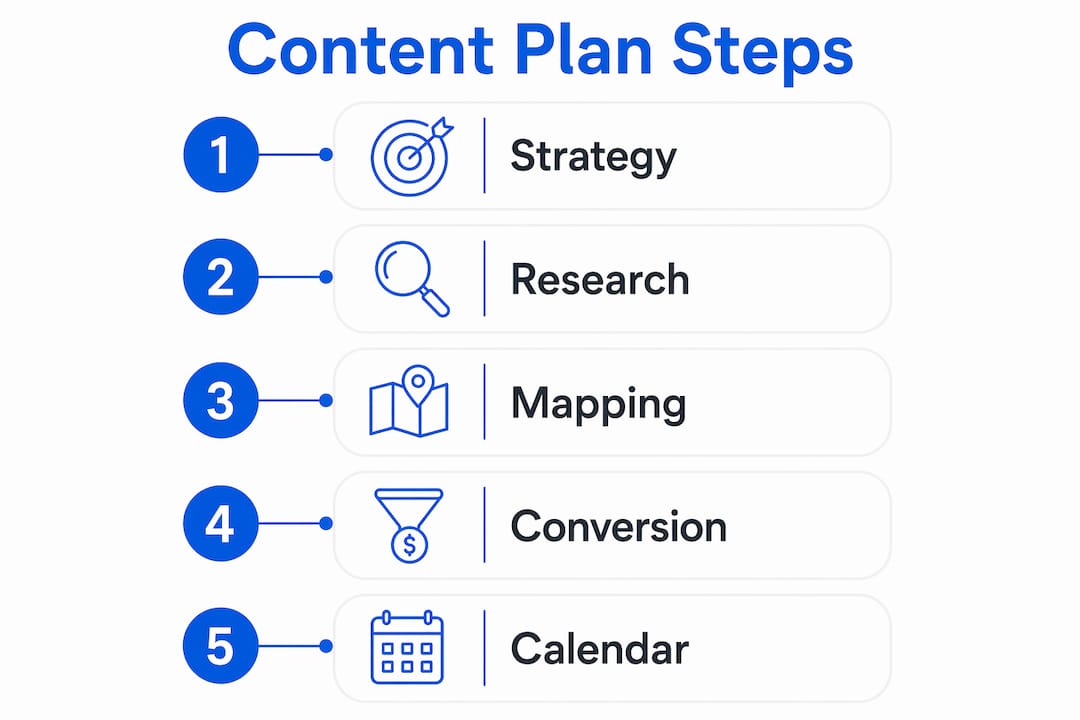
What are the steps to develop a content plan?
Developing a content plan follows a specific sequence. Skipping steps does not save time. It creates rework.
Step 1: Document your one-page strategy
Start by answering six core questions: who you are creating for, what problem you solve, what action you want readers to take, how you will distribute content, how you will create it, and how you will measure success. One page. No more. This document becomes your filter for every content decision going forward.
Step 2: Research and score topic ideas
Use keyword research tools like Ahrefs or Semrush alongside AI prompt research to build a topic backlog. Then score each topic. Tim Soulo’s 0–3 business potential scale separates traffic-driving topics from revenue-driving ones. A score of 3 means your product is the natural solution to the problem the article addresses. A score of 0 means the topic has no clear path to conversion. Prioritize topics with scores of 2 or 3.
Step 3: Map content to customer awareness stages
Every content decision should map back to a customer awareness level. Eugene Schwartz identified five stages: unaware, problem-aware, solution-aware, product-aware, and most aware. A blog post targeting a problem-aware reader needs a different CTA than one targeting a product-aware reader. Matching content to stage is what turns a content plan into a conversion system.
Step 4: Design content-conversion loops
Content without a clear next step is wasted opportunity. Every piece of content needs a contextually relevant CTA that moves the reader to the next stage. This is not about adding a generic “contact us” button. It means linking a problem-aware article to a solution-aware guide, then to a product comparison, then to a trial or demo. Build the loop before you write the content.
For a practical example of how this works in practice, see these content marketing examples that show how local businesses design next steps into their content.
Step 5: Build your content calendar and assign briefs
Schedule content using a tool like Notion, Trello, or Airtable. A well-built content calendar protects time for both new content and content refreshes. Assign each piece a brief before writing begins. The brief should include the target persona, primary keyword, funnel stage, format, and desired next action.
The table below summarizes each step with its output and approximate time investment.
| Step | Output | Time investment |
|---|---|---|
| 1. Document one-page strategy | Strategy brief | 2–4 hours |
| 2. Research and score topics | Prioritized topic backlog | 4–8 hours |
| 3. Map to awareness stages | Content-to-stage matrix | 2–3 hours |
| 4. Design conversion loops | CTA map per content piece | 2–4 hours |
| 5. Build calendar and assign briefs | Published schedule with briefs | 3–5 hours |
How can you maintain and optimize your content strategy after launch?
Most content strategies fail not at launch but at month three. The plan gets stale, the team defaults to new content creation, and existing content quietly decays.
Treat your content strategy as a hypothesis, not a finished document. Set measurement checkpoints at 7, 30, and 90 days after publishing each piece. At 7 days, check for indexing and early ranking signals. At 30 days, review click-through rate and time on page. At 90 days, assess keyword movement and conversion contribution.
Updating and improving existing content is often more impactful than creating new content from scratch. Teams that protect regular time slots for content refreshes consistently outperform teams focused only on new production. Schedule a monthly refresh review alongside your new content calendar.
The most common maintenance failures include:
- Ignoring content that ranks on page two. A single update can move it to page one.
- Publishing new content without checking if an existing piece already covers the topic.
- Reviewing only traffic metrics without checking conversion contribution.
- Letting the content backlog go stale for more than two weeks.
Practitioners recommend updating the content backlog every two weeks and reviewing content performance monthly. That cadence keeps your strategy responsive without creating constant disruption.
“A content strategy that never changes is not a strategy. It is a wish list.”
Pro Tip: Run a signal audit before a content audit. Check Google Search Console for pages losing impressions before you decide what to refresh. Data tells you where to focus. Gut instinct does not.
What are the most common content strategy mistakes?
The biggest mistake is treating a content calendar as a complete strategy. A calendar tells you when to publish. It does not tell you why, for whom, or what happens after a reader finishes the article.
The most damaging errors in content planning are:
- Skipping the content audit. Most content strategies fail because teams neglect audit and mapping steps, leading to duplicate content and lost topical authority. Audit before you plan.
- Ignoring buyer journey stages. Publishing only top-of-funnel awareness content without solution-aware or product-aware content creates a traffic source with no conversion path.
- No designed next steps. Content without a conversion loop sends readers to a dead end. Every piece needs a contextually relevant next action.
- Misaligned metrics. Measuring only pageviews rewards volume over impact. Track keyword rankings, conversion contribution, and content-assisted revenue.
- Content sprawl. Publishing on every topic without a clear topical authority map dilutes your domain’s credibility with search engines.
The fix for most of these mistakes is the same: go back to your one-page strategy document and check whether the content in question answers the six core questions. If it does not, it should not be published. For teams building out their workflow, a clear content marketing workflow reduces these errors before they happen.
Key Takeaways
A content strategy that aligns every piece of content with a specific audience stage, a clear business goal, and a designed next step consistently outperforms strategies built around publishing volume alone.
| Point | Details |
|---|---|
| Strategy before execution | Define who, what, why, and how before creating any content. |
| Score topics by business potential | Prioritize topics where your product is the natural solution. |
| Map content to awareness stages | Match every piece to a buyer stage and assign a relevant next step. |
| Refresh beats new creation | Updating existing content often delivers better returns than publishing new pieces. |
| Treat strategy as a hypothesis | Review performance at 7, 30, and 90 days and adjust based on data signals. |
Why most content strategies stall at month three
The content treadmill is real, and I have watched it derail teams that started with genuinely good plans. The pattern is always the same: strong launch, solid first month, then the pressure to publish more kicks in and the strategy document gets ignored.
The single biggest shift I have seen in effective teams is protecting time for refreshes on the calendar before scheduling new content. Not after. Before. When refresh time is optional, it never happens. When it is blocked on the calendar like a meeting, it becomes a habit.
The other thing I would push back on is the obsession with top-of-funnel content. Awareness articles are easy to justify because they get traffic. But traffic without a conversion loop is just a vanity metric. The teams I have seen grow revenue from content are the ones who spent as much time designing the next step as they did writing the article itself.
A digital marketing strategy that treats content as a system rather than a publishing schedule is what separates brands that grow from brands that just stay busy. Build the loop. Protect the refresh time. Check the data at 7, 30, and 90 days. That is the whole game.
— Mike
Content strategy planning on autopilot with Mysearchhero
Planning and executing a content strategy takes consistent effort across research, writing, publishing, and performance tracking.
Mysearchhero is a done-for-you SEO and content marketing service built for marketing professionals who need results without managing every moving part. Each month, subscribers receive published articles, backlinks, Reddit mentions, and AI-generated social media posts, all pushed through a fully automated pipeline. The platform handles content calendar management and publishing cadence so your strategy runs without constant oversight. If you are ready to move from planning to consistent execution, Mysearchhero gives you the infrastructure to do it.
FAQ
What is the difference between content strategy and content marketing?
Content strategy is the planning discipline that defines why, who, what, and how you create content. Content marketing is the execution of that plan through actual creation and distribution.
How long does it take to develop a content plan?
Building a complete content plan from strategy document to published calendar takes roughly 13–24 hours for most teams. The one-page strategy and topic scoring steps take the most time upfront.
How often should you update your content strategy?
Update your content backlog every two weeks and review overall performance monthly. Treat the strategy itself as a hypothesis and adjust it based on data at 7, 30, and 90-day checkpoints.
What is a content-conversion loop?
A content-conversion loop is a sequence of content pieces, each with a contextually relevant CTA, that moves a reader from one awareness stage to the next. It turns a standalone article into a conversion path.
Why do most content strategies fail?
Most content strategies fail because teams skip the audit and mapping steps, leading to duplicate content and no clear conversion paths. Publishing volume without a framework produces traffic that does not convert.