
TL;DR:
- Storytelling makes brand messages more memorable and trustworthy, significantly increasing engagement and purchase likelihood.
- Effective narrative marketing employs structured stories with characters, conflicts, and resolutions to build brand equity over time.
Storytelling in marketing is defined as the practice of using structured narratives to create emotional connections between a brand and its audience, making messages more memorable and persuasive than facts alone. The role of storytelling in marketing goes far beyond creative writing. It is a proven psychological mechanism that shapes how customers perceive, remember, and act on brand messages. Stories make messages 22 times more memorable than isolated facts, lifting retention rates from 5–10% with facts alone to 65–70% with narrative. For marketing professionals and entrepreneurs, that gap is the difference between a campaign people forget and one that drives real revenue.
What is the role of storytelling in marketing?
Storytelling in marketing works because the human brain is wired to process narrative, not data. When you present a list of product features, the brain treats it as information to be filed and quickly discarded. When you present the same information inside a story, the brain activates multiple regions simultaneously, including those responsible for emotion, memory, and sensory experience. That neurological response is why 92% of consumers prefer ads that feel like stories over ads that simply list benefits.
The industry term for this practice is narrative marketing, and it encompasses every format where a brand uses character, conflict, and resolution to communicate its value. This includes video campaigns, social media content, sales decks, email sequences, and even product descriptions. The distinction between narrative marketing and conventional advertising is not the channel. It is the presence of a story arc: a character with a problem, tension that builds, and a resolution the brand helps deliver.
Narrative marketing also functions as a trust mechanism. Personal brand stories boost trust by up to 55%, and authenticity in storytelling influences 86% of consumers’ brand support decisions. Those numbers reflect a simple truth: customers buy from brands they believe in, and belief is built through story, not specification sheets.
How does storytelling improve message retention and engagement?
The brain conserves energy by filtering out predictable information. When content follows a familiar pattern, attention drops. Stories interrupt that pattern by introducing novelty and uncertainty. Open loops in narratives create cognitive tension that keeps audiences engaged until the loop closes. That is why a well-constructed brand story holds attention longer than a feature comparison ever could.

Emotional engagement is the second mechanism. Narrative advertising moves audiences through four psychological phases: cognitive reflection, immersion, emotional fulfillment, and social belonging. Each phase deepens the audience’s connection to the brand. A viewer who reaches the social belonging phase does not just remember your brand. They identify with it.
Three elements accelerate this process:
- Unresolved tension at the opening. Beginning with stakes and conflict signals to the brain that something important is at risk, triggering sustained attention.
- Specific, relatable characters. Generic protagonists produce generic empathy. A character with a name, a job, and a specific problem produces real identification.
- Emotional arcs. Stories that move from struggle to resolution mirror the customer’s own buying journey, making the brand feel like a natural part of the solution.
Pro Tip: When writing a brand story, name your protagonist and give them one specific, concrete problem. “Sarah, a freelance designer who kept losing clients to bigger agencies” outperforms “a small business owner facing competition” every time.
What storytelling frameworks should marketers use?
Effective narrative marketing relies on structure, not inspiration. The most reliable framework for brand stories has three components: a compelling hook, a suspenseful middle, and a memorable conclusion tied to brand takeaways. Each component serves a distinct function in moving the audience from awareness to action.
Plot, theme, and narrative: what each one does
Plot is the sequence of events. Theme is the underlying idea the story communicates. Narrative is the perspective and voice through which the story is told. Marketers who confuse these three elements produce content that has events but no meaning, or meaning but no structure. The strongest brand stories align all three: a clear sequence of events, a theme that reflects the brand’s core values, and a narrative voice that matches the audience’s own way of speaking.
Data storytelling as a marketing tool
Data storytelling is the practice of combining accurate data, clear visualization, and a guiding narrative to turn numbers into decisions. Effective data storytelling requires all three elements. Remove the narrative and you have a chart. Remove the data and you have an opinion. Remove the visualization and you have a wall of text. For marketers presenting campaign results or pitching strategy to stakeholders, data storytelling is the format that converts skeptics into believers.
For brand identity work, the same principle applies. A brand that can articulate its story visually and verbally creates a consistent experience across every touchpoint, from a homepage to a sales call.
Pro Tip: Build a one-page “story brief” for each campaign. List the protagonist, the problem, the stakes, the resolution, and the brand’s role. Every piece of content you create for that campaign should map back to this brief.
The table below summarizes the core storytelling framework elements and their marketing functions.
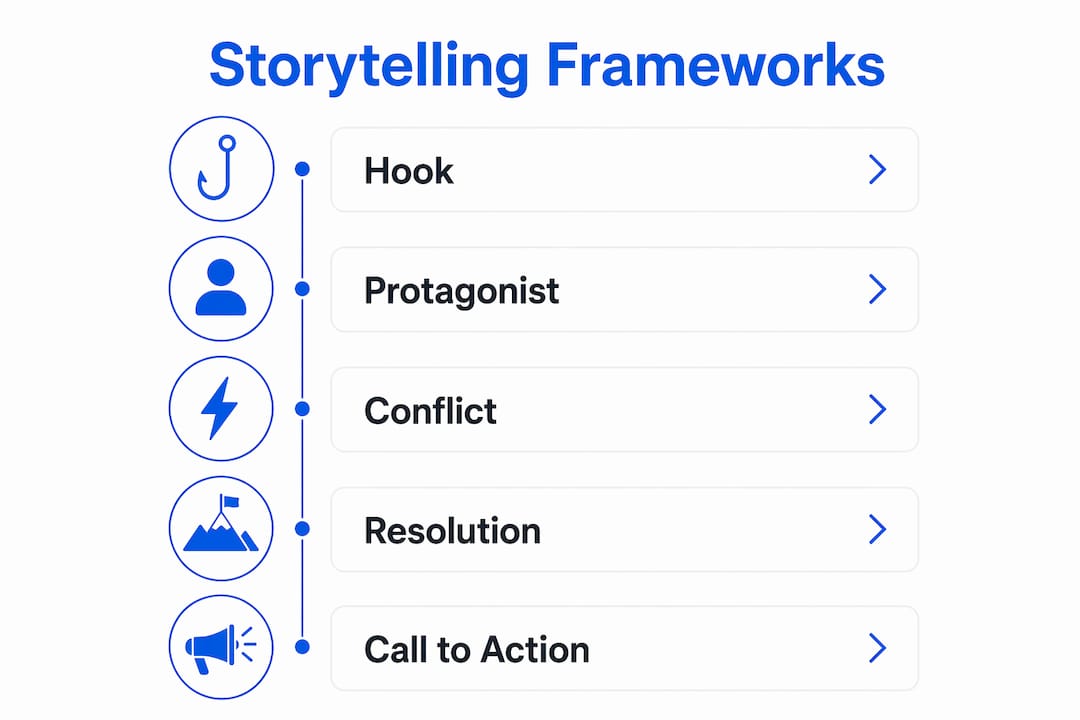
| Framework element | Marketing function |
|---|---|
| Hook with unresolved tension | Captures attention and signals relevance immediately |
| Specific, named character | Builds empathy and makes the story relatable |
| Emotional arc | Mirrors the customer’s buying journey |
| Data with visualization | Converts evidence into persuasive narrative |
| Clear brand takeaway | Links the story’s resolution to the brand’s value |
How do you measure the impact of storytelling on marketing results?
Storytelling’s commercial impact is measurable and significant. Narrative marketing can increase product value perception by over 2,700% and command price premiums up to 20%. That figure comes from case studies where identical products were sold with and without a story. The product with the story commanded dramatically higher prices. The implication is direct: the story is part of the product’s value.
Digital storytelling produces equally concrete results. Content with narrative structure is 35% more likely to be shared socially, and video storytelling increases purchase likelihood by 64%. Additionally, 47% of buyers view 3–5 story-driven content pieces before engaging a sales representative. That behavior pattern means storytelling does not just close deals. It builds the pipeline that makes closing possible.
Storytelling works as a mediator, not a direct sales trigger. Research in the cosmetics sector confirms that storytelling drives brand experience and engagement, and those two factors are what ultimately drive purchase intention. Marketers who expect a single story to produce immediate conversions will be disappointed. Marketers who use story to build sustained engagement will see compounding returns.
To track storytelling performance, measure across three categories:
- Engagement metrics: time on page, video completion rate, social shares, and comment sentiment.
- Pipeline metrics: content pieces consumed before a sales conversation, lead quality scores, and sales cycle length.
- Brand perception metrics: net promoter score shifts, brand recall surveys, and price sensitivity testing.
Pro Tip: Run an A/B test with two versions of the same landing page: one with bullet-point features and one with a short customer story. Measure conversion rate and time on page. The results will make the case for narrative marketing better than any statistic.
For a deeper look at how to evaluate content effectiveness, measuring content performance is a practical starting point.
How can marketers implement storytelling across their channels?
Implementing narrative marketing starts with identifying your brand’s core story. That story answers three questions: Who does your brand serve? What problem do they face? How does your brand resolve it? Every campaign, post, and sales conversation should trace back to those answers.
- Define your brand narrative. Write a two-paragraph version of your brand story that includes a named customer archetype, their specific challenge, and the transformation your product or service delivers. This becomes your narrative anchor.
- Localize stories to customer personas. A story that resonates with a solo entrepreneur will not land the same way with a marketing director at a mid-size company. Build separate story variants for each major persona, adjusting the character, stakes, and resolution while keeping the core theme consistent.
- Use video as your primary storytelling channel. Video storytelling increases purchase likelihood by 64%, making it the highest-return format for narrative content. Even short, low-production videos outperform long-form written content on social platforms when the story is strong. For brands investing in production quality, professional video production can significantly elevate how a narrative lands with an audience.
- Apply storytelling to sales content. Proposals, pitch decks, and case studies are all story formats. Replace feature lists with customer transformation narratives. Replace data tables with before-and-after scenarios that show what life looks like with and without your solution.
- Avoid the raw data trap. Data without narrative is noise. Presenting a chart without explaining what it means and why it matters to the audience produces confusion, not persuasion. Always pair data with a character who is affected by it and a resolution that your brand provides.
For practical examples of how story-driven marketing works across different business sizes, real-world case studies show what these principles look like in execution.
Pro Tip: Audit your last five pieces of marketing content. For each one, ask: “Is there a character, a problem, and a resolution?” If the answer is no, rewrite the opening paragraph to introduce all three. You will see engagement metrics shift within weeks.
Key Takeaways
Storytelling in marketing is the single most effective way to make brand messages memorable, build trust, and drive purchase behavior across every channel and audience type.
| Point | Details |
|---|---|
| Stories outperform facts | Narrative raises message retention from 5–10% to 65–70%, making story the most efficient communication format. |
| Trust scales with authenticity | Authentic brand stories boost consumer trust by up to 55%, directly influencing brand support decisions. |
| Storytelling drives pipeline | 47% of buyers consume 3–5 story-driven pieces before talking to sales, making narrative a pipeline tool. |
| Measure engagement, not just conversions | Track shares, video completion, and brand recall to capture storytelling’s full commercial impact. |
| Structure is non-negotiable | Every effective brand story needs a hook, emotional arc, and a clear brand takeaway to move audiences to action. |
Why most brands are still getting storytelling wrong
Working with marketing teams across industries, I keep seeing the same mistake: brands confuse content production with storytelling. They publish blog posts, shoot videos, and run social campaigns, but none of it has a character, a conflict, or a resolution. It is content shaped like a story without the substance of one.
The brands that get it right do something counterintuitive. They slow down before they produce anything. They spend time defining who their story is about, what that person is genuinely struggling with, and what transformation looks like on the other side. That clarity makes every piece of content faster to produce and more effective once it is out in the world.
The other shift I have seen matter is moving from campaign thinking to narrative thinking. A campaign has a start date and an end date. A narrative compounds over time. The brands building real equity right now are the ones treating their story as infrastructure, not as a quarterly deliverable. They are consistent in character, consistent in theme, and willing to let the story breathe across months and years rather than forcing a conversion in the first thirty seconds.
The data backs this up. Storytelling does not directly force sales. It builds the brand experience and engagement that make sales inevitable. That is a longer game, but it is the only game worth playing if you want a brand that lasts.
— Mike
How Mysearchhero helps you put storytelling to work
Building a consistent brand narrative takes more than good intentions. It takes a steady output of published content, backlinks, and social presence that keeps your story in front of the right audience every month.
Mysearchhero is a done-for-you SEO and content marketing service that handles the full pipeline: published articles, backlinks, Reddit mentions, and social posts, all delivered on autopilot. You define the brand story. Mysearchhero keeps it in circulation. For marketing professionals and entrepreneurs who want their narrative working around the clock without managing every moving part, that is a direct path from strategy to results.
FAQ
What is storytelling in marketing?
Storytelling in marketing is the practice of using structured narratives with a character, conflict, and resolution to communicate brand value. It makes messages more memorable and emotionally resonant than feature-based advertising.
Why does storytelling work better than facts alone?
Stories raise message retention from 5–10% to 65–70% by activating emotional and memory centers in the brain simultaneously. Facts alone are processed and discarded; stories are encoded as experience.
How does storytelling affect purchase decisions?
Storytelling drives brand experience and engagement, which are the strongest mediators of purchase intention. Video storytelling alone increases purchase likelihood by 64%, and 47% of buyers consume multiple story-driven pieces before contacting sales.
What makes a brand story authentic?
Authenticity comes from specificity: a real customer problem, a named protagonist, and a resolution that reflects genuine brand values. Authenticity in storytelling influences 86% of consumers’ brand support decisions.
How do I measure storytelling’s impact on my marketing?
Track engagement metrics such as video completion rate and social shares, pipeline metrics such as content consumed before a sales conversation, and brand perception metrics such as net promoter score and price sensitivity. Together, these capture both the immediate and compounding effects of narrative marketing.