
TL;DR:
- SEO investment in 2026 centers on building AI visibility and brand authority instead of focusing solely on keyword rankings. Content must be optimized for AI retrieval, with structured data and strong external mentions, as most searches now end without a click. Brands that invest in multi-channel recognition and topical content outperform those relying on traditional SEO tactics.
SEO investment in 2026 is defined by one shift: visibility in AI-powered search now drives brand authority and revenue more than traditional keyword rankings ever did. Businesses that treat SEO as a ranking game are losing ground to those who treat it as a trust-building discipline. Visitors from LLM-driven search engines convert at twice the rate of traditional search traffic, with only one-third the sessions needed per conversion. That single data point reframes the entire ROI argument for SEO in 2026. The question is no longer whether to invest. The question is how to invest correctly.
Why invest in SEO in 2026: the core case
The SEO market has moved from a ranking-first model to a visibility-first model. Google, Perplexity, ChatGPT, and similar AI systems now synthesize answers directly on the results page. That means your content must be retrievable, credible, and structured for AI consumption, not just indexed. The role of SEO in business growth has expanded to include brand recognition, topical authority, and digital reputation across multiple platforms.

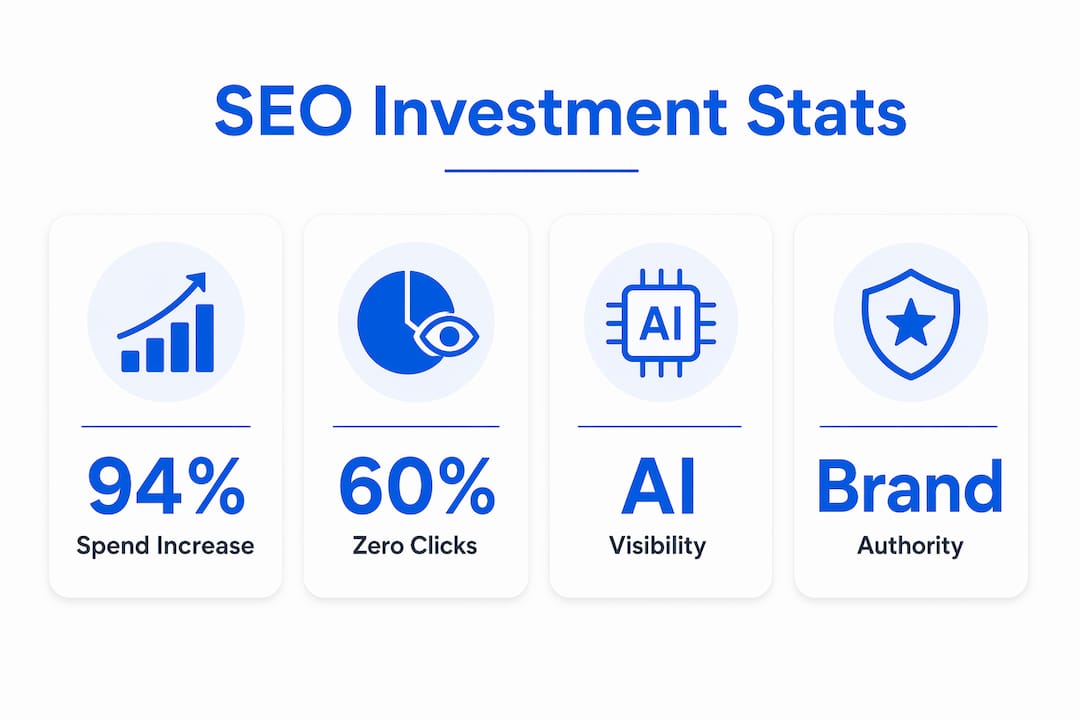
94% of marketing leaders plan to increase spending on Answer Engine Optimization in 2026. That figure reflects a broad recognition that AI-generated answers are the new front page of the internet. Businesses that appear in those answers capture attention at the exact moment a buyer is forming a decision.
How has SEO visibility changed with AI-powered search?
AI search engines use retrieval-augmented generation, a process where the AI pulls content from trusted sources to build its answers. This means content retrievability now depends on structured data, schema markup, and high-quality third-party mentions, not keyword density. A page can rank in position one and still lose most of its traffic if an AI Overview answers the query first.
The numbers confirm this. AI Overviews reduce clicks to the top-ranking page by 58%. That is not a minor adjustment. It fundamentally changes what “winning” in search means.
Here is what the shift to AI-driven search requires from your content:
- Direct answer blocks. Lead every page with a concise, factual answer to the target question. AI systems pull these first.
- Semantic relevance over keyword repetition. Cover a topic completely rather than repeating a phrase. AI retrieval rewards depth.
- Schema markup and structured data. FAQ schema, HowTo schema, and Article schema all improve AI crawlability and citation likelihood.
- Entity clarity. Name your brand, your authors, and your subject matter clearly so AI systems can identify and cite you accurately.
- Topical clusters over isolated pages. A cluster of related articles signals authority on a subject far more effectively than a single optimized page.
Pro Tip: Add a two-to-three sentence summary at the top of every article. AI systems frequently pull from introductory summaries when generating answers, so this placement maximizes your citation probability.
60% of Google searches in 2026 end without a click. That statistic does not mean SEO is dead. It means the goal has shifted from earning clicks to earning citations inside AI answers.
Why does brand authority matter so much for SEO now?
Brand authority is now a direct input into AI visibility. AI systems are trained on the web, and they weight content from recognized, frequently mentioned brands more heavily than anonymous sources. Branded web mentions correlate strongly with AI visibility scores, with YouTube mentions showing the highest correlation at approximately 0.74. That is a measurable signal, not a theory.
Businesses that invest in brand visibility strategies across platforms, including YouTube, podcasts, Reddit, and industry publications, build the kind of digital footprint that AI systems recognize and cite. A business mentioned in ten credible third-party sources carries more AI authority than a business with a perfectly optimized website and no external presence.
Google’s 2026 core updates reinforced this directly. 73% of top-ranking pages now feature expert authorship with verifiable credentials. That is the E-E-A-T framework (Experience, Expertise, Authoritativeness, Trustworthiness) operating as a real ranking factor, not a guideline.
“SEO now extends beyond ranking to trust-building, as AI systems rely heavily on brand recognition and citations within synthesized answers. Businesses that invest in brand presence across channels are the ones AI systems learn to trust and cite.”
Branded search activity is a primary driver of organic authority, especially for small and mid-sized businesses. When people search for your brand by name, that signal tells search engines and AI systems that your business is known, trusted, and worth citing. Building that branded search volume requires consistent content, PR, and social presence, not just on-page SEO.
How do you measure SEO success in 2026?
Traditional metrics like keyword rankings and organic traffic tell an incomplete story in a zero-click world. A page can generate brand awareness through an AI citation without ever receiving a direct visit. Measuring only traffic means missing a significant portion of SEO’s actual value.
Pro Tip: Track your brand’s unlinked mentions using tools like Google Alerts or dedicated brand monitoring platforms. Unlinked mentions still influence AI visibility scores and represent citation opportunities you can convert into backlinks.
The metrics that matter most in 2026 include:
| Metric | What it measures | Why it matters |
|---|---|---|
| AI share of voice | How often your brand appears in AI-generated answers | Directly reflects AI visibility and citation authority |
| Branded search volume | How often users search your brand name | Signals trust and recognition to search engines |
| SERP feature presence | Appearances in featured snippets, People Also Ask, and AI Overviews | Indicates content is structured for AI retrieval |
| Unlinked brand mentions | Third-party references without a hyperlink | Correlates with AI visibility and builds citation potential |
| Conversion rate by channel | Revenue attributed to organic and AI-driven traffic | Measures actual business impact, not just traffic volume |
Integrated platforms that unify SEO data, brand monitoring, and AI visibility tracking give businesses the agility to respond to algorithm changes quickly. Fragmented reporting across separate tools creates blind spots that cost rankings and revenue.
What are the most effective SEO investment strategies for 2026?
Effective SEO investment in 2026 follows a clear set of priorities. The businesses gaining ground are those that align their content, brand, and technical infrastructure with how AI systems retrieve and cite information.
-
Build content clusters around high-intent topics. Topical depth within a single cluster improves rankings up to three times faster than spreading content thin across many topics. Pick three to five core subjects your business owns and build ten to twenty pieces around each one.
-
Implement schema markup across all key pages. FAQ, HowTo, Article, and Product schema all improve how AI systems read and cite your content. This is a technical investment with direct visibility returns.
-
Invest in digital PR and third-party mentions. Guest articles, podcast appearances, YouTube content, and press coverage all generate the brand signals that AI systems use to assess credibility. These are not optional extras. They are core SEO inputs in 2026.
-
Add expert authorship to every piece of content. Named authors with verifiable credentials outperform anonymous content in post-update rankings. Attach real people with real expertise to your content.
-
Extend your SEO presence beyond Google. Multi-platform SEO across YouTube, TikTok, and Amazon is necessary because audiences now discover content across many channels. A Google-only strategy misses a growing share of search behavior.
-
Use AI content tools with editorial oversight. Automated content generation tools are maturing, but quality controls remain critical for SEO success. AI-generated content without editorial review produces generic output that AI search systems deprioritize.
The top marketing trends for SMEs in 2026 all point toward the same conclusion: businesses that integrate SEO with brand building, content marketing, and digital PR outperform those that treat SEO as a standalone channel.
AI-powered local visibility follows the same rules at a smaller scale. Local businesses that appear in AI-generated local answers, maintain consistent NAP (Name, Address, Phone) data, and earn local citations gain a measurable edge over competitors who rely solely on traditional local SEO tactics.
Key Takeaways
SEO investment in 2026 delivers its highest returns when businesses prioritize AI visibility, brand authority, and structured content over traditional ranking metrics alone.
| Point | Details |
|---|---|
| AI visibility beats rankings | Appearing in AI-generated answers drives conversions even without direct clicks to your site. |
| Brand mentions are SEO signals | Third-party mentions, especially on YouTube, correlate directly with AI citation scores. |
| Zero-click searches are the norm | 60% of searches end without a click, so content must earn citations, not just traffic. |
| Topical clusters outperform thin content | Focused content clusters improve rankings three times faster than scattered topic coverage. |
| Measure beyond traffic | Track AI share of voice, branded search volume, and SERP feature presence alongside traditional metrics. |
SEO in 2026 is not what most people think it is
I have watched businesses pour budget into keyword rankings for years and then wonder why their revenue does not move. The honest answer is that rankings were always a proxy metric. What actually drives revenue is visibility at the moment of decision, and in 2026, that moment increasingly happens inside an AI-generated answer, not on a results page.
The businesses I see winning right now are not the ones with the most backlinks or the highest domain authority scores. They are the ones whose brands show up in AI answers because they have built genuine authority across multiple channels. A well-produced YouTube series, a consistent guest posting program, and a content cluster built around a specific problem will outperform a technically perfect website with no external presence.
The other thing most articles will not tell you: SEO and brand marketing are now the same investment. You cannot separate them. Every piece of content you publish, every podcast you appear on, and every press mention you earn feeds the same system that AI search engines use to decide who to cite. Businesses that understand this stop asking “is SEO worth it?” and start asking “how do we build a brand that AI systems trust?”
That shift in thinking is worth more than any single tactic.
— Mike
How Mysearchhero supports your SEO investment in 2026
Building AI visibility and brand authority at the same time requires consistent output across content, backlinks, and social channels. Most business owners do not have the time or team to manage all of it.
Mysearchhero delivers done-for-you SEO services that cover the full picture: published articles built for AI retrieval, backlinks, Reddit mentions, and social content, all pushed through an automated monthly pipeline. Every deliverable is designed to build the brand signals and topical authority that AI search systems reward in 2026. If you want your business to appear where buyers are looking, Mysearchhero handles the execution so you can focus on running your business.
FAQ
Why invest in SEO in 2026 instead of paid ads?
SEO builds compounding brand authority and AI visibility that paid ads cannot replicate. Visitors from AI-driven search convert at twice the rate of traditional traffic, making organic presence a higher-return long-term investment.
What is Answer Engine Optimization?
Answer Engine Optimization (AEO) is the practice of structuring content so AI systems like ChatGPT and Perplexity retrieve and cite it in generated answers. 94% of marketing leaders plan to increase AEO spending in 2026.
How does brand authority affect SEO rankings?
Brand authority signals, including third-party mentions, branded search volume, and expert authorship, directly influence both traditional rankings and AI citation likelihood. YouTube mentions alone show a 0.74 correlation with AI visibility scores.
Is SEO still worth it if most searches end without a click?
Yes. A 60% zero-click search rate means appearing in AI-generated answers is more valuable than ever. Brands cited in AI answers build awareness and trust even when users never visit their site directly.
How long does it take to see results from SEO investment?
Topical content clusters can improve rankings three times faster than scattered content strategies, but meaningful AI visibility typically builds over three to six months of consistent publishing, link building, and brand mention activity.