
TL;DR:
- Search personalization customizes search results based on user signals like behavior and location, changing how relevance is calculated. It makes rankings probabilistic across user segments, requiring marketers to focus on scenario-specific content and entity authority. Users can limit personalization through settings, but fully controlling results remains challenging for most.
Search personalization is the process by which search engines tailor results to each user’s unique profile instead of showing the same results to everyone. It uses signals like search history, location, device, and browsing behavior to rank and present content differently for each person. Understanding this process matters now more than ever. Personalized results are no longer a feature layered on top of search. They are baked into the core relevance algorithms that determine what you see. For marketers, this changes how visibility works. For everyday users, it changes what “good results” even means.
What is search personalization and how does it work?
Search personalization is defined as the dynamic modification of search results based on user-specific signals like behavior, preferences, location, and context. Traditional search ranking treated every user as identical. Personalized ranking treats every user as an individual. That shift changes everything about how results are generated.

The signals that drive personalization fall into two categories: behavioral and contextual.
Behavioral signals include:
- Search history and click patterns
- Time spent on specific pages
- Past purchases or app activity
- Saved content and bookmarks
Contextual signals include:
- Current location and device type
- Time of day and language settings
- Explicit preferences set by the user
- Connected app data like calendar or email
Search engines feed these signals into machine learning models that modify rankings in real time. The result is a dynamic ranking layer that sits on top of traditional relevance scoring. Two users searching the same query can receive completely different results based on their profiles.
Pro Tip: True personalization is not the same as random variation in AI answers. Memory, location data, and profile-based retrieval are genuine personalization signals. Random model inconsistency is not.
Google’s Personal Intelligence in AI Mode is the clearest example of advanced personalization in action. It connects Gmail, Photos, and Search data to generate answers based on your actual purchases, travel plans, and personal context. Users must opt in through Google Search settings, and the feature is currently available mainly to premium subscribers.
What are the benefits of search personalization for users and marketers?
Personalized search improves result relevance by aligning retrieval with user behavior, preferences, and context. For users, this means less time wading through irrelevant results. For marketers, it means both opportunity and complexity.
The core benefits for users are clear:
- Better intent matching. Results reflect what you actually want, not just what you typed.
- Reduced ambiguity. A query like “bank” returns financial results for one user and riverbank content for another, based on context.
- Faster discovery. Familiar sources and preferred formats surface more often.
- More relevant local results. Location signals prioritize nearby businesses and services automatically.
For marketers, the picture is more complicated. Personalization does not eliminate the need for strong content. It raises the bar for it.
Personalized search breaks traditional SEO measurement. Rankings now exist as probabilities across cohorts rather than fixed positions. Marketers must use cohort-based visibility tracking using personas, locations, and behaviors instead of relying on a single universal rank.
This is the single most disruptive implication of personalization for SEO professionals. A page that ranks #1 for one user segment may not appear at all for another. Generic keyword optimization becomes less effective when results are filtered through individual profiles. The marketers who win are those who build clear entity authority and create scenario-specific content for distinct user segments.
Personalization also adds complexity around data management, UX consistency, and regulatory compliance. Balancing the benefits of personalization with privacy and transparency demands is now a core marketing challenge, not a technical afterthought.
How can you control your personalized search results?
Users have more control over their personalized results than most realize. Search engines provide settings to adjust, limit, or expand personalization based on personal preference.
The most direct controls available today include:
- Google Search History: Pause or delete your search and browsing history to reduce behavioral personalization.
- Preferred Sources: Google’s Preferred Sources experiment lets users select specific websites to prioritize in their results. These preferences adjust ranking outcomes for that account specifically.
- Personal Intelligence opt-in: Users can connect Google apps like Gmail and Photos to enable deeper context-aware results. This is voluntary and reversible.
- Location settings: Turning off location access limits geographic personalization, which can be useful when you want neutral results.
- Incognito or private browsing: Removes session-level behavioral signals, though it does not eliminate account-level personalization when signed in.
Privacy considerations matter here. Opting into features like Google’s Personal Intelligence means sharing data across multiple Google services. The tradeoff is more relevant answers in exchange for broader data access. Users should review what data they are comfortable sharing before enabling these features.
Pro Tip: If you want to see what “unpersonalized” results look like for a query, search while signed out and with location disabled. The difference is often significant, especially for local or commercial queries.
Marketers can use this same logic to audit their own visibility. Testing queries across different account profiles, locations, and device types reveals how personalization affects where your content appears.
What search personalization techniques do modern search engines use?
Search engines use several distinct techniques to personalize results. Each method draws on different data sources and serves different personalization goals.
| Technique | How it works | Best for |
|---|---|---|
| Collaborative filtering | Recommends results based on what similar users clicked or engaged with | Surfacing popular content within user cohorts |
| Content-based filtering | Matches results to a user’s past content preferences and interaction history | Returning familiar formats and topics |
| Hybrid models | Combines collaborative and content-based signals for real-time ranking adjustments | Balancing novelty with relevance |
| Behavioral signals | Uses click patterns, dwell time, and session data to infer intent | Dynamic ranking during active sessions |
| Contextual signals | Incorporates location, device, time, and language to adjust results | Local and time-sensitive queries |
| AI-driven memory | Stores user profile data across sessions to condition future responses | Long-term personalization in AI search modes |
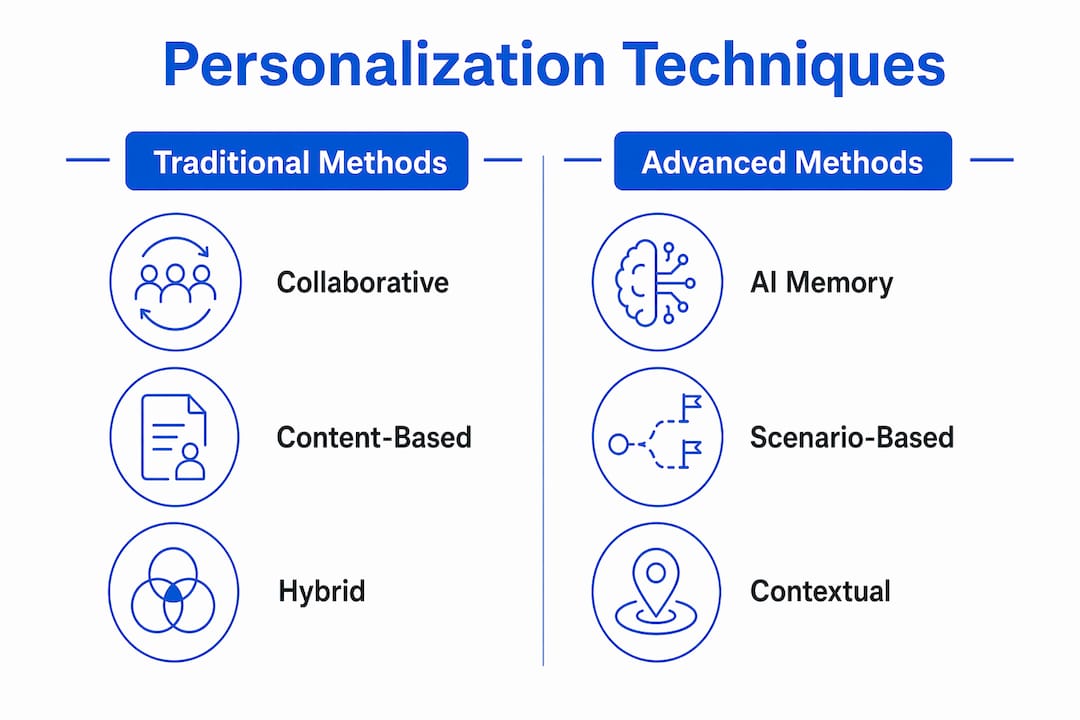
Collaborative filtering, content-based filtering, and hybrid models are the three foundational frameworks. Most modern search engines use hybrid approaches that combine all three with real-time behavioral data.
AI-driven memory is the newest layer. In AI-powered search modes, the system retains context from past interactions to shape future answers. This creates a compounding personalization effect. The more you use the system, the more it adapts to you. For marketers, this means a user who has previously engaged with your brand content is more likely to see it again in AI-generated answers.
Scenario-based personalization is another technique gaining traction. Rather than personalizing for individuals alone, search engines build cohort profiles based on shared behaviors and contexts. A user searching for “running shoes” at 6:00 AM on a Saturday fits a different scenario profile than someone searching the same term on a Tuesday afternoon. The results adjust accordingly.
Understanding these techniques helps marketers think beyond single keywords. The goal shifts to building content that performs across multiple scenarios and user segments, not just for one idealized searcher. For a broader view of how AI shapes discovery, the 2026 Marketer’s Guide to AI Search Discovery covers the mechanics in detail.
Key Takeaways
Search personalization makes traditional rank tracking unreliable. Marketers who build entity authority and scenario-specific content will outperform those chasing universal keyword rankings.
| Point | Details |
|---|---|
| Core definition | Search personalization tailors results using behavioral, contextual, and preference-based signals for each user. |
| Technical foundation | Machine learning models layer on top of traditional relevance scoring to modify rankings dynamically in real time. |
| Marketing impact | Rankings are now probabilistic across user cohorts, not fixed positions visible to all searchers equally. |
| User control | Users can adjust personalization through search history settings, Preferred Sources, and opt-in features like Personal Intelligence. |
| Winning strategy | Clear entity authority and scenario-based content outperform generic keyword optimization in personalized search environments. |
Search personalization is rewriting the rules. Here is what I actually think about it.
Most SEO advice still treats search as if one universal ranking exists. It does not. Personalization has been compounding quietly for years, and AI Mode has accelerated it to the point where the old mental model is simply broken.
What I find most underappreciated is the scenario-based dimension. Marketers obsess over keywords and miss the fact that the same keyword triggers different result sets depending on who is searching, when, where, and what they have searched before. That is not a minor variation. That is a fundamentally different competitive landscape for each user segment.
The practical implication is uncomfortable for most brands. You cannot optimize your way to universal visibility anymore. You have to earn authority on specific topics and build content that covers the range of scenarios your audience actually experiences. Generic content does not disappear from personalized search. It just gets deprioritized for users who have shown stronger signals toward more specific sources.
The brands that will win in this environment are the ones who treat content as a portfolio of scenarios, not a list of keywords. That means understanding your audience segments deeply, mapping their distinct contexts, and creating content that speaks directly to each one. Tools like AI-powered local SEO are already helping brands do exactly that.
Personalization is not a threat to good content. It is a filter that rewards it.
— Mike
How Mysearchhero helps you stay visible in personalized search
Personalized search rewards brands with consistent content output, strong entity signals, and broad scenario coverage. Building that kind of presence manually is slow and resource-intensive.
Mysearchhero is a done-for-you SEO and content marketing service built for exactly this environment. Each month, subscribers receive published articles, backlinks, Reddit mentions, and social media posts pushed through a fully automated pipeline. The result is a growing content footprint that builds entity authority across the user segments and scenarios that matter to your audience. If you want your brand to show up consistently across personalized results, visit Mysearchhero to see how the service works.
FAQ
What is search personalization in simple terms?
Search personalization is when a search engine shows different results to different users for the same query. It uses signals like your location, search history, and preferences to tailor what you see.
How does search personalization affect SEO?
Personalization means rankings are probabilistic, not fixed. A page may rank highly for one user segment and not appear at all for another, which makes traditional rank tracking unreliable.
Can I turn off search personalization?
You can reduce personalization by pausing your search history, using private browsing, and signing out of your account. Full removal is not possible on most platforms, but these steps significantly limit behavioral signals.
What data does Google use to personalize search results?
Google uses search history, location, device type, browsing activity, and, for users who opt in, data from connected apps like Gmail and Photos through features like Personal Intelligence.
Why does search personalization matter for marketers?
Personalization shifts the goal from ranking for a single keyword to building entity authority across multiple user scenarios. Marketers who understand this create content that performs across cohorts, not just for one generic searcher.