
TL;DR:
- Following a six-step media outreach checklist can help local service businesses secure publications and backlinks quickly. Consistent, personalized outreach targeting local reporters with timely angles and a strong press page increases chances of coverage that boosts local SEO. Automating this process with tools like Mysearchhero saves time and ensures ongoing content, backlinks, and community presence.
Run this six-step media outreach checklist this week and you can have your first pitch in a journalist’s inbox by Friday:
- Research targets — find several local reporters who cover your beat
- Craft your angle — tie your story to something happening in your community right now
- Prepare your media kit — one-paragraph bio, logo, two photos, contact link
- Send your pitch — subject line under 10 words, body under 200 words
- Follow up — wait 2–4 days, then send a brief second note; follow-ups yield roughly 22% more replies
- Measure and repurpose — check Google Search Console for new backlinks, then turn any coverage into a blog post or social content
A win is simple: a published story or backlink that drives measurable referral traffic to your site. If you want to skip the manual work entirely, Mysearchhero automates the content and backlink pipeline for you. The step-by-step breakdown below covers timing, templates, and exactly what to track.
Pro Tip: Subject line formula that works: “[City] [service] owner shares [timely local angle]” — keep it under 10 words and skip the exclamation points.
Table of Contents
- What does a step by step media outreach workflow actually look like?
- Copy-paste pitch templates and subject-line variations
- What should your media kit actually include?
- How do you build a media list without expensive software?
- How long does local media outreach take, and what does it cost?
- How do you measure whether media outreach is actually working?
- Key Takeaways
- Why local earned media still beats paid ads for trust
- Mysearchhero handles the outreach pipeline so you can focus on your business
- Sources and tools for further reading
- FAQ
What does a step by step media outreach workflow actually look like?
Start with 30 minutes, a spreadsheet, and one tailored pitch. That is the whole entry point.

Step 1: Set measurable PR goals. Before you contact anyone, decide what success looks like. A published placement in a local outlet, two new referring domains, or a 15% bump in referral sessions are all trackable. Defining measurable PR outcomes before you start keeps outreach focused and prevents you from chasing coverage that does not move your business.
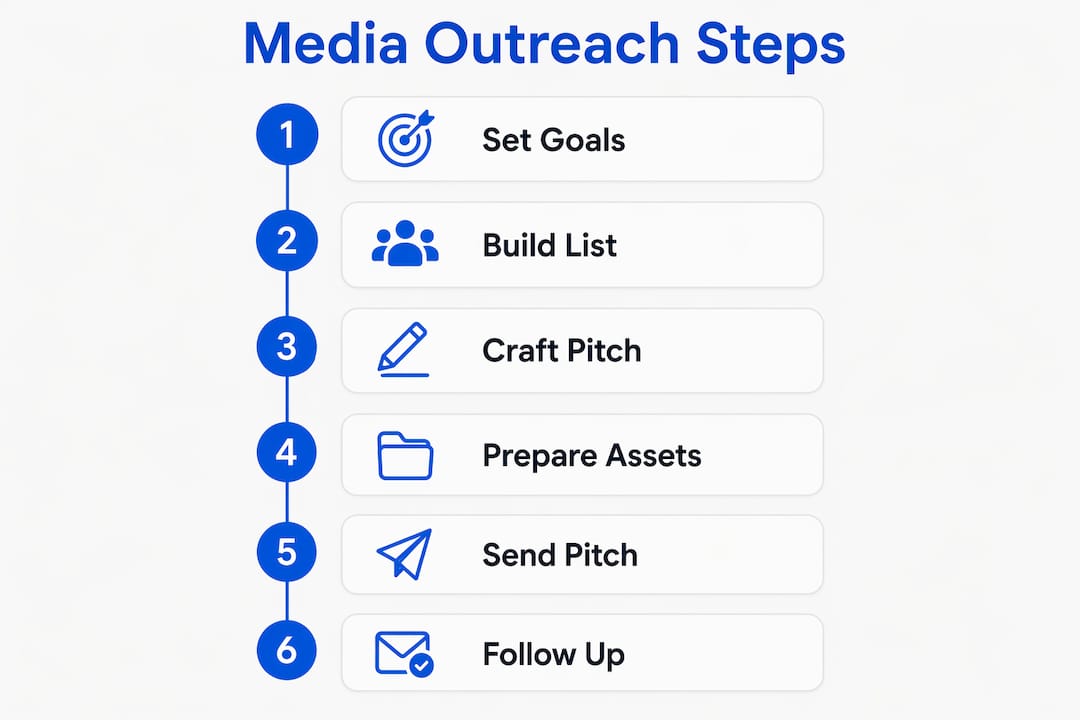
Step 2: Build a prioritized media list. Build a list of local reporters or bloggers who cover your city, neighborhood, or service category. Target the person, not just the publication. A reporter who wrote about a local plumber last month is far more likely to cover your HVAC business than a general-assignment editor who has never touched a trades story.
Step 3: Craft a local, timely angle. Tie your pitch to something current: a seasonal safety tip, a local event, a community problem your service solves. Generic pitches get deleted. A story angle that connects to what is already in the news gets read.
Step 4: Prepare your assets. You need a media kit and a press page on your domain before you send anything. Journalists verify facts fast, and a missing press page is a reason to skip you. More on the kit checklist in the next section.
Step 5: Send the pitch. Use your domain-based email address, not a free Gmail account. Set up your outreach email on your business domain and warm it up for a few weeks before mass outreach to avoid spam filters. Keep the body under 200 words.
Step 6: Follow up on a set cadence. Wait 2–4 days after the initial pitch, then send a short follow-up. A second follow-up at the one-week mark, and a final touch at roughly two weeks, is the right ceiling. Three follow-ups total. Studies show follow-ups increase reply rates by about 22% — that is not spam, it is persistence.
Step 7: Convert coverage into SEO value. Once a story runs, check Google Search Console within a week for new backlinks. Set up a UTM parameter on any link you gave the journalist so you can track referral sessions in Google Analytics separately from organic traffic.
Personalization checklist before you hit send:
- Read the reporter’s last two published stories
- Match your angle to their beat
- Reference one specific article they wrote (by headline, not just “I read your work”)
- Use their preferred contact channel (email vs. social DM)
- Link to your press page in the signature, not the body
Copy-paste pitch templates and subject-line variations
Use the short pitch template for local blogs and newsletters. Use the announcement template only for genuine news: a new location, a major award, or a community partnership. Press releases work best for real milestones, not routine updates.
Template 1 — Initial pitch (local blog or newsletter):
Subject: [City] homeowners are missing this [season] safety check
Hi [First Name],
I noticed your piece on [recent local story] — great angle on [specific detail].
I run [Business Name], a [service] company serving [City/Neighborhood]. We’re seeing [local trend or problem] this [season], and I’d love to share a quick tip your readers could use today.
Happy to send data, photos, or a short quote. Would a 10-minute call work this week?
[Your Name] | [Phone] | [Press Page URL]
Template 2 — Value-driven local angle (TV producer or radio):
Subject: Story idea: [City] [service] trend affecting local homeowners
Hi [First Name],
[One sentence on the local trend.] I can offer on-camera commentary, local stats, and a real customer example. Available [dates]. Press kit at [URL].
Template 3 — Press-release-style announcement:
Subject: [Business Name] opens second location in [City], creating [X] local jobs
FOR IMMEDIATE RELEASE — [Date]
[Business Name] today announced [milestone]. [Two-sentence context.] For photos and interview requests: [Press Page URL].
Follow-up subject-line variations:
- “Quick follow-up: [original subject line]”
- “Still available if timing works — [City] [service] story”
- “Last note: [angle] — happy to help if useful”
SMS/DM template for local bloggers:
Small edits that lift response rates: swap the reporter’s first name into the opening line, reference their outlet by name (not “your publication”), and keep the ask to one sentence.
What should your media kit actually include?
The single most important item is a one-paragraph company overview paired with a high-resolution logo and a direct contact link. Journalists who cannot find your contact info in 30 seconds move on.
| Asset | Format | Notes |
|---|---|---|
| Company boilerplate (1 paragraph) | PDF or plain text | Who you are, what you do, city served |
| Owner bio with credentials | — | |
| High-res logo | PNG (transparent background) | — |
| 2–3 location/team photos | JPEG, 300 dpi | No stock photos |
| Short video or B-roll link | MP4 or YouTube link | 60 seconds max |
| Recent local data or case example | One stat or story that proves local impact | |
| Prior press mentions | PDF or linked list | Links to published coverage |
| Contact and booking link | URL | Direct to your scheduling page |
Host the kit on a dedicated /press page on your own domain. A press page on your domain lets journalists verify your story and download assets without emailing you first. Back it up with a zipped folder on Google Drive or Dropbox for producers who prefer a single download. Add alt text to every image and captions to any video — producers reuse assets faster when they are already labeled.
How do you build a media list without expensive software?
Start locally. Find the 10 reporters or bloggers covering your city or service category before you look at regional or national outlets.
Manual search tactics:
- Search “[City] + [service category] + news” in Google News and note every byline
- Check Twitter/X for reporters who use your city name in their bio or post about local business
- Scan editorial calendars for local magazines (most publish them online; print lead times run 3–6 months)
- Look up your local chamber of commerce newsletter and community Facebook groups for contributor names
Tools that help:
- Google News Alerts — free; set alerts for your service category and city to catch new coverage as it publishes
- BuzzSumo — paid but useful for finding who shares and writes about topics in your niche
- LinkedIn — search “[City] journalist” or “[beat] reporter” to find contacts and verify current employers
- Twitter/X — search your beat keyword; active reporters often post story ideas and source requests
Prioritize contacts by beat match first, then recency of local coverage, then audience size. A blogger with 2,000 local readers who covers home services is worth more than a national outlet that never mentions your city.
Pro Tip: Keep a simple spreadsheet with columns for name, outlet, beat, last article date, and last contact date. Tag each contact as “warm” or “cold” before each campaign so you know who gets the personalized version first.
How long does local media outreach take, and what does it cost?
Most local outreach produces visible results in 2–12 weeks. The range depends entirely on outlet type.
| Outlet type | Typical lead time | Expected outcome |
|---|---|---|
| Local blog or newsletter | 1–4 weeks | Published post, backlink, referral traffic |
| Local TV or radio | Pitch week-of or 2–4 weeks | Segment, brand mention, social clip |
| Print magazine | 3–6 months | Feature story, high-authority backlink |
| Community news site | 1–2 weeks | Quick mention, local citation |
TV pitches need to be timely and should reach producers before their editorial meetings. Print is the opposite: pitch a seasonal story to a local magazine in January for a May feature.
Follow-up cadence recap:
- Day 0: Send initial pitch
- Day 2–4: First follow-up (one sentence, same thread)
- Day 7: Second follow-up (brief, new subject line)
- Day 14: Final follow-up, then move on
Cost tradeoffs:
- $0 budget: Manual search + Gmail templates + Google Sheets. Expect 3–5 hours per campaign.
- $50–$150/month: Add a media contact tool or BuzzSumo for faster list-building.
- $150–$300/month: Pitching platforms that manage sequences and track opens.
- Outsourced: Mysearchhero handles the content, backlink, and outreach pipeline for you on a monthly subscription, which suits owners who want results without the time investment.
For a first test, the $0 approach with 5 personalized pitches tells you more than any paid tool.
How do you measure whether media outreach is actually working?
Measure both direct coverage and what it does downstream. A mention that drives zero traffic is less valuable than a smaller placement that sends 50 qualified visitors to your booking page.
KPIs to track:
- Published placements (count and outlet authority)
- New referring domains in Google Search Console
- Referral sessions in Google Analytics, checked at one week and one month post-publication
- Social reach from shares of the coverage
- Calls or bookings you can attribute to the coverage period
Set UTM parameters on any link you provide to a journalist so referral traffic from that placement is trackable separately. PR outreach builds local backlinks and measurable referral traffic when you pair it with consistent tracking.
Repurposing tips:
- Turn a published story into a blog post (“As featured in [Outlet]”)
- Pull a quote from the article for a social post
- Add the coverage link to your email newsletter
For local SEO, link quality and relevance matter more than raw domain authority. A backlink from a local news site that covers your city carries more local ranking signal than a generic DR-60 site with no geographic relevance.
Pro Tip: Screenshot every piece of coverage the day it publishes. Outlets sometimes remove or archive articles, and your screenshot is proof for your media kit and social posts.
Key Takeaways
Consistent, personalized local media outreach is the most cost-effective way for small service businesses to earn backlinks, referral traffic, and community trust simultaneously.
| Point | Details |
|---|---|
| Start with a short list | Build a list of 10 local reporters before expanding; prioritize beat match over outlet size. |
| Follow up every time | Follow-ups increase reply rates; send up to three touches over two weeks. |
| Host a press page | A /press page on your domain lets journalists verify facts and download assets without asking. |
| Track downstream impact | Use Google Search Console and UTM links to measure backlinks and referral sessions after coverage. |
| Mysearchhero automates the pipeline | For owners short on time, Mysearchhero delivers monthly articles, backlinks, and social posts on autopilot. |
Why local earned media still beats paid ads for trust
Paid ads tell people you paid to be seen. A local news story tells them someone else thought you were worth covering. That distinction drives real buying decisions for service businesses, where trust is the primary purchase barrier.
Local news coverage builds trust that paid ads simply cannot replicate. A homeowner searching for a plumber who sees your business featured in the city paper has already received a third-party endorsement before they click your website. That implicit credibility shortens the sales cycle in ways no ad spend can match.
Small service businesses often assume PR is reserved for companies with communications departments. The reality is that local reporters actively need local sources. A plumber, electrician, or landscaper with a genuine community angle is exactly what a beat reporter is looking for on a slow news week. The barrier is lower than most owners think; the gap is usually just a well-crafted pitch and a press page that makes the journalist’s job easier.
The owners who get the most out of media outreach treat it as relationship-building, not a one-off campaign. A reporter you help with a quote today is a reporter who calls you first when they need a service-business source next quarter. That compounding effect is something no ad budget can buy.
Mysearchhero handles the outreach pipeline so you can focus on your business
Getting consistent press coverage and backlinks from scratch takes hours every week. Mysearchhero cuts that time to near zero by delivering monthly published articles, authority backlinks, Reddit brand mentions, and AI-generated social posts through a fully automated pipeline built for local service businesses.
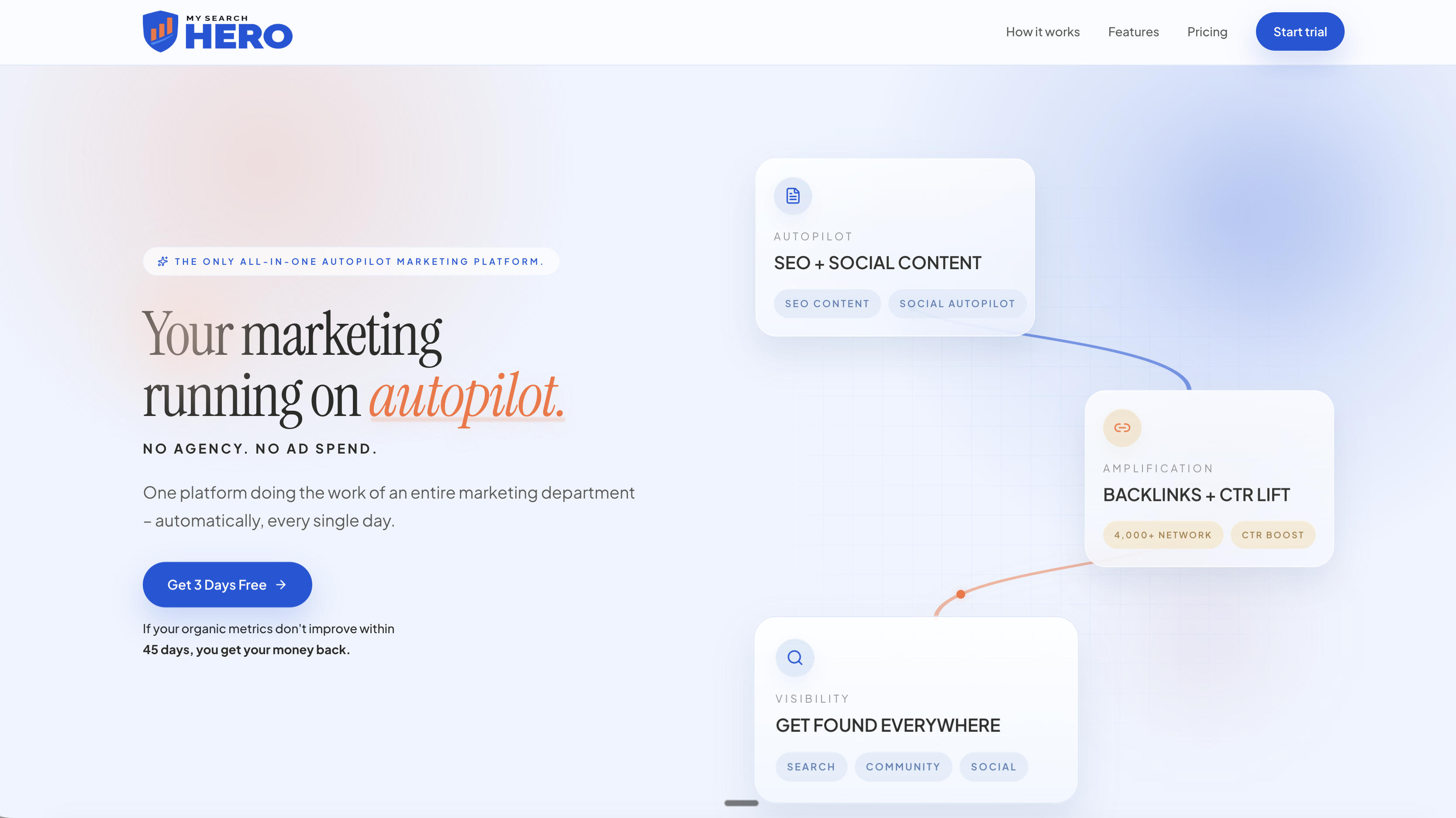
You get the content, the links, and the social presence without writing a single pitch or chasing a single journalist. The service is built specifically for owners who want their local SEO growing in the background while they run their business. Onboarding is fast, and most clients see their first published content and backlinks within the first billing cycle.
Start your Mysearchhero plan and put your content marketing on autopilot.
Sources and tools for further reading
Research sources used in this article:
- FieldPulse PR Guide for Service Businesses — practical PR tactics for trades and service companies, including media kit advice and press release guidance
- BrightLocal Local PR Outreach Guide — local backlink strategy, follow-up cadence data, and email setup recommendations
Recommended Mysearchhero resources:
- Small business PR tactics — pitching and visibility strategies for service businesses
- Backlink outreach strategy guide — combining local SEO and media outreach for link value
- Automated outreach process guide — scaling outreach without adding manual work
- Content ideas for local businesses — story angles that resonate with community reporters
- Content marketing for advisors — outreach channel advice and editorial calendar planning
Tools referenced:
| Tool | Best for |
|---|---|
| Google Search Console | Checking new backlinks after coverage |
| Google Analytics | Tracking referral sessions from placements |
| Google News Alerts | Monitoring new coverage in your category |
| BuzzSumo | Finding who writes about your niche |
| Verifying reporter names and current employers | |
| Gmail templates | Saving and reusing pitch and follow-up drafts |
FAQ
How many pitches should I send for my first outreach campaign?
Start with several highly personalized pitches to local reporters who cover your beat. Quality and personalization matter far more than volume for local outreach.
How long should I wait before following up on a pitch?
Wait 2–4 days after the initial pitch, then send a brief follow-up. A structured follow-up cadence of up to three touches over two weeks can increase reply rates by about 22%.
What is the most important item in a media kit?
A concise company overview paired with a high-resolution logo and a clear contact link. Journalists who cannot find your contact information quickly will move on to the next source.
Does media outreach actually help local SEO?
Yes. Coverage from local news sites and blogs generates referring domain backlinks and referral traffic, both of which are measurable in Google Search Console and contribute to local search rankings.
Can Mysearchhero handle media outreach for my business?
Mysearchhero automates the content, backlink, and social media pipeline for local service businesses, delivering monthly published articles, authority backlinks, and social posts without manual pitching on your part.