
TL;DR:
- The search journey traces every query and interaction a user makes before choosing a local service. Content aligned with all stages of this journey attracts more qualified visitors and increases conversion rates. Implementing a full search journey strategy helps local businesses improve visibility, trust, and bookings.
The search journey is the sequence of queries and interactions a user makes across search engines, AI tools, and apps while moving from awareness to a final decision. For a local service business, that means a potential customer might search “why is my water heater making noise,” then “water heater repair vs replace,” then “plumber near me open Saturday” — all before they ever call anyone. Businesses that align their content to that full path, rather than chasing a single keyword, consistently attract more qualified visitors and convert them at a higher rate.
Table of Contents
- Why the search journey matters for small and local service businesses
- What are the stages of the search journey?
- How to map your customers’ search journey in a few hours
- Search Journey Optimization: tactics for each stage
- Three search journey examples for local service businesses
- How to measure whether your SJO approach is working
- Common mistakes small businesses make with search journeys
- Key Takeaways
- Why most local businesses are still optimizing for one keyword
- Mysearchhero handles the full search journey pipeline for you
- Useful sources
- FAQ
Why the search journey matters for small and local service businesses
Single-keyword SEO made sense when search was simple. Now, AI-driven search compresses the customer-decision process: buyers ask longer, more descriptive questions and often get synthesized answers inside AI interfaces before they ever visit a website. For a local plumber or dentist, that shift has real consequences.
- Pre-qualified visitors arrive already knowing what they need, which means shorter sales conversations and higher close rates.
- Customers who find you at the awareness stage are far more likely to remember your business when they reach the decision stage.
- Local trust signals (consistent NAP, Google reviews, service-specific pages) now influence AI-generated answers, not just traditional rankings.
- Missing even one stage of the journey hands a competitor the conversation at that moment.
Pro Tip: If your Google Business Profile lacks service-specific descriptions, AI search tools may skip your business entirely when synthesizing answers for “best [service] near me” queries.
What are the stages of the search journey?
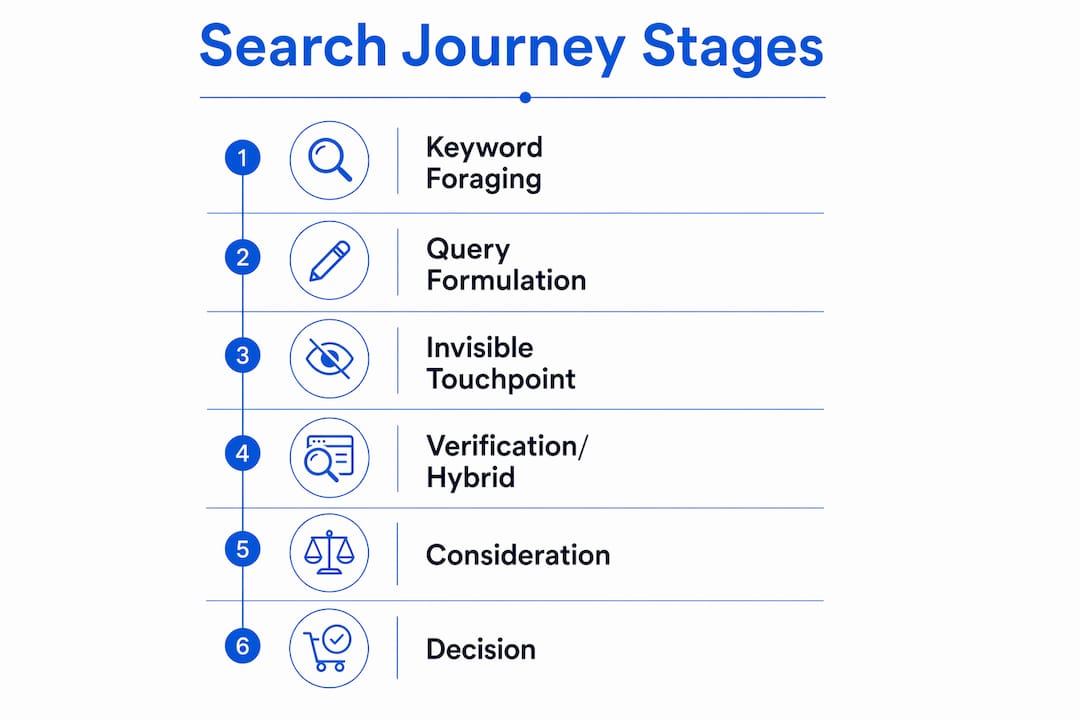
The search journey follows a six-stage model: keyword foraging, query formulation, invisible touchpoint, verification/hybrid switching, zero-click endpoint or click-through, and action/decision. Three stages — keyword foraging, invisible touchpoint, and verification switching — are new compared to traditional frameworks. Each stage corresponds to specific user behaviors, requiring mapped content for full visibility and conversion opportunities.

How to map your customers’ search journey in a few hours
The goal is a working spreadsheet, not a perfect document. Here is a practical process:
- Define your persona. Write one sentence: who is your most common customer, what problem do they have, and what outcome do they want?
- Collect seed queries. Pull your top 20 queries from Google Search Console. Add 5–10 from the “People Also Ask” boxes on your main service pages.
- Group by stage. Label each query: awareness, consideration, or decision. Queries with “how,” “why,” or “what” usually signal awareness. “Best,” “vs,” or “cost” signal consideration. “Near me,” “open now,” or a specific service name signal decision.
- Expand with AI prompt variants. For each seed query, write the conversational version a user might type into an AI tool (e.g., “what should I ask a plumber before hiring them for a water heater job”).
- Identify gaps. Any stage with fewer than three mapped queries is a content gap. Prioritize decision-stage gaps first — they have the most direct revenue impact.
- Build your content plan. Assign one content piece to each gap. Use the column structure below.
| Column | What to record |
|---|---|
| Stage | Awareness / Consideration / Decision |
| Intent signal | The word or phrase that reveals intent |
| Seed query | Exact query from Search Console or PAA |
| AI prompt variant | Conversational version for AI tools |
| Content idea | Blog post, FAQ, landing page, video |
| Page URL | Existing page or “new” |
| Priority | High / Medium / Low |
Search Journey Optimization: tactics for each stage
Search Journey Optimization (SJO) means aligning every piece of content to a specific stage, rather than publishing and hoping. Here is what works at each level, drawn from customer-journey SEO best practices:
- Awareness: Short how-to articles, local guides, and FAQ snippets. Add FAQ schema and definition markup so AI tools can cite your answer directly.
- Consideration: Comparison pages with clear pricing ranges, short case studies, and structured summaries. AI tools favor content with explicit headings and concise answer blocks.
- Decision: Landing pages with a visible phone number, hours, reviews, and a booking form. Use LocalBusiness and Service schema. Every page should answer “why you, why now.”
- Zero-click and invisible touchpoints: Write solution-first. Open every page with the answer, not the backstory. Add a “what to do next” block near the top so AI interfaces can surface it without requiring a click.
- Automation priority: For small teams, automate awareness-stage content first. It has the highest volume, the longest shelf life, and the lowest conversion pressure.
Pro Tip: The role of content in SEO has shifted from keyword density to intent coverage. One well-structured page that answers three related questions outperforms three thin pages targeting one keyword each.
Three search journey examples for local service businesses
| Business type | Awareness query | Consideration query | Decision query | Content to publish |
|---|---|---|---|---|
| Residential plumber | “why is my water pressure low” | “water heater repair vs replace cost” | “licensed plumber near me same day” | Blog post / comparison page / booking landing page |
| Local dentist | “why do my gums bleed when I brush” | “dental implants vs dentures pros cons” | “dentist accepting new patients [city]” | FAQ video / comparison page / appointment form page |
| Lawn care service | “lawn turning yellow in summer” | “lawn care service vs DIY cost” | “lawn treatment service near me free estimate” | Seasonal blog / pricing page / local landing page |
For the dentist, a short video answering the awareness-stage question builds trust before the patient ever searches for a provider. For the lawn care service, a seasonal blog post published in April captures the awareness query right when demand spikes.
How to measure whether your SJO approach is working
Realistic expectations: awareness-stage content typically takes 60–90 days to rank and generate traffic. Decision-stage pages can show conversion movement in 30 days if they are well-structured and the business already has some domain authority.
| KPI | Why it matters | How to measure it |
|---|---|---|
| Organic sessions by stage | Shows which stages are driving traffic | GA4 segments by landing page type |
| Click-through rate from SERP | Reveals title/meta relevance to intent | Google Search Console |
| Calls and form submissions | Direct revenue signal | Call-tracking software + UTM-tagged forms |
| Assisted conversions | Shows awareness content’s downstream value | GA4 multi-touch attribution |
| Search Console impressions | Proxy for invisible touchpoint reach | Filter by query type in Search Console |
For invisible touchpoints, combine Search Console impression data for long-tail queries with downstream conversion lift on decision pages. If impressions rise but clicks stay flat, AI is answering the question — and your content is being cited even when no click occurs.
Common mistakes small businesses make with search journeys
Spotting these early saves months of wasted effort:
- Optimizing only for branded or single keywords. If your only ranked content is your homepage and a “contact us” page, you are invisible for the first two stages of every customer’s journey.
- Ignoring zero-click signals. No FAQ schema means AI tools pull answers from competitors who have it. Add FAQ schema to your top five pages this week.
- Missing local trust signals. Inconsistent NAP across directories, fewer than ten Google reviews, or no service-specific pages all reduce your chances of appearing in AI-synthesized local answers.
- Publishing long content without solution language. A 1,500-word blog post that buries the answer in paragraph eight will lose to a 400-word post that answers the question in the first two sentences.
- Treating demand creation and conversion as separate projects. The compressed digital search path means a single page often needs to serve both awareness and decision intent simultaneously.
Quick fix to run this week: open your top five pages, check whether the first paragraph answers the user’s question directly. If it does not, rewrite the opening. That single change can lift both rankings and time-on-page.
Key Takeaways
The search journey is the full sequence of queries a user makes from first question to final decision, and aligning content to every stage of that path is the most direct way a local service business can grow qualified organic traffic.
| Stage model covers six behaviors | The search journey now includes keyword foraging, query formulation, invisible touchpoint, verification/hybrid switching, zero-click endpoint or click-through, and action/decision. Three of these stages are new in the AI era and require dedicated content strategies.
| Decision-stage gaps cost the most | Prioritize decision-stage content gaps first — they have the most direct impact on calls and bookings. |
| Measurement needs multiple signals | Combine Search Console, GA4, call-tracking, and UTM forms to capture both visible and invisible touchpoint data. |
| Timeline is 30–90 days | Decision pages can show conversion movement in 30 days; awareness content typically takes 60–90 days to rank. |
| Mysearchhero automates the pipeline | Mysearchhero publishes stage-mapped articles, backlinks, and social content monthly so local businesses cover the full journey without doing it manually. |
Why most local businesses are still optimizing for one keyword
The conventional wisdom in local SEO has always been “rank for the money keyword.” Get to position one for “plumber [city]” and the phone rings. That logic made sense in 2015. It does not hold up now.
The problem is not that keyword rankings stopped mattering. They still do. The problem is that a single ranking answers only one question in a journey that now spans six distinct behaviors, many of them invisible to standard analytics. A business that ranks for “plumber Houston” but has no content for “why is my water pressure low” or “water heater repair vs replace” is handing the first two stages of the journey to whoever does have that content. By the time the customer searches “plumber near me,” they already have a brand in mind — and it is probably not yours.
The businesses winning local search right now are not the ones with the highest domain authority. They are the ones whose content shows up at every stage, answers the question directly, and makes the next step obvious. That is SJO in practice, and it is a workflow problem as much as a content problem. The businesses that solve it fastest are the ones that automate the publishing side so they can focus on the service side.
Mysearchhero handles the full search journey pipeline for you
Most local service businesses know they need more content. The bottleneck is time. Writing, publishing, building backlinks, and maintaining social presence across six journey stages is a part-time job on top of running an actual business.
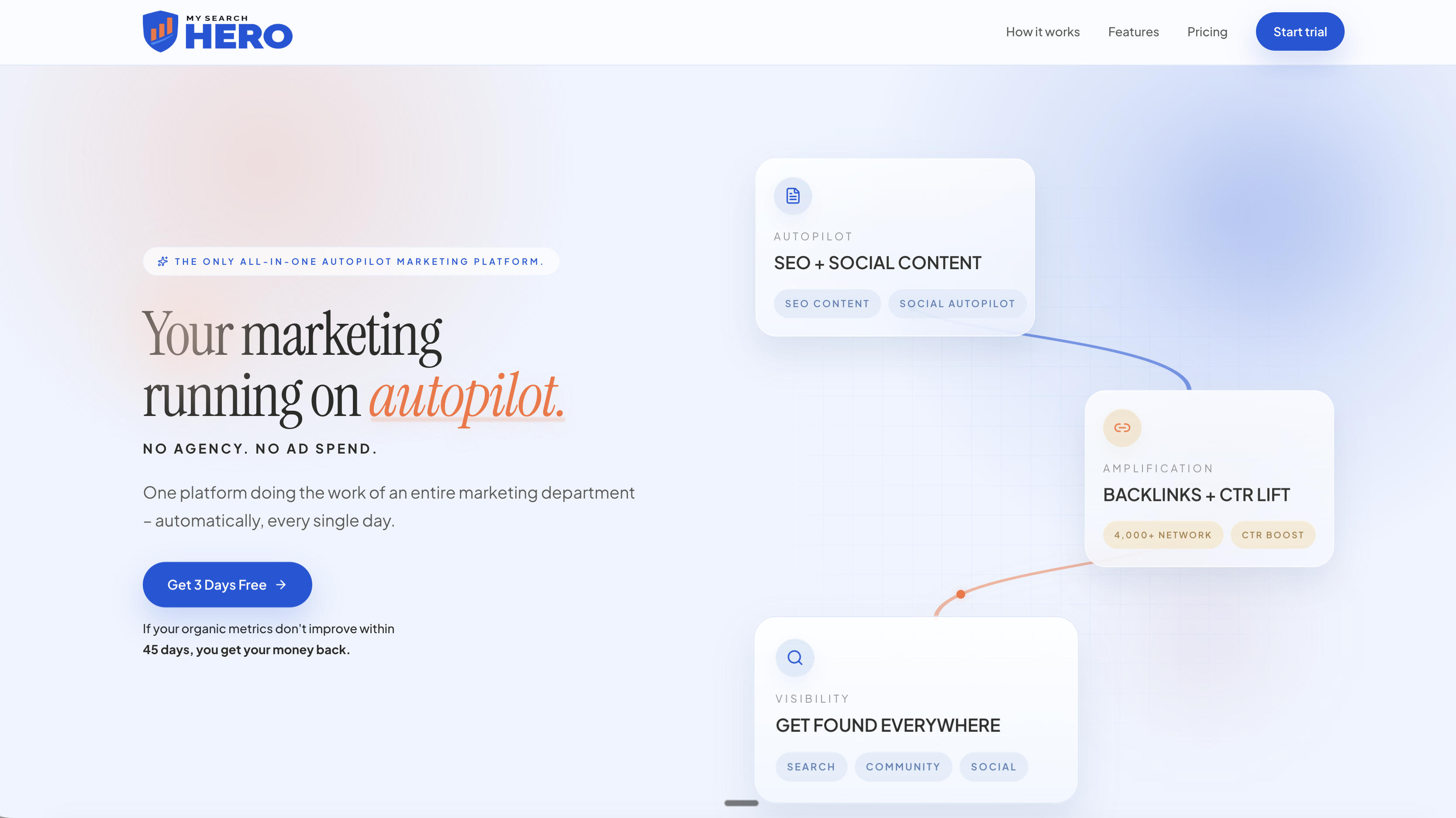
Mysearchhero delivers the full pipeline monthly: SEO articles published directly to your site, authority backlinks through a vetted publisher network, Reddit brand mentions in relevant conversations, AI-generated social posts across platforms, and CTR signal boosting to reinforce rankings. Every deliverable is mapped to your service category and location so the content covers awareness through decision, not just one keyword. It is built specifically for local and service-based businesses in the U.S. that want organic growth without hiring an agency or managing a content team.
Start your free trial and see what a fully mapped, automated search journey looks like for your business.
Useful sources
- How to Map the AI User Journey: A 6-Stage Framework — ZipTie.dev
- The Customer-Decision Journey and AI Search — Think with Google
- Search Journey: Definition, Stages, and Impact on AI Visibility — Am I Cited
- Customer Journey Mapping: SEO Framework and Touchpoint Analysis — SEO War Room
- How Customer Journey SEO Turns Clicks Into Conversions — HubSpot
- The Role of Content in SEO: A 2026 Guide — Mysearchhero Blog
- Digital Marketing Strategy Guide for Business Growth — Mysearchhero Blog
- Content Marketing Workflow for Small Business Success — Mysearchhero Blog
FAQ
What is a search journey in simple terms?
A search journey is the full series of searches a person makes — from first noticing a problem to choosing a solution. It typically spans multiple queries across days or weeks, not a single keyword.
How does the search journey differ from the customer journey?
The customer journey covers all touchpoints (ads, word of mouth, in-store). The search journey is the search-driven subset: query formulation, SERP evaluation, and decision, all happening inside search engines and AI tools.
Why do local service businesses need to map the search journey?
Without a mapped journey, most local businesses only have content for the decision stage. That means they are invisible when potential customers are in the awareness and consideration stages, where brand preference actually forms.
What tools do I need to map a search journey?
Google Search Console and GA4 cover the core data. Add People Also Ask results for query expansion, a call-tracking tool for offline conversions, and a simple spreadsheet to organize stages and content gaps.
How does Mysearchhero help with search journey optimization?
Mysearchhero publishes stage-mapped SEO articles, builds backlinks, and distributes social content monthly, covering the full awareness-to-decision path automatically for local service businesses in the U.S.