
Yes, content syndication can expand your reach without hurting your rankings, but only if you set up the right controls first. Google’s Search Central guidance is clear: duplicate content isn’t penalized when it’s handled honestly, and Mysearchhero has run enough of these workflows to know where publishers actually lose ranking value.
Before you send a single article to a partner, do three things. Confirm the original is indexed in Google Search Console. Decide whether the partner gets a full copy or an excerpt, and require noindex if they won’t guarantee a canonical pointing back to you. Insert your exact canonical URL and an attribution link with UTM tracking, not a generic homepage link.
- Check the original page’s index status before syndicating
- Choose excerpt syndication if you can’t verify partner technical controls
- Confirm the attribution link and canonical target are exact and followable
Pro Tip: Screenshot the partner’s published page within 48 hours. If their canonical tag doesn’t point to your URL, you have proof to request a fix before Google crawls it again.
Key Takeaways
Content syndication protects your rankings when you pair the right technical control (noindex or canonical) with a written spec and a monitoring cadence.
| Point | Details |
|---|---|
| Choose the right control | Use meta noindex on partner copies when canonical can’t be guaranteed exactly. |
| Confirm indexing first | Check Google Search Console before sending content to any syndication partner. |
| Separate UTMs from canonicals | Apply UTM tracking only to attribution links, never to canonical URLs. |
| Track three timeframes | Check index status at 72 hours, referrals at two weeks, backlinks at 90 days. |
| Use Mysearchhero for the whole pipeline | Mysearchhero automates publishing, backlinks, and distribution with built-in tracking so syndication controls don’t rely on manual follow-up. |
Table of Contents
- What Is Content Syndication SEO and How Does It Work?
- What Does Content Syndication Actually Deliver for SEO?
- How Does Google Handle Duplicate Syndicated Content?
- How Do You Set Up a Syndication Workflow Step by Step?
- How Do You Implement Canonical Tags and Noindex Correctly?
- What Metrics Prove Syndication Is Working?
- What Mistakes Cause Syndication to Hurt Rankings?
- What Legal and Copyright Rules Apply to Syndicated Content?
- How Do You Choose Syndication Partners Without Risking Penalties?
- An SEO-Safe Syndication Playbook, Not a Leap of Faith
- Get the Syndication Workflow Running Without the Manual Follow-Up
- Sources
- FAQ
What Is Content Syndication SEO and How Does It Work?
Content syndication SEO is the practice of republishing your content on other sites while managing the technical signals that determine which version Google ranks. The model you pick changes both your reach and your risk.
- Full-text syndication: the entire article republished elsewhere, word for word, usually requiring a noindex tag or strict canonical agreement
- Excerpt or partial syndication: a summary or first few paragraphs with a link back, common on industry news aggregators
- Guest posting: original content written specifically for the partner, not a duplicate of your own page
- Paid distribution networks: content pushed through platforms like Outbrain or Taboola, prioritizing traffic over SEO signals
Excerpt syndication is the safer default when you can’t audit a partner’s CMS. Full-text republishing works fine, but only with a written agreement on canonical or noindex handling.
What Does Content Syndication Actually Deliver for SEO?
Syndication reliably delivers referral traffic, audience discovery, and brand mentions in front of readers who never would have found your site otherwise. What it rarely delivers, on its own, is a bump in organic rankings.
Link signals from syndicated placements are inconsistent. A partner site with strong domain authority might send you a valuable backlink; a low-quality aggregator might send you nothing but noise. Effective content marketing treats syndication as a reach and awareness channel first, and an SEO channel second, layered on top with attribution links and clean canonical handling.
Syndication supports SEO best when three things line up: the partner has genuine topical relevance to your audience, the attribution link is followable and points to a specific page (not your homepage), and you enforce noindex or canonical rules instead of hoping the partner does the right thing by default. Skip any of those three and you’re just giving away content for free.
- Referral traffic and new-audience discovery are the most reliable wins
- Backlink and authority value depends entirely on partner quality
- Ranking gains require disciplined technical controls, not just distribution volume
How Does Google Handle Duplicate Syndicated Content?
Google doesn’t issue a manual penalty for honest syndication. Instead, it typically groups near-identical pages, picks one representative URL to show in search results, and consolidates ranking signals to that version, according to Google’s own developer guidance on duplicate content.
The catch is that Google decides which version wins, and it doesn’t always pick yours. Search Engine Land reported that Google no longer recommends cross-domain canonical tags as the primary safeguard for syndicated copies. If a partner’s page differs even slightly from yours, formatting changes, added images, a different headline, the canonical signal weakens. Google’s John Mueller has also noted that whichever page Google recognizes as canonical is the one most likely to get ranked, which is exactly why ambiguous signals are dangerous.
When your content is truly identical and a partner site has strong authority, asking them to noindex their copy is now the more reliable move than trusting cross-domain canonical alone.
| Control | Best Use Case | Risk If Skipped |
|---|---|---|
| Cross-domain canonical | Identical text, trusted partner | Partner may still get indexed and rank |
| Meta noindex,follow | Partner can’t guarantee exact-match content | None if implemented correctly |
| — | Partner site is retiring or merging content | Not applicable for active syndication |
How Do You Set Up a Syndication Workflow Step by Step?
A syndicated content strategy needs a written spec before anything gets sent to a partner. This isn’t bureaucracy for its own sake; it’s the difference between a partner adding real reach and a partner accidentally outranking you.
- Confirm the original is indexed. Check Google Search Console before you send anything out.
- Decide full or excerpt. Full text needs a canonical or noindex agreement in writing; excerpts need a prominent, followable link back.
- Specify the exact canonical URL. Give the partner the literal string, including protocol and trailing slash, not a verbal description.
- Set attribution and UTM rules. Attribution links carry UTM parameters; canonical tags never do.
- Request meta noindex if canonical isn’t guaranteed. This is now the safer fallback per current Search Central guidance.
- Set a publish delay. Wait until your original is indexed, then release the partner copy 24 to 72 hours later.
- Document allowed edits. Partners often want to tweak headlines or add their own intro. Get this in writing so it doesn’t break your canonical match.
Pro Tip: If a partner refuses noindex and won’t commit to an exact canonical URL, negotiate down to excerpt-only syndication with a link. It’s a smaller ask and still delivers referral value.
A written syndication spec covering these seven points is standard practice among publishers who syndicate at scale, and it’s the single easiest way to avoid the disputes that come up after a partner’s editor makes an unauthorized change.
How Do You Implement Canonical Tags and Noindex Correctly?
Technical execution is where most syndication deals quietly fail. The tag might be there, but formatted wrong, or placed somewhere Google never crawls.

Common canonical mistakes include pointing to a URL with tracking parameters attached, using the wrong protocol (http instead of https), missing or extra trailing slashes, and setting the tag in an HTTP header when the CMS only reads HTML head tags. Google Search Central’s guidance on consolidating duplicate URLs recommends combining canonical tags with consistent internal linking and sitemap entries, since stacking multiple signals increases the odds Google honors your preferred version.
Meta noindex,follow is often more reliable than cross-domain canonical because it removes ambiguity entirely: there’s no representative-URL decision for Google to make. Tools like Yoast automate canonical handling for most standard CMS setups, but cross-domain syndication is a special case that usually needs a manual override.
- Verify canonical tags with Google Search Console’s URL Inspection tool
- Re-check partner pages 24 to 72 hours after publish, since crawl timing varies
- Confirm the partner’s robots.txt isn’t blocking the page Google needs to crawl to see the canonical tag
- Inspect your original URL first to confirm indexing
- Inspect the partner’s published URL for canonical or noindex tags
- Re-run both inspections after 72 hours to catch delayed crawl behavior
What Metrics Prove Syndication Is Working?
Referral sessions, assisted conversions, new backlinks, and branded search lift are the four numbers that actually tell you whether a syndication deal paid off. Everything else is vanity.
Apply UTM parameters only to attribution links, never to canonical URLs. A canonical tag with tracking parameters attached is one of the most common ways publishers accidentally break their own signal consolidation. Use consistent campaign naming across every partner so your reports stay comparable month over month.
- Check index status within 24 to 72 hours of partner publish
- Review referral traffic and click behavior at the two-week mark
- Run a full backlink and authority review around the 90-day mark
| Timeframe | What to Check | Tool |
|---|---|---|
| 24-72 hours | Canonical/noindex status, indexing | Google Search Console |
| 2 weeks | Referral sessions, UTM performance | Analytics platform |
| 90 days | Backlink growth, branded search lift | Backlink tracking tool |
What Mistakes Cause Syndication to Hurt Rankings?
The most damaging mistake is letting the partner publish before your original gets crawled and indexed. Second most common: a partner’s CMS auto-canonicalizes to their own URL by default, silently overriding whatever you agreed to.
Other frequent failures include relying on robots.txt to control indexing when you actually need a canonical tag (robots.txt blocks crawling, which means Google can’t even see your canonical signal), and UTM parameters accidentally left inside a canonical URL, breaking the match entirely. Red flags in a partner’s system: no way to add custom meta tags, a CMS that force-generates self-referencing canonicals, or an editorial team that edits your text after publish without telling you.
- Confirm original indexing before sending content to any partner
- Get canonical or noindex requirements in writing
- Verify the partner’s CMS supports custom meta tags
- Check robots.txt isn’t blocking canonical discovery
- Strip UTMs from canonical URLs, keep them only on attribution links
- Set a publish delay of 24 to 72 hours
- Re-inspect both URLs after the partner goes live
Pro Tip: Ask partners for a staging preview before final publish. It’s the fastest way to catch an auto-canonical problem before it’s live and indexed.
Publisher Resources Behind This Workflow
This guide draws on Mysearchhero’s own editorial and technical practice for managing distributed content at scale, along with the Search Central documentation cited throughout.
- Mike, contributor on the Mysearchhero blog, focuses on practical SEO workflows for small and local service businesses
- Mysearchhero’s guide to content silos explains how internal linking reinforces the authority of your original pages
- Mysearchhero’s guide on writing SEO content that ranks covers preparing a page’s metadata before it ever reaches a syndication partner
What Legal and Copyright Rules Apply to Syndicated Content?
Syndication doesn’t transfer ownership. Your copyright stays with you unless a contract explicitly states otherwise, but that protection only matters if your syndication agreement spells out the terms in writing.
Every syndication deal should specify who owns the content, how long the partner can display it, whether they can edit it, and what happens if the relationship ends. Verbal agreements or a quick email exchange aren’t enough once a dispute starts, particularly with paid distribution networks that operate at volume and rely on standardized (often one-sided) terms of service.
Attribution requirements deserve their own line in the contract. A partner that strips your byline, removes the canonical link, or buries attribution below the fold isn’t meeting the spirit of a syndication agreement even if they technically republished the words correctly. Build a clause requiring visible, followable attribution near the top of the piece, not just a footer credit.
Watch for scraping and unauthorized republishing separately from legitimate syndication. If content shows up on a site you never agreed to work with, that’s a copyright issue, not an SEO tactic, and it needs a takedown request or DMCA notice, not a canonical fix. Keep records of every syndication agreement, including the exact date content went live on the partner’s site. If you ever need to prove which version came first, a timestamped Search Console index record combined with a signed agreement is far stronger evidence than a memory of “we published it first.”
How Do You Choose Syndication Partners Without Risking Penalties?
Partner quality determines almost everything else about whether a syndication deal helps or hurts you. A site with genuine topical relevance to your industry, real readership, and a technically sound CMS is worth ten low-quality aggregators combined.

Start by checking whether the partner’s CMS actually supports custom canonical tags and meta noindex, don’t take their word for it. Ask for a test page or check their published content from other syndication partners; if every one of those pages self-canonicalizes to the partner’s own domain, that’s your answer. Domain authority matters, but so does topical fit: a marketing blog syndicating to a general news aggregator gets diluted attention compared to syndicating to a niche trade publication read by your actual buyers.
Avoid partners that require exclusivity or that won’t put syndication terms in writing. Avoid content farms and paid networks that don’t disclose where your content will appear; you can’t monitor canonical behavior on sites you don’t even know about. Favor partners that let you review the published page before it goes live and that respond quickly when you need a fix.
A resource like Kontrol Media’s analysis on prioritizing original content makes a useful point here: the strategic value of syndication depends on protecting the primacy of your original page, not just maximizing the number of places your words appear. More partners isn’t automatically better if half of them are working against your canonical signal.
An SEO-Safe Syndication Playbook, Not a Leap of Faith
The conventional advice on content syndication treats it as a one-time decision: pick a partner, hit publish, hope for the best. That’s backward. The research on how Google actually handles duplicates points to something closer to an ongoing operational discipline, not a single yes-or-no call.
What gets underestimated is how much damage a “helpful” partner can do by accident. Most syndication problems don’t come from bad actors stealing content; they come from a well-meaning partner’s CMS auto-generating a self-referencing canonical tag nobody thought to check. The fix isn’t more trust. It’s more verification, at 72 hours, at two weeks, at 90 days.
If there’s one place to prioritize effort, it’s the pre-publish spec, not the partner outreach pitch. A mediocre partner with a locked-down technical agreement beats a prestigious partner with a handshake deal. Rankings are protected by written terms and follow-up checks, not by the size of the audience you’re syndicating to.
Get the Syndication Workflow Running Without the Manual Follow-Up
Everything in this guide, the pre-publish spec, the 72-hour index checks, the UTM discipline, works, but it takes someone watching it every week. Mysearchhero is built to run that pipeline automatically instead of leaving it to a spreadsheet someone forgets to update. Each month, subscribers get published SEO articles, authority backlinks through a publisher network, Reddit brand mentions, and social posts, all coordinated so your original content gets indexed and consolidated before anything goes out to a partner.
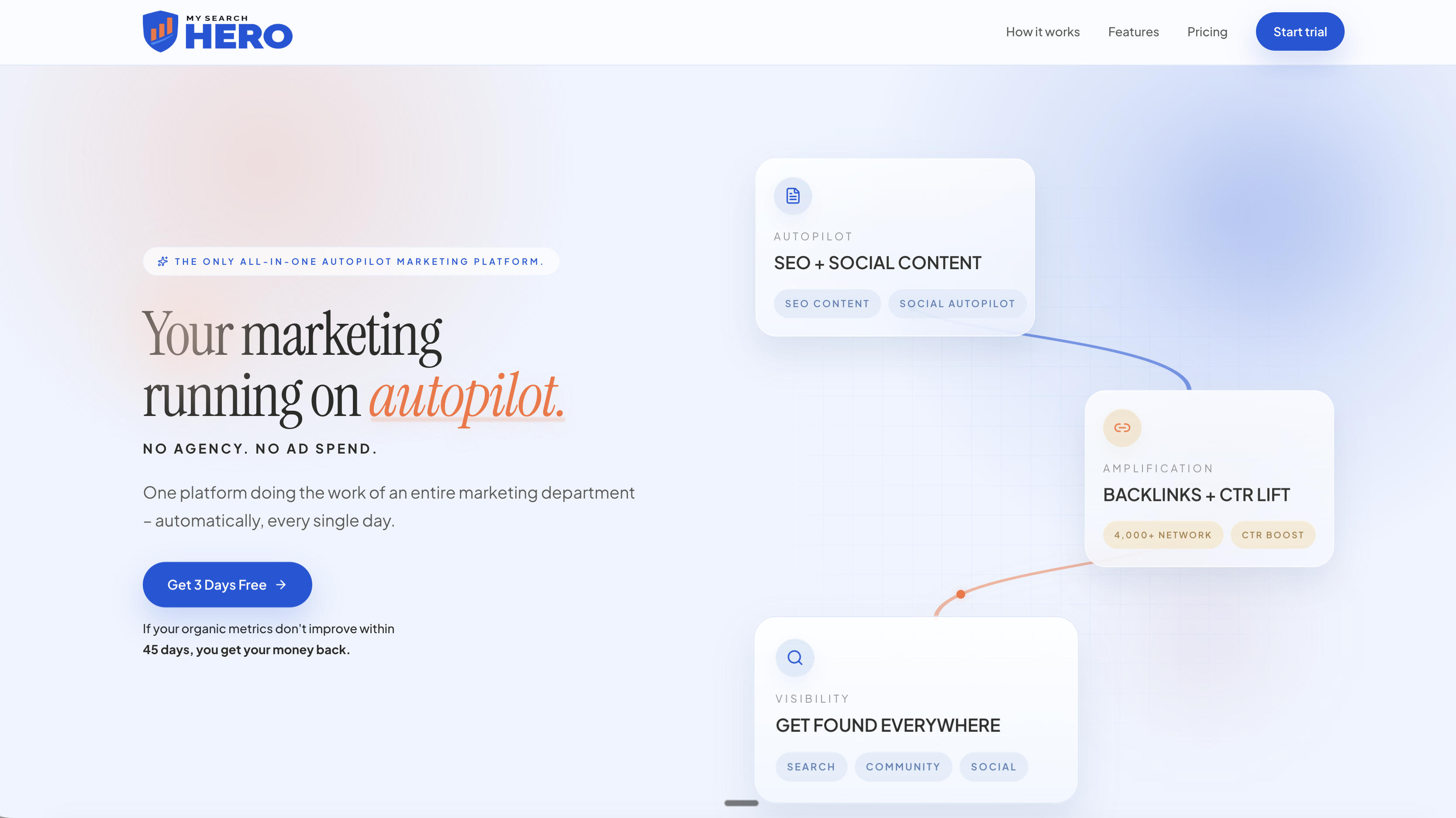
For a small or local service business without an in-house SEO team, that coordination is the part that usually falls apart, not the strategy itself. Mysearchhero handles the sequencing so your source content stays the version Google ranks. Check Mysearchhero to see current plans and start a trial.
Sources
- Google no longer recommends canonical tags for syndicated content
- Deftly dealing with duplicate content (Google Developers blog)
- Content Syndication: What it is & how to do it successfully
FAQ
Is content syndication still effective for SEO in 2026?
Yes, when partners are vetted for technical compliance and the original page is indexed first; referral traffic and audience reach remain reliable, while ranking gains depend on disciplined canonical or noindex controls.
What are examples of content syndication?
Common examples include full-text republishing on partner blogs, excerpt syndication with a link back, guest posts written specifically for a partner site, and paid distribution through networks like Outbrain or Taboola.
Should I use canonical tags or noindex for syndicated content?
Use noindex,follow on partner pages when you can’t guarantee an exact-match canonical; Google’s current guidance treats noindex as more reliable than cross-domain canonical for syndicated copies.
What are the four main types of SEO?
They’re typically grouped as technical SEO, on-page SEO, off-page SEO, and content SEO; syndication mostly touches off-page SEO (through backlinks and referral signals) and content SEO (through distribution reach).
Does the 80/20 rule apply to content syndication?
In practice, a small share of syndication partners, usually the ones with real topical relevance and clean technical setups, tend to drive most of the referral and authority value, while the rest add volume without meaningful SEO return.