
A working sequence beats a wish list: audit your site, map keywords to pages, build or refresh content around real intent, fix on-page and technical gaps, earn a handful of quality backlinks, distribute what you make, then measure and repeat. Skip the order and you waste months chasing tactics that can’t work yet, like link building on a site Google can’t crawl.
The prioritized path looks like this:
- Audit first — establish baseline metrics in Search Console and GA4
- Research keywords with intent labels, not just volume
- Build or refresh content mapped to winnable terms
- Fix on-page elements (titles, headings, schema)
- Resolve technical issues — Core Web Vitals, crawlability
- Earn backlinks from relevant, quality sources
- Distribute across channels you already own
- Measure and iterate every 30 days
Success benchmark: A well-executed 90-day cycle typically shows measurable movement in impressions within 4-6 weeks and clicks within 8-12 weeks, tracked through Google Keyword Planner for demand signals and Google PageSpeed Insights for technical health. Treat anything faster as luck, not process.
Key Takeaways
Organic traffic growth is repeatable when technical fixes, keyword mapping, content quality, and consistent distribution happen in the right sequence and get measured every month.
| Point | Details |
|---|---|
| Fix technical issues first | Resolve indexing, Core Web Vitals, and crawlability before content or link work, since nothing else performs well until Google can see the site. |
| Map keywords to single pages | Use Google Keyword Planner plus Semrush or Ahrefs, and assign one canonical URL per target term. |
| Prioritize GBP for local businesses | Google Business Profile optimization drives a majority of local service leads and often outpaces early link building. |
| Refresh before you create | Updating existing page-two content typically returns faster gains than publishing brand-new pages from zero. |
| Delegate the repeatable work | Mysearchhero automates monthly content, backlinks, Reddit mentions, and social distribution for teams that know the playbook but lack the execution time. |
Table of Contents
- Prioritizing Your Organic Traffic Growth Steps by Impact and Effort
- How Do You Run an SEO Audit and Set Baseline Metrics?
- What Is the Right Way to Do Keyword Research?
- How Do You Create Content That Actually Ranks?
- What Belongs on Your On-Page SEO Checklist?
- How Long Does Technical SEO Take to Fix?
- Which Backlink Strategies Actually Move Rankings?
- How Do You Distribute and Repurpose Content for More Traffic?
- How Do You Measure Progress and Set a Realistic Timeline?
- Setting Up Google Search Console and Analytics for Ongoing Tracking
- How Do You Use Competitor Analysis to Find Opportunities?
- Does Local SEO Optimization Matter for Your Business?
- How Do UX and Engagement Metrics Affect Rankings?
- How Do You Plan and Prioritize a Content Calendar?
- What Structured Data Options Go Beyond Basic Schema?
- Where Mysearchhero Fits Into This Playbook
- Sources
- FAQ
Prioritizing Your Organic Traffic Growth Steps by Impact and Effort
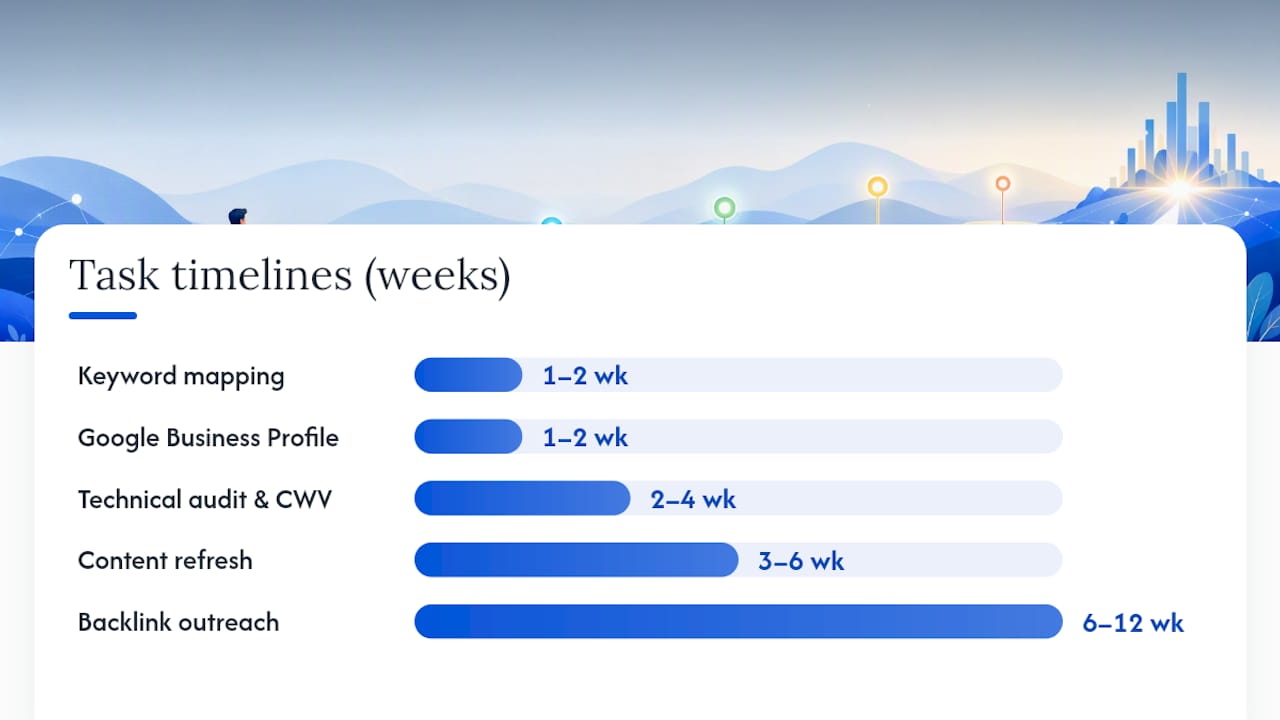
Not every task deserves equal attention in week one. Some fixes move rankings in days; others take a quarter to pay off. The table below ranks the core activities by what actually matters when you’re deciding where to spend Monday morning.
| Activity | Impact | Effort | Timeline | Recommended Tools |
|---|---|---|---|---|
| Technical audit & Core Web Vitals fixes | High | Medium | 2-4 weeks | Lighthouse, PageSpeed Insights |
| Keyword mapping to pages | High | Low | 1-2 weeks | Google Keyword Planner, Semrush |
| Content refresh (top 10 pages) | High | Medium | 3-6 weeks | Ahrefs, AIOSEO |
| Google Business Profile optimization | High (local) | Low | 1-2 weeks | Google Business Profile |
| High-value backlink outreach | Medium | High | 6-12 weeks | Ahrefs, Semrush |
| New long-tail content | Medium | Medium | 4-8 weeks | AIOSEO, Semrush |
Your first 30 days should focus on the fixes that unblock everything downstream:
- Confirm all key pages are indexed and free of crawl errors in Search Console
- Fix Core Web Vitals failures flagged by PageSpeed Insights
- Claim and fully complete your Google Business Profile if you serve local customers
- Map your top 20 keyword opportunities to specific URLs
- Install or verify GA4 conversion tracking
Local businesses should weight Google Business Profile work above almost everything else early on. Service businesses get roughly 60% of local leads through GBP, which makes it a faster win than most link-building campaigns. National or niche sites should instead push content mapping and technical fixes first, since there’s no local pack to capture.
Pro Tip: The Pareto principle applies directly to SEO: roughly 20% of your task list drives 80% of your results. Everything else is secondary until those three are solid.
How Do You Run an SEO Audit and Set Baseline Metrics?
You can’t prove growth without a starting line. Before touching a single page, pull a snapshot of where things stand so every future change has something to measure against.
Run through this checklist first:
- Check indexing status for every important page in Google Search Console
- Review the Coverage report for crawl errors and fix or explain each one
- Confirm your XML sitemap is current and submitted
- Verify robots.txt isn’t blocking pages you want ranked
- Test Core Web Vitals against the targets: LCP under 2.5 seconds, INP under 200 milliseconds, CLS under 0.1
Fixing technical foundations first is non-negotiable because nothing else performs well if Google can’t reliably see or render your pages. Chasing content or links before this step is like decorating a house with a cracked foundation.
Once the technical side is clean, capture your baseline numbers:
- Total impressions and clicks from the last 90 days (Search Console)
- Top 20 queries by impressions, with current average position
- Organic sessions, bounce rate, and goal completions (GA4)
- User behavior signals from a tool like Microsoft Clarity, which offers session replay and heatmaps (review its privacy guidance before deploying, since replay tools touch user data)
Save these numbers in a simple template: date, page URL, impressions, clicks, average position, and conversions. Revisit it every 30 days.
Pro Tip: Run your audit on the same day each month. Comparing Tuesday-to-Tuesday data removes weekly traffic noise that can make a flat month look like a decline.
What Is the Right Way to Do Keyword Research?
Keyword research fails most often because marketers chase volume instead of winnable intent. A term with 10,000 monthly searches and a 70+ difficulty score is worthless to a new site; a 200-search long-tail term you can actually rank for pays rent faster.
Here’s the method that works for most service sites and small businesses:
- Pull demand data from Google Keyword Planner — it’s free and shows real search volume ranges.
- Layer on Semrush or Ahrefs to check keyword difficulty and see which competitors already rank.
- Sort every term by intent: informational, commercial, transactional, or local.
- Map each term to exactly one canonical page. Never let two pages compete for the same query.
- Flag long-tail variations. Long-tail keywords carry lower volume but rank faster and convert at higher rates than broad head terms.
Build a simple keyword map with four columns: target keyword, search intent, assigned URL, and current ranking position. This single sheet prevents the most common content mistake: publishing five different pages that all target the same phrase.
Low-authority sites need to respect a realistic difficulty ceiling. Chasing high-volume, high-authority terms wastes months for domains without established trust — target the winnable long-tail terms instead, and let rankings compound before going after competitive head terms. For deeper paid-search-style demand analysis, a resource like this keyword research guide for Google Ads offers a useful cross-check on commercial intent.
How Do You Create Content That Actually Ranks?
Writing content that ranks and refreshing content that already exists are two different skills, and most sites underinvest in the second one. A page you published two years ago is often one update away from doubling its traffic.
A strong content brief should include:
- The primary search intent and target keyword, plus 2-3 supporting terms
- A heading outline built around the questions searchers actually ask
- At least one original data point, local detail, or example the reader can’t get elsewhere
- Clear calls to action tied to the page’s business goal
For refreshing existing pages, work through this checklist:
- Update outdated statistics and examples
- Add depth where competitors currently outrank you on comprehensiveness
- Fix keyword targeting if the page is ranking for the wrong query
- Add 3-5 internal links from other relevant pages on your site
- Rewrite the introduction to answer the query directly in the first two sentences
A page that jumps from position 14 to position 6 after a refresh usually didn’t get new content. It got sharper targeting, one added data point, and a title tag that finally matched what searchers typed. That’s a smaller lift than most teams assume.
Structuring content with question-based headings followed by direct answers, along with lists and original data, improves the odds of being surfaced by both traditional search and AI-generated overviews. Write your H2s as the questions your customers actually ask, then answer them in the first sentence.

Pro Tip: Once a piece performs well, don’t let it die on the page. Repurposing a top article into a video, a social carousel, or a newsletter section multiplies the return on the research you already paid for.
What Belongs on Your On-Page SEO Checklist?
On-page work is where most sites leave easy wins on the table, usually because it’s tedious rather than difficult. Run through this list for every priority page:
- One H1 per page, matching primary search intent
- Title tag under 60 characters with the primary keyword near the front
- Meta description under 155 characters with a clear reason to click
- Logical H2/H3 structure that mirrors how a reader would ask questions
- A specific call to action above the fold and again at the end
Structured data extends your visibility beyond the blue link. Add:
- FAQ schema on pages that answer common questions, to qualify for expanded SERP results
- HowTo schema on step-by-step guides and tutorials
- LocalBusiness schema on your homepage and location pages if you serve a specific area
Internal linking is the cheapest authority-distribution tool you have, and most sites use it badly. Build a hub-and-spoke structure: one comprehensive “hub” page for a topic, linked out to several supporting “spoke” articles, each of which links back with descriptive anchor text. This tells Google which page matters most for a topic cluster and moves ranking signal to it faster than waiting for external links.
For snippet and AI-overview extraction, format your most important answers as a direct sentence immediately following a question-style heading, then support it with a short list or table. Tools like AIOSEO can help manage schema markup, meta fields, and internal linking suggestions without hand-coding every page. For a deeper walkthrough on structuring content itself, see this guide to writing SEO content that ranks.
How Long Does Technical SEO Take to Fix?
Technical problems are invisible to visitors and lethal to rankings. A beautiful, well-written page that takes six seconds to load or shifts content around as it renders will lose to a plainer page that loads clean.
Work through this technical checklist in order:
- Reduce server response time and enable caching
- Compress and lazy-load images, especially above-the-fold hero images
- Hit Core Web Vitals targets: LCP under 2.5 seconds, INP under 200 milliseconds, CLS under 0.1
- Fix duplicate content with canonical tags
- Map old URLs to new ones with 301 redirects instead of letting them 404
- Confirm mobile rendering matches desktop functionality
Run Lighthouse and PageSpeed Insights monthly, and again immediately after any theme, plugin, or hosting change. Pair them with Microsoft Clarity to see where real visitors get stuck, not just where a lab test flags an issue.
Pages that load quickly and content updated recently are cited more often by AI systems. Speed and freshness aren’t just user-experience niceties anymore. They’re citation criteria.
Timeline expectation: Technical fixes usually show up in crawl stats within 1-2 weeks, but ranking impact from Core Web Vitals improvements often takes 6-8 weeks to fully register as Google recrawls and re-evaluates your pages.
Pro Tip: Fix your slowest page first, not your most important one. A single bloated page can drag down your site’s overall Core Web Vitals score even if your other pages are fast.
Which Backlink Strategies Actually Move Rankings?
Ten spammy directory links do less for you than one relevant, editorially placed link from a site your customers actually read. Quality over volume isn’t a slogan here. It’s math: search engines weight relevance and authority far more heavily than raw count.
Prioritize these tactics:
- Topical guest posts on sites your customers already trust, in your specific niche
- Digital PR around original data, local news angles, or expert commentary
- Partnerships with complementary (non-competing) local or industry businesses
- Targeted resource-page links from lists that already curate tools or services like yours
Before pitching anyone, run through a quality checklist: Is the site topically relevant? Does it have real organic traffic, not just a high authority score? Will the link sit in an editorial context, not a footer or sidebar? Does the anchor text read naturally in the sentence?
A working outreach template stays short: introduce yourself in one line, name the specific piece of content you’re referencing, explain why your resource adds value to their existing page, and ask for nothing more than a look. Long pitches get ignored.
Timelines vary by site difficulty. A new domain might need 15-20 relevant links before rankings move on competitive terms; an established site with decent authority can sometimes move a page with 3-5 highly relevant placements. For a full walkthrough of vetting and outreach mechanics, see this guide to backlinks that actually boost rankings, and for the broader case on why authority matters, this breakdown of backlinking benefits.
Avoid link farms, paid directory blasts, and reciprocal-linking schemes entirely. They rarely move rankings anymore and carry real risk of a manual action. Invest outreach time only where a human editor is making the placement decision.
How Do You Distribute and Repurpose Content for More Traffic?
Publishing is half the job. A great article that sits unshared on your blog captures a fraction of the traffic the same piece could earn distributed properly.
Turn each strong-performing post into multiple formats:
- A LinkedIn carousel summarizing the key points
- A short video walkthrough for YouTube or social
- A newsletter section linking back to the full piece
- A forum or community post answering the same question in your own words
Rank your channels by realistic return for a service business: email list and existing customers first, since they convert fastest; social platforms your audience actually uses second; relevant forums and communities third; paid amplification last, and only for your best-performing pieces. This content promotion approach for local businesses breaks down channel sequencing in more depth.
A simple distribution play: publish, email your list same-day, post a native social version (not just a link) within 48 hours, and seed a relevant forum thread within the week. That combination consistently outperforms publish-and-hope by a wide margin.
Don’t overlook secondary re-engagement tools. Push notifications and on-site conversion overlays can bring past visitors back to new content without new acquisition spend. Platforms focused on social traffic amplification are worth a look if social is currently underused in your mix.
How Do You Measure Progress and Set a Realistic Timeline?
Track five numbers weekly: impressions, clicks, click-through rate by query, average time on page, and conversions. Backlink velocity matters too, but check it monthly rather than weekly since it moves slower.
Run structured experiments instead of guessing:
- Meta description tests — rewrite and compare CTR over a 30-day window
- Content expansion tests — add depth to a mid-performing page and track position shift over 60 days
- Link-impact tests — note ranking position before and after a new high-quality backlink lands
Realistic timeline: Expect early movement (impressions, minor ranking shifts) within 4-6 weeks, meaningful traffic growth within 3-4 months, and compounding results by month six if you keep executing the cycle consistently.
Cost expectations: In-house execution costs staff time across content, technical, and outreach skills, often 15-25 hours monthly for a small site. Outsourced or done-for-you services typically run as a flat monthly subscription instead.
Always attribute organic traffic to conversions, not just sessions. A page with fewer visits but higher conversion intent is worth more than a high-traffic page that never turns into a lead.
Setting Up Google Search Console and Analytics for Ongoing Tracking
If you haven’t verified your site in Google Search Console yet, that’s step one, done through DNS verification or an HTML tag before anything else here matters. Once verified, submit your XML sitemap and check the Coverage report weekly for the first month to catch indexing issues early.
In GA4, set up conversion events that match your actual business goals: form submissions, phone clicks, or purchase completions, not just “pageview” as a proxy for success. Link GA4 to Search Console directly inside Google Analytics so you can see query-level data alongside on-site behavior in one place, instead of toggling between two dashboards.
Build one recurring report that pulls: top queries by impressions, top landing pages by clicks, average position trends, and conversion rate by traffic source. Review it every two weeks, not daily. Daily fluctuations in organic data are mostly noise, and reacting to them wastes effort chasing patterns that don’t exist.
Set up email alerts in Search Console for manual actions and major indexing drops so you catch problems within days instead of discovering a ranking collapse a month later during a routine check. This single habit prevents the most common tracking failure: finding out about a technical issue only after it’s already cost you six weeks of traffic.
How Do You Use Competitor Analysis to Find Opportunities?
Competitor research isn’t about copying what ranks. It’s about finding the gap they left open. Pull the top 5-10 competitors ranking for your priority keywords and look at what they’re missing, not just what they’re doing well.
Check for:
- Content gaps — questions your competitors don’t answer that your customers actually ask
- Weak on-page targeting — pages ranking despite thin content or mismatched titles, which signal low competition
- Backlink sources — sites linking to competitors that might link to you too, especially local directories or partnership pages
- Technical weaknesses — slow-loading competitor pages you can beat on Core Web Vitals alone
Tools like Ahrefs and Semrush both offer competitor gap reports that show keywords a rival ranks for that you don’t. Run this analysis quarterly rather than once. Competitor rankings shift, and a gap you found six months ago may already be closed.
The most useful competitor insight usually isn’t a keyword at all. It’s realizing a competitor’s top-ranking page hasn’t been updated in three years. That’s a direct signal that a fresh, better-structured page from you can likely outrank it within a reasonable timeline, especially if you pair the content update with faster load times and cleaner schema markup.
Does Local SEO Optimization Matter for Your Business?
If you serve customers in a specific geographic area, local SEO isn’t optional. It’s frequently the fastest path to revenue, faster than most content or link strategies.

Google Business Profile optimization deserves priority placement in your roadmap because it consistently outperforms early link-building for service businesses. That means complete business categories, weekly photo uploads, prompt review responses, and regular GBP posts, not a profile you claimed once and forgot.
Beyond GBP, build location-specific landing pages if you serve multiple service areas, each with unique content, not a duplicated template with the city name swapped. Local citation consistency matters too: your business name, address, and phone number should match exactly across every directory listing you appear on.
Local search visibility often beats early-stage link building for service businesses specifically because local intent searchers convert faster. Someone searching “plumber near me” is closer to a purchase decision than someone reading a general how-to article. For a full local playbook, see this guide to growing local traffic for service businesses.
If your business doesn’t serve a specific geographic area, most of this section doesn’t apply. Skip GBP investment and redirect that effort toward content and technical work instead.
How Do UX and Engagement Metrics Affect Rankings?
Search engines watch what happens after the click, and a page that gets abandoned in three seconds sends a signal, even if the exact ranking mechanics stay proprietary. Bounce rate, time on page, and scroll depth all describe whether your content actually satisfied the query.
Fixes that consistently improve engagement:
- Answer the core question in the first two sentences instead of building up to it
- Break long paragraphs into shorter blocks with clear subheadings
- Add a table or comparison where it genuinely clarifies a decision
- Remove intrusive pop-ups that interrupt reading before a visitor has engaged
Use session replay tools like Microsoft Clarity to watch actual visitor behavior. If people consistently stop scrolling at the same point, that’s usually a sign the content structure or a slow-loading element is losing them right there.
Mobile experience deserves specific attention since most organic traffic now arrives on a phone. Test tap targets, font sizing, and whether your CTA is reachable without excessive scrolling. A page that reads beautifully on a 27-inch monitor can be genuinely frustrating on a five-inch screen, and Google’s mobile-first indexing means that frustrating mobile experience is the one that gets evaluated for ranking purposes.
How Do You Plan and Prioritize a Content Calendar?
A content calendar without a prioritization method is just a list of ideas nobody agreed on. Rank every potential topic by three factors: search volume and intent match, competitive difficulty, and business value if the page converts.
Build your calendar around this cadence:
- Weekly: One new piece targeting a mapped keyword, or one refresh of an existing page
- Monthly: Review performance data and adjust the next month’s topics based on what’s actually gaining traction
- Quarterly: Reassess your overall keyword map for gaps competitors have opened up
Prioritize refreshes of pages already ranking on page two (positions 11-20) over brand-new content. Those pages have existing authority and often need only incremental improvement to cross onto page one, which is a faster return than starting a new topic from zero. For a structured approach to sequencing this work, see this practical guide to content strategy planning.
Balance your calendar across intent types too. A calendar stacked entirely with informational blog posts builds traffic but not conversions; mix in commercial and transactional pages that map directly to what you sell.
What Structured Data Options Go Beyond Basic Schema?
Most sites stop at FAQ and LocalBusiness schema and leave real SERP real estate on the table. Review-based schema, event markup, and product schema can each unlock different result formats depending on your business type.
If you collect customer reviews, Review schema can surface star ratings directly in search results, which measurably improves click-through rate compared to a plain blue link. Video schema helps video content earn a thumbnail preview in search results, useful if you’ve repurposed written content into video.
Breadcrumb schema improves how your site’s structure displays in search results and helps search engines understand page hierarchy, which supports the hub-and-spoke internal linking approach covered earlier. For service businesses running promotions or time-limited events, Event schema can surface dates and details directly in relevant searches.
Implement structured data through a plugin like AIOSEO rather than hand-coding it across dozens of pages, since manual JSON-LD errors are common and can silently disqualify a page from rich results. Validate every implementation with Google’s Rich Results Test before considering it done, and recheck after any major site update, since a theme change can quietly break markup that was working fine the week before.
When Does a Done-for-You Service Make Sense?
Marketers typically keep strategy, keyword prioritization, and technical fixes in-house since those require site-specific judgment. Content production, backlink outreach, social distribution, and CTR optimization are more commonly outsourced because they’re repeatable at scale. When evaluating any provider for this work, check their reporting cadence and ask for proof of actual placements, not just promised deliverables. A vendor who can’t show you a published article or a live backlink isn’t ready to be trusted with your budget.
Where Mysearchhero Fits Into This Playbook
Running every step above well, every month, is a real job. That’s the honest tradeoff: the playbook works, but content production, backlink outreach, and distribution are time-intensive even after you know exactly what to do.
Mysearchhero handles the recurring execution layer of this playbook on autopilot, so you spend your time on strategy instead of production. Each month, subscribers receive published SEO articles built around the keyword mapping and content brief approach covered above, authority backlinks placed through a publisher network, Reddit brand mentions in relevant conversations, and AI-generated social posts distributed across platforms, all backed by CTR signal boosting and reporting.
Onboarding typically runs in two phases. In the first 30 days, the platform maps your priority keywords, sets a content calendar, and begins publishing while backlink outreach starts running in parallel. By day 60, you should see a steady monthly cadence of published content, live backlinks, and distributed social posts, with reporting showing what’s been delivered.
If the roadmap in this article looks right but the execution time doesn’t, visit Mysearchhero to see the current plans and start a trial.
Sources
Keep this shortlist bookmarked for ongoing execution, not just the initial audit:
- Local SEO for Service Businesses (2026 Complete Playbook)
For deeper reading on specific tactics, see types of SEO strategies for marketers and content marketing workflow guidance, or browse the broader marketing resource archive for ongoing updates.
FAQ
What Is the 80/20 Rule in SEO?
What Is the Process for Gaining Higher Organic Visibility?
The core process runs audit, keyword mapping, content creation or refresh, on-page and technical fixes, backlink acquisition, distribution, and measurement, repeated on a monthly cycle. Skipping the audit or technical steps typically stalls every later step, since indexing and crawlability issues block visibility regardless of content quality.
How Long Does It Take to See Organic Traffic Growth?
Early signals like impressions and minor ranking shifts often appear within 4-6 weeks, with meaningful traffic growth typically visible within 3-4 months of consistent execution. Compounding results usually show by month six if the cycle continues without gaps.
Should I Focus on New Content or Refreshing Old Pages First?
Refreshing pages already ranking on page two (positions 11-20) usually returns results faster than new content, since those pages already carry some authority. New content matters too, but prioritize refreshes when you’re choosing where to start.
Can a Service Like Mysearchhero Replace This Entire Process?
Mysearchhero automates the recurring execution work, published content, backlinks, Reddit mentions, and social distribution, while strategic decisions like keyword prioritization and technical fixes typically stay with the site owner or marketer. It’s built to handle the repeatable monthly deliverables this playbook requires.