
Content silos are the single most underused structural lever in SEO. A silo groups related pages under a shared topic umbrella, concentrating internal link equity and topical signals so search engines can recognize your site as an authority on that subject. The role of content silos goes beyond tidy organization: they directly affect how efficiently Googlebot crawls your site, how cleanly internal PageRank flows to your most important pages, and whether you suffer from keyword cannibalization across similar posts.
Three immediate effects worth knowing:
- Crawlability: A clear folder or link hierarchy reduces crawl depth, so search engines reach every page faster and more reliably.
- Concentrated link equity: Internal links stay within a topic group, pushing authority toward the pillar page rather than scattering it across unrelated content.
- Reduced cannibalization: When each page owns a distinct intent within a silo, you stop competing against yourself in the SERPs.
Tools like HubSpot, Ahrefs, and platforms like Mysearchhero reference silo architecture as a foundational element of topical authority building. The sections below break down exactly how to build, measure, and maintain silos that hold up in 2026.
Key Takeaways
Content silos concentrate topical authority by grouping related pages under a shared URL or link structure, making your site more crawlable, more authoritative, and less prone to keyword cannibalization.
| Point | Details |
|---|---|
| Silos build topical authority | Grouping and linking related pages signals comprehensive topic coverage to search engines. |
| Physical vs. virtual choice | Use folder-based URLs for new builds; update internal links first on existing flat sites. |
| Hybrid model for scale | Sites over 200 pages benefit from combining silo URL structure with cluster-style semantic links. |
| Measure at 4–8 weeks, 3 months, 6 months | Track crawl depth, orphan count, ranking spread, and organic sessions by topic group. |
| Mysearchhero automates the content volume | Monthly published articles and backlinks support the supporting-page cadence silos require. |
Table of Contents
- What content silos are and the two types that matter
- Why silos matter for SEO and topical authority
- How to build content silos step by step
- Silos vs. topic clusters: which one fits your site?
- How to measure silo impact and when to expect results
- Common mistakes that break silos and how to avoid them
- Tools and technical checks for silo audits
- Where to invest first when resources are limited
- Mysearchhero handles the content and linking work your silos need
- Sources
- FAQ
What content silos are and the two types that matter
A content silo is an architectural pattern, not just a content strategy. It groups pages covering the same broad topic so that navigation, URLs, and internal links all reinforce a single subject area. The distinction matters because you can have a silo without changing a single URL, and you can have a perfectly organized URL structure that functions as no silo at all if the internal links are a mess.
Good site architecture helps search engines find and index pages, spreads authority through internal links, prevents orphan pages, and improves user navigation. Grouping topically relevant content is the mechanism that makes all of that happen.
Physical silos (URL hierarchy)
A physical silo uses folder-based URLs to signal topic grouping directly to crawlers. Every page in the group lives under the same directory path:
/seo/(pillar)/seo/on-page-seo//seo/technical-seo//seo/link-building/
The URL itself tells Google what neighborhood the page lives in. Physical silos are easy to audit and hard to break accidentally.
Virtual silos (link-based)
A virtual silo keeps URLs flat but uses internal linking to create the same topical grouping. A blog at /blog/on-page-seo/ and /blog/technical-seo/ can still form a silo if those pages link to a shared pillar and to each other, while avoiding links to unrelated topics. Silo structure SEO groups related content to build topical relevance and improve crawl efficiency, but virtual silos demand disciplined internal linking and regular auditing to prevent leaky cross-topic links.
Content hubs
A content hub is a hybrid: a pillar page that explicitly aggregates and links to all supporting pages, often with a dedicated hub URL (/topic/) that acts as the entry point. Think of it as a physical silo with a formal index page at the top.
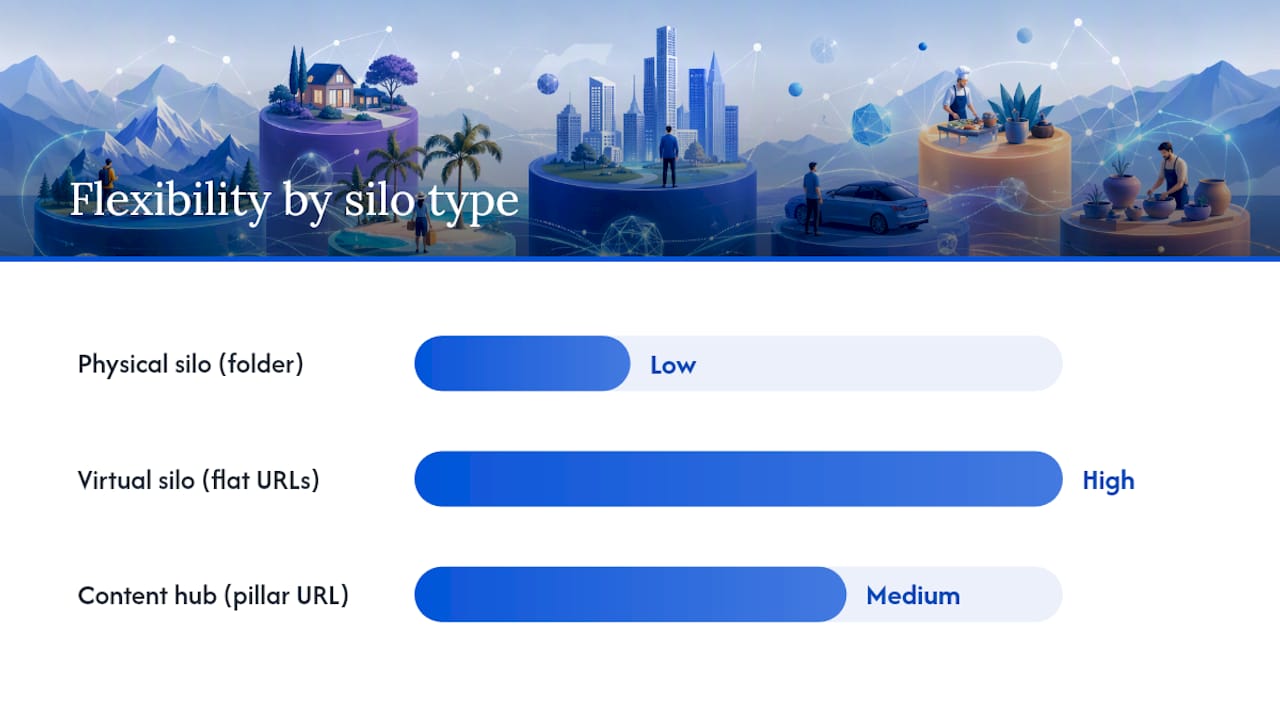
| Type | URL structure | Flexibility | Maintenance demand |
|---|---|---|---|
| Physical silo | Folder-based (/topic/subtopic/) |
Low | Low |
| Virtual silo | Flat URLs + internal links | High | High |
| Content hub | Pillar URL + linked cluster | Medium | Medium |
Why silos matter for SEO and topical authority
The SEO case for silos rests on four mechanisms: topical authority, internal link equity concentration, crawl efficiency, and cannibalization prevention. Each one compounds the others.

Topical authority is built by covering a subject comprehensively and connecting that content. Pillar pages, cluster pages, and internal links are the core mechanism. When Google sees a tightly linked group of pages all addressing different facets of the same topic, it treats the site as a reliable source on that subject, which lifts rankings across the entire group, not just the pillar.
Internal link equity works the same way. A silo keeps link signals circulating within a topic group. Every supporting page that links back to the pillar reinforces its authority. Scatter those links across unrelated pages and the signal dilutes.
Crawl efficiency is the less-discussed benefit. A shallow, well-organized structure means Googlebot reaches your newest pages faster and spends less crawl budget on dead ends. For sites publishing frequently, that matters.
Silo site architecture organizes content into clear sections using navigation, breadcrumbs, internal links, and page depth to make a topic obvious to crawlers and readers alike. Breadcrumbs alone give both users and search engines a persistent signal of where a page sits in the hierarchy.
The E-E-A-T angle is worth noting too. A site that covers a topic end-to-end, with pages that reference each other logically, reads as more authoritative than a site with isolated posts on the same subject. Silos make that comprehensiveness visible in the link graph, which is exactly where Google looks.
How to build content silos step by step
Building a silo is a planning exercise before it is a technical one. Get the architecture right on paper, then execute.
-
Choose your pillars using keyword and entity mapping. Pick 3–5 broad topics your site can genuinely own. Each pillar should map to a high-volume head term with clear subtopics beneath it. Use Google Search Console (GSC), a tool like SemDash, or Ahrefs to identify the entity clusters around each head term.
-
Map supporting pages and assign primary intent. Each supporting page covers one specific subtopic or question within the pillar’s topic. Assign a single primary keyword per page and confirm no two pages share the same intent. This is where you prevent cannibalization before it starts.
-
Decide: physical or virtual silo. If you are building a new site or a new section, use a physical folder structure. If you are working with an existing flat blog, implement a virtual silo by updating internal links first. Avoid mass URL rewrites on live sites; the ranking risk rarely justifies the gain.
-
Build the pillar page. The pillar covers the broad topic at a high level and links explicitly to every supporting page. HubSpot’s guidance recommends a silo of one pillar and 5–10 supporting pages as a practical starting point for establishing initial authority in a topic.
-
Apply the internal linking template. Each supporting page links back to the pillar (exact-match or descriptive anchor) and to 2–3 sibling pages when editorially relevant. Sample anchor patterns:
- Supporting → Pillar: “complete guide to [topic]” or “[topic] overview”
- Supporting → Sibling: “how [subtopic A] relates to [subtopic B]”
- Avoid generic anchors like “click here” or “read more.”
-
Add breadcrumbs and schema. Breadcrumbs reinforce hierarchy for crawlers and users. Add
BreadcrumbListschema markup so Google can display the path in SERPs. AddArticleorFAQPageschema where appropriate. -
Set canonical rules. If any pages share overlapping content (e.g., a tag page and a category page), set the canonical to the pillar or the most authoritative page in the silo. Never leave duplicate content without a canonical.
-
Run a pre-launch QA checklist:
- Crawl the new structure with Screaming Frog or Sitebulb
- Confirm no orphan pages (pages with zero internal links pointing to them)
- Verify all internal links resolve without redirects
- Check breadcrumb rendering in GSC’s URL Inspection tool
- Confirm the sitemap reflects the new structure
Pro Tip: Cross-silo links are not forbidden. When a page in your “technical SEO” silo genuinely answers a question a reader in your “content marketing” silo would have, link it. The rule is editorial relevance, not rigid isolation. One well-placed cross-silo link helps readers and signals semantic breadth; a dozen indiscriminate ones dilute topical focus.
For writing the actual pillar and supporting pages, practical SEO content guidance covers brief structure and on-page optimization in detail.
Silos vs. topic clusters: which one fits your site?
SEO professionals distinguish silos from topic clusters along a clear line: a silo is architecture (URL structure and link flow), while a topic cluster is a content strategy (semantic coverage of a subject). In practice, most modern sites use both, and the question is how to layer them.
The choice between silos and topic clusters depends on site size and editorial capacity. Small or new sites often benefit from a foldered silo because the rules are simple and the structure is self-enforcing. Mature sites with hundreds of pages usually benefit from clusters or a hybrid model, where the URL directory provides topical grouping and editorial linking connects semantically related pages across silos.
| Scenario | Recommended model | Rationale |
|---|---|---|
| New site, under 50 pages | Physical silo | Simple rules, easy to maintain, clear crawl path |
| Growing site, 50–200 pages | Hybrid (silo + cluster) | URL structure for organization, cluster links for semantic depth |
| Large site, 200+ pages | Cluster or hybrid | Pure silo isolation often backfires at scale |
| Migrating from flat blog | Virtual silo first | Update links before touching URLs to reduce ranking risk |
The safest migration path: keep existing URLs, build cluster behavior by updating internal links, measure performance on one cluster for 8–12 weeks, then expand. Rewriting URLs is a last resort. When migrating from silo to cluster models, starting with a single cluster and measuring before expanding is the standard risk-reduction approach.
HubSpot and Ahrefs both track cluster performance through ranking spread (how many pages in a cluster rank for related queries) and internal link depth (how many clicks from the pillar to the deepest supporting page). Those two signals tell you whether your architecture is working before organic traffic confirms it.
For a broader view of where silos fit among SEO strategies, the strategic context helps when pitching silo work to stakeholders.
How to measure silo impact and when to expect results
Silos do not produce overnight results. The typical timeline runs 4–8 weeks for crawl and indexation improvements, 3 months for ranking movement on supporting pages, and 6 months for measurable topical authority gains on competitive head terms. Set those expectations with stakeholders before launch.
The KPIs worth tracking, and where to find them:
| KPI | Source | What to watch |
|---|---|---|
| Organic sessions by topic group | Google Analytics | Segment by URL folder or tag |
| Pages ranking per cluster | GSC / Ahrefs | Count of pages appearing in SERPs for cluster queries |
| Average crawl depth | Site crawl (Screaming Frog) | Should decrease after silo implementation |
| Internal link count to pillar | Site crawl / Ahrefs | Should increase as supporting pages are added |
| Orphan page count | Site crawl | Should trend to zero |
| AI citation impressions | GSC Search Appearance | Track “AI Overview” appearances for pillar queries |
Monthly reports should include a before/after architecture snapshot (crawl depth map, internal link count per pillar), the top 10 queries gained and lost per cluster, and any indexation gaps flagged by GSC’s Coverage report. Quarterly reviews should compare ranking spread across the cluster against the baseline taken at launch.
Topical authority tracking through Ahrefs’ organic keywords report, filtered by topic, gives a clean view of whether the cluster is expanding its ranking footprint over time.
Common mistakes that break silos and how to avoid them
Most silo failures trace back to a handful of recurring errors. Knowing them in advance is cheaper than fixing them after six months of publishing.
The most common pitfalls:
- Overly rigid isolation. Refusing to link across silos at all creates a fragmented site that frustrates users and misses semantic signals. Editorial relevance is the rule, not strict containment.
- Orphan pages. A supporting page with no internal links pointing to it gets no link equity and may not get crawled regularly. Every page needs at least one link from within its silo.
- Keyword cannibalization. Building silos around keyword volume instead of semantic relevance leads to multiple pages competing for the same query. Group by entity and user intent, then enforce link rules.
- Weak pillar pages. A pillar that covers its topic superficially cannot anchor the silo. It needs to be the most comprehensive page on the subject on your site.
- Indiscriminate cross-links. Linking freely between silos for the sake of internal linking volume defeats the purpose. Each cross-silo link should serve a reader need, not an SEO quota.
Maintenance checklist (run monthly for active sites, quarterly for low-publish sites):
- Crawl the site and export the internal link report; check for new orphan pages
- Audit anchor text distribution on pillar pages; flag over-optimized or generic anchors
- Review redirect chains; resolve any 301 chains longer than one hop
- Check canonical tags on new pages; confirm no unintentional self-canonicals
- Scan for new cross-silo links added by editors; evaluate editorial relevance
Red flags to watch: a sudden drop in rankings for a pillar page after adding new internal links (possible link dilution), unexpected indexation gaps in GSC (possible orphan or canonical issue), and ranking volatility across a cluster after a site migration.
A content schedule tied to your silo map makes governance far easier. When every new post has a designated silo before it is written, the linking rules apply automatically.
Tools and technical checks for silo audits
The right toolkit makes silo audits repeatable rather than heroic. These are the tools that do the actual work:
| Tool | Primary use | What to check |
|---|---|---|
| Screaming Frog / Sitebulb | Site crawl | Crawl depth, orphan pages, redirect chains, canonical errors |
| Google Search Console | Indexation and performance | Coverage report, internal links report, AI Overview appearances |
| Ahrefs / Semrush | Link analysis and rankings | Internal LinkRank distribution, ranking spread per cluster |
| Google Analytics | Traffic segmentation | Organic sessions by URL folder or topic tag |
| SemDash free tools | Topic research and quick audits | Keyword clustering, content gap identification |
Quick technical checks after any silo implementation:
- Run a full crawl and filter pages with zero inlinks (orphan check)
- Confirm breadcrumb schema renders correctly in GSC’s Rich Results Test
- Verify sitemap includes all pillar and supporting pages; no pages blocked by
robots.txt - Check that canonical tags on supporting pages point to themselves, not the pillar
- Confirm internal links use descriptive anchor text, not URL strings or “click here”
For CMS-specific implementation: if you are adding a new folder-based URL structure to an existing WordPress or similar site, set up 301 redirects from old URLs before publishing new ones. Test every redirect before removing the old URL from your sitemap. A broken redirect chain on a pillar page can wipe out months of authority accumulation in days.
Pro Tip: Use Ahrefs’ “Best by links” report filtered to your silo’s URL folder to identify which supporting pages are accumulating the most internal link equity. Those are your candidates for expansion or for adding cross-silo contextual links, since they already carry authority within the group.
For AI search surfaces, AI search optimization increasingly rewards sites with clear topical groupings because AI retrieval systems favor structured, comprehensive topic coverage when generating answers.
Where to invest first when resources are limited
The conventional advice is to build silos comprehensively from the start. That is fine if you have the team and the time. Most site owners do not.
On a small site (under 50 pages), the highest-return move is picking one topic you can genuinely own and building a single silo around it: one pillar, five to eight supporting pages, clean internal links, breadcrumbs. Do not spread effort across three half-built silos. One tight, well-linked silo outperforms three loose ones every time.

On a medium site (50–200 pages), the first step is an audit, not new content. Run a crawl, identify your existing orphan pages, and fix the internal linking before publishing anything new. You almost certainly have pages that are already topically related but not linked to each other. Connecting them costs nothing and often produces ranking movement within weeks.
On a large site (200+ pages), pure silo isolation tends to backfire. The better investment is identifying your two or three highest-traffic topic groups and converting them to a hybrid model: keep the URL structure, add cluster-style semantic links, and measure the ranking spread before touching anything else. URL rewrites at scale carry real risk; internal link updates do not.
The resource allocation principle across all three: fix architecture and linking before creating new content. New content on a broken structure compounds the problem. New content on a clean silo compounds the authority.
For local and small service businesses, the content production and linking work required to maintain even a modest silo is often more than an in-house team can sustain. That is where a done-for-you approach makes practical sense.
Mysearchhero handles the content and linking work your silos need
Building a silo is straightforward on paper. Maintaining one while running a business is where most site owners fall behind. Mysearchhero is the done-for-you alternative to hiring an SEO agency or managing a content team yourself: every month, subscribers receive published SEO articles, authority backlinks, Reddit brand mentions, and social media posts, all pushed through an automated pipeline with no project management required on your end.
For silo implementation specifically, Mysearchhero’s monthly content deliverables map directly to the supporting-page volume a silo needs to build topical authority. The backlink acquisition adds external authority to your pillar pages, and the reporting gives you the before/after snapshot that makes silo performance visible to stakeholders.
Before hiring any vendor for silo work, ask: Do they publish content to your site or just deliver drafts? Do they provide an internal link plan with each piece? How do they handle redirect strategy when URL changes are needed? What does their monthly reporting cover? Start with Mysearchhero to see how the automated pipeline fits your site’s current structure.
Sources
- Silo SEO: How to Structure Site Architecture for Topical Authority — HubSpot Blog
- Website Architecture: Best Practices for SEO Site Structures — Semrush
- Topical authority: what it is, how Google measures it, and how to build it — Ahrefs
FAQ
What are content silos?
Content silos are groups of related pages organized under a shared topic, connected by URL structure, internal links, or both, so search engines can recognize the site as authoritative on that subject.
What is the main purpose of a silo in SEO?
The main purpose is to concentrate topical authority and internal link equity around a pillar page, which improves rankings for the entire topic group rather than just individual pages.
What are the three main types of content silos?
The three types are physical silos (folder-based URL hierarchy), virtual silos (flat URLs connected by disciplined internal linking), and content hubs (a pillar page that aggregates and links to all supporting pages in the group).
How long does it take to see results from a content silo?
Crawl and indexation improvements typically appear within 4–8 weeks; ranking movement on supporting pages usually shows at 3 months; measurable topical authority gains on competitive head terms take closer to 6 months.
Can Mysearchhero help implement a content silo strategy?
Yes. Mysearchhero’s monthly deliverables, including published SEO articles and authority backlinks, directly support the content volume and link acquisition that a silo needs to build topical authority over time.