
Press mentions help SEO mainly when they turn into editorial backlinks, entity signals, or measurable referral traffic, not because a journalist wrote your brand name. Most press-release syndication links carry no ranking weight at all. The first move worth making today is setting up monitoring so you catch new mentions while the article is still fresh and worth reclaiming.
TL;DR:
- High-authority, relevant, and fresh mentions with unlinked signals are the most valuable for link reclamation and SEO impact.
- Monitoring with both PR and SEO tools ensures timely detection of mentions, but prioritization should focus on domain authority and topical relevance.
- Most press release links are nofollow and do not directly boost rankings, but earned coverage still enhances brand visibility and referral traffic.
- Personal outreach should be short, specific, and non-demanding, with a focus on existing relationships to improve response rates.
- Consistent, ongoing monitoring and follow-up are essential, as the greatest value comes from a continuous process rather than sporadic efforts.
Table of Contents
- What Does “Press Mentions SEO” Actually Mean?
- How Do You Monitor for New Press Mentions?
- How Do You Prioritize Which Mentions to Chase?
- What Outreach Actually Gets Links Reclaimed?
- Do Press Releases Still Help SEO, or Only Earned Coverage?
- How Do You Measure Whether Press Mentions Move the Needle?
- How MySearchHero Runs Reclamation at Scale
- Dofollow vs. Nofollow: Which Press Mentions Actually Count?
- What Mistakes Waste the Most Reclamation Effort?
- Does Anchor Text in Press Mentions Matter for Rankings?
- The Reclamation Workflow That Actually Scales
- How MySearchHero Can Help
- Sources
- FAQ
What Does “Press Mentions SEO” Actually Mean?
“Press mentions SEO” isn’t a formal industry term, but it describes a real discipline: link reclamation combined with brand-mention monitoring. The standard term practitioners use is link reclamation, sometimes paired with unlinked mention outreach. Both describe the same job: finding places online that already name your brand, then converting the unlinked ones into backlinks and using the linked ones as SEO signal.
The distinction matters because “getting press coverage” and “getting SEO value from press coverage” are two different skills. A journalist can write 800 words about your company and give you zero SEO lift if the piece links to a wire-service page instead of your site, or doesn’t link at all. Media coverage SEO only works when someone follows a process: catch the mention, evaluate it, and act on it before it goes cold.
How Do You Monitor for New Press Mentions?
You need two categories of tools running at once, because they catch different things. PR and social listening tools like Talkwalker Alerts and Google Alerts scan news, blogs, and forums for your brand name, catching mentions the moment they publish. SEO and backlink tools like Semrush’s brand monitoring or Ahrefs go further. They tell you whether a mention actually includes a link, what the linking domain’s authority looks like, and whether that link is dofollow.
Set up both, because relying on just one leaves gaps. Google Alerts might flag a mention on day one, but it won’t tell you the site’s domain rating. Ahrefs will show you the backlink profile, but it usually lags a few days behind real-time news.
For every mention you find, log these fields somewhere your team can act on quickly:
- Source URL and publication date
- Author or byline (for outreach later)
- Domain authority or DR score
- Whether a link exists, and if so, the exact anchor and target URL
- Estimated traffic or reach of the publication
Filter out low-value domains early. A mention on a spun content farm or an auto-aggregator site isn’t worth outreach time. Route fresh, high-authority mentions into Slack or email alerts automatically using RSS-to-Slack integrations, so your team sees them the same day instead of during a monthly audit. Our guide to social listening for marketers walks through the setup in more detail.
Pro Tip: Reclamation outreach converts far better when the mentioning article is still fresh — aim to review and act on new mentions within the same week they publish, before the writer moves on to the next story.
How Do You Prioritize Which Mentions to Chase?
Not every mention deserves an email. You’ll get more done by scoring mentions on a simple scale before you write a single outreach message.
- Domain authority. A mention on a site with strong DR or DA is worth chasing hard. A mention on a directory with a DR of 8 usually isn’t.
- Topical relevance. A mention in an article about your actual industry carries more weight than an off-topic namedrop in a listicle.
- Proximity to money pages. Can the reclaimed link point toward a service or product page instead of your homepage? That’s a better outcome for rankings and conversions.
- Editorial placement. A brand mention embedded in the article body, especially near a resource list, converts to a link far more often than one buried in a footnote or a photo caption.
- Freshness. Mentions from the last two weeks respond better to outreach than ones from six months ago, when the writer has moved on.
Once you’ve scored a batch of mentions, sort them into three lanes. Immediate outreach candidates are high-authority, relevant, unlinked, and fresh. Medium-priority mentions might have decent authority but weak relevance, or good relevance but a small site. Everything else, low authority, off-topic, or already linked correctly, goes in the ignore pile.
Before contacting anyone, run a quick verification pass: confirm the mention is factually accurate, confirm the page is actually indexed by Google, check whether a link exists somewhere else on the page you might have missed, and check whether the anchor text (if any) makes logical sense for the topic.
What Outreach Actually Gets Links Reclaimed?
Ahrefs found that link reclamation converts far better than cold link-building outreach, and the reason is simple: the writer already knows your brand and already found it worth mentioning. You’re not asking a stranger for a favor. You’re asking someone who already did half the work to finish the job.
The sequence that works is short and doesn’t overstay its welcome:
- Message one (thank you): A brief note thanking the writer for the coverage, no ask attached yet.
- Message two (the request): Two or three days later, mention the exact URL and ask if they’d be willing to link your brand name to your site, with a specific page suggested.
- Message three (gentle follow-up): One week later, a short nudge with a soft deadline, framed as a favor rather than a demand.
If there’s no response after the third message and the mention is high-value, escalate to the section editor rather than the byline writer.
Here’s a script that works over email or LinkedIn:
“Hi [Name], thanks for including [Brand] in your piece on [Topic] last week. Would you be open to linking our name to [specific URL]? Happy to send any extra details you need.”
Personalization matters more than polish. Reference the specific article, make the ask one sentence long, and give the writer a single link to copy and paste. Log every outreach attempt and its outcome in a simple spreadsheet so you can see which messaging style earns the best response rate over time. Our backlink outreach strategy guide has more template variations if this sequence doesn’t fit your brand’s tone.
Do Press Releases Still Help SEO, or Only Earned Coverage?
Google has been direct about this: links inside distributed press releases are treated like advertisements, and should carry a nofollow or sponsored tag. If you’ve been counting on wire distribution links to move rankings, they mostly don’t, and haven’t for years.
That doesn’t make press releases worthless. They still work as journalist-ready assets rather than link conduits. A release creates a time-stamped public record of a fact (a funding round, a launch date, a hire), gives your own newsroom page something fresh to publish, and hands reporters a ready-made source they can quote from without a phone call.
To increase the odds a release turns into earned, linked coverage instead of a syndicated dead end:
- Include data points a journalist can cite directly, not just marketing language.
- Attach a real quote from a named person at your company, not a generic soundbite.
- Build a simple media kit: logos, headshots, and boilerplate facts, so reporters don’t have to ask.
- Follow up individually with reporters who cover your industry instead of relying on the wire alone.
The release gets you discovered. The follow-up outreach is what actually earns the link.
How Do You Measure Whether Press Mentions Move the Needle?
Tie every metric to a specific tool and a realistic timeline, or you’ll end up reporting vanity numbers that don’t survive a budget conversation.
| Outcome to measure | Tool to use | Realistic timeline |
|---|---|---|
| Media pickups | Google News, Talkwalker Alerts | Days to 1 week |
| Earned backlinks | Ahrefs, Semrush | 1 to 4 weeks |
| Referral traffic spikes | Google Analytics | Same day to 1 week |
| Branded search lift | Search Console | 4 to 12 weeks |
| Ranking changes | Ahrefs, Search Console | 8 to 12 weeks |
Report short-term wins (a traffic spike the week a story runs) separately from longer-term authority gains (a ranking improvement three months later). Mixing the two in one report confuses stakeholders about what’s actually working. Google’s own community guidance on visibility and backlinks recommends this same multi-signal approach rather than fixating on a single number.
Branded search volume tends to be the most underused metric here. If your brand name searches climb after a wave of coverage, that’s an entity signal search engines pick up on even from mentions that never carried a link, something we cover in more depth in our piece on branded mentions and visibility.
How MySearchHero Runs Reclamation at Scale
Running this workflow by hand for one brand is manageable. Running it across dozens of client accounts is a different problem, and it’s the one that shaped how Mysearchhero built its process. Automated monitoring flags new mentions, a scoring pass sorts them by value, and outreach goes out on a schedule instead of whenever someone remembers to check.
The output most teams care about: consistent monthly content that generates its own fresh mentions to monitor, paired with backlink and Reddit mention activity that gives the reclamation pipeline something new to work with every cycle.
If you’re building this in-house instead, the minimum viable setup looks like:
- One person spending 2 to 3 hours a week on monitoring and triage
- A brand monitoring tool plus a backlink tool (not one or the other)
- A shared log for outreach attempts and outcomes, reviewed monthly
Pro Tip: Assign reclamation to whoever already owns PR relationships, not a generic SEO task queue. The outreach lands better when it comes from someone the writer already recognizes.
Dofollow vs. Nofollow: Which Press Mentions Actually Count?
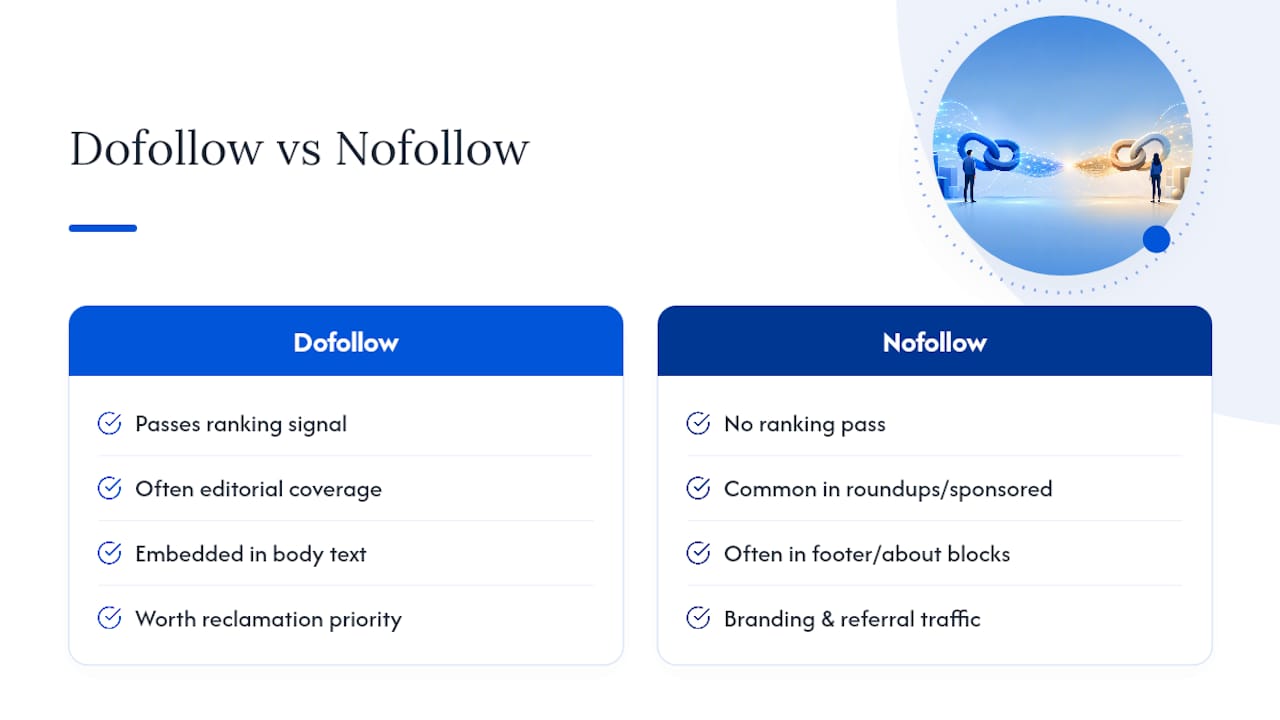
A dofollow link passes ranking signal from the linking page to yours. A nofollow link, tagged with rel="nofollow" or rel="sponsored", tells search engines not to pass that signal along. This distinction decides whether a mention is worth SEO effort or mostly worth brand-awareness credit.
Most major news outlets default to nofollow on outbound links, especially in press-release roundups, sponsored content sections, and any coverage tagged as paid or syndicated. Editorial coverage, the kind a reporter writes because they found your story genuinely newsworthy, is far more likely to carry a dofollow link, particularly when it’s embedded naturally in the body text rather than a boilerplate “About” paragraph at the bottom.
Check link type using your browser’s inspect tool, or faster, run the URL through Ahrefs or Semrush, which flag nofollow attributes automatically in their backlink reports. Don’t assume: some outlets nofollow everything regardless of context, and some smaller, more relevant blogs dofollow by default because they’ve never bothered to change their CMS settings.
Here’s the part worth remembering: nofollow mentions aren’t worthless. They still drive referral traffic, and search engines can still use them as discovery paths and entity signals even without passing direct ranking weight. Treat a nofollow mention as a branding and traffic win, and save your reclamation energy for hunting dofollow opportunities or converting nofollow links to dofollow through direct outreach when the relationship allows it.
What Mistakes Waste the Most Reclamation Effort?
The biggest one is treating every mention the same. Teams burn hours drafting personalized outreach for a mention on a DR 12 blog while a DR 70 unlinked mention sits untouched in a spreadsheet. Score mentions before you write a single email.
The second mistake is going in too aggressive. Demanding a link, citing SEO jargon, or attaching a media kit nobody asked for turns a friendly ask into an annoyance. Writers respond to short, specific, low-effort requests, not a pitch deck.
Third, teams often chase homepage links when a deeper page would serve them better. A mention about your new product line should point to that product page, not your homepage, if the writer is willing to choose the target.
Fourth, and this one’s sneaky: ignoring mentions that already have a link because “the job’s done.” Check the anchor text and target URL anyway. A link pointing to a discontinued page, or using an anchor that has nothing to do with the content, still needs a follow-up.
Finally, don’t confuse volume with value. Ten mentions on low-authority aggregator sites won’t move rankings the way one mention on a respected trade publication will. Chasing every mention that shows up in Google Alerts, instead of filtering for the ones that matter, is how reclamation programs stall out after the first few weeks.
Does Anchor Text in Press Mentions Matter for Rankings?
It matters, but less than SEO practitioners coming from link-building tend to assume. In earned press coverage, you rarely get to choose your own anchor text the way you would in a guest post or a directory listing. Writers link using whatever phrase fits their sentence, and that’s usually your brand name, not a keyword phrase.
That’s actually fine, and often preferable. A backlink profile made entirely of exact-match keyword anchors looks manipulated.
When you do get input, during reclamation outreach for instance, request your brand name or a natural phrase over a keyword-stuffed anchor. Asking a journalist to link the phrase “best project management software” instead of your company name is a red flag to both the writer and to search engines evaluating anchor diversity. A branded anchor pointing to a relevant page still passes authority. It just does it without looking engineered.
The Reclamation Workflow That Actually Scales
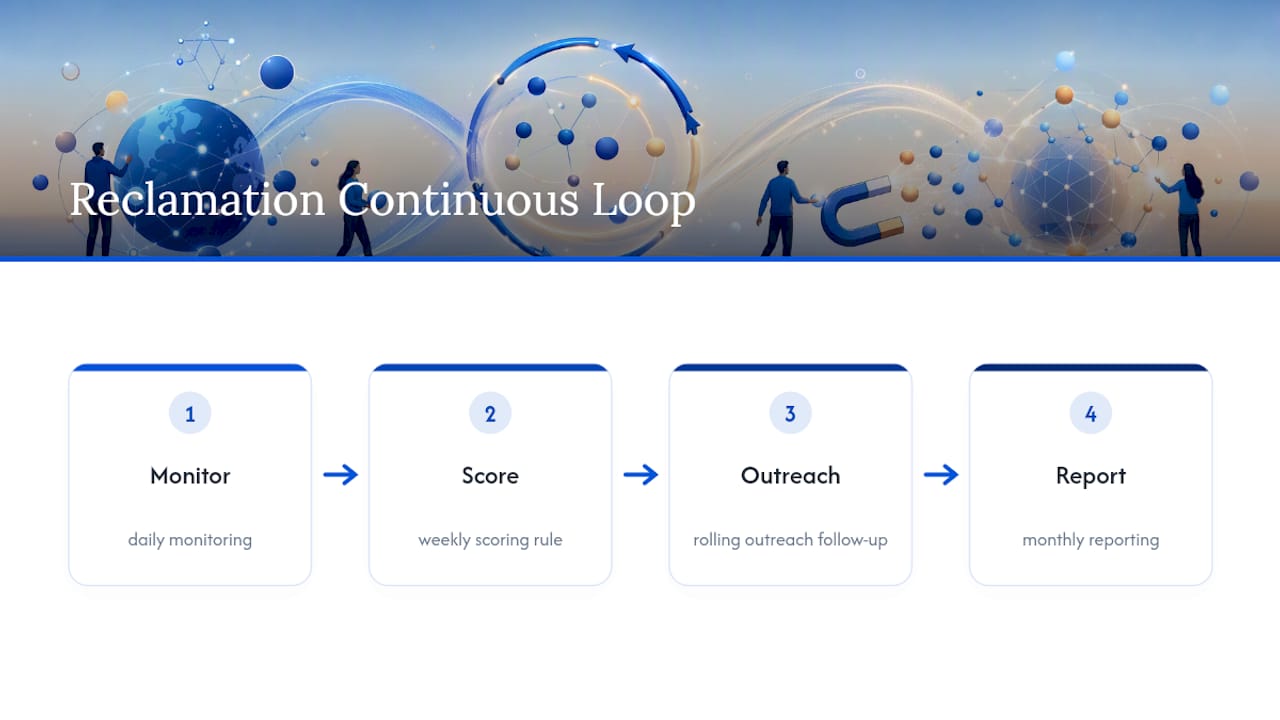
The conventional advice on this topic treats monitoring, outreach, and measurement as three separate projects. That’s backwards, and it’s why so many reclamation programs produce a burst of links in month one and then quietly die by month three. The teams that keep reclaiming links treat it as one continuous loop: monitor daily, score weekly, outreach on a rolling basis, and report monthly, not as three disconnected sprints run by three different people.
The most overrated part of this entire discipline is the press release itself. Too many PR budgets still go toward wire distribution under the assumption that syndication equals SEO value. It doesn’t, and hasn’t for a long time. The underrated part is the follow-up email nobody sends because the mention already “counts” in a press clippings folder somewhere.
What actually moves the needle is unglamorous: a spreadsheet, a scoring rule, and someone who checks it every week. Prioritize the mention with a DR 60 unlinked namedrop over five new press releases. That’s not a popular thing to tell a PR team that just landed six placements, but it’s the honest read of where the SEO value actually sits.
— Mike
How MySearchHero Can Help
If you’ve read through this whole workflow and thought “that’s a lot of ongoing work for one person to manage,” that’s the honest reaction. Monitoring, scoring, outreach, and monthly reporting is a real job, not a once-a-quarter task, and most local service businesses don’t have a spare PR hire sitting around to run it.
A managed monthly program can provide published SEO articles that generate mentions to monitor, authority backlinks through a publisher network, Reddit brand mentions in relevant conversations, and AI-generated social posts, coordinated to support the reclamation loop without manual daily alert checking.
This fits best for service businesses that want the visibility benefits of an ongoing PR and content program without staffing an in-house team to run monitoring and outreach every week. If that’s where you are, visit the Mysearchhero landing page to see current plans and start a trial.
Sources
For deeper technical detail, Ahrefs’ link reclamation guide covers prioritization scoring in more depth, Orbit Media’s mention-to-link process walks through outreach sequencing, and Search Engine Roundtable’s coverage of Google’s press-release guidance documents the nofollow policy directly from Google’s own statements.
- Press release basics — Rutgers (summary of guidance)
- 5 steps for turning mentions into links (Orbit Media)
- Link reclamation: How to recover lost backlinks (Ahrefs)
- Do press releases help SEO? The 2026 answer — Savon PR
FAQ
Do Press Releases Still Work for SEO?
Not for direct ranking value. Distributed press-release links are typically nofollow or sponsored, but releases still help indirectly by increasing discoverability and giving journalists a reason to write earned, linked coverage.
Is SEO Still Worth It in 2026?
Yes, but the mechanics keep shifting toward entity and brand signals rather than pure link volume. Press mentions now contribute to SEO through earned backlinks, branded search lift, and reinforcing what search engines already know about your brand.
What Is SEO in Journalism?
In a journalism context, SEO refers to optimizing headlines, structure, and on-page elements so news content ranks well in search results. For brands, the more relevant angle is how journalism about you (press mentions) feeds back into your own site’s SEO through links and referral traffic.
What Does DR Mean in an SEO Context?
DR stands for Domain Rating, a metric from Ahrefs that estimates a website’s overall backlink authority on a numerical scale. It’s one of the core factors used to prioritize which press mentions are worth chasing for reclamation.
How Can I Track Press Mentions Automatically?
Pair a PR listening tool like Talkwalker Alerts or Google Alerts with an SEO tool like Semrush’s brand monitoring feature or Ahrefs, then route fresh, high-authority hits into Slack or email so your team reviews them the same week they publish.