
AI will write in almost any tone you ask for, but it only sounds like your business when you hand it your own words, a short set of voice rules and a human editor. Without those, you get smooth, generic copy that could belong to any company in your town. This guide shows local and service business owners how to define a voice, brief AI to use it, fix robotic drafts and get headlines that fit.
TL;DR
- Tone of voice is how your business sounds in writing. AI copies it only from examples and rules you supply, not from adjectives like “friendly” or “professional.”
- Collect real samples of your writing, then turn them into three to five voice rules, each with a “this, not that” boundary.
- Brief AI with the reader, the goal, the voice rules and an example. Then edit: add real details, vary the rhythm and read it aloud.
- For headlines, ask for several options, test them against your guidance and the search results, and pick the one that is specific.
- Treat every AI draft as a draft. A person on your side checks facts and adds the experience AI does not have.
Table of Contents
- What AI tone of voice actually means
- Why a generic prompt gives generic copy
- Step 1: Gather samples of how you really write
- Step 2: Turn the samples into a short voice guide
- Step 3: Brief the AI every time
- Step 4: Make the draft sound human
- Step 5: Edit and check before publishing
- AI headline and title ideas that fit your tone
- A weekly routine for owners with no spare time
- Our perspective
- Put your voice to work every month
- FAQ
- Sources
What AI tone of voice actually means
Tone of voice is the personality of your writing: word choice, sentence length, how formal you are, whether you joke, how you handle a worried customer. “AI tone of voice” and “AI brand voice” are two names for the same job: getting an AI writing tool to produce text in that personality, consistently, instead of in its default register.
The default register is the problem. Left alone, AI tends to land on a middle-of-the-road style that can come across as overly confident or salesy. One brand team writing about its own voice work described AI writing as having a tendency to sound a bit pompous, and said it needed a deliberate dose of empathy to read the room. That matches what most owners notice: the grammar is fine, the warmth is missing.
It helps to separate two ideas:
- Voice is constant. It is who you are: plain-spoken, careful, a little dry, whatever fits.
- Tone flexes by situation. You sound different in a reply to an angry review than in a post announcing a seasonal special, but both are recognizably you.
A good AI setup captures both: a stable voice, plus notes on how the tone shifts by context.
Why a generic prompt gives generic copy
The prompt “write a friendly, professional blog post about water heater repair” tells the model almost nothing. Thousands of businesses would write that same sentence, so the model returns the statistical average of all of them.
Broad adjectives fail because they are not instructions. “Professional” could mean formal and stiff, or calm and clear. “Conversational” could mean contractions and short sentences, or slang and emojis. The fix is to replace adjectives with observable rules: sentence length, words you use and avoid, how you address the reader, what you never promise.
The second cause is missing context. The model does not know your service area, your typical customer, the questions you hear on the phone every day or the way you explain a quote. Every piece of that context you supply moves the draft away from average.
Step 1: Gather samples of how you really write
You do not need to invent a voice. You already have one, hidden in things you wrote without thinking about branding. Pull together five to ten varied samples, such as:
- Customer emails and text replies you were proud of
- Your About page and service page copy
- Social posts that got real responses
- Proposals, estimates or follow-up messages
- A short voice memo transcript of you explaining your service to a new customer
Variety matters. If every sample is a formal proposal, the AI will learn only your formal side. Include at least one casual piece and one where you handled a problem.
Also write down three facts the AI cannot guess: who your best customers are, what they worry about before they call, and what you want them to feel after reading. Those become the audience and mission lines of your brief.
Step 2: Turn the samples into a short voice guide
Paste the samples into an AI chat and ask it to describe patterns: average sentence length, formality, humor, favorite phrases, how you open and close, what you avoid. Then edit its answer yourself. You are the judge of whether it sounds right.
Keep the result short. A guide of one to two pages is enough, and AI follows concrete rules better than long essays. A workable structure:
- Three to five voice traits, each with a boundary. For example: “Direct, not blunt.” “Warm, not casual.” “Confident, not boastful.” The second half stops the trait from tipping over.
- Do and don’t examples. Write one sentence in your voice and one the way you would never say it.
- Vocabulary rules. Words you use (“estimate,” “visit”) and words you avoid (“solutions,” “world-class,” “leverage”).
- Tone by context. How you sound in a how-to article, a review reply, a social post and an emergency-service page.
- Formatting preferences. Short paragraphs, no exclamation marks, numbers as digits, whether you use “we” or “I.”
- Two or three model paragraphs that you consider perfect.
If you need a worked example, here is a trimmed guide for a fictional family-run HVAC company:
| Trait | Means | Not this |
|---|---|---|
| Plain-spoken | Short sentences, explain the part and the cost | Trade jargon without explanation |
| Reassuring | Say what happens next and when | Scare tactics about “dangerous” systems |
| Local | Mention neighborhoods, seasons, typical house types | Generic national-brand phrasing |
| Honest | Give a range and what changes it | “Best price guaranteed” claims |
Some writing tools can also build this for you. Several marketing platforms now offer a feature that analyzes existing writing and infers tone and style, which you can refine with attributes or uploaded samples. If you use one, still read the result critically against your own samples.
Step 3: Brief the AI every time
A voice guide only works if it travels with the request. Save it as a reusable block, or store it in a custom instruction or project if your tool supports that, and add a task-specific brief each time. Guidance from Search Engine Land on writing with AI points to the same ingredients: reader personas, target grade level, headline formulas, tonality, examples and opening hooks, with reference material added as the project develops and the output refined through back-and-forth.
A prompt template you can adapt:
You are writing for [business name], a [type] serving [area]. The reader is [who], and right now they are worried about [concern]. Write a [format] of about [length] at a [grade] reading level. Follow the attached voice guide. Open with [hook type]. Include one concrete example from [real situation]. Do not use the banned words list. Here is a sample paragraph in our voice: [paste].
Three habits improve results fast:
- Give one real example. A single paragraph you wrote teaches more than a page of adjectives.
- Name the reader. “A homeowner in a 1990s house whose AC stopped on a hot weekend” gives the model something to be specific about.
- Iterate in the same conversation. Say “shorter sentences, drop the second paragraph’s intro, sound less like an ad” rather than starting over.
Prompting for a specific audience matters in every trade. A good illustration is how one Delaware mobile locksmith explains AI SEO optimization for locksmith marketing, where the content has to speak to people locked out of a car at midnight differently than to a property manager planning a master key system.
Step 4: Make the draft sound human
Even with a strong brief, first drafts often read stiff. Microsoft’s guidance on humanizing AI text boils down to a few moves: add audience context and real-world examples, adjust tone and vocabulary, vary sentence structure and read the copy aloud. It also suggests adding questions and tone-appropriate warmth where they fit.
Here is how that looks in practice.
Swap abstractions for specifics. Replace “We provide high-quality service” with “Most visits take about an hour, and we text you when we’re ten minutes away.” Only include specifics that are true for your business.
Vary the rhythm. AI loves sentences of similar length. Mix a long explanatory sentence with a short one. Like this.
Cut the filler openers. Delete lines such as “In today’s fast-paced world” and any paragraph that only announces what the next paragraph will say.
Add what only you know. A story from a recent job, a mistake customers often make, a seasonal pattern in your area. This is the part no tool can generate for you, and it is usually what readers remember.
Read it aloud. If you would not say a sentence to a customer standing in your shop, rewrite it. Stumbling over a line is a reliable sign it is stiff.

A before-and-after
Before: “Our professional team delivers comprehensive plumbing solutions tailored to your needs, ensuring customer satisfaction at every step.”
After: “If your kitchen sink is backing up, call us. We’ll tell you the likely cause on the phone, quote the job before we start and clean up before we leave.”
The second version is shorter, makes concrete promises you can keep and sounds like a person.
Step 5: Edit and check before publishing
Voice is not the only risk. AI can state wrong numbers, invent product details or describe a process the way a competitor does rather than the way you do it. Before anything goes live:
- Fact-check statistics, product specifications, prices, licensing claims and technical details. Remove anything you cannot verify.
- Add your own perspective and experience. Guidance on AI-generated content recommends using the output as a draft rather than a final version, adding your unique voice and experience after checking the facts.
- Check the voice against your guide: banned words, trait boundaries, sentence length.
- Check local accuracy: service areas, hours, neighborhood names.
This habit has a name in AI research: human-in-the-loop. Google’s machine learning glossary defines it as a policy of critically viewing AI output, or a strategy for people to help shape, evaluate and refine a model’s behavior. The same glossary notes that human evaluation is especially useful for generative AI outputs with no single right answer, which describes marketing copy well. There is no one correct way to write your About page, so a person has to judge.
AI headline and title ideas that fit your tone
Headlines are where tone shows up first, and where AI defaults are weakest. Ask for “10 blog title ideas” and you will get ten interchangeable lines with colons and superlatives.
A better process follows the same research-backed pattern. Search Engine Land suggests creating three to five title options and comparing them with search results, then asking AI to evaluate them against your title guidance, best practices and differentiators. Your prompt for headline ideas should include:
- The reader persona and the problem they searched for
- The target reading level
- Headline formulas you like (a how-to, a number, a plain question, a direct promise)
- Your tonality, with two or three of your past headlines as examples
- The opening hook the article uses
Then run a quick filter on what comes back:
| Check | Keep if | Cut if |
|---|---|---|
| Specific | It names the problem, place or number | It could fit any business |
| On voice | You could say it out loud | It uses your banned words |
| Honest | The article delivers the promise | It oversells |
| Distinct | It differs from the top search results | It copies the same angle |
Finally, search the phrase yourself. If the first page is full of near-identical titles, pick the option that says something the others do not, such as a local detail or a concrete outcome.
A weekly routine for owners with no spare time
You do not need a content team to keep a consistent voice. A realistic rhythm for a small service business:
- Once, about an hour: collect samples and build the one-to-two-page voice guide.
- Each piece, 10 to 15 minutes of briefing: reader, goal, one real detail from a recent job, then generate.
- Each piece, 10 to 20 minutes of editing: facts, voice, read aloud.
- Quarterly: reread your published pieces together. Where do they drift from the guide? Update the rules or the banned list.
The quarterly review is what keeps voice from decaying. AI tools change, your services change and your guide should too.
Our perspective
We built MySearchHero for owners who are great at their trade and short on hours, so we think about voice a lot. Our view: the voice question is really a consistency question. A local business does not lose customers because one post was a little stiff. It loses them because its website, its articles and its social posts each sound like a different company, or like no company at all.
That is why we treat AI as a production engine, not a replacement for judgment. Our approach is designed around a monthly bundle of published articles, backlinks, Reddit mentions and social posts, all pushed out through one automated pipeline, so your message shows up in the same place and the same shape week after week. When one system handles the repetitive publishing, you can spend your limited attention on the part only you can do: telling us what you stand for, who you serve and which details are true.
We also believe in doing the work on one platform rather than stitching together separate providers for content, links and social. Fewer handoffs mean fewer chances for your voice to get lost between them. Give any system real samples and clear rules, review what it produces, and the results get better each month.
Mike
Put your voice to work every month
If you would rather not run the prompting, publishing and distribution yourself, MySearchHero is a done-for-you service for local and service-based businesses. Each month you get a bundle of deliverables: AI-generated SEO articles published to your website, authority backlinks through a publisher network, Reddit brand mentions in relevant conversations and AI-generated social posts across multiple platforms, with CTR signal boosting and reporting included.
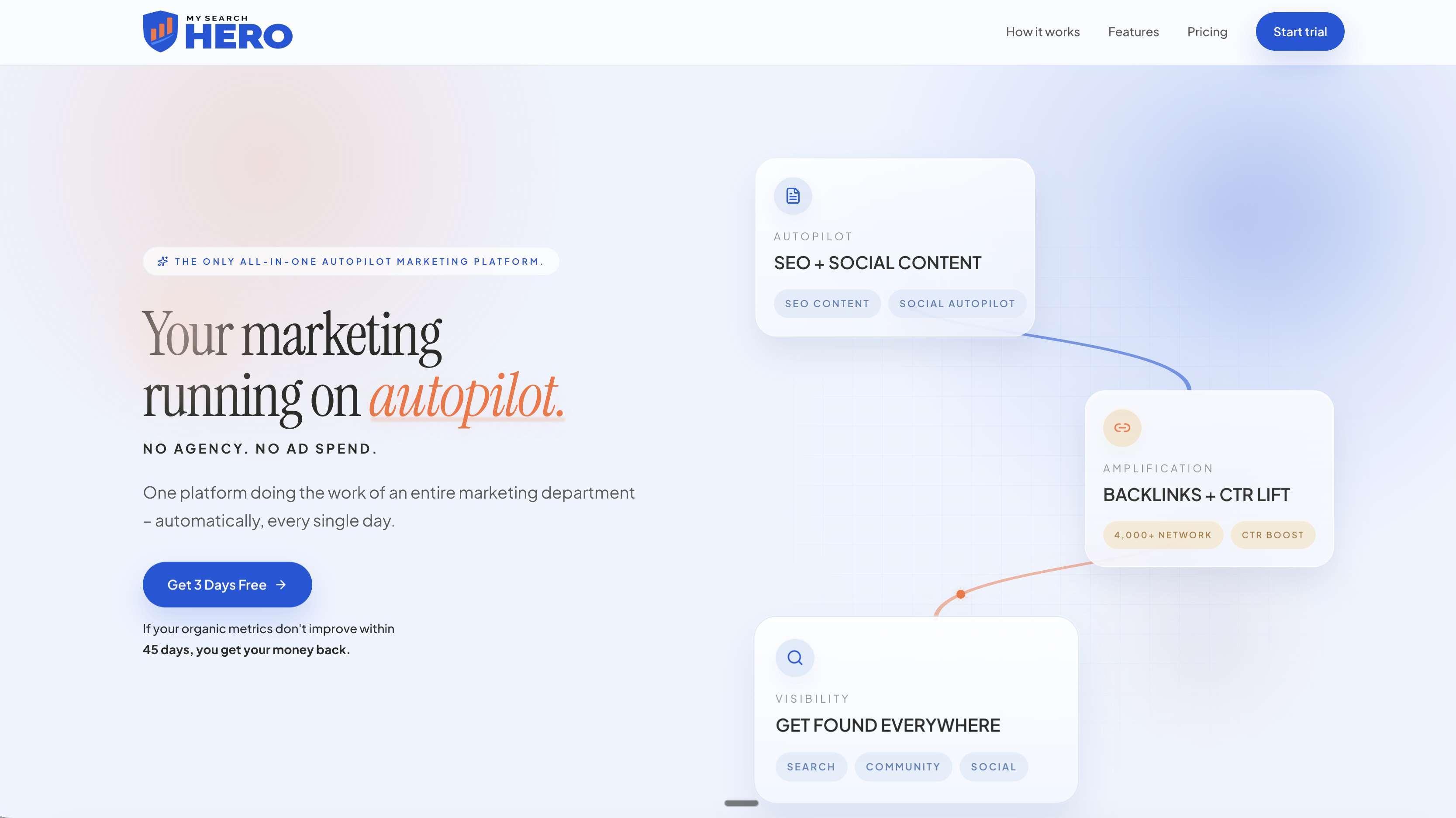
Plans are published at mysearchhero.com: Spark at $197 per month, Authority at $297 per month and Hero at $397 per month, with annual billing at $1,970, $2,970 and $3,970 respectively, plus an Enterprise plan at $2,997 per month. We also offer a 45-day money-back guarantee if your organic metrics do not improve. To see how the content side fits into search, our guides on the role of AI in content for small businesses and AI in SEO for local visibility are good next reads.
FAQ
What is the difference between AI tone of voice and AI brand voice?
The two phrases are used almost interchangeably. Brand voice is your constant personality, while tone is how it flexes by situation, such as a review reply versus a promotion. In AI work, you define both in a short guide so the tool can reproduce them.
How many writing samples does AI need to match my voice?
Five to ten varied samples is a practical starting point, such as emails, social posts, About-page copy and proposals. Variety matters more than volume, because it shows the AI how you sound in different situations. Add a short list of do and don’t rules to sharpen the result.
Can AI write headlines that sound like my business?
Yes, if you give it reader personas, a reading level, headline formulas you like, examples of your past titles and your tone. Ask for three to five options, compare them with what already ranks, and choose the one that is most specific and true to the article.
Do I still need to edit AI content if I trained it on my voice?
Yes. A trained prompt improves style but does not guarantee accuracy, so check statistics, prices, licensing and technical details every time. Add your own experience and local details, and read the piece aloud before it goes live.
Will AI-written content hurt my search rankings?
The quality of the finished page matters more than the tool that started it. Pages that are accurate, specific and written for a real reader serve searchers best. For a deeper look, see our guide to the role of content in SEO.
Sources
- How to use AI for writing exceptional content, Search Engine Land
- How to Humanize AI Text for Natural Writing, Microsoft
- The Pros and Cons of AI-Generated Content, Constant Contact
- Machine Learning Glossary: Generative AI, Google for Developers