
The best-performing approach is neither pure AI nor pure human writing. It is AI-assisted drafting with a person who owns the facts, the voice and the final edit. AI gives you speed and consistency. People give you real experience, local knowledge and accountability. For a plumber, dentist, roofer or any service business, the practical question is not which one to pick but who does which job in your content workflow.
Below is what the research says about quality, reader trust, search performance and copyright, followed by a simple split of tasks you can put to work this week.
TL;DR
- On measured writing quality, modern AI models can match or beat average human writers on structure and clarity. Humans still lead on nuance, lived experience and specific local detail.
- Readers react to the label more than the text: the same article was rated less credible when readers were told it was AI-written.
- In one 2025 analysis, most articles ranking in Google were human-written, and the AI-generated ones that did rank tended to sit lower. That study did not test heavily edited AI content.
- Google does not ban AI content. It targets content made mainly to manipulate rankings and rewards helpful, people-first pages.
- The safest setup for a local business: AI drafts, a person adds real experience and checks every claim, then publishes.
Table of Contents
- How AI and human content differ in practice
- How readers react to AI-written content
- Can you tell AI writing from human writing?
- AI content and SEO: what Google and the data say
- Copyright: who owns AI-assisted content?
- A workflow that uses both
- Perspective
- Put your content on autopilot
- Choosing your approach
- FAQ
- Sources
How AI and human content differ in practice
Start with the writing itself. In a large-scale 2023 comparison published in Scientific Reports, ChatGPT-generated essays were rated higher in quality than student-written essays, and GPT-4 beat GPT-3.5 on logical structure, language complexity, vocabulary richness and text linking. Those were student essays, not marketing pages, but the pattern is clear: on structure and polish, AI is no longer the weak link.
Where do people still win? A 2024 peer-reviewed comparison of two medical case reports found that human reviewers rated the human-written manuscript significantly higher for presentation quality and nuanced writing, even though both had logical flow. Nuance is exactly what separates a page that explains a service from a page that sounds like it came from someone who has done the job for 15 years.
Here is the practical split:
| Task | AI strength | Human strength |
|---|---|---|
| Speed and volume | Drafts in minutes, scales to many pages | Slower, limited by hours in the day |
| Structure and clarity | Consistent outlines, clean headings | Judges what the customer actually needs to know |
| Local knowledge | Only what you give it | Neighborhoods, permits, seasons, customer stories |
| Experience and proof | Cannot have any | Real jobs, photos, results, opinions |
| Accuracy | Can reproduce errors and bias | Can verify against real-world knowledge |
| Voice | Neutral by default, adjustable with guidance | Distinct, recognizable |
The research on style backs this up. Work presented at the 2025 ACM Web Science Conference found that AI responses tend to be longer and more formal, while human responses are shorter, more informal and use analogies more often. A study of Portuguese news texts likewise found that human-written texts varied more in length and carried more specific time and personal references. Those gaps are precisely the details a human editor can add to an AI draft.
How readers react to AI-written content
This is the part many business owners miss. The reaction is driven as much by what readers believe as by what is on the page.
In a 2024 experiment, readers who saw the same GPT-written article rated it less credible, its source less credible and its author less intelligent when it was labeled AI-written than when it was labeled human-written. The text did not change. Only the label did.
Suspicion alone has a cost. A Raptive survey of 3,000 U.S. adults found that trust drops by nearly 50% when an article feels AI-generated, even if it is not. The same study reported a 14% decline in purchase consideration for products advertised next to content perceived as AI-made. If you want a wider view of how AI is changing the way owners decide where to spend money, this piece on business decisions in the AI era covers the angle.
What does this mean for you?
- Generic copy is the real risk. Readers feel “AI-ish” writing when it is vague, padded and detached from any real place or person. Specifics fix that.
- Human fingerprints build trust. Named technicians, real job photos, local street names, prices you actually charge and opinions you actually hold all signal that a real business stands behind the page.
- Be honest about your process. Google’s own generative AI policy prohibits misrepresenting generated content as human-created to deceive. Never pass off a raw AI draft as a person’s firsthand account.
Can you tell AI writing from human writing?
Sometimes, but not reliably. The patterns researchers describe are tendencies, not proof: longer and more formal sentences, even rhythm, few concrete references to time, people or places, and a lot of safe, general statements. Skilled editing removes most of them.
For your own site, the better question is not “Will someone detect this?” but “Would a customer learn something here they could not get from any other page?” If the answer is yes, the origin of the first draft matters far less than the quality of the finished page.
A quick self-check before you publish:
- Does the page name your city, service area or neighborhoods in a natural way?
- Does it contain at least one detail only your business would know, such as a typical job, a price range you quote or a mistake you see often?
- Is every number, rule or claim something you have verified?
- Does it sound like the way you talk to customers on the phone?
- Would you be comfortable putting your name on it?
AI content and SEO: what Google and the data say
Google’s position is more nuanced than “AI is banned.” Its guidance says that using automation, including AI generation, primarily to manipulate search rankings violates its spam policies. The same guidance recommends people-first content and says its systems use signals related to E-E-A-T (experience, expertise, authoritativeness and trust), with trust the most important. The test is whether the page is helpful, not which tool typed the first draft.
The ranking data points the same way. Graphite’s October 2025 analysis found that 86% of articles ranking in Google Search were human-written and 14% were AI-generated, and the AI-generated ones that appeared tended to rank lower. Among articles cited by ChatGPT and Perplexity, 82% were human-written and 18% AI-generated. Importantly, the study did not evaluate heavily human-edited AI content, which Graphite believes may be effective.

Read that carefully. It does not say AI-assisted content cannot rank. It suggests that unedited, mass-produced AI pages struggle, while content with real human input is the standard that ranking pages tend to meet. That is why the workflow matters more than the tool.
For more on how content fits into search, see our guides on the role of content in SEO and AI in SEO for local business visibility. If you care about showing up in AI answers too, our AI Overviews playbook covers that side.
Copyright: who owns AI-assisted content?
Owners rarely ask this, but it matters if your content is a business asset. The U.S. Copyright Office’s January 2025 report on copyrightability states that AI used to assist human creativity does not by itself remove copyright protection, but purely AI-generated material is not copyrightable, and prompts alone generally do not give enough human control. Human authorship is assessed case by case. Protection attaches to perceptible human expression, creative selection or arrangement, and creative modifications.
The practical takeaway is simple and matches the quality advice: put a person’s real edits, examples and judgment into what you publish. If copyright over your content matters to you, ask an attorney about your specific situation.
A workflow that uses both
Editorial guidance from across the industry converges on one model. Articulate’s editorial guidance suggests using AI for brainstorming, outlines, summaries and first drafts, then having subject-matter experts review and fact-check for accuracy, bias, readability, relevance and tone, with human review as the last step. Search Engine Land’s October 2025 guidance describes a similar process: AI may assist with drafting, while humans verify claims and sources, edit for clarity and voice, get sign-off and disclose AI involvement where required.
Translated for a local service business:
Let AI handle the heavy lifting
- Topic ideas based on questions customers ask
- Outlines and section structure
- First drafts of service pages, location pages and how-to articles
- Summaries, meta descriptions and social post variations
- Repurposing one article into several formats
Keep a person in charge of what only a person knows
- Your real prices, guarantees, service areas and licensing details
- Stories from actual jobs and customers
- Photos and examples from your work
- Anything involving safety, legal, health or financial advice, where a wrong claim can hurt someone
- The final read: does this sound like us, and is it true?
A simple weekly routine
- Pick one customer question you heard this week.
- Have AI produce an outline and draft.
- Add two or three specifics from your own experience, such as a typical timeline, a local rule or a common mistake.
- Verify every number and claim, and link to the original source for anything that is not your own knowledge.
- Publish, then share a short version on your social profiles.
This takes a fraction of the time of writing from scratch, and it produces pages that carry your experience. Our small business guide to the role of AI in content goes deeper, and the real role of AI in marketing shows where content fits in the bigger picture.
Perspective
We built MySearchHero on a simple belief: most local business owners do not lose to competitors because their work is worse. They lose because they are invisible, and they are invisible because consistent marketing is a second job nobody has time for.
That is where automation earns its place. Daily output, steady publishing, backlinks, brand mentions in relevant conversations and social posts are the kind of repetitive work a pipeline does better than a busy owner. Our platform is designed to put that work on autopilot so visibility compounds month after month, without ad spend or an agency retainer.
The debate over AI versus human content is often framed as a fight. We see it as a division of labor. Let the system carry volume and consistency, and let the owner’s real expertise, services and local reputation be what the content is about. The research is clear that helpful, trustworthy pages win, and that is the standard we build toward.
Our own claim, and we stand behind it with a 45-day money-back guarantee if organic metrics do not improve, is that one platform can replace the patchwork of providers most small businesses end up juggling.
Mike
Put your content on autopilot
If you would rather not run the weekly routine yourself, MySearchHero is built for local and service-based business owners. Each month you get a bundle of deliverables: AI-generated SEO articles published to your website, authority backlinks through a publisher network, Reddit brand mentions in relevant conversations, and AI-generated social posts across multiple platforms, with reporting included.
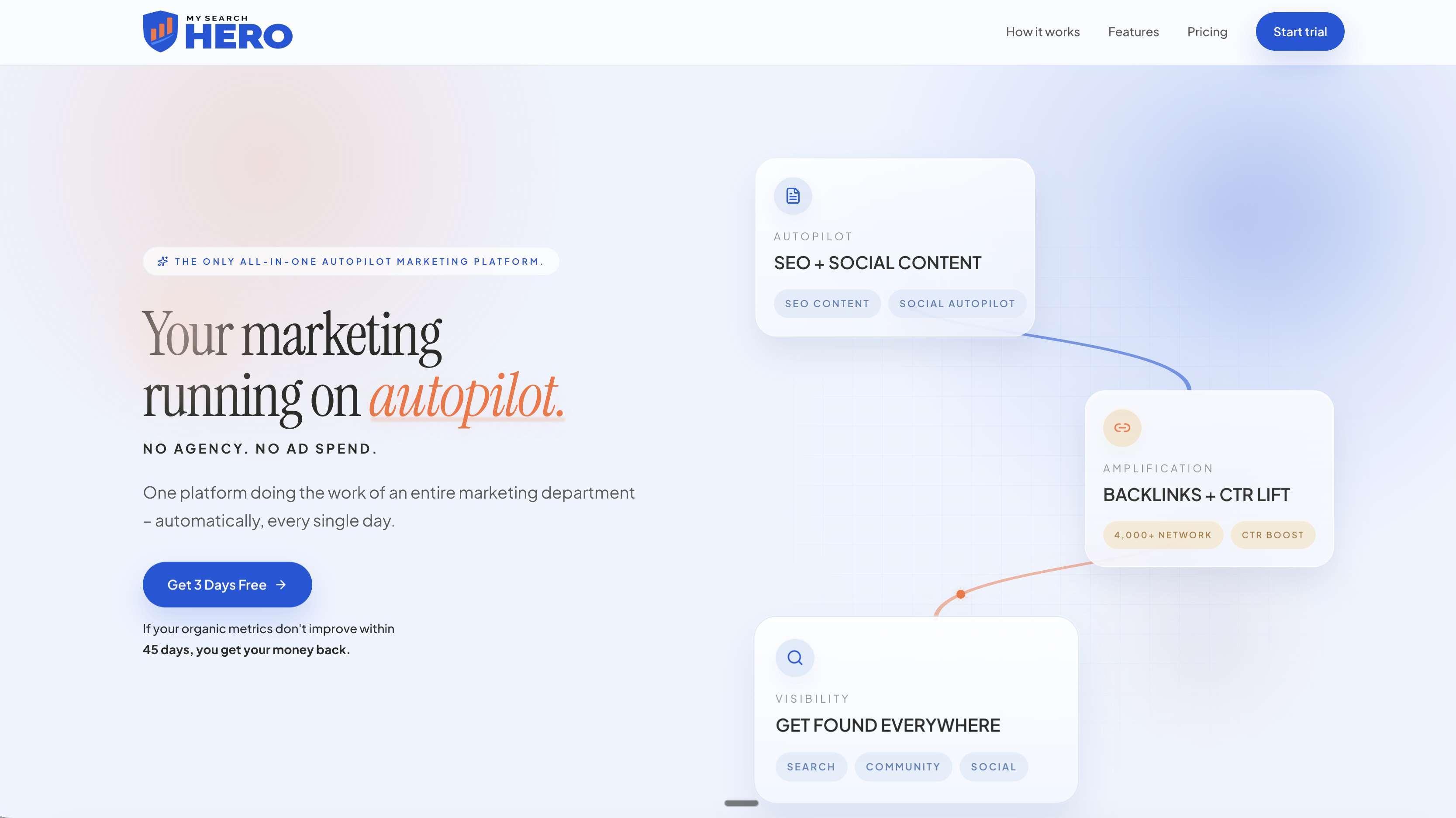
Plans as published on our site in 2026: Spark at $197 per month, Authority at $297 per month and Hero at $397 per month, with annual billing at $1,970, $2,970 and $3,970 respectively. An Enterprise plan is listed at $2,997 per month. Hero combines SEO, backlink building, CTR boosting, Reddit presence and automated social posting in one plan. See the plans and start your trial.
Choosing your approach
Use this quick guide to decide how much human involvement your content needs:
| Content type | Suggested approach |
|---|---|
| Blog posts answering common questions | AI draft, owner adds examples and verifies facts |
| Service and location pages | AI draft, owner supplies prices, areas, credentials and photos |
| Social posts | AI-generated, spot-checked for tone |
| About page, team bios, case studies | Written or heavily shaped by you |
| Health, legal, financial or safety content | Reviewed by a qualified professional before publishing |
The more a page depends on trust and personal credibility, the more of you should be in it. The more it depends on consistency and volume, the more automation helps.
FAQ
Is AI content better than human content?
It depends on the measure. On structure, vocabulary and clarity, studies have rated AI output highly. On nuance, firsthand experience and local detail, people still lead. The strongest results come from combining them, with AI drafting and a person adding what only they know.
Can AI replace a human content writer?
For first drafts, outlines and repetitive formats, AI can do most of the work. For firsthand experience, verification and brand voice, you still need a person involved, even if that person is simply the owner doing a final review. Editorial guidance consistently recommends human review as the last step.
Does Google penalize AI-generated content?
Not for using AI as such. Google says that using automation primarily to manipulate search rankings violates its spam policies, and it recommends helpful, people-first content. Publish pages that genuinely help customers and you are aligned with that guidance.
How do you tell AI writing from human writing?
Look for long, formal, evenly paced sentences with few concrete references to people, times and places. Research has found that human writing tends to be shorter, more informal and richer in analogies. These are tendencies only, and edited AI text can easily lose them.
Sources
- A large-scale comparison of human-written versus ChatGPT-generated essays (Scientific Reports)
- Comparison of an AI-Generated Case Report With a Human-Written Case Report (PMC)
- Human or GenAI? Characterizing the Linguistic Differences (ACM Web Science Conference)
- A linguistic comparison between human- and AI-generated texts (PMC)
- The Effects of Assumed AI vs. Human Authorship (MDPI)
- Suspected AI Content Halves Reader Trust and Hurts Ad Performance (Raptive study coverage)
- Creating Helpful, Reliable, People-First Content (Google Search Central)
- Generative AI Prohibited Use Policy (Google)
- How Does AI-Generated Content Perform in Search and Answer Engines? (Graphite)
- Copyright and Artificial Intelligence, Part 2: Copyrightability (U.S. Copyright Office)
- Writing With AI: Everything You Need to Know (Articulate)
- How to balance speed and credibility in AI-assisted content (Search Engine Land)