
TL;DR:
- An automated content creation platform offers small local service businesses a hands-free way to generate SEO articles, backlinks, and social content effortlessly. It prioritizes direct site publishing, local intent keywords, and verified backlinks to improve search visibility within months. This approach delivers consistent results at a low monthly cost, ideal for businesses with limited internal marketing resources.
An automated content creation platform is the right call for most small and local service businesses that lack a dedicated marketing person. If you’re running a plumbing company, a dental practice, a landscaping crew, or any other local service operation, the math is simple: you don’t have time to write multiple SEO articles monthly, build backlinks, and post consistently on social media. An automated subscription service handles all of that while you run your business.
This fits you if:
- You or a single employee handles all marketing alongside other duties
- You need predictable, monthly SEO output without managing freelancers
- You want organic traffic to grow without paying agency retainer rates
- You’re willing to spend 15–45 minutes on onboarding and then let the system run
Expect the first concrete signals — keyword movement, local pack visibility, early organic clicks — within a few months of consistent monthly publishing.
Table of Contents
- What does “content creation platform” actually mean for a local service business?
- What features should you actually evaluate in a content platform?
- How do you choose the right platform or service?
- What should a strong automated monthly package include?
- Why quality beats quantity for local service content
- What does success look like, and how do you validate a vendor?
- Is an automated content platform right for your business?
- Key Takeaways
- The thing most owners get wrong about switching to automation
- Mysearchhero handles the entire content pipeline for you
- Useful sources and further reading
- FAQ
What does “content creation platform” actually mean for a local service business?
The term covers three very different delivery models, and mixing them up is how owners waste money.
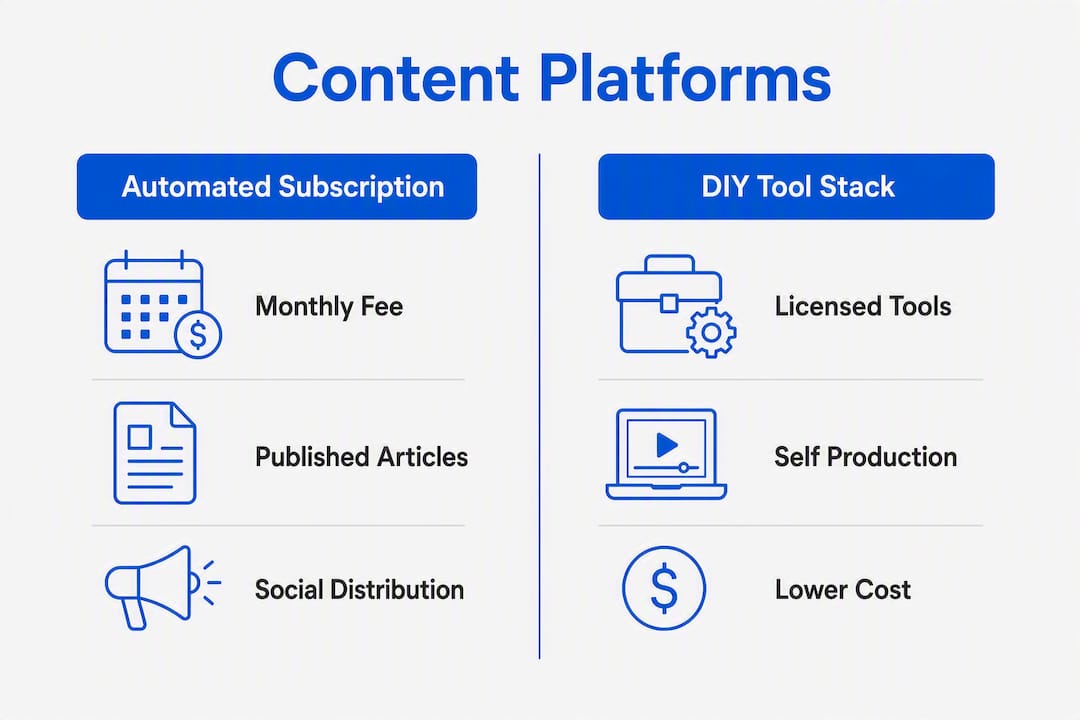
Automated subscription service: You pay a monthly fee and receive a bundle of published articles, backlinks, and social posts on a fixed schedule. Content goes live on your site without you writing a word. This is content as infrastructure, not a personal task.
DIY tool stack: You license tools like Semrush, Jasper, or Canva and produce content yourself. Lower monthly cost, but the time burden lands entirely on you. Most local service owners fail at content marketing not because they lack ideas, but because the recurring execution falls apart the moment business picks up.
Traditional agency: A team handles strategy, writing, and distribution. High quality ceiling, but typically priced for mid-market budgets and slower to execute.
For a local service business without internal marketing capacity, the automated subscription model treats content the same way you treat your phone bill: it runs every month whether you think about it or not.
What features should you actually evaluate in a content platform?
Not every feature matters equally for a local service business. Here’s what to prioritize:
- SEO-first article creation: Keyword research tied to local intent and real customer questions. Intent-driven keyword tactics consistently outperform broad, high-volume terms for local lead generation.
- Direct publishing to your site: CMS integration (WordPress, Squarespace, Wix) so content goes live without you copying and pasting. Canonical handling matters for duplicate content protection.
- Backlink and publisher network delivery: Authority backlinks from a real publisher network, with sourcing you can verify. Ask for sample reports before you commit.
- Distribution automation: AI-generated social posts, repurposed content snippets for local community threads, and CTR signal boosting.
- Reporting: Monthly traffic movement, keyword ranking changes, and local pack presence. A dashboard or regular report you can actually read in five minutes.
- Integrations: Google Business Profile workflow, CRM or appointment system compatibility, and Google Analytics passthrough.
- Voice customization: Brand voice capture during onboarding, editable drafts, and content briefs you can adjust.
Pro Tip: Prioritize platforms that publish directly to your site and hand you editable assets. Vendor lock-in — where your content lives only inside a third-party platform — is a structural risk for a small business.
How do you choose the right platform or service?
The right platform matches your primary bottleneck, not a feature checklist. Use this process:
Questions to ask during a demo or onboarding call:
- How do you capture my brand voice and service area before writing starts?
- Do you publish directly to my site, or do I receive drafts to upload?
- Where do backlinks come from, and can I see sample placements?
- What’s the revision process if a piece doesn’t match my voice?
- How often do I receive a performance report, and what does it include?
Red flags that should stop the deal:
- No direct publishing capability — you’ll be doing manual uploads forever
- Vague backlink sourcing (“high-authority sites”) with no examples
- No documented results from similar local service businesses
- Unclear SLAs on delivery dates and revision turnaround
Validate claims quickly: Request two or three published articles on similar business sites. Ask for a keyword movement report from an existing client. If a vendor can’t produce either within 24 hours, that’s your answer.

What should a strong automated monthly package include?
A realistic package for a local service business at the entry tier looks like this:
| Deliverable | Monthly Target |
|---|---|
| SEO articles published to your site | 2–4 posts |
| Authority backlinks | 2–5 from publisher network |
| Reddit brand mentions | 2–4 in relevant threads |
| AI-generated social posts | 8–12 |
| CTR signal boosting | Included |
| Performance report | Monthly |
Timeline to expect:
- Month 1: Onboarding call (brand voice, services, target geography), site integration, first articles drafted and published.
- Months 2–3: Content ramp with consistent publishing cadence; initial indexing and early keyword movement.
- Months 3–6: Measurable organic traffic lift, local pack visibility improvements, and engagement signals (click-throughs, form submissions).
Pricing for entry-level automated packages typically starts under $300/month for a basic content bundle, scaling higher for full-service tiers that include backlinks, social distribution, and reporting. A short onboarding call that captures brand voice and customer questions reduces revision cycles and speeds time-to-publish significantly.
Why quality beats quantity for local service content
Two to four well-researched, locally targeted articles per month outperform ten thin posts every time. The reason is simple: Google rewards content that answers specific questions from real customers in a specific geography. A post titled “How much does HVAC repair cost in Austin?” will outrank a generic “HVAC tips” post almost every time.
Pair that with weekly lightweight social updates repurposed from each article, and you multiply reach without multiplying workload:
- Pull two or three key sentences from each article as standalone social posts
- Convert the article’s FAQ section into a Google Business Profile Q&A update
- Stage a short email draft from the article’s introduction for your subscriber list
The evidence is clear: Integrated editorial and SEO workflows produce more reliable ranking improvements than SEO handled as an afterthought. Teams that build SEO into the writing process, rather than bolting it on after drafting, reach page one more consistently.
What does success look like, and how do you validate a vendor?
Concrete trust signals to request before signing:
- Published articles on current client sites in your industry vertical
- A sample backlink report showing domain authority and placement URLs
- Before/after organic traffic screenshots from a comparable local business
- A measurable KPI history: keyword positions at month 1 vs. month 6
Ongoing measurement checklist:
- Monthly organic traffic (Google Search Console)
- Local pack presence for your primary service keywords
- Keyword position movement for 5–10 target terms
- Lead form submissions or calls attributed to organic search
Practitioners recommend measuring early success by engagement signals — click-through rate, local pack presence, and lead form submissions — rather than raw keyword rank in months 1–3.
Is an automated content platform right for your business?
Three quick questions:
- Do you have internal bandwidth to write and publish 2–4 SEO articles monthly? If no, automated wins.
- Do you need heavily customized creative or regulated content (legal, medical, financial)? If yes, consider a specialist agency or hybrid model.
- Is your monthly marketing budget under $1,000? If yes, automated subscription services offer the best deliverable-to-dollar ratio.
Who should not buy automated services:
- Businesses requiring subject matter expert review on every piece (certain healthcare, legal, or financial niches)
- Brands with complex visual identity requirements needing custom creative production
- Businesses that want full editorial control over every word before anything publishes
Next steps if you’re ready:
- List your top 5–10 service keywords with your city or region attached
- Request sample articles from two or three vendors
- Confirm direct publishing capability and backlink sourcing before committing
- Start a trial month and measure keyword movement at day 30 and day 60
Key Takeaways
Automated content platforms deliver the best ROI for local service businesses that lack internal marketing capacity and need consistent monthly SEO output.
| Point | Details |
|---|---|
| Automation beats DIY for most owners | Without dedicated marketing staff, a subscription service maintains cadence when business gets busy. |
| Direct publishing is non-negotiable | Confirm the platform publishes to your site; manual uploads negate the time-saving benefit. |
| Quality over volume | Two to four locally targeted articles monthly outperform high-volume thin content for local SEO. |
| Measure engagement first | Track click-through rate, local pack presence, and lead submissions before chasing raw keyword rank. |
| Mysearchhero delivers the full package | Monthly SEO articles, authority backlinks, Reddit mentions, and social posts published automatically to your site. |
The thing most owners get wrong about switching to automation
The friction isn’t the technology. It’s the assumption that content still needs to feel like a personal project.
Most local service owners I’ve seen struggle with automated platforms spend the first month trying to rewrite every article themselves, which defeats the entire point. The operational shift that actually works is treating published content the same way you treat your accounting software: set it up correctly at the start, review the outputs quarterly, and let it run.
The onboarding call is where this either clicks or doesn’t. A good automated service asks the right questions upfront — your service area, your best customers, the questions you answer on every sales call. When that information feeds the content engine, revision cycles drop and the articles sound like you wrote them. When it doesn’t, you end up with generic posts that could belong to any business in your category.
That single operational change, treating onboarding as a real investment of 30–45 minutes rather than a formality, is what separates owners who get results from those who cancel after month two.
Mysearchhero handles the entire content pipeline for you
Most local service businesses don’t need a bigger marketing budget. They need one that actually runs without constant attention.
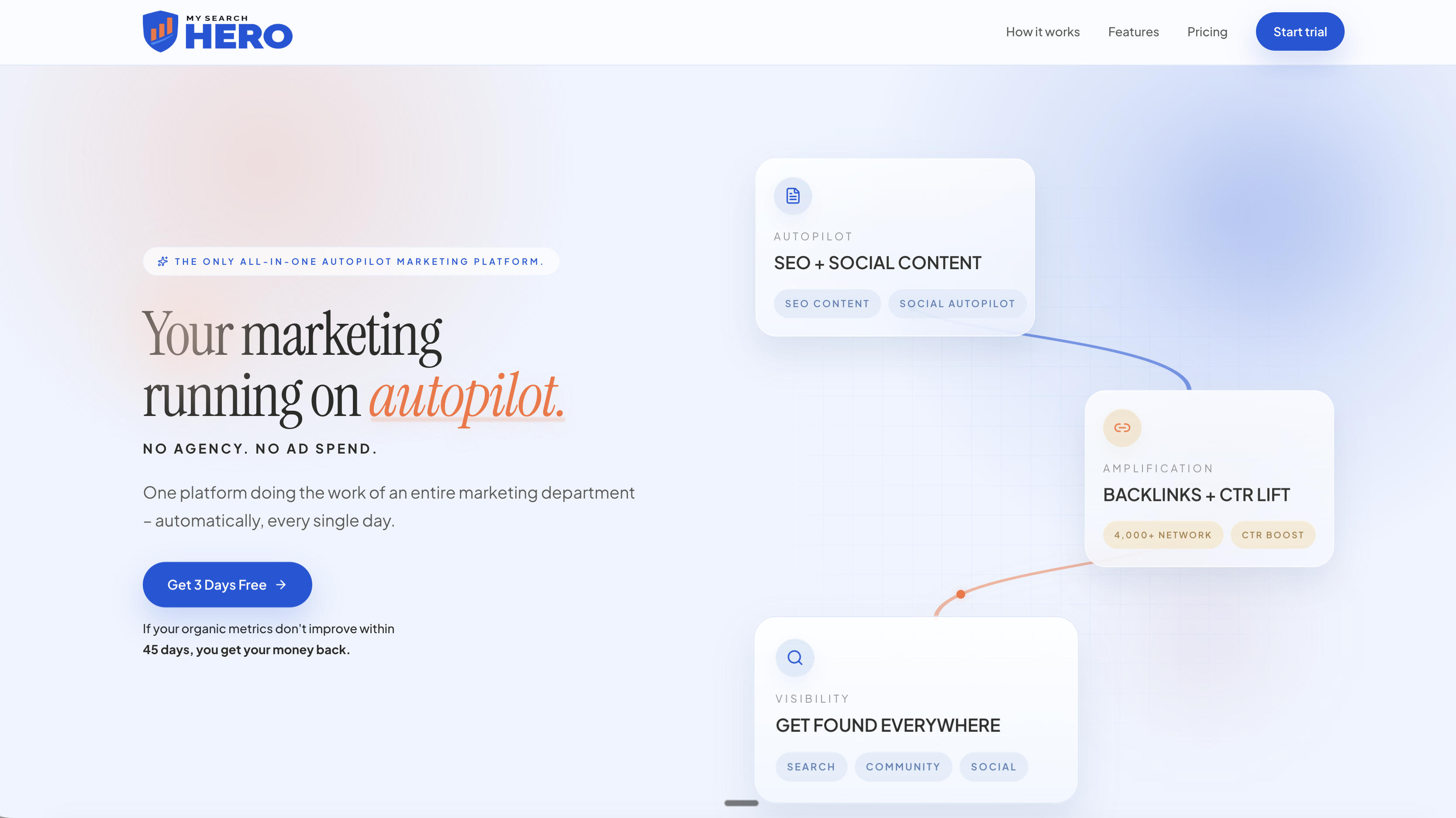
Mysearchhero is the done-for-you alternative to hiring an agency or managing a DIY tool stack. Every month, your subscription delivers SEO articles published directly to your site, authority backlinks from a real publisher network, Reddit brand mentions in relevant conversations, and AI-generated social posts across your platforms. The onboarding is a 30–45 minute voice capture call. After that, the pipeline runs on autopilot.
The deliverables map directly to the checklist in this guide: direct publishing, verified backlink sourcing, social distribution, and a monthly performance report. No long-term contracts, no account manager handoffs, no waiting six weeks for your first piece of content.
Start your free trial at Mysearchhero and see your first month of deliverables before you commit to a paid plan.
Useful sources and further reading
- Content Marketing Platform Selection Guide — Softabase: Practical framework for matching platform features to business bottlenecks.
- Why Small Service Businesses Fail at Content Marketing — DEV Community: Practitioner breakdown of the structural failure mode and the automation fix.
- How to Choose the Right Content Marketing Platform — AdTech & MarTech: Selection criteria and measurement guidance for small business buyers.
- Intent-Driven Keyword Tactics for Local Businesses — Southwind Marketing: Evidence on why local-intent keywords outperform broad terms for service businesses.
- Digital marketing examples for SMBs: Real-world examples of content and platform results for small service businesses.
- Content marketing workflow for small business success: Workflow templates to operationalize the cadence and sample package advice in this guide.
For Mysearchhero proof points, published client examples, and current plan pricing, visit mysearchhero.com.
FAQ
What is the best content creation platform for small service businesses?
For local service businesses without internal marketing staff, a done-for-you automated service like Mysearchhero delivers the most consistent results. It publishes SEO articles, builds backlinks, and distributes social content monthly without requiring owner time beyond initial onboarding.
How long does it take to see SEO results from content marketing?
Most local service businesses see initial keyword movement and local pack signals within 3–6 months of consistent monthly publishing. Engagement metrics like click-through rate and lead form submissions are the most reliable early indicators.
How many articles should a local service business publish per month?
Two to four locally targeted SEO articles per month is the recommended cadence. Quality and local intent matter far more than volume; a well-researched post targeting a specific service and city consistently outperforms multiple thin, generic posts.
What red flags should I watch for when evaluating a content platform?
No direct publishing to your site, vague backlink sourcing with no verifiable examples, and no documented results from comparable local businesses are the three clearest signs to walk away.
Which content creation platforms work for businesses on a tight budget?
Automated subscription services are the most affordable option for consistent SEO output, with entry-level plans typically starting under $300/month. That covers published articles, backlinks, and social distribution at a cost well below traditional agency rates.