
TL;DR:
- Brand awareness influences whether a customer considers your brand during purchase decisions. Improving recognition, recall, and search volume builds trust and reduces marketing costs over time. Consistent exposure through content, local SEO, and community presence fosters lasting brand recognition.
Brand awareness is the degree to which people recognize and recall your brand — and it determines whether your product even enters a customer’s consideration set. Without it, you don’t lose deals. You never get invited to compete for them.
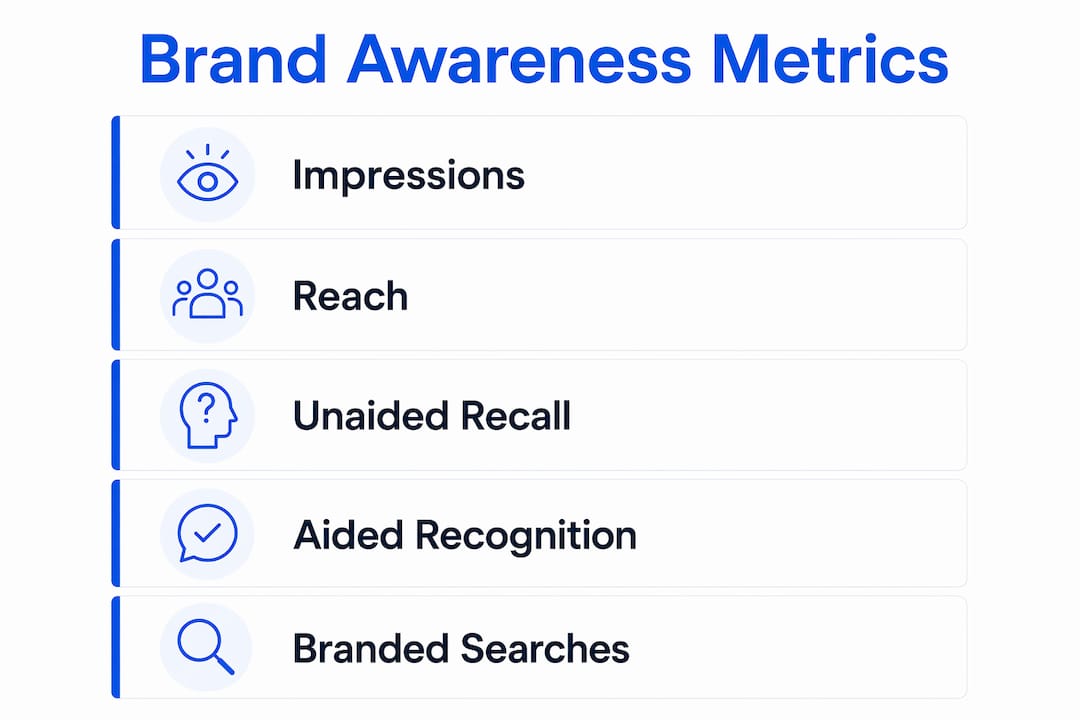
The three metrics that matter most:
- Unaided recall: Can people name your brand without being prompted?
- Aided recognition: Do they recognize your name or logo when shown it?
- Branded search volume: How often do people search your brand name directly in Google?
Three quick reasons to invest in awareness:
- It puts your brand in the running when buyers start comparing options
- It reduces paid acquisition costs over time as organic recognition grows
- It builds the kind of trust that shortens sales cycles
Table of Contents
- Why does brand awareness matter for marketing outcomes?
- How does brand awareness work in the customer journey?
- What are the types and stages of brand awareness?
- How do you measure brand awareness effectively?
- What are the proven strategies to build brand awareness?
- How do you set realistic goals, timelines, and budgets?
- What do brand awareness campaigns look like in practice?
- What mistakes should you avoid with brand awareness?
- How content and SEO build brand awareness over time
- Key Takeaways
- Why consistency beats virality for most brands
- Mysearchhero puts your brand awareness on autopilot
- Useful sources and further reading
- FAQ
Why does brand awareness matter for marketing outcomes?
A buyer who has never heard of you cannot choose you. That sounds obvious, but the business implications run deeper than most marketers realize. Brand awareness creates an economic moat: once your name is familiar, you benefit from lower friction at every stage of the funnel, from the first ad impression to the final purchase decision.
The consideration set is the short mental list a buyer assembles before making a purchase. Research consistently shows that brands outside that list rarely win the sale, regardless of price or quality. Getting onto that list requires repeated, consistent exposure long before the buyer is ready to act.
Brand awareness is often the “fuzziest” growth channel, but it can be made measurable with the right combination of surveys, brand-lift tests, branded search volume, and new-to-brand website metrics.
For a national brand, the math is straightforward: higher awareness across a large audience translates directly to more consideration events and, eventually, more revenue. For a local service business, say a plumbing company in a mid-sized city, the same principle applies at a smaller scale. When a pipe bursts at 11 PM, the homeowner calls the name they already know. That recall is worth more than any last-minute ad.
Awareness also compounds. A brand that earns consistent impressions over 12 months typically sees its paid media perform better because audiences already recognize the creative. Familiarity reduces skepticism, which lifts click-through rates and conversion rates without increasing spend.
How does brand awareness work in the customer journey?
Every purchase starts with exposure. A person sees your logo on a sponsored post, hears your name mentioned in a podcast, or finds your article in a Google search. That single exposure rarely converts anyone. What it does is plant a memory trace.

Repeated exposure strengthens that trace until it becomes recognition: the person sees your name and knows they’ve encountered it before. With enough reinforcement, recognition becomes recall: they can retrieve your brand name without any prompt. Recall is the goal, because recalled brands get considered and recognized brands often don’t.
Here’s how the two concepts differ in practice:
- Recognition (aided): “Have you heard of [Brand X]?” — measures market-level familiarity; useful for tracking campaign reach
- Recall (unaided): “Name a brand that offers [category]” — measures top-of-mind strength; predicts purchase likelihood more reliably
The funnel maps neatly onto this sequence. Awareness KPIs like impressions and reach live at the top. Recognition metrics sit in the middle, where consideration happens. Unaided recall and branded search volume signal that a prospect is close to a purchase decision. Measuring only impressions and calling it “awareness” misses two-thirds of the picture.
What are the types and stages of brand awareness?
Marketers typically track four types of awareness, each representing a different depth of consumer memory.
- Unaided recall: The consumer names your brand without any cue. This is the strongest form of awareness and the hardest to earn.
- Aided recognition: The consumer confirms familiarity when shown your name or logo. Easier to achieve, but a weaker purchase predictor.
- Top-of-mind awareness: Your brand is the first name a consumer mentions in a category. This is the gold standard for mature brands.
- Brand preference: The consumer not only knows your brand but actively prefers it over alternatives.
The progression from unaware to loyal follows a four-stage model most measurement programs track:
- Unaware: The consumer has no knowledge of your brand.
- Aware: They recognize the name but have no strong association.
- Familiar: They associate your brand with a category or specific benefit.
- Loyal/Top-of-mind: Your brand is their default choice.
Survey question examples you can adapt:
Unaided recall: “When you think of [category, e.g., home security services], which brands come to mind first?”
Aided recognition: “Which of the following brands have you heard of? [List including your brand and competitors]”
These two question formats measure fundamentally different things. Run both in your baseline survey so you have a complete picture before you spend a dollar on campaigns.
How do you measure brand awareness effectively?
Brand awareness measurement works best as a combination of methods rather than a single metric. Each approach captures a different signal.
| Method | What it measures | Best for | Limitation |
|---|---|---|---|
| Brand surveys (aided/unaided) | Recognition and recall directly | Baseline and trend tracking | Requires panel or sample; takes time |
| Brand lift studies | Shift in awareness caused by a campaign | Paid media evaluation | Needs sufficient ad spend to run |
| Branded search volume | How often people search your brand name | Ongoing organic demand tracking | Lags behind campaigns by weeks |
| Impressions and reach | How many people saw your content | Top-of-funnel volume | Doesn’t confirm memory formation |
| Social listening / share of voice | Brand mentions vs. competitors | Competitive benchmarking | Noisy; requires filtering |
| New-to-brand website sessions | First-time visitors from organic/direct | Awareness-to-interest conversion | Depends on GA4 or similar setup |
Measurement checklist:
- Set a baseline survey before any major campaign launches
- Track branded search volume monthly in Google Search Console
- Monitor new-to-brand sessions in Google Analytics 4 (GA4) under “new users” by source
- Run a brand lift study if you’re spending meaningfully on paid reach
- Use a social listening tool (Brandwatch, Mention, or Sprout Social) to track share of voice quarterly
- Re-survey your audience at 90 days to measure recall and recognition shifts
Pro Tip: Set up a branded keyword segment in Google Search Console from day one. It costs nothing and gives you a clean, continuous signal of awareness growth that no survey can match for frequency.
The analytics approach you choose should match your budget. A solo marketer at a local business can start with Google Search Console and a free SurveyMonkey poll. A mid-market team should add a social listening platform and quarterly brand lift tests.
What are the proven strategies to build brand awareness?
Tactics fall into two buckets: organic (slower to start, compounds over time) and paid (faster reach, stops when you stop paying). The most durable awareness programs layer both, starting with organic foundations.
Brand identity and creative consistency
Before any campaign, your visual identity needs to be consistent across every touchpoint: logo, color palette, typography, and tone of voice. Inconsistent creative forces audiences to re-learn your brand with every exposure, which wastes impressions. Digital branding examples show that even small businesses can build strong recognition with a tight, repeatable visual system.
Content and SEO
Publishing articles that rank for category-level search terms puts your brand in front of people who are actively researching your space. Over time, this creates a library of branded touchpoints that work around the clock. Content drives brand growth precisely because it generates repeated impressions without repeated ad spend.

Social media
Consistency matters more than reach here. Showing up three times a week on the platforms your audience actually uses builds recall through repetition. For local service businesses, Facebook and Nextdoor often outperform Instagram or TikTok simply because that’s where the local community lives.
Paid reach campaigns
Reach-focused ads on Meta, YouTube, or connected TV prioritize impressions over clicks. These are awareness tools, not conversion tools. Run them with frequency caps (3–5 exposures per person) to build memory without causing fatigue.
PR, partnerships, and earned media
A mention in a local news outlet or a guest spot on an industry podcast delivers credibility that paid ads can’t replicate. Small-business PR tactics that focus on earned media tend to produce longer-lasting awareness lifts than equivalent paid placements.
Community sponsorships and events
For local service businesses, sponsoring a youth sports team or a neighborhood event creates emotional associations that digital ads rarely achieve. These investments are especially powerful because they reach people in a trusted, low-distraction context.
Referral programs
Word-of-mouth is the oldest awareness channel and still one of the most effective. A structured referral program turns satisfied customers into brand ambassadors, extending your reach into networks you’d never reach with paid media.
Pro Tip: Repeated low-cost impressions almost always outperform a single viral attempt. A brand that shows up consistently for 52 weeks builds stronger recall than one that spends the same budget on one campaign and goes dark for the rest of the year. Frequency and consistency are the actual drivers of memory formation.
For a layered organic-first approach, small and local businesses should start with content and local SEO, then add paid amplification once the organic foundation is in place. This sequence produces more durable awareness at a lower long-term cost.
How do you set realistic goals, timelines, and budgets?
Awareness goals need to be specific enough to measure. “Increase brand awareness” is not a goal. “Grow unaided recall from 8% to 15% among homeowners in our metro area within 12 months” is.
Tie every goal to a specific KPI: branded search growth, unaided recall lift, reach and impressions, or new-to-brand sessions. Then build a timeline that reflects how awareness actually accumulates.
| Timeframe | Typical milestone | What to measure |
|---|---|---|
| 30 days | Baseline established; first content and social assets live | Branded search volume baseline; new-to-brand sessions |
| 60 days | First impressions data available; social cadence running | Reach and impressions; social follower growth |
| 90 days | First survey re-run; early recall shifts visible | Aided recognition change; branded search trend |
Budget guidance:
- Small/local business (under $2,000/month): Prioritize content, local SEO, and organic social. Add $300–$500/month in local paid reach once organic is running.
- Mid-market ($5,000–$15,000/month): Add brand lift studies, social listening tools, and a broader paid reach strategy across two or three channels.
Goal-setting checklist:
- Define the specific KPI and the baseline value
- Set a realistic target lift (10–20% improvement in 90 days is achievable for most small businesses)
- Assign a measurement method and frequency for each KPI
- Schedule a 90-day review to assess progress and adjust spend
What do brand awareness campaigns look like in practice?
National brand: search demand through creative consistency
A national home-services brand runs a 12-week reach campaign on YouTube and connected TV, pairing consistent visual identity with a single memorable tagline. The campaign targets homeowners aged 30–55 across 20 metro markets. At the 90-day mark, branded search volume climbs measurably, new-to-brand website sessions increase, and aided recognition scores rise in post-campaign surveys. The key driver isn’t the budget. It’s the consistency of the creative across every placement.
Local service business: community presence plus local SEO
A residential HVAC company in a mid-sized city sponsors a local 5K run, places a banner at a youth baseball field, and publishes two blog posts per month targeting local search terms like “AC repair [city name].” After 90 days, the owner notices more calls where prospects say “I’ve seen your name around.” Branded search queries for the company name increase. New-to-brand organic sessions grow. Local tactics like these produce awareness that compounds because the brand becomes part of the community’s mental landscape, not just an ad in a feed.
The contrast between these two examples is instructive. The national brand wins through scale and repetition. The local business wins through presence and trust. Both rely on the same underlying mechanism: repeated exposure that builds memory.
What mistakes should you avoid with brand awareness?
Most awareness programs fail not because the tactics are wrong, but because the measurement is.
Common mistakes:
- Treating awareness like direct response. Awareness campaigns are not supposed to generate immediate clicks or conversions. Judging them by cost-per-click or ROAS will always make them look like failures.
- Relying only on impressions. Impressions tell you how many times your ad was served, not how many people actually formed a memory. Pair impressions with recall surveys and branded search data.
- Ignoring creative fatigue. Running the same creative for more than 8–10 weeks typically causes recall to plateau or decline. Refresh visuals and messaging on a regular cycle.
- Skipping the baseline. Without a pre-campaign measurement, you can’t prove that anything changed. Always survey before you spend.
- Measuring too early. Awareness shifts take time. Checking recall at two weeks and concluding “it’s not working” is a measurement error, not a campaign failure.
Red flags to watch for:
- Impressions climbing but branded search flat: your creative may not be memorable enough
- High reach but low new-to-brand sessions: your audience targeting may be off
- Survey scores unchanged after 90 days: frequency may be too low to form memories
The fix for most of these is the same: add a recall survey, check branded search trends, and give campaigns enough time and frequency to work.
How content and SEO build brand awareness over time
Every article your business publishes is a potential brand impression. When someone searches “how to choose an HVAC contractor” and finds your post at the top of Google, they encounter your brand in a high-trust context. They may not call you that day, but your name is now in their memory. Do that across 50 topics and you’ve built a recall engine that runs without ongoing ad spend.
The mechanism works in three steps: content earns organic search visibility, visibility generates branded mentions across the web, and those mentions feed back into search demand as more people search your brand name directly. Over 12–18 months, this cycle produces measurable branded search growth that no paid campaign can replicate at the same cost.
A starter plan for integrating content and SEO into awareness:
- Audit your current branded search volume in Google Search Console (this is your baseline).
- Identify 10–15 category-level search terms your ideal customers use before they’re ready to buy.
- Publish one well-researched article per week targeting those terms, with consistent brand voice and visuals.
- Distribute each article on two or three social channels to multiply impressions.
- Track branded search volume and new-to-brand sessions monthly. Expect meaningful movement at the 90-day mark.
The brands that win on search aren’t always the biggest. They’re the ones that show up consistently, answer real questions, and make their name familiar before the buyer is ready to decide.
Mysearchhero’s branding resources for small businesses walk through this process in detail, with practical examples sized for local and service-based businesses.
Key Takeaways
Brand awareness is built through consistent exposure across multiple channels, measured with a combination of surveys, branded search data, and reach metrics, and improved through a layered organic-first strategy.
| Point | Details |
|---|---|
| Start with a baseline | Survey aided recognition and unaided recall before any campaign launches. |
| Track branded search monthly | Google Search Console gives you a free, continuous signal of awareness growth. |
| Layer organic before paid | Content and local SEO build durable recall; paid reach amplifies what’s already working. |
| Give campaigns 90 days | Awareness shifts take time — measure recall at 30, 60, and 90 days, not at two weeks. |
| Mysearchhero automates the content layer | Monthly articles, backlinks, and social posts keep your brand visible without manual effort. |
Why consistency beats virality for most brands
The marketing world loves a viral moment. A single video that racks up millions of views feels like the ultimate awareness win. For most brands, especially local service businesses, it’s a distraction.
Virality is unpredictable, unrepeatable, and often disconnected from the audience that actually buys from you. A plumber whose video goes viral nationally doesn’t get more calls from homeowners in their city. What they need is to be the name that comes to mind when a pipe bursts at 11 PM within a 20-mile radius.
That kind of recall is built through repetition, not spectacle. Showing up in local search results every week, sponsoring the neighborhood 5K every spring, publishing a helpful article every month — these create the layered impressions that turn strangers into customers. The research on memory formation backs this up: recall improves with frequency and spacing, not intensity.
Small businesses that chase viral moments usually end up with inconsistent brand presence and no measurable awareness lift. The ones that commit to a consistent content and community cadence for 12 months almost always see branded search grow, new-to-brand traffic increase, and more inbound calls from people who say “I’ve heard of you.”
Pick your channels, show up on schedule, and measure what changes. That’s the whole strategy.
Mysearchhero puts your brand awareness on autopilot
Most small and local businesses know they need consistent content and a stronger online presence. The problem is finding the time to produce it every single month without it falling off the to-do list.
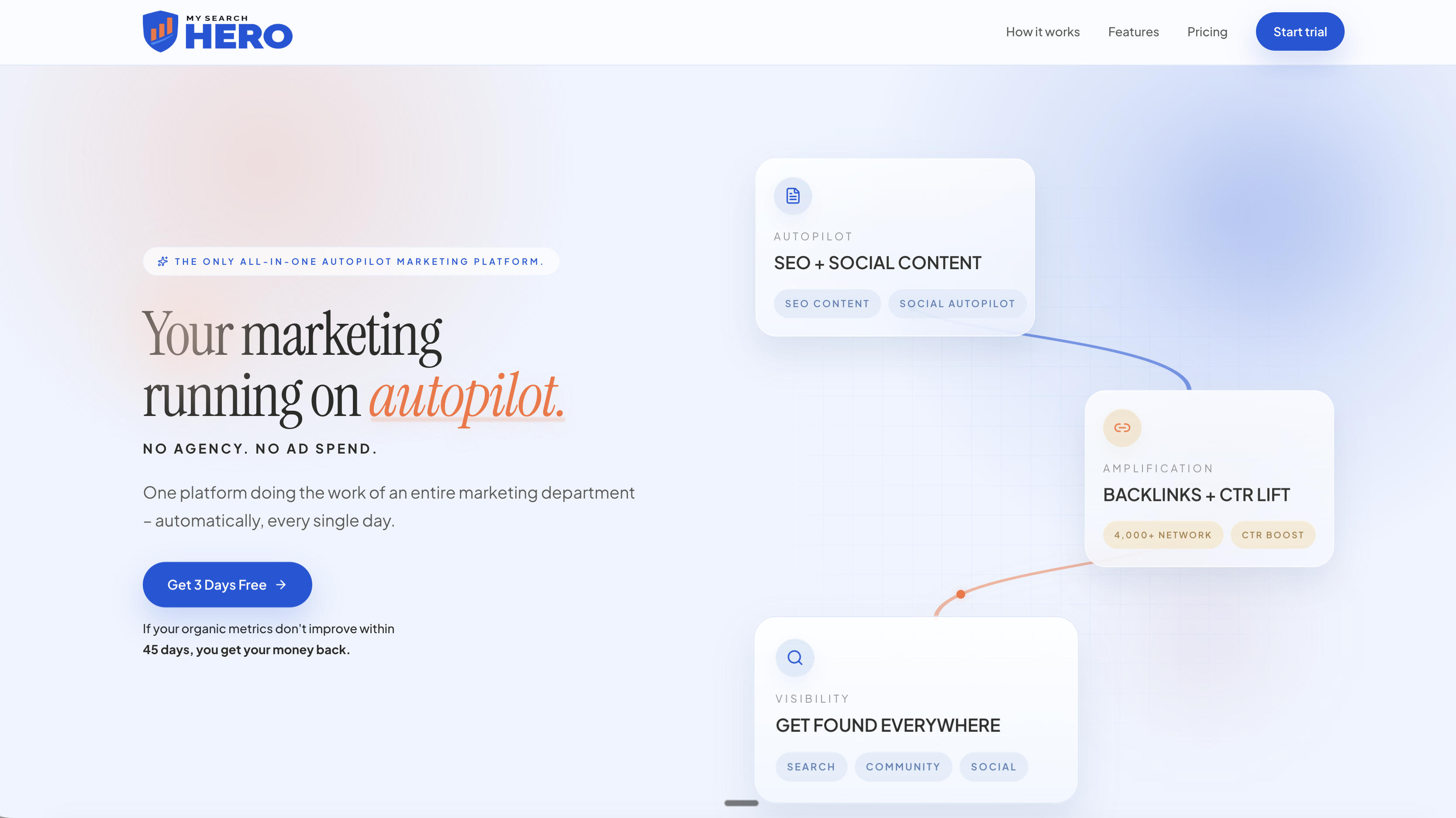
Mysearchhero delivers the content layer for you. Every month, subscribers receive published SEO articles on their website, authority backlinks through a publisher network, Reddit brand mentions in relevant conversations, and AI-generated social media posts across multiple platforms. The entire pipeline runs automatically, so your brand keeps showing up in search and social without you managing it manually.
What you get each month:
- SEO articles published directly to your site, targeting category-level search terms
- Authority backlinks that build domain credibility and organic reach
- Social posts distributed across platforms to multiply impressions
If you’re ready to build brand awareness without adding hours to your week, see how Mysearchhero works and start your free trial.
Useful sources and further reading
These are the primary sources used to build this article, plus recommended tools for implementing your own measurement program.
- Harvard Business School Online — Brand Awareness: Foundational definition and the role of awareness in the purchase process. Start here for concept clarity.
- Investopedia — Brand Awareness Explained: Covers the economic moat argument and long-term business value. Useful for making the ROI case internally.
- Ahrefs — How to Measure Brand Awareness: Practical guide to operationalizing awareness metrics. Use this when setting up your measurement stack.
- Qualtrics — What Is Brand Awareness?: Covers aided vs. unaided survey formats with question templates. Use it to build your baseline survey.
- Amazon Ads — What Is Brand Awareness and Why Is It Important?: Platform-level best practices for multi-channel awareness campaigns. Useful for paid reach planning.
- Smartsheet — Brand Awareness Campaign Examples: Templates and campaign examples adaptable for small budgets. Good starting point for campaign planning.
- Wikipedia — Brand Awareness: Covers the academic definitions of recall and recognition. Useful background for measurement design.
- Google Search Console: Free tool for tracking branded search volume over time. Set it up before any campaign launches.
- Brandwatch / Sprout Social: Social listening platforms for tracking share of voice and brand mentions. Start with a free trial to assess fit.
- SurveyMonkey: Accessible survey platform for running aided and unaided recall polls. Free tier works for small sample sizes.
FAQ
What do you mean by brand awareness?
Brand awareness is the extent to which consumers recognize, recall, or are familiar with a brand’s name, logo, or products. It determines whether a brand enters a buyer’s consideration set when a purchase decision arises.
What is an example of brand awareness?
A homeowner who searches “HVAC repair near me” and clicks the first result they recognize by name is demonstrating brand awareness. The HVAC company earned that recognition through repeated local impressions, whether from search results, community sponsorships, or social media.
What are the three types of brand awareness?
The three main types are unaided recall (naming a brand without prompting), aided recognition (confirming familiarity when shown a brand name), and top-of-mind awareness (being the first brand named in a category). Each measures a different depth of consumer memory.
What are the four stages of brand awareness?
The four stages are: unaware (no knowledge of the brand), aware (recognizes the name), familiar (associates the brand with a category or benefit), and loyal/top-of-mind (the brand is the consumer’s default choice). Most measurement programs track movement through these stages over time.
How long does it take to build measurable brand awareness?
Most businesses see early signals, such as branded search growth and aided recognition shifts, within 60–90 days of consistent activity. Meaningful unaided recall improvement typically takes many months of sustained effort across multiple channels.