
TL;DR:
- Building brand authority relies on consistent signals across digital channels, such as Google Business Profile, reviews, content, and earned media. This systematic approach fosters trust, increases branded search volume, and helps local businesses dominate their markets.
Brand authority is the degree to which customers and search engines trust your business over every competitor in your market. For local business owners, it is concrete and measurable. Branded search volume tracks it directly: when people search your business name instead of a generic category term, that signals rising trust. This build brand authority guide covers five proven strategies, from Google Business Profile optimization to earned media, that turn scattered digital signals into a coordinated trust engine.

How to build brand authority: the complete guide
Brand authority is not a feeling. It is a pattern of consistent signals across every channel where your customers look for you. Brand authority correlates strongly with branded search volume, and you can track that progress inside Google Search Console month over month. The businesses that win local markets treat authority as a system, not a one-time project.
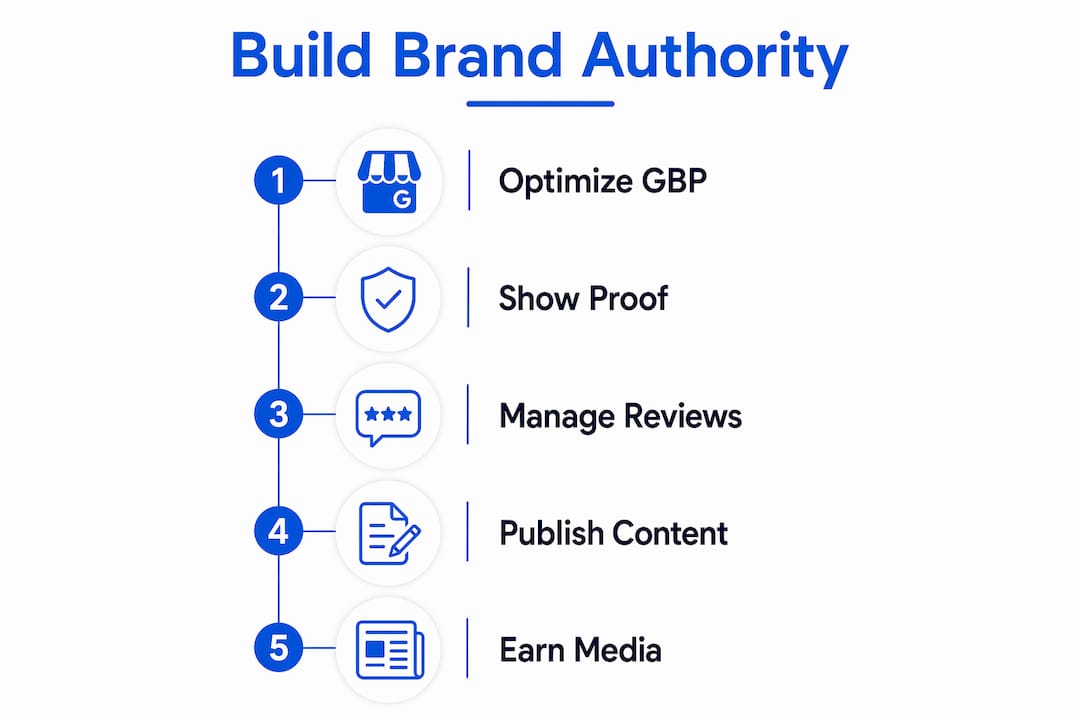
The five pillars of that system are: a fully optimized Google Business Profile (GBP), credible proof points like testimonials and certifications, authentic review management, consistent content across owned channels, and earned media coverage. Each pillar reinforces the others. Neglect one and the whole structure weakens.
How does Google Business Profile build brand authority?
Your GBP is the single highest-leverage asset for local brand authority. Filling all GBP fields and responding to reviews within 48 hours improves both local visibility and customer trust. Most local businesses leave critical fields blank, which hands authority to competitors who do not.
Write a description that works in 250 characters
The first 250 characters of your GBP description are what customers see before they click “more.” That preview text is where your authority signals must land. Lead with your primary service, your city or neighborhood, and one specific differentiator. The full 750-character description gives you room to expand, but the opening lines do the heavy lifting.
A plumber in Austin, for example, should open with: “Licensed Austin plumber serving residential and commercial clients since 2008. Same-day service, upfront pricing, and a 2-year labor warranty.” That sentence answers who, where, and why in under 150 characters.
Use photos, posts, and Q&A to stay active
Google rewards active profiles. Post updates at least twice a month, answer every question in the Q&A section before a stranger does, and upload new photos regularly. Photos humanize your brand in a way that text cannot. A before-and-after photo from a landscaping job or a team photo from a restaurant kitchen builds the kind of familiarity that drives calls.
Pro Tip: Seed your own Q&A section with the three questions customers ask most often. You control the answer, and it appears before any user submits a question.
| GBP Element | Best Practice |
|---|---|
| Business description | Lead with service, city, and differentiator in the first 250 characters |
| Photos | Upload new images monthly; include team, work, and location shots |
| Posts | Publish at least two updates per month with a clear call to action |
| Q&A | Seed common questions yourself; respond to all user questions within 24 hours |
| Review responses | Reply within 48 hours using personalized, conversational language |
What proof points actually establish brand credibility?
Customers build trust when they see transparent evidence of expertise, not just marketing claims. Credibility grows over time through proof points aligned to your service domain. The goal is to reduce information asymmetry: the gap between what you know about your business and what a stranger knows.
The most effective proof points for local businesses are:
- Video testimonials. A 60-second video from a real customer outperforms a five-star text review because it is harder to fake and easier to believe.
- Third-party certifications and badges. Industry certifications, Better Business Bureau accreditation, and trade association memberships signal that an outside authority has vetted you.
- Staff bios with credentials. A licensed contractor’s bio listing their certifications and years of experience reduces the risk a customer feels before hiring.
- Transparent pricing and process pages. Explaining exactly how you work and what things cost removes the fear of hidden surprises.
Pro Tip: Place your strongest proof point, whether a video testimonial or a certification badge, above the fold on your homepage. Most visitors decide within seconds whether to stay or leave.
Consistent product and service quality underpins all of this. No amount of credibility marketing survives a pattern of bad experiences. The proof points amplify a good reputation; they cannot manufacture one.
How should you manage reviews to increase brand trust?
Review management is an operational practice, not a marketing task. Google endorses review requests via direct links and QR codes, and the velocity of reviews should match your natural business flow. Asking every customer after a completed job or service is the right cadence.
Here is a repeatable process for review management:
- Ask at the right moment. Request a review immediately after a positive interaction, while the experience is fresh. A text message with a direct link works better than an email buried in an inbox.
- Respond within 48 hours. Personalized, conversational replies outperform templated responses every time. Mention the customer’s specific service or situation.
- Handle negative reviews publicly and calmly. Acknowledge the issue, apologize sincerely, and offer to resolve it offline. Never argue in the reply.
- Avoid copy-paste responses. Future buyers read your replies as much as they read the reviews themselves. Generic replies signal that you do not care.
- Coordinate across locations. If you run multiple locations, establish a consistent voice and escalation process so every location responds with the same standard.
Pro Tip: Treat every review response as a public message to your next customer, not just a reply to the reviewer. Write it with that audience in mind.
Review responses are public decision support tools. Specific, personalized replies increase profile credibility and give undecided buyers the confidence to choose you. You can learn more about getting more reviews and why they matter for local reputation.
How does consistent content shape your brand reputation?
Content is how you control your brand narrative before a customer ever contacts you. Consistent presence across directories, social media, and forums strengthens local brand authority and trust signals. Discrepancies in your name, address, or messaging dilute trust and confuse search engines.
Build a content habit around these practices:
- Align every post with your brand voice. A family-owned bakery and a commercial HVAC company need different tones. Define yours in writing and apply it everywhere.
- Use forums and community platforms. Answering questions on local Facebook groups, Nextdoor, or Reddit builds authority in your geographic community without spending a dollar.
- Tell founder and behind-the-scenes stories. People trust people. A short video of the owner explaining why they started the business creates connection that a product photo cannot.
- Seed questions on third-party platforms. Post a question on a relevant forum and answer it yourself with genuinely useful information. This shapes the narrative around your category.
A local marketing guide can help you map out which channels deserve your time based on your specific market and customer base. The key is consistency: showing up in the same places, with the same message, month after month.
Why does earned media coverage boost brand legitimacy?
Earned media is coverage you did not pay for, and it carries far more weight than advertising. Editorial coverage generates 3.2× more consumer trust than paid ads in the same publication. That gap exists because readers know the difference between an ad and a journalist’s endorsement.
“89% of consumers view brands as more legitimate after editorial features in Tier-1 publications. The credibility lift from a single well-placed article can outperform months of paid advertising in the same outlet.”
Baden Bower, The Credibility Effect (2026)
The practical steps to pursue earned media are straightforward:
- Identify local and trade publications that cover your industry or geography. A roofing company should target local news sites and home improvement trade outlets.
- Build a story angle, not a pitch. Journalists want a story their readers care about. “Local contractor donates services to veterans” is a story. “Local contractor is great at roofing” is not.
- Work with a publicist or PR partner if you lack the time or contacts. Small business PR tactics can help you identify the right approach for your budget and goals.
- Time your outreach to news cycles. Pitching a story about storm damage repair after a major weather event is far more likely to land than a cold pitch in a quiet news week.
Earned media compounds. One feature in a regional publication often leads to mentions in smaller outlets, which builds a citation trail that search engines and customers both notice. For e-commerce businesses expanding locally, brand authority that converts follows the same earned media principles.
Key takeaways
Brand authority for local businesses is built through coordinated, consistent action across Google Business Profile, credible proof points, review management, content, and earned media.
| Point | Details |
|---|---|
| GBP is your foundation | Complete every field, post regularly, and respond to reviews within 48 hours. |
| Proof points reduce buyer risk | Video testimonials, certifications, and transparent pricing close the trust gap faster than claims alone. |
| Review responses are public messages | Write every reply for the next customer reading it, not just the reviewer who left it. |
| Consistent content controls narrative | Align your message across every platform and show up in the same places every month. |
| Earned media multiplies trust | Editorial coverage delivers 3.2× more trust than paid ads and compounds over time. |
What I’ve learned about brand authority that most guides skip
Most local business owners treat brand authority as a marketing project with a start and end date. That is the wrong mental model. Brand authority is a flywheel. Each review response, each GBP post, each piece of content adds a small amount of momentum. The businesses I see dominate their local markets are not doing anything exotic. They are doing the basics consistently, every single week, without stopping.
The mistake I see most often is treating these channels as separate. A business will invest heavily in GBP optimization but ignore their review responses. Or they will collect great testimonials but never post them anywhere. The trust signals only work when they reinforce each other. A customer who finds you on Google, reads your reviews, visits your website, and sees consistent messaging across all three is far more likely to call than one who finds a gap anywhere in that chain.
One more thing: do not wait until you have a reputation problem to start managing your brand. The businesses that build authority proactively are the ones that weather bad reviews, slow seasons, and competitive pressure without losing ground. Start the flywheel now, and keep it spinning. Check out the local SEO checklist if you want a concrete starting point for tying these signals together.
— Mike
How Mysearchhero helps local businesses build brand authority
Building brand authority across GBP, reviews, content, and earned media takes time and coordination. Mysearchhero handles that work for you through a fully automated pipeline that publishes articles, builds backlinks, places brand mentions, and distributes social content every month.
Local business owners who want consistent growth without managing a dozen moving parts use Mysearchhero’s done-for-you service to keep their brand signals active and aligned. Every deliverable is designed to strengthen your authority in the channels that matter most for local visibility. If you are ready to build brand trust without adding to your workload, Mysearchhero is built for exactly that.
FAQ
What is brand authority for a local business?
Brand authority is the level of trust and recognition your business holds in your market. It is measured through signals like branded search volume, review quality, and consistent presence across digital channels.
How do I measure brand authority growth?
Track branded search queries in Google Search Console over time. Rising branded search volume signals that more people are looking for your business by name, which reflects growing trust and recognition.
How long does it take to build brand authority?
Brand authority builds gradually over months, not weeks. Consistent action across GBP, reviews, and content typically produces measurable results within three to six months of sustained effort.
Why are review responses important for brand trust?
Review responses are public messages that future customers read before deciding to contact you. Personalized, specific replies signal that you care about customer experience and increase profile credibility.
Does earned media really outperform paid advertising for trust?
Editorial coverage generates 3.2× more consumer trust than paid ads in the same publication, according to Baden Bower’s Credibility Effect study. That gap reflects the credibility readers assign to independent editorial judgment versus purchased placement.