
TL;DR:
- SEO forecasting predicts future organic search performance by connecting efforts to business outcomes using scenario-based models. It helps justify budgets, allocate resources, and manage risk by linking traffic projections to revenue and pipeline impact. Regular updates and accurate inputs ensure forecasts inform strategic decision-making effectively.
SEO forecasting is the strategic process of predicting future organic search performance through scenario-based models that connect SEO efforts directly to business outcomes. The role of SEO forecasting goes far beyond traffic projections. It transforms SEO from a historical reporting activity into a forward-looking growth model that business owners and marketing professionals can use to justify budgets, allocate resources, and manage risk. Credible forecasts use three scenarios: conservative, expected, and optimistic, each with documented assumptions that leadership can interrogate and trust. This discipline, sometimes called organic growth modeling in enterprise settings, is now a core input to marketing strategy planning in 2026.
What is the role of SEO forecasting in strategy?

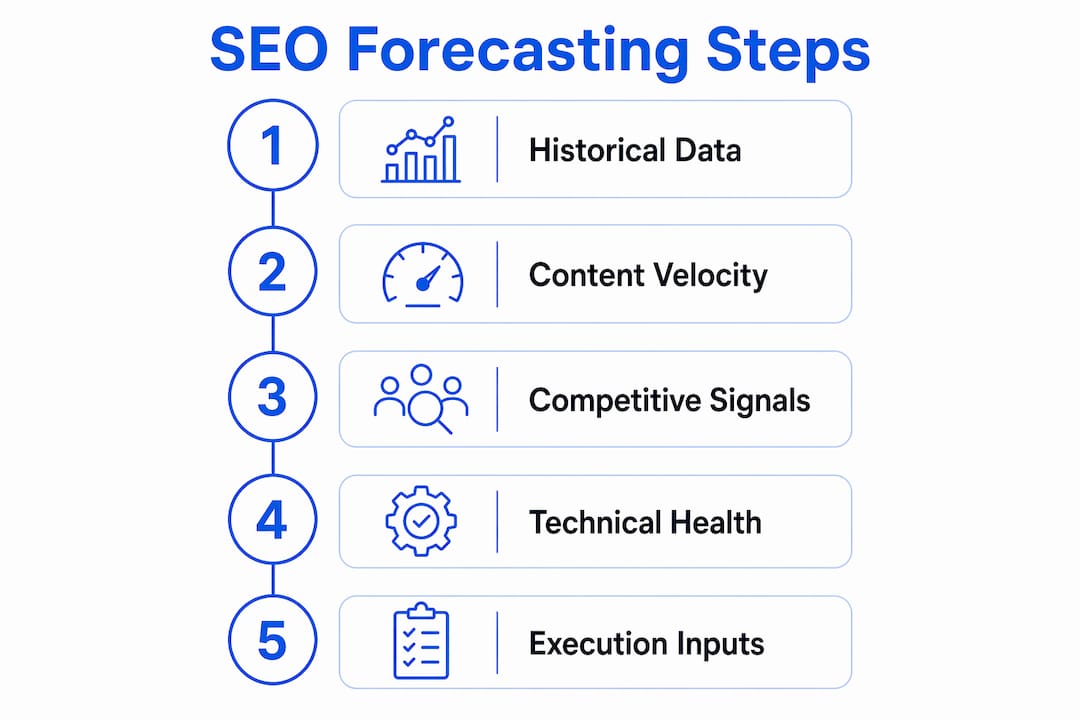
SEO forecasting is defined as the practice of using historical data, competitive signals, and execution inputs to project future organic search performance across multiple scenarios. The industry standard framework, as documented by SRNA SEO, requires explicit assumptions for each scenario rather than a single fixed number. Single-point forecasts fail because they offer no context for what conditions must hold true to achieve the result.
The strategic value becomes clear when forecasts connect to revenue. SEO forecasts that only project traffic without linking to leads, pipeline value, or revenue are treated as vanity metrics by executive leadership. A forecast that says “we expect 12,000 additional monthly visitors” means little. A forecast that says “those visitors will generate an estimated $180,000 in pipeline value under expected conditions” gets budget approved.
Demand-based forecasting models total addressable search demand and competitive capture rates, reframing SEO as market modeling rather than just optimization. This shift in framing is what moves SEO from a cost center to a measurable growth channel. Marketing leaders who adopt this framing consistently win more internal investment.
What are the key inputs for an accurate SEO forecast?
Accurate SEO forecasting requires structured inputs across four categories. Missing any one of them produces a model that looks credible but fails in practice.
- Historical baseline data: At minimum 12 months of organic traffic, ranking positions, and click-through rates, adjusted for seasonality. Without this, the model has no reliable starting point.
- Content production velocity: How many pages your team publishes per month, and at what quality level. A forecast that assumes 20 new articles per month when your team delivers 6 will miss badly.
- Technical SEO health metrics: Crawl coverage, Core Web Vitals scores, and indexation rates all affect how quickly new content gains ranking traction. Poor technical health slows the entire model.
- Competitive share of voice: Your visibility relative to competitors in target keyword clusters. A competitor gaining ground in your core topics will suppress your forecast outcomes even if your own execution is strong.
- Implementation capacity: The most underestimated input. Implementation capacity, including realistic delivery timelines, is the single most commonly missed variable in SEO forecast accuracy. Organizations that model realistic execution speed consistently produce more accurate results.
These inputs do not produce a single prediction. They produce a range. The conservative scenario assumes slower execution and stronger competition. The optimistic scenario assumes full delivery and favorable algorithm conditions. The expected scenario sits between them with the most probable assumptions documented.
Pro Tip: Build your content velocity input from the last 90 days of actual output, not from what your team plans to produce. Planned output almost always exceeds actual delivery.
Which forecasting methods handle SEO’s unique challenges?
Standard statistical methods break down when applied to organic search data. Linear regression is unsuitable for organic search forecasting because organic traffic is non-linear, seasonal, and subject to sudden structural breaks caused by algorithm updates. Linear models assume a straight-line relationship between time and traffic. Organic search does not behave that way.
Probabilistic models like Facebook Prophet detect changepoints that align with algorithm updates and model multiplicative seasonality automatically. This makes them far better suited to the volatility of organic search. Bayesian Structural Time Series (BSTS) models offer similar advantages, with the added benefit of quantifying uncertainty explicitly through probability distributions rather than point estimates.
Ensemble modeling takes this further by combining multiple forecast outputs into a single weighted projection. When Facebook Prophet, a BSTS model, and a demand-based capture model all agree on a range, that range carries more credibility than any single method alone. Real-time update detection, which flags when actual traffic deviates significantly from the forecast, triggers reforecasting after major algorithm changes.
| Method | Best use case | Key limitation |
|---|---|---|
| Linear regression | Stable, short-term trends | Fails with seasonality and structural breaks |
| Facebook Prophet | Seasonal organic traffic with algorithm volatility | Requires clean historical data of 12+ months |
| BSTS models | Uncertainty quantification and causal inference | Higher technical complexity to implement |
| Ensemble modeling | High-stakes forecasts requiring robustness | More resource-intensive to build and maintain |
Pro Tip: If you are new to probabilistic forecasting, start with Facebook Prophet on 24 months of Google Search Console data. It handles seasonality automatically and produces confidence intervals that are easy to explain to non-technical stakeholders.
How does SEO forecasting improve business decisions?
SEO forecasting earns its place in business planning when it connects organic search metrics to outcomes that executives care about. Forecasting ROI from SEO initiatives requires modeling expected traffic, traffic-to-lead conversion rates, lead-to-revenue conversion, and average deal value, all integrated into scenarios to inform business planning. This is the difference between an SEO report and an SEO business case.
The practical applications are direct:
- Budget justification: A scenario model showing that a $50,000 content investment generates an expected $320,000 in pipeline value gives finance teams a concrete basis for approval.
- Resource prioritization: Forecasts reveal which keyword clusters carry the highest revenue potential per unit of effort, directing writers and developers to the highest-impact work first.
- Risk management: The conservative scenario shows what happens if execution slows or a competitor gains ground. Leadership can plan contingencies before problems occur.
- Sales and marketing alignment: When SEO forecasts use the same lead and revenue definitions as the sales team, both functions work from a shared model of growth.
- Governance and accountability: Embedding forecasting in routine operating processes prevents the strategy-execution gap that causes most SEO programs to underdeliver. Quarterly forecast reviews keep assumptions current and teams accountable.
“SEO forecasting transforms organic search from a reporting exercise into a business planning tool. When a forecast shows the revenue impact of a six-week implementation delay, it changes how leadership prioritizes engineering resources. That is the conversation SEO needs to be part of.”
SEO forecasting helps prioritize tasks, allocate budget effectively, and align organic search with sales and marketing objectives. The teams that do this well treat their forecast as a living document, not an annual slide deck. You can read more about SEO’s role in business growth to see how forecasting fits into a broader growth strategy.
What are the most common SEO forecasting mistakes?
Most forecast failures trace back to a small set of avoidable errors. Recognizing them before you build your model saves months of wasted effort.
- Overestimating implementation speed: Teams consistently plan for more content and technical work than they can actually deliver. A forecast built on aspirational output will miss every quarter.
- Using generic industry benchmarks: Average click-through rates and conversion rates from industry reports rarely match your specific audience, domain authority, or competitive position. Use your own historical data wherever possible.
- Ignoring competitor dynamics: A competitor launching an aggressive content program in your core keyword cluster will suppress your traffic gains even if your execution is perfect. Competitive share of voice must be a live input, not a one-time assumption.
- Presenting point estimates without assumptions: Presenting a forecast with ranges and documented assumptions builds trust and creates accountability. A single number with no context creates false precision and erodes credibility when results vary.
- Treating forecasts as static: Forecasts should be revisited regularly, with algorithm updates, content deployments, and capacity changes all triggering assumption reviews. Quarterly reviews maintain relevance far better than annual projections.
Pro Tip: After each quarterly review, document what changed and why the forecast deviated from actual results. This error log becomes your most valuable input for improving the next model.
For a broader look at how forecasting fits into your overall approach, the marketing strategy archives at Mysearchhero cover the full range of planning frameworks used by growth-focused teams. If you are evaluating whether SEO investment makes sense before building a forecast, why businesses invest in SEO in 2026 provides the foundational context.
Key Takeaways
SEO forecasting is only credible when it connects organic traffic projections to business revenue through documented, scenario-based models that leadership can interrogate and act on.
| Point | Details |
|---|---|
| Use three-scenario models | Build conservative, expected, and optimistic forecasts with explicit assumptions for each. |
| Connect traffic to revenue | Link projected visitors to leads, pipeline value, and deal revenue to earn executive buy-in. |
| Model implementation capacity | Use actual delivery speed from the past 90 days, not planned output, as your execution input. |
| Choose the right method | Facebook Prophet and BSTS models outperform linear regression for volatile organic search data. |
| Review forecasts quarterly | Algorithm updates and capacity changes require updated assumptions to keep forecasts accurate. |
Why most SEO forecasts fail before they start
The honest truth about SEO forecasting is that most organizations skip it entirely or do it badly, and both outcomes cost real money. I have seen marketing teams spend six months executing a content program with no forecast at all, then struggle to explain to leadership why organic traffic grew by less than expected. The problem was never the SEO work. The problem was the absence of a model that connected execution to outcomes.
The most common failure I observe is not a technical one. It is organizational. Teams build a forecast in January, present it once, and never revisit it. When a Google core update lands in april and reshapes the competitive landscape, the January forecast becomes fiction. But because no one owns the process of updating it, the team keeps reporting against numbers that no longer reflect reality.
The second failure is framing. SEO forecasts presented as traffic projections get ignored. The same numbers presented as revenue scenarios get funded. The math does not change. The framing does. Marketing professionals who learn to speak in pipeline and revenue terms consistently secure more budget and more cross-functional support than those who report in sessions and impressions.
The future of SEO forecasting points toward tighter integration with AI-driven demand modeling and real-time competitive intelligence. But the fundamentals will not change. A credible forecast still requires clean historical data, realistic execution assumptions, and a direct line to business outcomes. Teams that build that discipline now will be far ahead when the tools become more sophisticated. An SEO strategy guide for 2026 is a good place to start building that foundation alongside your forecasting practice.
— Mike
How Mysearchhero supports data-driven SEO forecasting
Mysearchhero is a done-for-you SEO and content marketing service built for business owners and marketing professionals who want organic growth without managing the complexity themselves.

Every Mysearchhero subscription includes published articles, backlinks, Reddit mentions, and AI-generated social media posts delivered through a fully automated pipeline each month. The content velocity, backlink cadence, and distribution frequency are all inputs that feed directly into a defensible SEO forecast. When you know exactly what goes out each month, you can model what comes back. Explore Mysearchhero to see how a predictable content pipeline translates into forecasted organic growth and measurable business results. For teams that also want professional SEO alignment built into their broader web presence, Expedition offers a complementary approach worth considering.
FAQ
What is SEO forecasting?
SEO forecasting is the practice of predicting future organic search traffic and its business impact using historical data, competitive signals, and execution inputs across multiple scenarios. It connects SEO activity to revenue, pipeline, and risk outcomes that leadership can act on.
Why is a three-scenario model better than a single forecast?
A single forecast number creates false precision and erodes trust when results vary. Three scenarios, conservative, expected, and optimistic, each with documented assumptions, show leadership what conditions must hold true for each outcome and allow faster adaptation when those conditions change.
How often should an SEO forecast be updated?
Forecasts should be reviewed at least quarterly. Algorithm updates, significant content deployments, and changes in team capacity all require updated assumptions to keep the model accurate and useful for business planning.
What data do you need to build an SEO forecast?
The core inputs are 12 or more months of organic traffic and ranking data, content production velocity, technical SEO health metrics, competitive share of voice, and realistic implementation capacity based on actual recent delivery.
How does SEO forecasting connect to business revenue?
Forecasting ROI from SEO requires modeling expected traffic volume, traffic-to-lead conversion rates, lead-to-revenue conversion rates, and average deal value. These inputs, combined across scenarios, produce a revenue range that finance and sales teams can use for planning.