
How to leverage user generated content the right way

User-generated content works best when you treat it as an operational system, not a one-off campaign. The brands seeing the biggest returns in 2026 are running weekly cycles of collection, rights clearance, distribution, and measurement. They are not just reposting whatever looks good.
The core steps are straightforward:
- Set a single primary goal. Choose either conversion (on-site, product page-led) or awareness (paid social, organic reach) for your first 90 days. Mixing both from day one dilutes results on both fronts.
- Source content systematically. Use hashtag monitoring, post-purchase prompts, direct-upload widgets, creator outreach, and ambassador programs.
- Secure rights before publishing. Get explicit written permission for every piece, specifying scope and duration.
- Distribute by channel and funnel stage. Product pages, email, paid social, and organic each need different content types.
- Measure with holdout testing. Split visitors with and without UGC exposure to isolate the actual lift.
The payoff is real. Pages featuring UGC received 4.11x more traffic and 6.73x more conversions than non-UGC pages in Q1 2026. That is not a marginal improvement.
Table of Contents
- What types of user-generated content should you collect?
- Why the benefits of user-generated content marketing are hard to ignore
- Where to find UGC and how to encourage more of it
- How to use user-generated content effectively in campaigns
- Grow your content pipeline on autopilot
- Key Takeaways
- FAQ
What types of user-generated content should you collect?
Not all UGC serves the same purpose. Matching content type to funnel stage is where most brands leave performance on the table.
- Customer photos: High volume, easy to collect, lowest rights-clearance friction. Best for product detail pages (PDPs) and email. The lift compounds when combined with written reviews.
- Video reviews: The highest-conversion format, but also the most operationally demanding. Rights collection takes longer, moderation queues get noisier, and hosting costs more. Worth it once your program is running smoothly.
- Written reviews and star ratings: The workhorse of the consideration and conversion stages. Visible above the fold on a PDP, they reduce purchase hesitation faster than almost anything else.
- Social posts and hashtag content: Platform-native and ideal for awareness. TikTok Reels challenges and Instagram hashtag campaigns reach new audiences without requiring commercial rights upfront.
- Live streams: High conversion-per-viewer, but audience size in Western markets is still limited outside high-average-order-value verticals. Operationally complex to run consistently.
- Testimonials: Long-form, structured, and well-suited to email sequences and landing pages where buyers need deeper reassurance.
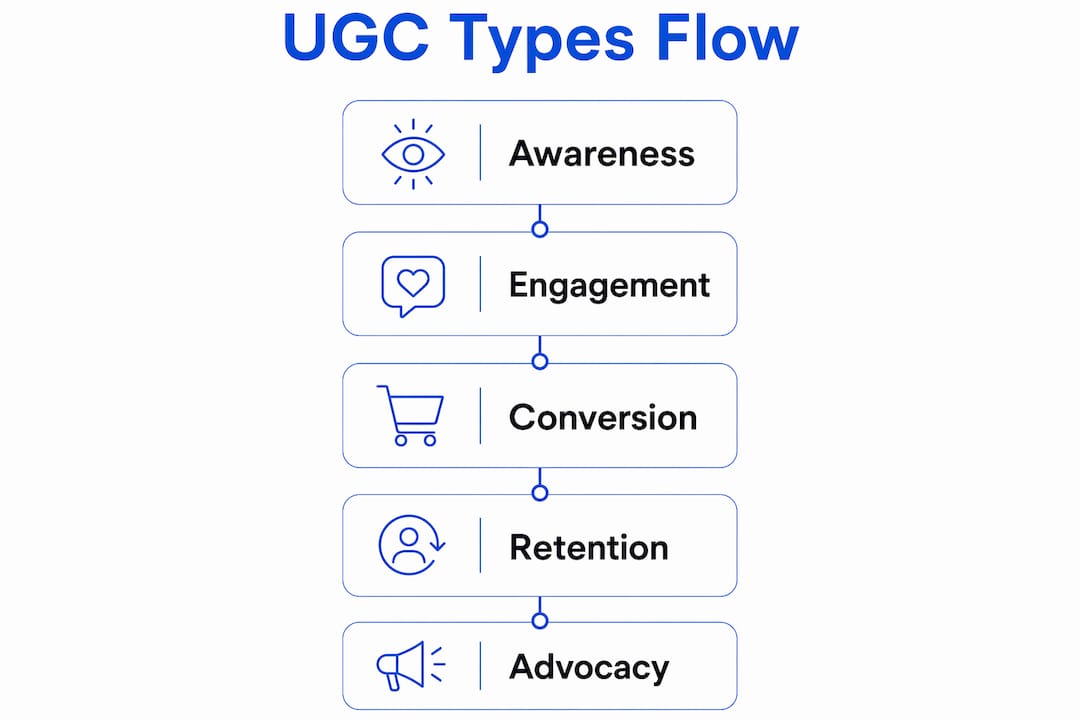
The funnel logic matters. Awareness-stage content (TikTok challenges, hashtag campaigns) reaches people who do not know you yet. Conversion-stage content (photo reviews, star ratings, Q&As on PDPs) closes buyers who are already considering a purchase. Running awareness content at people who are ready to buy, or vice versa, wastes both the content and the audience.
Why the benefits of user-generated content marketing are hard to ignore
Authenticity is the core mechanism. More than 90% of consumers say authentic engagement builds trust, and 85% say they would pay more for brands they perceive as authentic. UGC delivers that authenticity in a way polished brand creative simply cannot replicate.
Stat to know: UGC-driven conversions for U.S. brands jumped 57% quarter-over-quarter from Q4 2025 to Q1 2026, reaching a 6.73x conversion lift versus non-UGC pages.
The benefits stack up across multiple dimensions:
- Higher conversion rates. PDPs featuring customer photos, star ratings, and reviews convert 74% higher than pages without UGC. That is the highest-value single deployment point in any UGC program.
- Lower content production costs. Brands that negotiate usage rights for UGC report noticeable reductions in creative production costs.
- Stronger purchase intent. UGC on product pages increases conversion by 74% and a significant portion of consumers actively look for reviews or UGC before buying.
- Better email performance. UGC in email tends to increase click-through rates, with customer photos and review snippets performing especially well in post-purchase and abandoned cart flows.
- Improved brand sentiment. As UGC volume grows, brand sentiment can trend upward over time, a compounding effect that paid advertising may not produce on its own.
The cost-effectiveness angle is underappreciated. Many marketers find UGC more cost-effective than other content types. When you factor in the production cost savings alongside the conversion lift, the ROI case for a disciplined UGC program is stronger than almost any other content investment you can make. For more on how content drives measurable growth, see why content matters for brand growth.
Where to find UGC and how to encourage more of it
The five most productive sources for UGC are hashtag monitoring, post-purchase prompts, direct-upload widgets, creator outreach, and ambassador programs. Most brands default to hashtag monitoring and stop there. That is a mistake.

Post-purchase prompts are the most underused high-yield source. A photo-incentivized prompt sent 7–14 days after delivery can double the yes-rate versus an unincentivized request. Adding a single post-purchase prompt to an existing program lifts UGC volume 2.1x within 90 days at no extra rights-collection cost.
Pro Tip: Design brand experiences that are inherently worth capturing. Kat Kavner of Shopify calls these “capture-worthy” moments: packaging that surprises, unboxing experiences that delight, in-store moments that beg to be photographed. When customers want to share on their own, you get organic UGC without asking for it.
For rights management, speed is everything. Send your rights-request message within 24 hours of a post going up. The yes-rate halves after 7 days and drops 80% after 30 days. Replace lengthy legal text with a one-tap consent form. That single change lifts consent rates by 9–12 percentage points on the same outreach template.
At scale, manual monitoring misses approximately 30% of tagged content. For brands collecting more than a few hundred pieces per month, automated platforms that track brand mentions and hashtags across Instagram, TikTok, and YouTube are a practical requirement. These tools also handle rights workflows, consent logging, and revocation tracking, which is where manual programs tend to collapse. A good content management software guide can help you evaluate which platforms fit your program’s scale.
How to use user-generated content effectively in campaigns
Deployment strategy determines whether your UGC program drives revenue or just fills a gallery. The same piece of content does not work equally well on every surface.
Product pages are your highest-priority deployment point. Star ratings visible above the fold, customer photos showing the product in real-use context, and Q&A sections where previous buyers answer common pre-purchase questions, these three formats address purchase hesitation at the exact moment it matters most.
Paid social needs platform-native formats. A polished brand video repurposed as a paid ad underperforms a raw customer video shot on a phone. UGC ads deliver 4.5x higher click-through rates than brand-made ads. The creative brief matters here: briefing creators on the objective and call-to-action rather than scripting every line preserves the authenticity that makes UGC ads outperform.
Email is where UGC compounds quietly. Post-purchase flows, re-engagement sequences, and abandoned cart emails all benefit from customer photos and review snippets. 50% of marketers already include UGC in email campaigns, and the click-through rate improvement is consistent.
Best practices for maximizing UGC impact across channels:
- Always credit the creator. Tag their username on social and include attribution in branded campaigns. Public credit signals to your community that creating content earns visible rewards.
- Separate organic and commercial rights. Permission to reshare on Instagram does not cover running the same content as a paid ad. Get explicit commercial rights before any paid deployment.
- Disclose incentivized content. The FTC’s Endorsement Guides, updated through 2025, require clear disclosure whenever a brand provides anything of value in exchange for content. Direct terms like #ad or #sponsored meet the standard; vague language like “thanks to” does not.
- Review UGC for unsubstantiated claims before publishing. If a customer’s photo or video makes a health or performance claim you cannot substantiate, do not amplify it.
- Build a freshness cadence. UGC galleries older than 90 days show measurable conversion degradation. Weekly content refreshes keep performance in range.
For measurement, correlation-based metrics are not enough. The only honest way to measure UGC lift is a holdout test: serve UGC to half of your PDP visitors, hide it from the other half, and measure the delta over at least 12 weeks. Likes and shares tell you about engagement volume. Holdout-tested conversion lift tells you whether the program is actually driving revenue. For a deeper look at how UGC fits into broader conversion strategy, Google Ads conversion rate optimization principles apply directly to UGC-driven landing page performance.
If you want to see how these principles translate into real campaign structures, digital marketing examples for SMBs show what disciplined UGC deployment looks like in practice.
Grow your content pipeline on autopilot
Running a UGC program alongside your broader content strategy is a lot to manage. Mysearchhero handles the content side for you: published articles, backlinks, Reddit mentions, and social posts pushed out through a fully automated pipeline every month. If you want your brand showing up consistently without rebuilding the wheel each quarter, see how Mysearchhero works.
Key Takeaways
UGC programs that run as continuous operational systems, not one-off campaigns, consistently outperform brands that treat UGC as a reactive social activity.
| Point | Details |
|---|---|
| Set one goal first | Choose conversion or awareness for your first 90 days; splitting focus dilutes results on both. |
| UGC lifts conversions sharply | Pages with UGC received 6.73x more conversions and 4.11x more traffic than non-UGC pages in Q1 2026. |
| Rights speed matters | Send consent requests within 24 hours of posting; yes-rates halve after 7 days. |
| PDPs are the highest-value surface | Product pages with customer photos and reviews convert significantly higher than pages without UGC. |
| Measure with holdout tests | Correlation metrics undercount UGC’s influence; holdout testing isolates the real conversion lift. |
FAQ
What does it mean to leverage user-generated content?
Leveraging UGC means systematically collecting, rights-clearing, and distributing customer-created content across your marketing channels to build trust and drive conversions, rather than simply reposting whatever gets tagged.
What is the 70-20-10 rule in content?
The 70-20-10 rule suggests allocating most content to proven formats, some to content that builds on what works, and a small portion to experimental ideas. UGC typically fits the proven content bucket once a program is running.
Does using a hashtag automatically give a brand rights to the content?
No. Campaign terms can state that using a hashtag grants a license, but those terms must be clearly communicated. Even then, best practice is to obtain direct written confirmation before featuring specific content in paid advertising.
How do you measure the ROI of a UGC campaign?
Use a holdout test: serve UGC to half of your product page visitors and withhold it from the other half, then track the conversion rate delta over at least 12 weeks. Engagement metrics alone do not capture revenue impact.
How do you get more customers to create UGC?
Post-purchase email or SMS prompts sent 7–14 days after delivery are the highest-yield source per request. Adding a photo incentive doubles the yes-rate, and designing genuinely share-worthy brand experiences generates organic content without any direct ask.