
A niche edit adds your link to an article that is already published on another site. A guest post is a new article you (or someone on your behalf) write and publish on another site, with a link back to yours. Niche edits usually go live faster and sit on pages that already have history. Guest posts give you more control over the message and the anchor context. Most local and service businesses do best with a mix, and both have to follow Google’s rules on paid links.
This guide explains how each one works, what they cost in the US, how they compare on speed and risk, and how to pick based on where your business is today.
TL;DR
- Niche edit: a link inserted into an existing, already-indexed article. Often quicker to show up, and typically cheaper per link than a guest post bought through a vendor.
- Guest post: a new article on someone else’s site, with a link to yours. Slower to start, but you control the topic, the angle and the author byline.
- Cost: BuzzStream’s 2026 data puts the average link insertion at $179 and the average guest post at $295 direct from a site, or $461 through a vendor.
- Google’s rule: if money changes hands for a link, it should be tagged rel=“sponsored” or rel=“nofollow”. Editorial links earned on merit are a different thing.
- Best approach: build a base of fresh, relevant content first, then add selective insertions on pages that already rank and match your service.
Table of Contents
- What is a niche edit?
- What is a guest post?
- Niche edits vs. guest posts: the differences that matter
- How long each one takes
- What each costs in the US
- What to check before you accept any placement
- Staying inside Google’s link rules
- Which one should you choose?
- Our perspective
- Skip the manual outreach
- FAQ
- Sources
What is a niche edit?
A niche edit, also called a link insertion or contextual link, is a link added to a page that has already been published. Someone finds an article that covers a topic related to your page, then asks the site owner to add a sentence or a link to your content. If the owner agrees, your link appears inside the body text, surrounded by content that was written for that site’s readers.
That is why people searching for “niche edit backlinks” are usually after the same thing: a link inside real, existing copy rather than a link in a footer, sidebar or directory.
What matters about a niche edit:
- The page already exists. It has a publish date, an index history and, often, links of its own.
- The link is placed by editing. The host site changes published work, which is why site owners are choosy about it.
- Relevance decides the value. A plumbing company linked from an article about water heater maintenance is a natural fit. The same link on a page about cryptocurrency is not.
What is a guest post?
A guest post is an original article written for another site. The host publishes it, usually with an author bio, and the article or bio contains a link to your site. Guest posting works like this:
- You pick a site your customers or peers read.
- You pitch a topic that fits its audience and isn’t already covered.
- You write the article to the site’s standards, or you pay for it to be written.
- The editor reviews, edits and publishes it.
- Your link sits in the body or the bio, according to the site’s policy.
The upside is that the page is built around your expertise. A roofing contractor can publish a practical piece on storm damage checks, with a link to the relevant service page. The downside is the new page starts with no history, so it has to be crawled, indexed and given time.
Niche edits vs. guest posts: the differences that matter
| Factor | Niche edit | Guest post |
|---|---|---|
| What you get | A link added to a published page | A new page with your content and link |
| Content control | Low: you get one sentence or phrase | High: you shape the topic and angle |
| Starting authority | Page already has history | New page, starts from zero |
| Typical cost (BuzzStream 2026 averages) | $179 per insertion | $295 direct, $461 via vendor |
| Speed | Often faster to take effect | Needs time to be indexed and noticed |
| Brand exposure | Limited, readers see a mention | Higher, readers see your expertise |
| Main risk | Irrelevant or low-quality host pages | Thin, off-topic or obviously paid posts |
The table shows a trade-off, not a winner. A niche edit is a precise tool: it borrows an existing page’s standing. A guest post is a building block: it creates something new that can earn attention on its own.
How long each one takes
A niche edit can start counting as soon as the host page is recrawled, because the page is already in the index. A guest post is a new URL that search engines have to discover first.
One published personal test of 50 links from DR 50+ domains between 2022 and 2024 reported an average of 46 days to the first measurable ranking improvement for niche edits and 52 days for guest posts. The ranges were wide: 22 to 118 days and 28 to 145 days. That is a single small test, so treat it as a rough picture and not a promise. The practical takeaway is that neither link type works overnight, and both need weeks.

Speed also depends on your own page. A link to a service page that is thin, slow or unclear gives search engines little to reward, whichever link type you used.
What each costs in the US
BuzzStream’s 2026 link building pricing data, updated October 20, 2026, gives the clearest recent US benchmarks:
- Link insertion: $179 on average, with a range from $20 to $1,500.
- Guest post, direct from the site: $295 on average, range $150 to $10,000.
- Guest post through a vendor: $461 on average, range $150 to $10,000.
The same analysis, covering 257,267 sites, shows guest post prices climbing with site authority. On the DR scale, a DR 0 to 9 site averages $132 direct and $196 through a vendor. At DR 50 to 59 that becomes $470 direct and $759 through a vendor. At DR 80 and up, it is $1,735 direct and $2,983 through a vendor.
Two lessons for a local business owner:
- A cheap link is not a bargain if the site is unrelated. A link from a site that doesn’t serve your market or region does little for a local company.
- A single expensive link is rarely the right first spend. Several relevant, mid-range placements usually do more for a service business than one trophy link.
What to check before you accept any placement
Whether it is a niche edit or a guest post, run the same checklist:
- Topical fit. Does the page or site serve the same audience you want as customers?
- Real traffic and real readers. Look for a site that publishes real content on a regular basis, not a page that exists only to hold links.
- Link location. A link in the body of relevant text beats one in a footer or a list of dozens of links.
- Other outbound links. If the page links out to many unrelated businesses, yours gets lost among them.
- Anchor text. Natural wording, often your brand name or a plain description, looks better than the exact phrase you want to rank for repeated everywhere.
- Indexing. Confirm the page can be found in Google and isn’t blocked from search.
- Disclosure and tagging. If it is a paid placement, expect the link to carry the right attribute, as covered below.
Staying inside Google’s link rules
Google’s spam policies list buying or selling links for ranking purposes as link spam, including exchanging money for links or for posts that contain links. The same page also says that buying and selling links for advertising and sponsorship is a normal part of the web, and it isn’t a violation as long as the links are qualified with rel=“nofollow” or rel=“sponsored”.
Google’s guidance on qualifying outbound links says that links tied to advertising or paid placements should be marked rel=“sponsored”, and that nofollow is also acceptable.
Google’s John Mueller said in September 2023 that using guest posts for links goes against Google’s spam policies unless the links are qualified so they don’t affect search results. Search Engine Journal adds that a paid guest post with a link is an advertisement as far as Google is concerned, and that unlabeled advertising can also raise legal questions about misleading readers.
In practice:
- Paid placements: have the link tagged sponsored or nofollow. You still get the visibility and referral traffic.
- Earned placements: an expert contribution accepted on merit, with no payment for the link, is editorial.
- Keep anchors natural and avoid bulk, repetitive placements on sites that exist to sell links.
The point is to pick a source that is honest about how it works, rather than to chase a link type that looks safe on paper.
Which one should you choose?
Use your situation, not a general rule, to decide.
Choose guest posts first when:
- You have few pages that tell people what you know. A guest article on a respected local or industry site gives you a reference point.
- You want to be seen as a voice in your field, not just a URL.
- You can supply real expertise, such as case notes, local data or practical checklists.
Choose niche edits first when:
- You already have strong service pages or articles worth pointing to.
- You want a link on a page that has been around and is relevant to a specific topic.
- You need a lean, targeted addition rather than another article.
Use both when you have the budget for steady, monthly activity. Fresh articles create new things worth linking to. Insertions then point relevant existing pages at your best content. A varied profile also looks more natural, which we cover in our piece on why diversifying backlinks matters.
A worked example for a local service business
Say you run an HVAC company with a handful of service pages and a few blog posts. A sensible first quarter might look like this:
- Month 1: fix your own service pages, publish two helpful articles on your site, and secure one guest article on a regional home improvement site.
- Month 2: add a link insertion on a relevant article about energy-efficient home upgrades, pointing to your best guide.
- Month 3: review which pages gained impressions and clicks, and put the next placements behind what is working.
That is an illustration of the sequence, not a result we can promise. The principle is steady, relevant, trackable work.
Our perspective
Business owners often ask us which link type wins. Our honest answer is that a single link is rarely the thing that moves a local business. What moves it is a steady rhythm: new content going live, relevant authority backlinks arriving, and your brand showing up in the places your customers already look.
That is the idea behind how we built MySearchHero. We designed it so a service business doesn’t have to find publishers, negotiate each placement, write pitches and track tags by hand. Each month, our pipeline pushes out SEO articles on your website, authority backlinks through a publisher network, Reddit brand mentions and social posts, so your visibility builds in more than one place at once.
We believe consistency compounds. One link placed this month and nothing next month leaves a gap. A monthly bundle keeps your presence growing without ad spend or agency retainers, and for a busy owner that is the part that tends to get dropped when it is done by hand.
If you want to go deeper on the mechanics, our guides on how to get backlinks that actually boost rankings and the best backlink types for local SEO are a good next step.
Mike
Skip the manual outreach
Chasing editors for insertions and guest slots takes hours that most owners don’t have. MySearchHero is built for exactly that gap: a done-for-you service for small and local service businesses that publishes SEO articles to your site, builds authority backlinks through a publisher network, adds Reddit mentions and posts to social platforms every month.
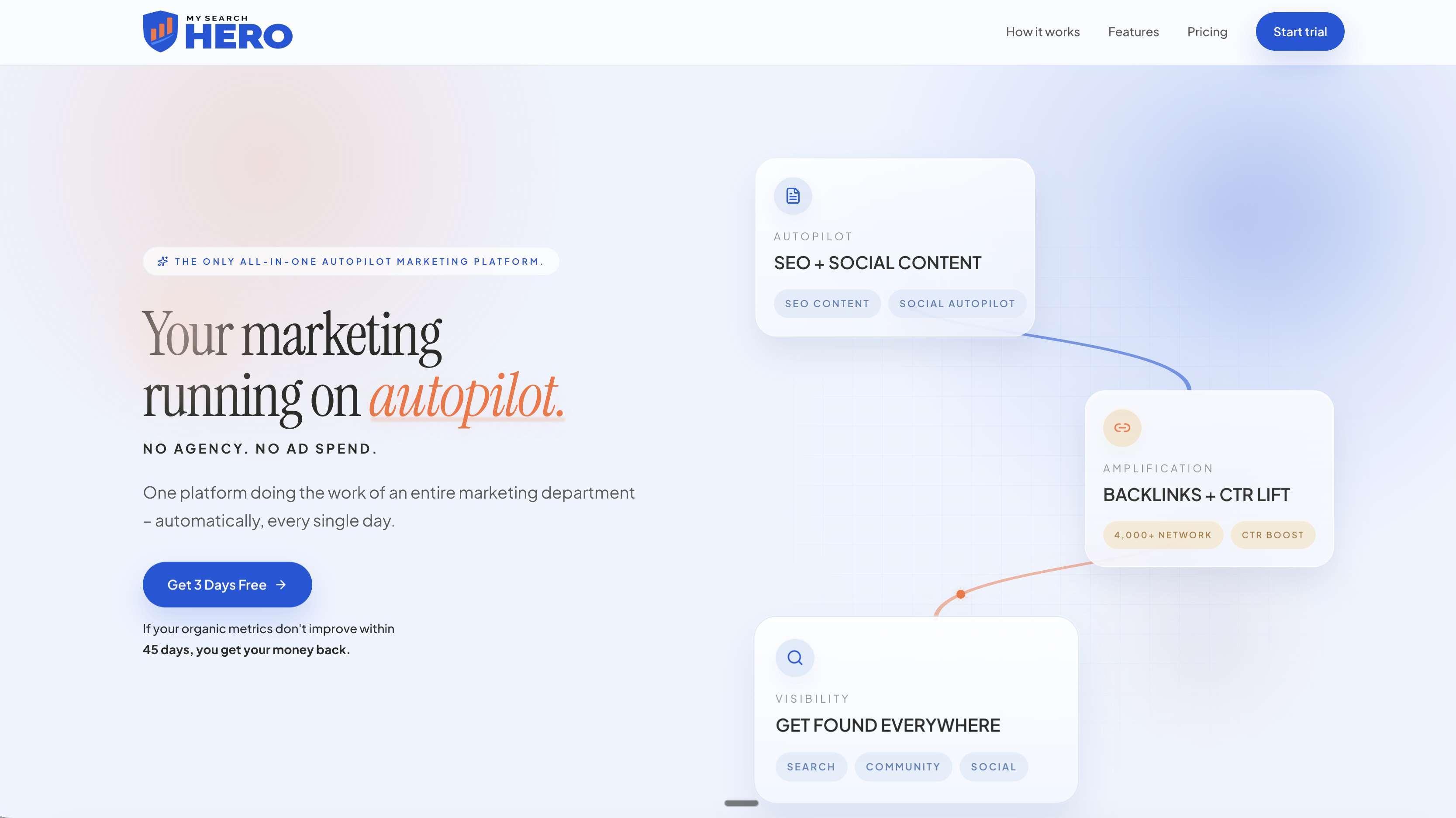
Plans are published at $197 per month for Spark, $297 for Authority and $397 for Hero, or $1,970, $2,970 and $3,970 per year on the annual versions. An Enterprise plan is listed at $2,997 per month. Our offer also includes a 45-day money-back guarantee if organic metrics do not improve. See the plans and start your trial to compare what each bundle includes.
FAQ
Are niche edits better than guest posts?
Neither is better in every case. Niche edits borrow the standing of a page that already exists and are often quicker to take effect. Guest posts create new content that you control and that can build your reputation. A mix usually works best.
Are niche edits safe under Google’s rules?
They are fine when handled honestly. If a link was paid for, Google’s documentation says it should carry rel=“sponsored” or rel=“nofollow”. Relevant links the host chose to add on merit are editorial. Avoid bulk placements on sites that sell links to anyone.
How much do niche edits and guest posts cost?
BuzzStream’s 2026 data shows an average of $179 per link insertion and $295 per guest post bought direct, or $461 through a vendor. Prices rise with the site’s authority, so a stronger site costs noticeably more.
How long until I see results?
Expect weeks, not days. One published test of 50 links averaged 46 days for niche edits and 52 days for guest posts before a measurable ranking improvement, with wide variation. Your own site’s quality also affects the pace.
Do I need to choose one?
No. New articles give you something worth linking to, and insertions can point relevant pages at it. For more on how the pieces fit together, see our link building explainer.
Sources
- Spam policies for Google web search
- Google: qualifying outbound links
- Search Engine Journal: Google on the right way to do paid guest posts
- BuzzStream: Link Building Pricing and Costs (2026)
- How Long Do High-Authority Backlinks Really Take to Pass Link Equity