
Editorial backlinks are links a publisher or journalist places in content because it genuinely adds value, not because anyone paid for it. They matter because editorial links build durable authority while paid or manipulative links behave like rented visibility that disappears the moment you stop paying. The single most important move: build something worth citing, then pitch it to the right people.
TL;DR:
- Editorial backlinks are earned when publishers or journalists independently decide to cite your content based on its value, not payment or sponsorship.
- The most effective way to earn these links is through original data, research reports, or interactive tools that journalists and publications find genuinely useful for their audience.
- High-quality editorial links are characterized by relevance, placement inside main content, natural anchors, traffic on the linking page, and a unique referring domain.
- Cost and time vary widely, with journalists’ requests being low-cost and fast, while digital PR campaigns with original data can take around six weeks and cost thousands of dollars.
- Maintaining relationships with journalists through prompt appreciation and targeted, relevant pitches boosts the chances of ongoing coverage and backlinks.
Table of Contents
- What Are Editorial Backlinks, Exactly?
- Why Do Editorial Backlinks Matter for SEO?
- How Do You Actually Earn Editorial Backlinks?
- What Makes an Editorial Link High Quality?
- How Much Do Editorial Backlinks Cost and How Long Do They Take?
- What’s the Difference Between Sponsored and Editorial Links?
- How Do You Scale an Editorial Backlink Program?
- How Do You Keep Editors and Journalists Coming Back?
- What Do Successful Editorial Backlink Campaigns Actually Look Like?
- What Legal and Ethical Rules Apply to Editorial Link Acquisition?
- An Editor’s Take on What Actually Matters
- Want a Managed Editorial Backlink Program Instead?
- Sources
- FAQ
What Are Editorial Backlinks, Exactly?
An editorial backlink shows up when an editor or writer decides, on their own judgment, that your content deserves a mention. Nobody negotiated payment for it. Nobody slipped it into a content calendar as a “sponsored placement.” It happens because your data, your quote, or your resource made their article better.
These links show up in a few common forms:
- Unsolicited mentions — a publisher cites your research or product without you ever reaching out.
- Journalist citations — a reporter quotes your expert commentary or pulls a stat from your site.
- Earned guest contributions — a byline you wrote for a publication because your expertise fit their beat, not because you paid a fee.
- Niche edits — a link inserted into existing content, but only when the publisher added it for editorial reasons rather than compensation.
The line that separates editorial from paid isn’t the link’s location on the page. It’s whether the publisher made an independent decision, free of undisclosed payment, to include it.
Why Do Editorial Backlinks Matter for SEO?
Editorial links carry contextual relevance that paid placements rarely match. When a respected outlet in your industry links to you organically, that signals to Google that real experts trust your content. Contrast that with a purchased link buried in a footer: it tells search engines almost nothing about relevance, because there’s no editorial judgment behind it.
They also drive referral traffic that keeps working long after the link goes live. A single feature on a site with a large, engaged readership can send a steady trickle of visitors for years. A study analyzing citations across AI models found that earned media accounts for 84% of citations in major AI answer engines, with traditional journalism contributing a significant portion of cited sources. That’s a strong signal that earned coverage, not paid placement, is what fuels visibility as more searches move into ChatGPT, Perplexity, and Google’s AI Overviews.
Compounding matters here, a mixed link profile with editorial links at the core and other link types supporting it tends to outperform a portfolio built entirely on outreach shortcuts or paid placements.
How Do You Actually Earn Editorial Backlinks?
Most link building techniques fall into a handful of repeatable categories. Here’s how to prioritize them based on effort versus payoff.
- Digital PR with a data story. Build something newsworthy, an original survey, a proprietary dataset, an analysis of public records, and pitch it to reporters covering that beat. This is the highest-effort, highest-yield method, and it’s where original data and interactive assets consistently outperform generic blog content for earning links over time.
- Journalist requests (HARO-style platforms). Reporters post specific queries looking for expert sources. Respond fast, answer the exact question asked, and skip the self-promotion. Journalist request platforms reward speed and specificity over polish.
- Manual outreach. Filter prospects by topical relevance and real traffic, not just a high authority score. Personalize the first line with something specific to their recent work, then follow up once, maybe twice, before moving on.
- Guest contributions. Pitch a byline to a publication where your expertise genuinely fits their coverage area. Editorial standards mean the outlet accepts or rejects your pitch on merit, not payment.
- Niche edits, handled carefully. Only pursue these when you can confirm the publisher is inserting the link for editorial reasons. Document the exchange, and if money changed hands, treat it as paid and tag it accordingly.
- Broken-link outreach. Find dead links on resource pages in your niche, then offer your content as a working replacement. It’s a smaller-scale tactic, but the win rate can be strong because you’re solving a real problem for the site owner.
If you’re starting from zero, begin with journalist requests and one solid piece of original data. Both require less lead time than a full digital PR campaign and can produce your first placements within weeks.
Pro Tip: Build one linkable asset (a calculator, a survey, an interactive tool) and reuse it across six months of outreach instead of pitching a new idea every time. Repeatable assets earn links long after the initial launch.
What Makes an Editorial Link High Quality?
Not every editorial mention is worth the same. Run every placement through this checklist before you count it as a win:
- Topical relevance — does the linking page actually relate to your industry or subject?
- In-body placement — is the link inside the main content, not a sidebar, footer, or author bio?
- Anchor naturalness — does the anchor text read like something a human would write, or does it look stuffed with your target keyword?
- Organic traffic — does the linking page actually get visitors, or is it a dead page nobody finds?
- Unique referring domain — is this a domain you haven’t already gotten links from, adding real diversity to your profile?
- Editorial standards — does the publisher have a visible editorial process, or does it look like a link farm dressed up as a blog?
Red flags include exact-match commercial anchors (“best cheap insurance” linking straight to a sales page), untagged paid placements, obvious link networks where the same handful of sites link to each other constantly, and links buried in author bios that never see organic traffic.
A quick rubric: a high-value link sits in-body on a relevant, trafficked site with a natural anchor. A medium-value link might check most boxes but come from a smaller or tangentially related domain. A low-value link fails two or more criteria, usually relevance and traffic, and probably isn’t worth the outreach time it took to get it.
How Much Do Editorial Backlinks Cost and How Long Do They Take?
Price depends heavily on publisher authority, how much original content creation the pitch requires, and how complex the outreach is. A journalist request response might cost you nothing but time. A full digital PR campaign with a custom research report and a dedicated outreach push can run into the thousands once you count content production and specialist time.
| Method | Typical cost range | Placement timeline |
|---|---|---|
| Journalist requests (HARO-style) | Low (time only) | Days to 2 weeks |
| Manual outreach | Low to moderate | 2 to 6 weeks |
| Guest contributions | Moderate | 3 weeks |
| Digital PR with original data | Moderate to high | 6 weeks |
Ranking and traffic impact usually lags the placement itself. Expect visible movement in rankings over three to six months, with compounding authority gains stretching out over twelve to twenty-four months. Budget your KPIs around links per month, unique referring domains gained, and a realistic traffic lift target rather than focusing on a single big placement.
What’s the Difference Between Sponsored and Editorial Links?
Google expects site owners to tag paid or exchanged links with rel="sponsored", links from user-generated content with rel="ugc", and any link they don’t want to vouch for with rel="nofollow". Editorial links, placed independently without compensation, need none of these tags.
The risk shows up when a paid placement gets dressed up as editorial. Paid links intended to pass ranking value are treated as a policy violation when they’re left untagged, and link-swap arrangements or bulk niche-edit buys tend to age into liabilities rather than assets.
If you discover a risky placement already live on your profile, here’s the remediation sequence:
- Contact the publisher and request the correct
rel="sponsored"orrel="nofollow"tag. - If the publisher doesn’t cooperate or the link came from an obvious link network, add it to your disavow file.
- Keep a record of every outreach agreement and payment, so you can prove intent if a manual action ever asks.
How Do You Scale an Editorial Backlink Program?
A workable monthly cadence looks like this: prospecting, outreach, content creation, follow ups, then reporting. Repeat it every month rather than treating link building as a one time sprint.
- Prospecting — one person filters target sites by relevance, traffic, and editorial standards, and builds the list before outreach starts.
- Outreach — a dedicated lead sends personalized pitches, tracks response rates, and manages the follow-up cadence.
- Content creation — whoever writes the guest post, data report, or pitch assets needs lead time before outreach goes out, not after.
- Analyst review — someone tracks which pitches convert, which anchors and topics perform, and feeds that back into next month’s prospecting.
A basic outreach template blueprint: personalized opener referencing their recent work, one sentence on why your asset fits their audience, a direct link to the resource, and a low-friction ask. Track referring domains, response rate, and placements per month as your core KPIs.
This is also where an automated or done-for-you model earns its place. A subscription service that bundles content creation and backlink outreach into one monthly deliverable maps almost exactly onto this workflow, minus the internal hiring.
Pro Tip: Track unique referring domains, not total link count. Ten links from ten different quality domains beat fifty links from five domains every time.
How Do You Keep Editors and Journalists Coming Back?
Getting the first link is the easy part. Staying on a journalist’s radar for the next six stories is where most outreach programs quietly fail.
Start by acknowledging the placement without asking for anything. A short thank-you email, sent within a day or two of publication, costs nothing and separates you from the hundreds of pitches that vanish the moment the link goes live. Skip the temptation to immediately pitch a second story in that same email. Let the relationship breathe.
Track which journalists and editors have covered your space before, and build a running list with notes on their beat, their preferred contact method, and what kind of pitch they said yes to. When you have something genuinely new (fresh data, a relevant expert take on breaking news in their niche) send it to that specific list instead of blasting a generic pitch to everyone in your database.
Respond fast when a journalist follows up with a clarifying question. Speed is often the deciding factor in whether your quote makes the final draft, especially on time-sensitive stories.
Share their work occasionally, not performatively, when it’s genuinely relevant to your audience. Reporters notice who actually reads their output versus who just wants a link.
And when a pitch gets rejected, don’t disappear. A polite acknowledgment and an offer to help with a future story keeps the relationship intact for the next opportunity, which matters more than any single placement.
What Do Successful Editorial Backlink Campaigns Actually Look Like?
The strongest campaigns share one trait: they start with an asset a journalist would want to cite even if no one ever asked them to.
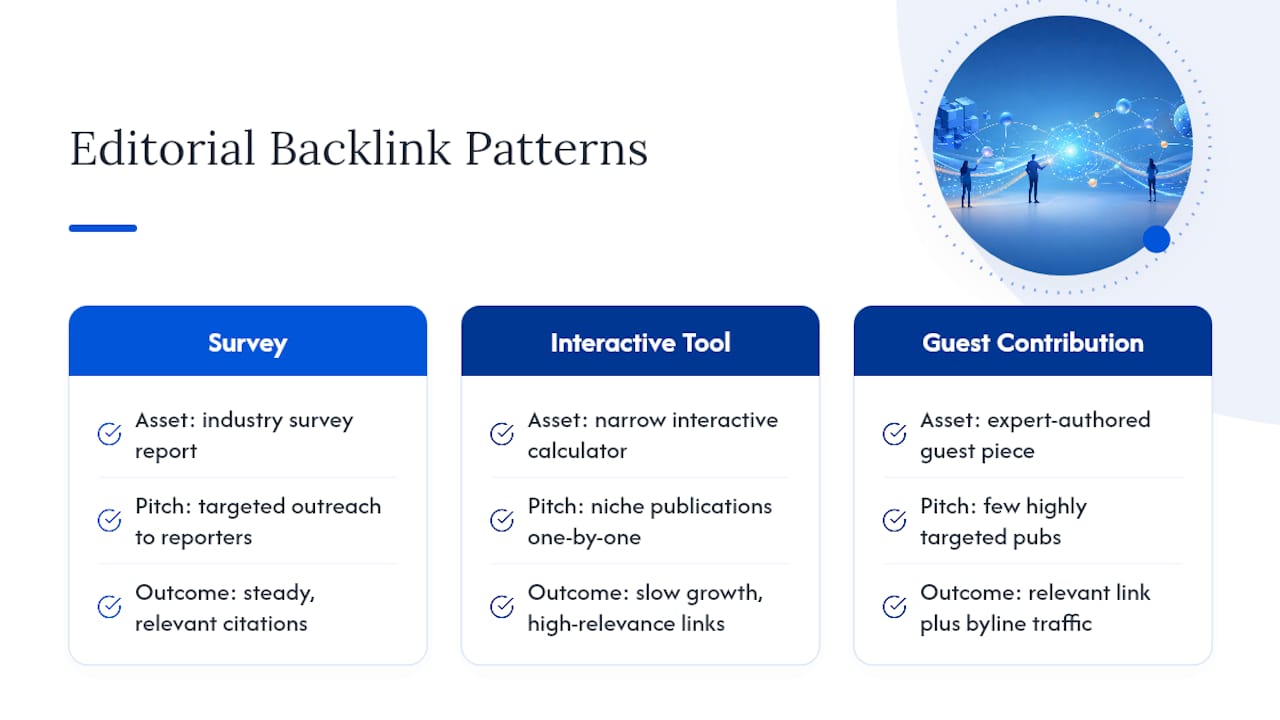
A company that runs an annual survey in its industry and publishes the raw findings as a free report tends to earn steady citations every time a reporter needs an industry statistic. The report doesn’t need to be flashy. It needs to answer a question reporters in that beat get asked repeatedly, salary benchmarks, adoption rates, pricing trends, and package the answer in a way that’s easy to quote.
Another common pattern: a company built a genuinely useful calculator or interactive tool solving a narrow, specific problem, then spent months pitching it to niche publications one at a time rather than blasting a mass press release. The link count grew slowly, but each one came from a highly relevant domain, which tends to produce a more durable ranking lift than a fast spike in low-relevance links.
A third pattern shows up in guest contributions done right: a subject-matter expert pitches a handful of highly targeted publications instead of dozens of low-tier sites, and each contribution generates one strong, relevant link plus a byline audience that occasionally converts into direct traffic. The volume is lower, but the durability of that kind of link tends to outlast programs built purely on outreach volume.
The common denominator across all three isn’t budget or team size. It’s a genuinely useful asset paired with patient, targeted pitching instead of a numbers game.
What Legal and Ethical Rules Apply to Editorial Link Acquisition?
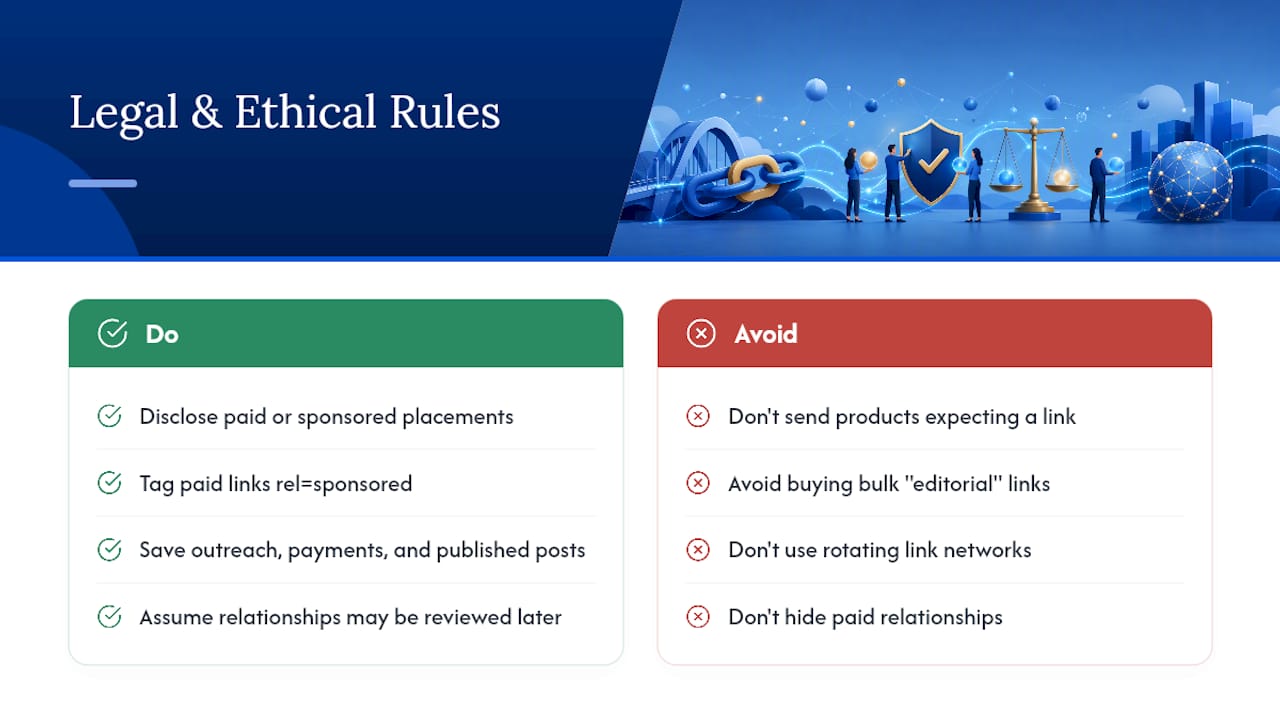
Disclosure isn’t optional once money or product exchanges hands for a placement. If you pay for a link, sponsor content, or send free products in exchange for coverage, both US advertising guidelines and Google’s own policies expect that relationship to be disclosed and the link tagged appropriately.
The ethical line gets blurry fastest with influencer outreach for backlinks. Sending a free product to an influencer or blogger in exchange for a mention crosses into paid-placement territory the moment there’s an expectation of a link back, even if no cash changes hands. Treat any exchange of value, product, service, or payment, as something that needs a rel="sponsored" tag rather than passing as purely editorial.
Manufactured link networks, where a group of sites link to each other on a rotating schedule to simulate organic endorsement, create real risk beyond just a wasted link. They can trigger a manual action against your entire domain, not just the flagged links. The same goes for buying links in bulk through marketplaces that promise “editorial” placement but never involve actual editorial review.
Keep records. Save your outreach emails, any payment agreements, and the final published version of every placement. If a publisher’s editorial policy changes or a link gets flagged years later, having a clear paper trail showing you disclosed appropriately protects you far more than trying to reconstruct intent after the fact.
The safest long-term posture: treat every relationship as if a search engine’s policy team might review it later, because eventually, on a domain with enough coverage, one might.
An Editor’s Take on What Actually Matters
Most link building advice obsesses over domain authority scores. I’d rather see topical relevance and unique referring domains. A link from a small, tightly focused industry blog often does more work than a broad-reach site that covers everything and nothing. Insist on transparent reporting, live URLs you can check yourself, not screenshots, and treat every metric that isn’t verifiable as noise. If you want the execution details, our posts on backlink outreach and diversifying your link profile go deeper than this overview can.
— Mike
Want a Managed Editorial Backlink Program Instead?
Running digital PR, HARO responses, and outreach cadences in-house takes a dedicated person, or several, every single month. A managed service can deliver the output of that workflow without hiring for it: SEO articles published regularly to your site, backlinks through a publisher network, Reddit mentions in relevant conversations, and reporting that shows what actually landed.
It is designed for local and service-based businesses that prefer to approve a monthly report rather than manage outreach spreadsheets and follow-up emails themselves. If you’re weighing whether to build this workflow internally or hand it off, the fastest way to find out is to look at what a month of deliverables actually includes. Check the plans and get started at Mysearchhero.
Sources
FAQ
Are Backlinks Still Relevant in 2026?
Yes. Editorial links remain one of the strongest ranking signals search engines use, and earned media now drives the majority of AI answer-engine citations as well, making them more relevant than ever for visibility beyond traditional search.
What Are the Three Main Types of Backlinks?
The three broad categories are editorial links (earned through publisher judgment), paid links (exchanged for payment and requiring disclosure tags), and self-created links (like directory listings or forum posts, which carry little SEO weight on their own).
Can You Give an Example of an Editorial Backlink?
A common example is a journalist citing your company’s original survey data in a news article, or an industry blog linking to your guide because it answered a reader’s question better than existing resources.
Are Backlinks Good or Bad for SEO?
Backlinks themselves are neutral. Editorial links earned through genuine value tend to help rankings, while manipulative or untagged paid links can trigger manual actions and hurt a site’s standing.
What’s the Difference Between a Guest Post and a Niche Edit?
A guest post is new content written specifically for a publisher, while a niche edit inserts a link into an existing, already-published article. Niche edits are frequently paid arrangements, so their editorial legitimacy depends entirely on whether the publisher made the insertion decision independently.