
TL;DR:
- Effective service business marketing involves a systematic approach from defining your ideal client to measuring impactful conversion metrics. Focusing on two or three targeted channels, aligning marketing and sales processes, and ensuring your website effectively converts inquiries into bookings are key to sustainable growth. Most businesses improve by establishing clear client journeys, continuous system management, and automation tools like Mysearchhero to run marketing on autopilot.
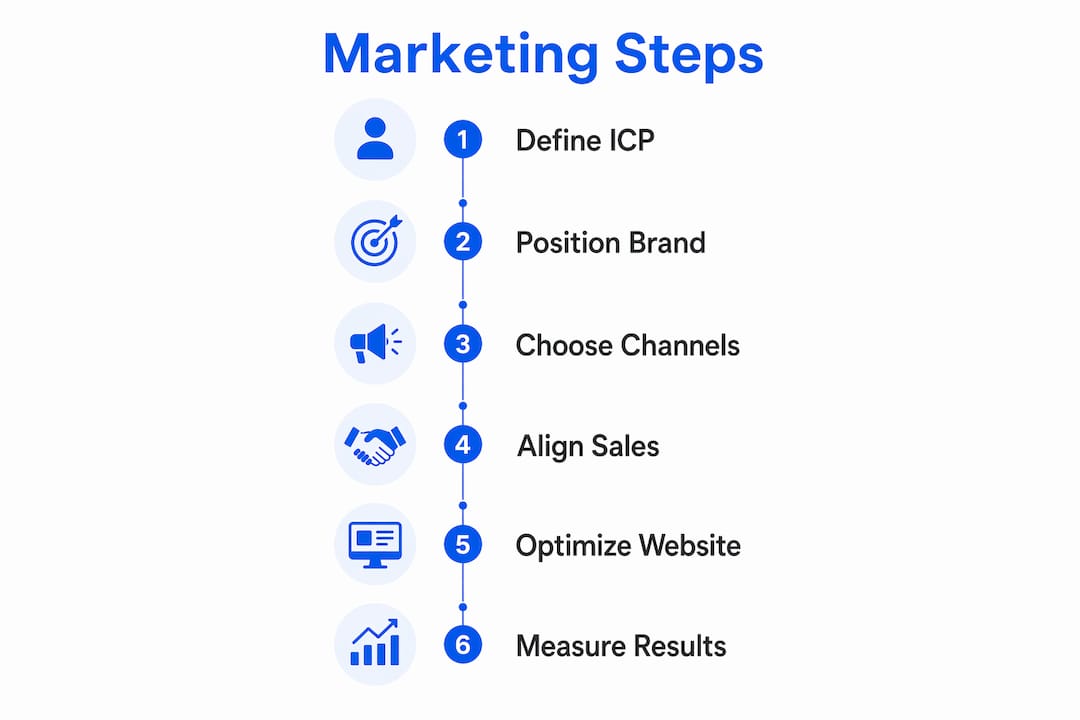
Effective service business marketing steps are defined as a structured sequence of decisions and actions that move a prospect from first awareness to confirmed booking. Most service businesses lose clients not because their work is poor, but because their marketing operates as a collection of disconnected tactics rather than a repeatable system. This article walks you through each step in the right order: defining your ideal client, choosing the right channels, aligning your sales workflow, optimizing your website, and measuring what actually drives revenue. Tools like HoneyBook, Google Business Profile, and CRM automation each play a specific role in making that system work.
What are the core service business marketing steps?
The foundation of any effective marketing plan for a service business is knowing exactly who you are trying to reach. An ideal client profile (ICP) is a detailed description of the specific type of buyer most likely to need your service, pay your price, and refer others. Without it, every other step in your marketing plan is guesswork.
To build your ICP, document three things: demographics (industry, company size, location, role), pain points (what problem keeps them up at night), and decision criteria (what makes them choose one provider over another). Interview your five best current clients. Ask them why they hired you, what they almost chose instead, and what made them stay. The answers will tell you more than any market research report.
Positioning follows directly from your ICP. A competitive positioning statement answers one question: why should your ideal client choose you over every other option, including doing nothing? The strongest positioning focuses on the problem you solve, not the features of your service. “We help independent financial advisors fill their calendar with pre-qualified prospects” is more compelling than “We offer digital marketing services for financial professionals.”
- Define your ICP before writing a single piece of marketing copy
- Document pain points in your client’s exact language, not your industry jargon
- Write a one-sentence positioning statement that names the problem, the audience, and the outcome
- Test your positioning with three people outside your business. If they cannot repeat it back clearly, rewrite it.
Pro Tip: Avoid describing your ideal client as “small business owners” or “anyone who needs my service.” The more specific your ICP, the more your marketing copy will resonate. Specificity signals expertise, and expertise commands higher fees.
Good branding and positioning work at this stage pays dividends across every channel you use later.
How do you choose the right marketing channels for your service?
Picking the wrong channels is the most expensive mistake service business owners make. Omnichannel marketing rarely works for service businesses because it spreads budget and attention too thin. Two or three channels executed with discipline will outperform six channels executed poorly every time.
Evaluate each channel against three criteria: where your ideal clients actually spend time, what it costs to reach them there, and whether your team has the skills to execute it well. A B2B consultant whose clients are VP-level buyers at mid-size companies will get more traction from LinkedIn outreach and referral partnerships than from Instagram. A local home services company will see better returns from Google Business Profile and targeted local ads than from a podcast.
| Channel | Best fit for | Relative cost |
|---|---|---|
| Google Business Profile | Local service businesses with geographic demand | Low |
| LinkedIn outreach | B2B services targeting specific roles or industries | Low to medium |
| Paid social ads | Services with broad consumer appeal or visual outcomes | Medium to high |
| Referral programs | Any service business with satisfied existing clients | Low |
| Email marketing | Nurturing warm leads and past clients | Low |

Before committing budget to any channel, run a low-cost pilot. A phased 8-week approach to testing your first two or three channels prevents wasted spending and gives you real data on what converts. Set a clear success metric before you start, such as cost per lead or booking rate, so you are comparing channels on the same terms.
Pro Tip: Your channel choice must match your messaging and your team’s actual capacity. If no one on your team writes well, email marketing will underperform regardless of list size. Match channel to capability, not just to where your competitors are.
How do you align marketing and sales to close more service clients?
The gap between marketing and sales is where most service business revenue leaks. Aligning marketing and sales on shared definitions of Marketing Qualified Leads (MQLs) and Sales Qualified Leads (SQLs) is the single most effective structural fix you can make. An MQL is a lead that meets your ICP criteria and has shown interest. An SQL is a lead that has been contacted, confirmed fit, and is ready for a proposal or discovery call.
Once those definitions are agreed upon, build a repeatable outreach sequence. A well-designed sequence mixes channels and timing. For example, a seven-touch sequence might look like this:
- Send a personalized LinkedIn connection request referencing a specific detail about their business
- Follow up two days later with a short message that names the problem you solve
- Send a value-add email with a relevant case study or article three days after connection
- Leave a voicemail on day seven if a phone number is available
- Send a second email on day ten with a direct ask for a 20-minute call
- Re-engage on LinkedIn with a comment on their recent post on day fourteen
- Send a final “closing the loop” email on day twenty-one
Documenting this sequence in a CRM means every lead gets the same quality of follow-up regardless of who handles it. Tools like HoneyBook or similar CRM platforms let you automate outreach workflows while keeping personalization intact. A clear discovery process that answers mutual-fit questions before a proposal reduces wasted time on both sides and accelerates the handoff from marketing to a closed deal.
Pro Tip: The fastest way to improve your close rate is not better proposals. It is better qualification before the proposal. Build a five-question discovery framework that confirms budget, timeline, decision authority, and fit before you invest time in scoping.
Does your website actually convert service inquiries into bookings?
Your website is not a brochure. It is the most important conversion asset in your marketing system, and most service business websites fail at the one job they need to do: turn a curious visitor into a booked client. Websites that map out the service delivery process clearly, rather than just listing outcomes, reduce prospect uncertainty and build trust faster.
The structure of a high-converting service page follows a specific logic:
- The problem: State the exact pain your ideal client is experiencing right now
- The process: Explain step by step what working with you looks like, from first contact to final delivery
- The proof: Include two or three specific testimonials that name the result, not just the experience
- The path: Make the next step obvious. One clear call to action, not three competing options.
Social proof is not optional. Case studies that show before-and-after results, named client testimonials, and specific outcome metrics all reduce the perceived risk of hiring you. Automating first responses and simplifying scheduling with tools like HoneyBook or Calendly removes the friction that kills conversions between inquiry and booking.
Your Google Business Profile and your website must work as a single system. Misalignment between GBP leads and landing pages causes lost opportunities because the visitor lands on a page that does not match what they searched for. Match your landing page headline and content to the specific service and location intent that drove the click.
| Website element | Conversion impact |
|---|---|
| Clear service process explanation | Reduces uncertainty, increases trust |
| Specific outcome testimonials | Lowers perceived risk |
| Online booking or scheduling tool | Removes friction from inquiry to commitment |
| GBP-aligned landing pages | Captures local search intent accurately |
How do you measure and improve your service marketing performance?
Marketing without measurement is spending without accountability. An attribution model connects each marketing channel to actual revenue, so you know which activities are generating clients and which are generating noise. Setting this up early prevents the common mistake of cutting channels that look quiet but are actually driving referrals or assisted conversions.
The metrics that matter most for a service business are:
- Lead capture rate: What percentage of website visitors submit an inquiry or book a call?
- Qualified lead rate: What percentage of inquiries meet your ICP criteria?
- Booking rate: What percentage of qualified leads convert to paying clients?
- Channel attribution: Which source generated each lead and each closed deal?
Review these numbers quarterly, not monthly. Monthly data is too noisy for service businesses with longer sales cycles. Quarterly reviews give you enough data to spot real trends and make confident adjustments. Combine marketing automation with human follow-ups for the best results. Automation handles speed and consistency. Human follow-up handles nuance and relationship.
The most common measurement mistake is tracking activity metrics like social media impressions or email open rates instead of conversion metrics. Impressions do not pay your bills. Booked clients do. Build your local marketing tracking around the metrics that connect directly to revenue.
Pro Tip: Set up a simple UTM tagging system for every link you share across channels. It takes 30 minutes to configure in Google Analytics and gives you clean attribution data from day one. Without it, you are making budget decisions based on assumptions.
Key takeaways
Effective service business marketing works as an operating system, not a set of random tactics. Every step from ICP definition to measurement must connect to the next.
| Point | Details |
|---|---|
| ICP and positioning come first | Every channel and message decision depends on knowing exactly who you serve and why they choose you. |
| Focus on two or three channels | Depth beats breadth. Test channels with low-budget pilots before scaling any investment. |
| Align marketing and sales early | Shared MQL and SQL definitions and documented outreach sequences prevent revenue from falling through the cracks. |
| Your website must convert, not just inform | Map your service process, add specific proof, and remove friction from the booking path. |
| Measure conversion metrics, not activity | Track lead capture rate, qualified lead rate, and booking rate to make confident budget decisions. |
Why most service businesses are one system away from consistent growth
I have worked with enough service business owners to know that the problem is almost never the quality of the service. The work is good. The problem is that marketing is treated as something you do when business slows down, not something you run continuously as a system.
The ICP and positioning work feels slow and abstract at first. Most owners want to skip straight to ads or social media. That is the wrong order. Every hour you spend getting your positioning sharp saves ten hours of wasted marketing spend later. When you know exactly who you are talking to and what problem you solve for them, writing copy becomes fast, channel selection becomes obvious, and sales conversations become shorter.
The omnichannel myth is one I see damage real businesses regularly. Owners spread themselves across LinkedIn, Instagram, Google Ads, email, and a podcast simultaneously, then wonder why nothing is working. Pick two channels. Go deep. Get good at them. Then add a third.
The other thing I have seen consistently is that the businesses growing fastest are not the ones with the biggest marketing budgets. They are the ones with the clearest client journey. From the first touchpoint to the signed contract, every step is documented, repeatable, and measured. That is not a marketing strategy. That is a marketing funnel built to run without you having to reinvent it every month.
— Mike
How Mysearchhero helps service businesses market on autopilot
Implementing these steps takes time, consistency, and the right content infrastructure. Mysearchhero is built specifically for service business owners who want their marketing running in the background while they focus on delivering their service.
Each month, Mysearchhero publishes SEO-optimized articles, builds backlinks, places Reddit mentions, and distributes AI-generated social media posts through a fully automated pipeline. You get a complete content marketing system without hiring a team or managing the details yourself. If you are ready to put your online presence on autopilot, Mysearchhero delivers the infrastructure to make it happen.
FAQ
What are the first steps to market a service business?
The first steps are defining your ideal client profile and writing a clear positioning statement. Every channel and message decision depends on knowing exactly who you serve and what problem you solve for them.
How many marketing channels should a service business use?
Most service businesses perform better with two or three focused channels rather than spreading effort across many. Omnichannel marketing rarely delivers the ROI that focused, well-executed channel strategies do.
How do I convert website visitors into service clients?
Map your service delivery process clearly on your website, include specific outcome-based testimonials, and add an online booking or scheduling tool. Reducing friction between inquiry and booking is the fastest way to improve conversion rates.
What metrics should I track for service business marketing?
Track lead capture rate, qualified lead rate, and booking rate as your core conversion metrics. Activity metrics like impressions and follower counts do not connect directly to revenue and should be secondary.
How do marketing and sales alignment improve client acquisition?
When marketing and sales share definitions of qualified leads and use documented outreach sequences, fewer leads fall through the cracks and conversion rates improve. Shared MQL and SQL definitions are the structural fix most service businesses are missing.