
TL;DR:
- Most businesses neglect mobile SEO, risking lower rankings, higher bounce rates, and lost revenue.
- Focusing on mobile-first indexing, speed, and content parity can significantly boost organic visibility and conversions.
Most businesses treat mobile SEO as an afterthought, a “we’ll get to it eventually” checkbox buried beneath other priorities. That thinking is quietly costing them customers. The role of mobile SEO has shifted from optional enhancement to the foundation of how Google ranks every website. Mobile users are 3x more impatient than desktop users, and a sluggish mobile experience doesn’t just frustrate visitors. It tanks your rankings, inflates your bounce rate, and shrinks your revenue.
Table of Contents
- Key takeaways
- The role of mobile SEO and why it defines your rankings
- How mobile performance directly affects your rankings
- Common mobile SEO pitfalls and how to fix them
- The business case for prioritizing mobile optimization
- My perspective on mobile SEO after years of watching businesses get this wrong
- How Mysearchhero helps you win on mobile
- FAQ
Key takeaways
| Point | Details |
|---|---|
| Mobile-first indexing is the default | Google ranks your site based on its mobile version, making mobile SEO non-negotiable for visibility. |
| Speed directly drives conversions | A 1-second delay cuts conversions by ~7%, so faster mobile sites earn measurably more revenue. |
| Core Web Vitals are ranking signals | Less than half of mobile sites pass all Core Web Vitals, creating a real competitive advantage for those that do. |
| Content parity protects rankings | Hiding content on mobile that exists on desktop causes Google to ignore it entirely in rankings. |
| Real-user data beats lab tests | Google Search Console field data reflects actual ranking signals, not just what a speed testing tool reports. |
The role of mobile SEO and why it defines your rankings
Mobile SEO is the practice of optimizing your website so it performs well for users on smartphones and tablets, covering everything from page speed and responsive design to content structure and crawlability. It is not simply a smaller version of desktop SEO. The signals, user behaviors, and technical requirements are meaningfully different.
The biggest structural shift happened when Google moved to mobile-first indexing. This means Google primarily uses your site’s mobile version to determine how it ranks, regardless of how polished your desktop site looks. If your mobile site loads slowly, hides key content, or lacks structured data, your rankings suffer across all devices.
Here is what specifically differentiates mobile SEO from desktop SEO:
- Crawling priority: Google’s bots crawl the mobile version of your site first and use that data as the canonical ranking source.
- Content visibility: Any content collapsed or hidden on mobile gets treated as lower priority by Google, even if it’s visible on desktop.
- Page speed thresholds: Google applies stricter performance expectations to mobile given network variability and device limitations.
- User intent signals: Mobile searches are often local and immediate in nature. “Near me” queries and location-based searches are almost entirely mobile-driven.
- Interaction patterns: Tap targets, font sizes, and layout shifts that feel minor on desktop become conversion killers on a 6-inch screen.
If you are running a local business and your mobile site is slow or incomplete, you are likely ranking below competitors whose sites aren’t even that much better. They just pass the mobile threshold. That gap is entirely closable with the right attention to mobile SEO strategies.
How mobile performance directly affects your rankings
The importance of mobile SEO becomes clearest when you look at Core Web Vitals, Google’s set of user-experience metrics that function as direct ranking signals. The three metrics that matter most are Largest Contentful Paint (LCP), Interaction to Next Paint (INP), and Cumulative Layout Shift (CLS).
LCP measures how fast your main content loads. INP tracks how responsive your page is after a user interacts with it. CLS captures how much the page visually shifts while loading, the kind of movement that causes users to accidentally tap the wrong button.
Here’s how these metrics compare between a site that passes and one that doesn’t:
| Metric | Good threshold | Poor threshold | Business impact |
|---|---|---|---|
| LCP | Under 2.5 seconds | Over 4 seconds | Slower LCP correlates with higher bounce rates and lost conversions |
| INP | Under 200ms | Over 500ms | Poor responsiveness frustrates users and signals low page quality |
| CLS | Under 0.1 | Over 0.25 | Layout instability causes accidental clicks and destroys trust |
As of January 2026, only 49.7% of mobile sites pass all Core Web Vitals. That means roughly half of your competitors are handing you a ranking advantage if you get this right. The number is even more specific for WordPress users: about 44% of WordPress mobile sites pass Core Web Vitals scores, which means most WordPress-based businesses are leaving visibility on the table.

Speed’s connection to revenue is not abstract. Sites that load under 2 seconds convert 32% higher than slower alternatives. That is a substantial lift achievable through technical fixes, not marketing spend.
Pro Tip: Don’t rely solely on lab testing tools like PageSpeed Insights for your mobile performance data. Google’s rankings are based on field data from real users collected through the Chrome User Experience Report. Check your Google Search Console’s Core Web Vitals report regularly, since it aggregates 28 days of real-user data and reflects what’s actually affecting your rankings.
Common mobile SEO pitfalls and how to fix them
Most mobile SEO problems fall into a predictable set of categories. Knowing what they are makes fixing them much faster than diagnosing symptoms one by one.
- Unoptimized images: Large, uncompressed images are one of the leading causes of poor LCP scores. Convert images to WebP format, use lazy loading for below-the-fold content, and specify image dimensions in your HTML to prevent layout shifts.
- Excessive third-party scripts: Script bloat from third-party tools like chat widgets, ad networks, and tracking pixels delays page interactivity significantly. Audit your scripts and remove or defer anything that isn’t critical to the user experience on load.
- Content mismatch between desktop and mobile: If your mobile site uses a separate URL structure or hides sections for “cleaner” mobile layouts, Google treats missing mobile content as nonexistent. Use responsive design to maintain full content parity.
- Slow Time to First Byte (TTFB): TTFB is often overlooked but heavily influences LCP. Slow server response times, often caused by shared hosting or unoptimized databases, compound every other performance problem.
- Poor tap target sizing: Buttons and links that are too close together or too small trigger accidental clicks and signal poor usability to Google’s quality assessments.
The most effective approach combines these fixes rather than addressing them in isolation. Combining image compression, script removal, and hosting improvements compounds load time reductions significantly, producing conversion lifts well beyond what any single fix achieves alone.
Pro Tip: Set up a monthly review of your Google Search Console’s Mobile Usability report alongside your Core Web Vitals report. When these two data sources show overlapping issues on the same URLs, those pages should become your highest-priority fixes. For a broader view of how mobile SEO connects to your local marketing efforts, the content marketing for local clients resource on the Mysearchhero blog covers how mobile visibility ties directly into client acquisition.
The business case for prioritizing mobile optimization
When you understand what mobile optimization does to your bottom line, it stops feeling like a technical task and starts looking like a revenue decision.

Consider the compounding math. A 1-second improvement in mobile load time increases conversions by 27% on average. Now factor in that most sites carry 2 to 4 seconds of fixable load time waste. Mobile SEO improvements that reduce load time by over 2 seconds correlate with 15 to 40% increases in conversions. For a local business generating $20,000 a month through its website, a 20% conversion lift means $4,000 in additional monthly revenue from technical changes, not new ad spend.
Here is how mobile SEO improvements translate into specific business outcomes:
- Higher search rankings: Passing Core Web Vitals improves your ranking signals directly, since Google uses them as a page experience factor. Better rankings mean more organic traffic without increasing your marketing budget.
- Lower bounce rates: Faster, more responsive pages keep visitors engaged longer. Google interprets lower bounce rates as a signal of quality, which reinforces your rankings over time.
- More repeat visits: Mobile users who have a good experience on your site return more frequently and are more likely to convert on subsequent visits.
- Reduced customer acquisition cost: When organic mobile traffic converts at a higher rate, your cost per acquired customer drops across every channel you run in parallel.
The impact of mobile search on local businesses is particularly sharp. Searches like “open now near me” or “[service] in [city]” are almost exclusively done on mobile. If your site loads slowly or behaves poorly on a phone, you lose those searchers to competitors who don’t. The AI in local business visibility space is also converging with mobile SEO, as AI-generated search results increasingly pull from well-optimized, fast mobile pages.
My perspective on mobile SEO after years of watching businesses get this wrong
I’ve watched countless businesses invest heavily in content and paid ads while their mobile site loads in six seconds on a mid-range Android device. They wonder why their cost per click keeps rising and their organic rankings plateau. The answer is almost always the same: the mobile experience is quietly bleeding conversions and tanking engagement signals.
What I’ve found over time is that businesses underestimate mobile SEO because the damage is invisible. Unlike a broken checkout page, a slow mobile load doesn’t generate error reports. It just generates exits. Visitors leave without a trace, and nobody connects those exits to a performance number sitting in a dashboard they rarely open.
The businesses I’ve seen succeed with mobile SEO treat speed as a revenue lever, not a technical metric. When you frame a 1-second load time improvement as “this will add X dollars in monthly conversions,” the prioritization conversation with stakeholders changes completely. That framing is what makes mobile optimization get funded and executed instead of deferred.
My take on 2026 and beyond: mobile SEO is not plateauing. With AI-generated search results pulling content from fast, well-structured pages, and with Google continuing to refine Core Web Vitals thresholds, the gap between optimized and unoptimized mobile sites will widen. Getting ahead of this now is far cheaper than catching up later.
— Mike
How Mysearchhero helps you win on mobile
Getting mobile SEO right requires consistent execution across technical performance, content, and ongoing monitoring. That’s where most businesses stall. They know what needs to be done but don’t have the bandwidth to do it month after month.
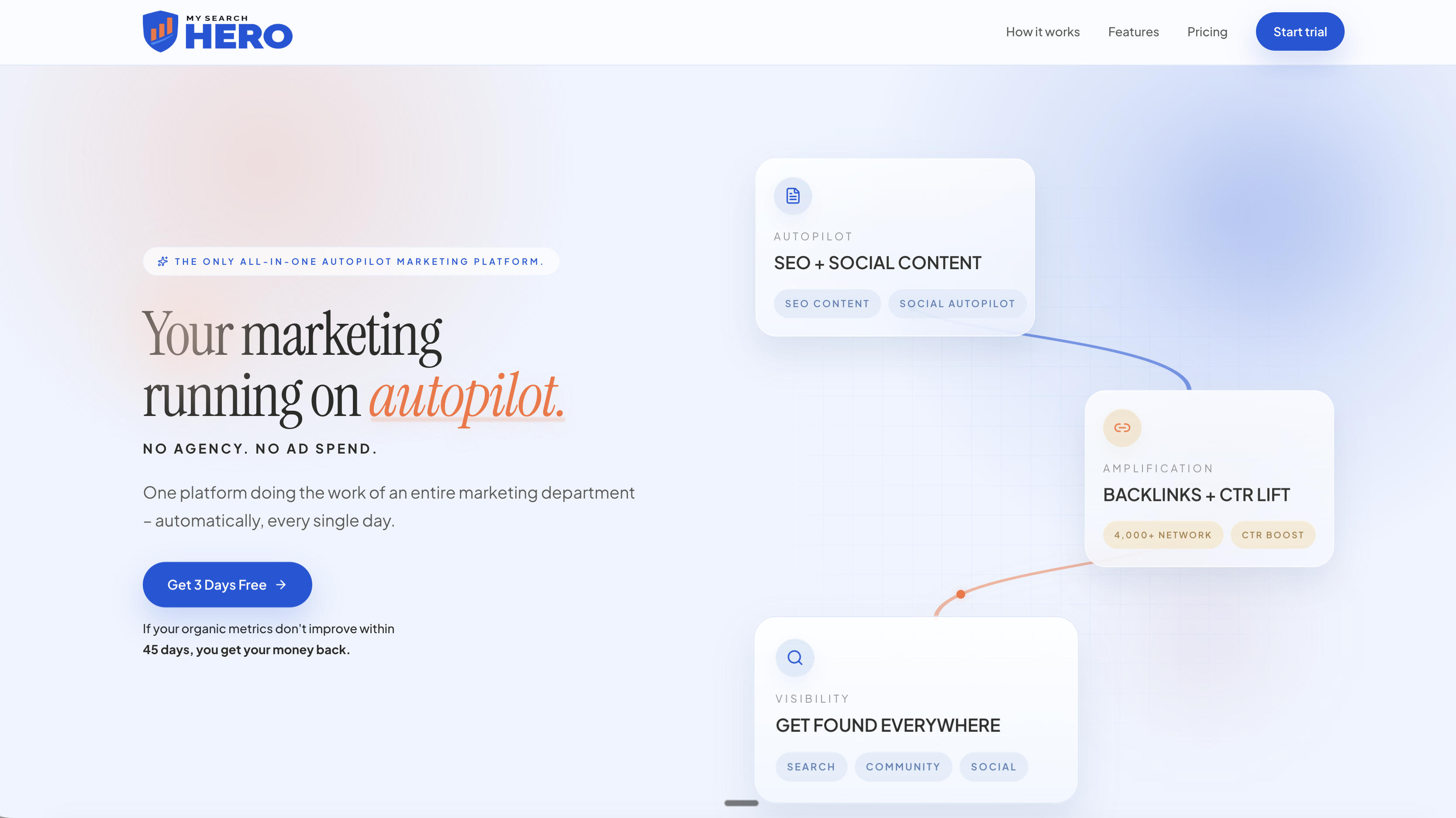
Mysearchhero is a done-for-you SEO and content marketing service built to handle exactly this kind of ongoing work. Each month, subscribers receive published articles, backlinks, Reddit mentions, and AI-generated social media posts through a fully automated pipeline. The content is built for mobile-first indexing, structured to perform in both traditional search and AI-generated results, and consistently published so your site gains momentum without requiring your constant attention.
If you are a digital marketer or local business owner who wants to grow organic traffic and improve mobile visibility without managing every moving part yourself, Mysearchhero is designed for you. Explore the platform and see how automated SEO execution turns mobile optimization into a consistent business advantage.
FAQ
What is mobile-first indexing and why does it matter?
Mobile-first indexing means Google uses your site’s mobile version as the primary source for ranking. If your mobile content is incomplete or slow, your rankings drop across all devices.
How does page speed affect mobile conversions?
A 1-second delay in mobile load time reduces conversions by approximately 7%, while sites loading under 2 seconds convert 32% more than slower competitors.
What are Core Web Vitals and how do they affect mobile SEO?
Core Web Vitals are Google’s page experience metrics covering load speed (LCP), interactivity (INP), and visual stability (CLS). As of early 2026, only 49.7% of mobile sites pass all three, making them a clear ranking differentiator.
How do I measure real mobile SEO performance accurately?
Use Google Search Console’s Core Web Vitals report, which relies on field data from real users rather than simulated lab conditions. Lab tools are useful for diagnostics but don’t reflect what actually influences your rankings.
What is the fastest way to improve mobile SEO?
Start by compressing images, deferring non-critical third-party scripts, and checking Google Search Console for mobile usability errors. These three fixes combined produce the most immediate improvements to Core Web Vitals scores and load times.