
Multi-location SEO is the practice of optimizing a single brand so every physical location ranks in its own local market while the shared domain builds cumulative authority across all of them. If you run three locations or three hundred, the playbook starts the same way: five actions, done now.
Start here:
- Verify one Google Business Profile per physical address (not per service area, not per manager).
- Publish a unique location page at a subdirectory URL (yoursite.com/locations/city-neighborhood) for each address.
- Audit and centralize your NAP data (name, address, phone) into a single master spreadsheet so every listing matches exactly.
- Add LocalBusiness schema on each location page with the address, phone, hours, and geo-coordinates.
- Assign clear ownership: decide which tasks corporate controls and which local managers handle, then document a phased rollout order.
In the first 30–90 days, watch three signals: GBP verification status (confirmed vs. pending), page indexing (submit each location URL to Google Search Console), and review volume per location (even two or three fresh reviews per month signals activity). Those three metrics tell you whether the foundation is working before you invest in anything else.
Check your local SEO checklist to make sure nothing slips through the cracks during setup.
Key Takeaways
Multi-location SEO requires consistent entity signals at every location, built on a single domain, governed by clear ownership rules, and measured at both location and brand level.
| Point | Details |
|---|---|
| One GBP per address | Verify a separate Google Business Profile for each physical location, linked to its own location page URL. |
| Subdirectory structure | Use yoursite.com/locations/city for each location to consolidate domain authority across the full portfolio. |
| NAP consistency is foundational | A master data repository and aggregator sync (Data Axle, Foursquare) prevent citation drift that weakens entity signals. |
| Schema and corroboration | LocalBusiness schema with sameAs links connects your location pages to third-party listings for AI recommendation systems. |
| Mysearchhero automates delivery | Mysearchhero’s subscription pipeline publishes location-specific content, backlinks, and social posts monthly without a full-time team. |
Table of Contents
- What is multi-location SEO and why does it change everything?
- The core components of a multi-location SEO program
- How to structure location landing pages for scale
- Managing Google Business Profile and third-party listings
- Citations, aggregators, and third-party corroboration
- Review strategy and reputation management across many locations
- Corporate vs. local content roles and avoiding keyword cannibalization
- Technical setup and LocalBusiness schema for each location
- KPIs, reporting cadence, and tools for multi-location SEO
- Common multi-location SEO problems and how to fix them
- Typical timelines, resource needs, and cost expectations
- Expert research: entity signals and becoming the business AI recommends
- How multi-location SEO and paid local advertising work together
- What actually breaks multi-location SEO (and what fixes it)
- Mysearchhero handles the operational load so you can focus on the business
- Sources
- FAQ
What is multi-location SEO and why does it change everything?
Most businesses treat local SEO as a single-location problem: one GBP, one “Contact Us” page with an address, done. Multi-location SEO is categorically different. Each physical location needs its own signals, its own page, its own reviews, and its own presence in local directories. The domain ties them together, but the location-level signals are what actually drive foot traffic.
Google ranks local results based on three factors: relevance, distance, and prominence. Relevance is how well your profile and page match what someone searched. Distance is proximity to the searcher. Prominence is how well-known and trusted the business is, measured through reviews, links, and citations. A brand with ten locations has to earn all three signals for each location independently. A single homepage with a list of addresses earns almost none of them.
The business case is straightforward. When someone searches “plumber near me” or “coffee shop open now,” Google’s local pack shows three results. Those three spots drive calls, direction requests, and walk-ins. A brand that appears in the local pack for eight of its ten locations captures eight times the foot traffic opportunity compared to one that only shows up for its flagship store.
Stat: According to Search Engine Journal’s expert analysis, multi-location visibility is shifting from traditional rankings to entity-driven AI recommendations. Brands that build consistent data signals across listings, reviews, and third-party sources are the ones AI systems surface first.
A single-domain subdirectory approach compounds authority across all locations. Every backlink the brand earns, every piece of content published, every citation built strengthens the domain. That domain strength flows to every location page sitting on it. Separate domains for each location throw that advantage away.
The core components of a multi-location SEO program
A complete program has five interdependent layers. Weakness in any one of them limits what the others can accomplish.
- Location pages and site architecture: One authoritative URL per location, built on a consistent subdirectory structure, with unique content for each address.
- Google Business Profiles and third-party listings: One verified GBP per physical location, plus consistent presence in major aggregators and industry directories.
- Reviews and reputation management: A repeatable system for soliciting, responding to, and monitoring reviews at the location level, not just brand-wide.
- Content governance: Clear rules about what corporate owns (brand authority, evergreen content) and what local teams own (team bios, local events, neighborhood-specific details).
- Technical foundations and measurement: LocalBusiness schema on every location page, clean sitemaps, mobile performance, and a reporting dashboard that tracks KPIs at both location and brand level.
These five layers map to what Search Engine Land describes as the full multi-location SEO program: GBP management at scale, unique location pages, citation building, review strategy, and consistent technical foundations.
How to structure location landing pages for scale
Subdirectory vs. subdomain vs. separate sites
The default choice for most multi-location brands is the subdirectory: yoursite.com/locations/chicago-lincoln-park. A subdirectory approach consolidates domain authority so backlinks and content on the main domain benefit every location page. Subdomains (chicago.yoursite.com) split that authority and require separate crawl budgets. Separate domains multiply the problem by ten or a hundred.
The exceptions are narrow: a franchise where each franchisee is a legally distinct business with its own brand identity, or an acquisition where the acquired brand has significantly more local authority than the parent. Outside those cases, subdirectory wins.
Search Engine Land recommends building the smallest number of purposeful pages that accurately represent real locations, using hub-and-spoke linking and a dedicated locations sitemap to avoid page bloat. That means no city pages for cities where you have no physical presence. Every page must represent a real place.
What every location page must include
- A unique H1 that names the location (city, neighborhood, or both).
- 300–500 words of unique, localized content that is not copy-pasted from other location pages.
- An embedded Google Map pinned to that address.
- Crawlable NAP in plain text (not an image, not a JavaScript-rendered element).
- Authentic photos of that specific location (not stock photos used on every page).
- LocalBusiness schema with name, address, phone, hours, and geo-coordinates.
URL and canonical governance
Pick one URL format and use it everywhere: on the GBP listing, in the sitemap, in internal links, and in citations. A self-referencing canonical tag on each location page prevents duplicate content signals if the same page is accessible via multiple paths. Submit location URLs to Google Search Console individually so you can track indexing status per location.
Pro Tip: Apply the 80/20 rule to your rollout. Refine the template on three to five locations before scaling the process to the rest of your portfolio.
Managing Google Business Profile and third-party listings
Setting up and verifying each GBP
- Create one GBP per physical address. Do not create service-area profiles for locations that have a storefront.
- Use a local phone number for each location, not a centralized call center number.
- Verify each profile through Google’s verification process. Bulk verification is available for brands with ten or more locations.
- Assign ownership roles: one corporate admin who controls all profiles, plus a local manager role for each location to handle posts and Q&A.
- Monitor for status changes monthly. Google can suspend, merge, or unverify profiles without warning, especially after address changes or ownership transfers.
Which GBP fields drive the most impact
- Primary category: The single most important field. Choose the most specific category that matches your core service.
- Business hours: Keep these accurate and update them for holidays. Inaccurate hours generate negative reviews and suppress local pack visibility.
- Service options: Mark dine-in, takeout, delivery, or in-store shopping as applicable. These filter into local search results.
- Photos: Upload location-specific photos monthly. Profiles with active photo uploads tend to receive more direction requests and calls.
- Q&A: Seed this section with the questions customers actually ask. Unanswered Q&A gets filled in by strangers, sometimes inaccurately.
- Posts: Use weekly or biweekly posts for offers, events, or updates. Posts signal an active, maintained profile.
Link each GBP directly to its corresponding location page URL, not the homepage. That connection between the GBP and the location page is how Google ties the entity signal on the profile to the content signal on the site.
Pro Tip: Buyers often audit your profile before they ever reply or visit. A complete, photo-rich, actively maintained GBP builds trust before the first call. Profile completeness directly affects conversion rates at the location level.

Citations, aggregators, and third-party corroboration
The directories and aggregators that matter most
| Platform | Type | Why It Matters |
|---|---|---|
| Data Axle | Aggregator | Feeds hundreds of downstream directories from one submission |
| Foursquare | Aggregator | Powers location data for Apple Maps, Uber, and other platforms |
| Yelp | Consumer directory | High domain authority; reviews influence local pack signals |
| TripAdvisor | Industry directory | Critical for hospitality, restaurants, and tourism businesses |
| Nextdoor | Neighborhood platform | Hyper-local reach; strong for service businesses |
| Google Business Profile | Primary listing | The most influential single listing for local search |
How to manage citation data at scale
Consistent NAP across every listing is not optional. A phone number formatted differently on Yelp than on your website creates a data conflict that weakens entity signals. The fix is a master data repository: a single spreadsheet or platform record that holds the canonical name, address, phone, website URL, and hours for every location. Every listing update starts from that record.
Use data sync tools to push updates from the master record to aggregators like Data Axle and Foursquare. When those aggregators update, the downstream directories they feed update too. That one-to-many relationship makes aggregator management the highest-leverage citation task.
The sameAs property in LocalBusiness schema lets you declare the relationship between your location page and its listings on Yelp, TripAdvisor, and other platforms. Search engines and AI systems use those declared connections to corroborate entity identity across sources.
Third-party mentions in local news, neighborhood blogs, and industry publications serve as corroboration signals. A restaurant that appears in a local food publication, has a Yelp listing, a TripAdvisor profile, and a GBP with 80 reviews is a much stronger entity signal than one with only a GBP.
Review strategy and reputation management across many locations
Building a repeatable review workflow
- Time the request right. Ask for a review within 24–48 hours of a completed service or transaction, when the experience is fresh.
- Choose the right channel. SMS and email both work; SMS tends to get higher open rates. Send a direct link to the GBP review form for that specific location.
- Keep it short. One sentence asking for honest feedback, one link. No lengthy explanation.
- Respond to every review. Positive reviews get a brief, specific thank-you (mention the location or service). Negative reviews get a calm, factual response within 24 hours, with an offer to resolve offline.
- Track velocity per location. A location getting zero new reviews for 60 days needs attention. Review freshness is a ranking signal.
New locations need a burst of early reviews to establish credibility. Established locations need consistent velocity to maintain it. Those are different problems with different tactics.
Pro Tip: Surface location-specific testimonials on the location page itself, not just on the GBP. A quote from a customer mentioning the neighborhood or a specific staff member adds unique, localized content that generic pages cannot replicate. Reviews play a direct role in local SEO rankings and should be treated as a content asset, not just a reputation metric.

Handling negative reviews at scale
When a negative review appears, respond publicly within 24 hours. Acknowledge the issue without admitting liability, offer a resolution channel (phone or email), and close the response professionally. If the review contains false information or violates platform policies, flag it for removal through the platform’s reporting tool.
For reviews that escalate to legal or reputational risk, escalate to corporate PR or legal counsel before responding publicly. A poorly worded public response to a serious complaint can cause more damage than the original review.
Corporate vs. local content roles and avoiding keyword cannibalization
Clear content ownership is the most underrated governance decision in multi-location SEO. Search Engine Land’s analysis shows that unclear ownership between corporate and local teams drives keyword cannibalization: two pages on the same domain competing for the same local keyword, splitting authority and ranking for neither.
What corporate should own:
- Brand-wide service pages (the authoritative “what we do” content)
- Evergreen educational content and blog posts
- The main locations hub page (
yoursite.com/locations/) - Technical templates and schema markup standards
What local teams should own:
- Location-specific details: team bios, local hours, parking, neighborhood landmarks
- Local events and promotions
- Community involvement and local partnerships
- Location-specific FAQs
A centralized keyword map prevents duplication. Assign one target keyword cluster per location page and document it. If “HVAC repair Chicago” belongs to the Chicago location page, no blog post or service page should target that exact phrase. Templates help here: build a content brief template with required variables (location name, neighborhood, local landmark, team member name) that must be filled in uniquely for each page. A page that fills those variables with real, specific information cannot be a doorway page.
Content approval workflows matter at scale. Local teams should have publishing rights for their own location page updates, but a corporate editor should review any changes to template structure or primary keyword targeting. That split keeps content fresh without letting local teams accidentally create cannibalization problems.
For practical content marketing examples that work at the location level, the pattern is consistent: specific beats generic every time.
Technical setup and LocalBusiness schema for each location
Schema markup that makes locations machine-readable
Every location page needs LocalBusiness structured data with at minimum:
name: the exact business name as it appears on the GBPaddress: full PostalAddress with street, city, state, and ziptelephone: the local phone numberopeningHoursSpecification: hours by day of weekgeo: latitude and longitude coordinatessameAs: URLs of the GBP listing, Yelp page, and other authoritative profiles
The sameAs property is particularly valuable for AI-driven search. It explicitly declares that the entity on your location page is the same entity as the one on Yelp, TripAdvisor, and the GBP. That cross-source corroboration is exactly what AI recommendation systems look for when deciding which business to surface.
Stat: Search Engine Journal’s expert analysis confirms that brands with consistent entity signals across web properties, review platforms, and third-party sources are the ones AI systems recommend. Schema markup is the technical layer that makes those connections explicit.
Canonical tags, sitemaps, and mobile performance
Use self-referencing canonical tags on every location page. If a location is accessible at both /locations/chicago/ and /locations/chicago-il/, pick one, redirect the other, and canonical the winner.
Segment your XML sitemap: maintain a separate locations sitemap (sitemap-locations.xml) and submit it to Google Search Console. This makes it easy to monitor indexing status for location pages specifically, without mixing them into the broader site sitemap.
Mobile performance is not optional for local SEO. The majority of “near me” searches happen on mobile devices. A location page that loads slowly or renders poorly on a phone loses the conversion even when it ranks. Monitor Core Web Vitals per location page in Search Console and prioritize fixes on your highest-traffic location pages first.
KPIs, reporting cadence, and tools for multi-location SEO
What to measure at location level vs. brand level
Location-level KPIs:
- Local pack impressions (GBP Insights)
- GBP actions: calls, direction requests, website clicks
- Review count and average rating per location
- Local organic traffic to each location page (Google Analytics)
- Conversions attributed to local traffic (form fills, calls, bookings)
Brand-level KPIs:
- Domain visibility score (tracked in rank monitoring tools)
- Total verified GBP listings vs. total physical locations
- Aggregate review count and rating trend
- Crawl and index health (Search Console coverage report)
Tool categories and task ownership
| Tool Category | What It Tracks | Who Owns It |
|---|---|---|
| GBP management platforms | Profile completeness, post scheduling, Q&A, photo uploads | Corporate marketing |
| Citation and data aggregators | NAP consistency, listing coverage, aggregator sync | Corporate SEO or agency |
| Local rank trackers (e.g., BrightLocal) | Local pack rankings per location, keyword position trends | Corporate SEO |
| Centralized dashboards (e.g., AgencyAnalytics) | Cross-location KPI rollup, client/executive reporting | Corporate SEO or agency |
| Review monitoring platforms | Review volume, velocity, sentiment per location | Local manager + corporate oversight |
BrightLocal is purpose-built for local rank tracking and citation auditing across multiple locations. AgencyAnalytics handles cross-location KPI rollup and is particularly useful when reporting to executives or clients who need a single view across the portfolio. Neither replaces the other; they solve different parts of the measurement problem.
Reporting cadence: location-level GBP metrics weekly, local organic traffic and rankings monthly, full citation and schema audits quarterly.
Common multi-location SEO problems and how to fix them
The most frequent failures and their fixes
-
Pages not indexed. Check Search Console for crawl errors on location URLs. Common causes: noindex tags left on from staging, thin content triggering quality filters, or the page not linked from anywhere on the site. Fix: add internal links from the locations hub page, remove noindex tags, and add 300+ words of unique content.
-
Inconsistent NAP. Run a citation audit using BrightLocal or a similar tool. Export every listing for every location and compare against the master data repository. Fix: update aggregators (Data Axle, Foursquare) first, since they feed downstream directories. Then correct major directories (Yelp, TripAdvisor) directly.
-
Duplicate GBP listings. Search Google Maps for your business name in each city. If duplicate listings appear, claim the correct one and request removal of duplicates through GBP support. Fix: after removal, verify the correct listing and lock the address field to prevent future duplicates.
-
Keyword cannibalization. Use Google Search Console’s Performance report filtered by location-specific queries. If two URLs rank for the same local keyword, one of them is competing against the other. Fix: consolidate content onto the authoritative location page, 301-redirect the weaker URL, and update internal links.
-
GBP suspended or unverified. This usually happens after an address change or a policy violation. Fix: submit a reinstatement request through GBP support with documentation (utility bill, business license) proving the address.
Pro Tip: Lock the business name and address fields in your GBP management platform so local managers cannot accidentally edit them. Governance changes that prevent problems are worth ten times more than fixes applied after the fact.
Typical timelines, resource needs, and cost expectations
How long multi-location SEO actually takes
The pilot phase runs roughly three months: pick three to five high-potential locations, build and publish their location pages, verify their GBPs, fix NAP, add schema, and set up review workflows. By month three, you have a tested template and real data on what works.
Each subsequent rollout phase covers a batch of locations and takes one to three months depending on location count and content complexity. A brand with 50 locations might run three rollout phases of 15 locations each. A franchise with 500 locations needs a platform and a dedicated team.
Ongoing maintenance runs continuously: monthly GBP updates, quarterly citation audits, and a review monitoring cadence that never stops.
Resource and cost ranges
| Location Count | Recommended Approach | Approximate Effort Per Location |
|---|---|---|
| 1–10 | DIY with tools (BrightLocal, GBP) | 4 hours setup, 1–2 hours/month |
| 10–50 | Agency or managed service | 2–4 hours setup (with templates), 1 hour/month |
| 50+ | Platform + agency or in-house team | Template-driven; 1–2 hours setup, platform handles ongoing |
Cost ranges (approximate, US market):
- DIY with tools: $100–$300/month in software subscriptions
- Agency or consultant: $1,500–$5,000/month for a 10–50 location portfolio
- Enterprise platform plus agency: $5,000–$20,000+/month for 50+ locations
These ranges vary significantly by industry, market competitiveness, and the current state of the location data. A brand starting with clean, consistent NAP data costs less to manage than one with years of citation drift.
Expert research: entity signals and becoming the business AI recommends
The frame for modern local SEO has shifted. Search Engine Journal’s analysis of multi-location visibility makes the direction clear: the goal is no longer just to rank in the local pack. The goal is to become the business an AI system recommends when a user asks a conversational question.
That shift changes where you invest. Traditional local SEO optimized for a single page and a single GBP. Entity-first SEO optimizes for a consistent signal across every source that mentions the business: the GBP, the location page, Yelp, TripAdvisor, Nextdoor, local news coverage, and industry directories. The more sources that agree on who you are, where you are, and what you do, the higher the AI’s confidence in recommending you.
The trust triangle has three sides:
- Business data: NAP accuracy across all listings and aggregators (the factual foundation).
- Website location pages: The single source of truth for each location’s content and schema (the owned signal).
- Third-party corroboration: Reviews, directory listings, local news mentions, and social proof (the external validation).
Weaken any side and the triangle loses integrity. A brand with perfect location pages but inconsistent citations sends a mixed signal. A brand with great reviews but no schema markup makes it harder for AI systems to connect the review entity to the website entity.
Practical implication: budget allocation should cover all three sides. Content and technical work strengthen the website layer. Citation management and aggregator sync strengthen the data layer. Review campaigns and local PR strengthen the corroboration layer. Local business marketing tactics that generate genuine community coverage are worth more than ever in an AI-driven search environment.
How multi-location SEO and paid local advertising work together
Organic local SEO and paid local advertising are not separate strategies. They reinforce each other, and the data flows both ways.
Google Local Services Ads (LSAs) and Google Ads location extensions both pull from GBP data. A verified, complete GBP with accurate hours and photos makes paid ads more effective because the ad unit inherits that information. A GBP with missing hours or a suspended listing breaks the ad extension entirely.
Organic local rankings tell you which locations and keywords are already converting without paid spend. That data should inform where you run paid campaigns: locations where organic rankings are weak but the market is high-value are the best candidates for paid support. Locations where organic already dominates the local pack may not need paid at all.
Paid campaigns generate clicks and conversions that feed back into organic signals. A location page that receives consistent traffic and engagement signals to Google that the page is relevant and useful. Running a paid campaign to a location page during its first 60–90 days, before organic rankings have built, can accelerate that signal.
Local inventory ads and promotion extensions work best when the location page they link to is fully built out. A paid ad that sends a user to a thin, generic location page wastes the click. The location page is the landing page; its quality determines whether the paid click converts.
For brands running campaigns across many locations, content promotion strategies that combine organic content with paid amplification at the location level tend to outperform either channel used in isolation.
What actually breaks multi-location SEO (and what fixes it)
Most multi-location SEO failures trace back to one of two root causes: nobody owns the data, or nobody owns the governance.
The data problem looks like this: the GBP for location 14 still shows the old phone number from two years ago. The Yelp listing for location 7 has a different suite number than the website. The location page for location 22 was published by a local manager who copied the content from location 21 and changed the city name. None of these are catastrophic individually. Together, they create an entity signal that search engines and AI systems cannot trust.
The governance problem looks like this: corporate built a location page template, but local managers have edit access and have been “personalizing” their pages by removing the schema markup, changing the URL slug, and adding promotional copy that targets the same keywords as the main service pages. Now you have cannibalization, broken schema, and inconsistent URLs across 40 locations.
The fix for both is the same: a master data repository that nobody can edit without a documented approval process, and a GBP management platform that locks the fields that matter most. Automation handles the maintenance; governance prevents the drift.
When to DIY versus when to outsource: brands with fewer than ten locations can manage this in-house with the right tools and a clear process. Beyond that, the operational overhead of managing GBPs, citations, reviews, and content across dozens of locations becomes a full-time job. That is where a managed service or platform subscription pays for itself.
Mysearchhero handles the operational load so you can focus on the business
Running multi-location SEO at scale means publishing location-specific content every month, monitoring GBP profiles for status changes, keeping citations in sync, and managing review workflows across every location simultaneously. Most marketing teams do not have the bandwidth for all of that, and most agencies charge retainer fees that make the math difficult for brands with tight margins.
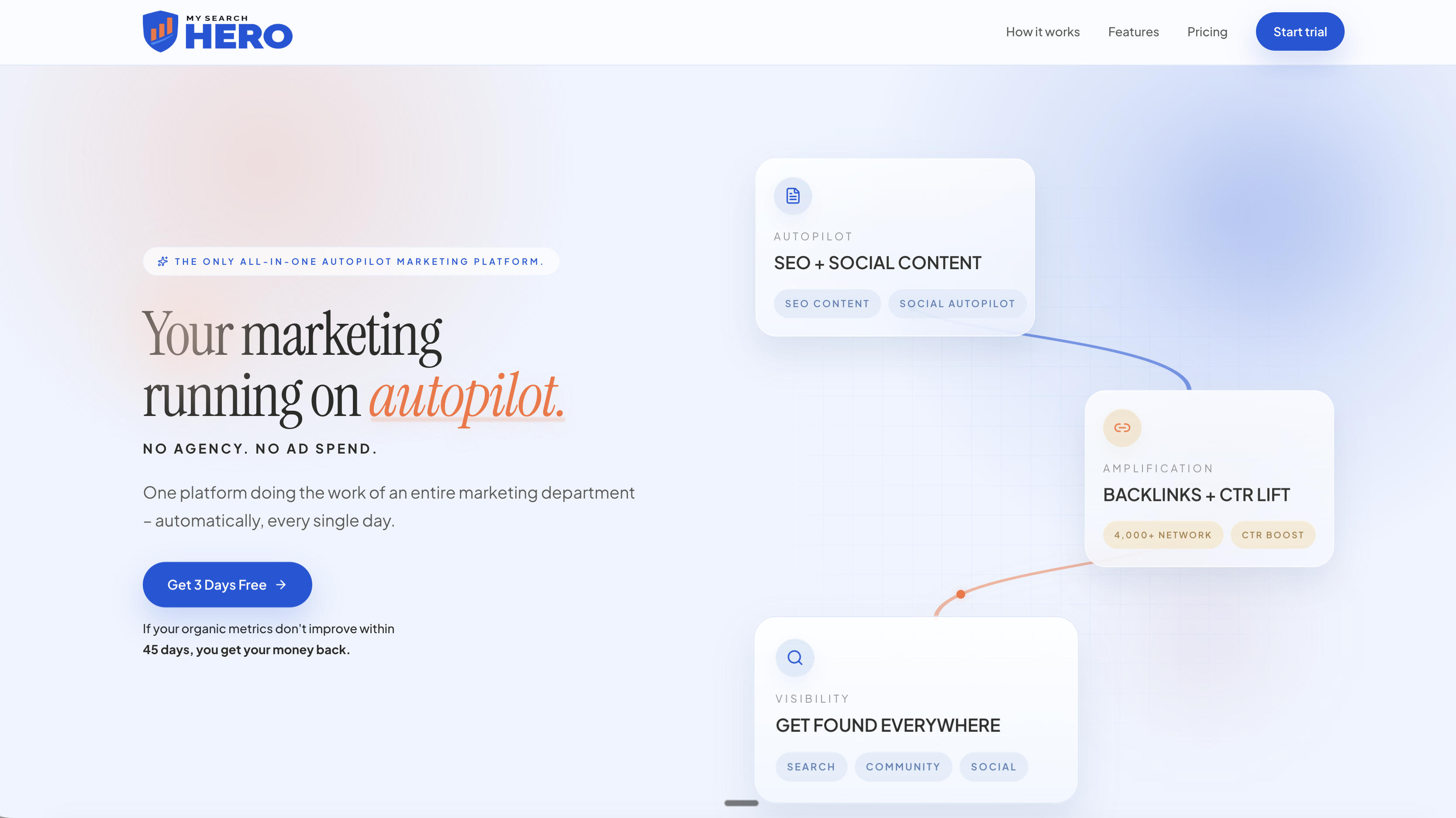
Mysearchhero is the done-for-you alternative: a subscription that delivers published SEO articles, authority backlinks, Reddit brand mentions, and social media posts through an automated pipeline every month. For multi-location brands, that means location-specific content going out consistently without requiring a full-time content team. The platform handles the publishing cadence; you handle the business.
Start with Mysearchhero to see how automated SEO delivery fits your location count and budget. The first step is a conversation about your current setup and where the biggest gaps are.
Sources
- Tips to improve your local ranking on Google – Google Business Profile Help
- Schema
- Multi-location search visibility: Winning in Google AI — Search Engine Journal
- Multi-location SEO: How to structure geographic pages at scale — Search Engine Land
FAQ
What is multi-location SEO?
Multi-location SEO is the practice of optimizing a brand so each physical location ranks in its own local market, using separate location pages, verified Google Business Profiles, and consistent citation data across directories, all on a single domain that builds shared authority.
How do you do multi-location SEO?
Start by verifying one Google Business Profile per address, publishing a unique location page at a subdirectory URL for each location, and centralizing NAP data in a master record. Then add LocalBusiness schema, build citations through aggregators like Data Axle and Foursquare, and set up a review solicitation workflow per location.
What does “multi-location” mean in a business context?
A multi-location business operates two or more physical locations, each serving its own local market. In SEO terms, each location needs its own set of signals (GBP, location page, citations, reviews) to rank in local search results for that specific area.
What is location SEO?
Location SEO (also called local SEO) is the process of optimizing a business’s online presence so it appears in local search results when nearby customers search for relevant products or services. For a single location, this means one GBP and one location page. For multiple locations, it means repeating that process for every address.
How long does multi-location SEO take to show results?
Most brands see indexing and GBP verification within the first 30 days. Meaningful local pack visibility typically builds over 3–6 months per location, depending on market competitiveness, review velocity, and citation consistency. High-potential locations optimized first tend to show results fastest.