
Search visibility is the estimated percentage of organic clicks a website earns based on its keyword rankings, weighted by position and search volume. Think of it as a predictive score: if you rank third for a keyword that gets 10,000 monthly searches, your visibility for that term reflects the expected click share at position three, not the actual clicks recorded in Google Search Console. Tools like Semrush and Moz aggregate these estimates across every keyword you track, then express the result as a single percentage from 0% to 100%.
A few things worth knowing right away:
- It is predictive, not actual. Visibility scores forecast potential traffic; real clicks can diverge because AI Overviews, map packs, and featured snippets absorb clicks before users reach your blue link.
- It is keyword-list dependent. You control which keywords go into the calculation, so the score reflects performance on terms that matter to your business, not every query your site happens to rank for.
- Higher positions carry heavier weight. A position-one ranking contributes far more to your score than a position-nine ranking for the same keyword, because click-through rates drop sharply down the page.
- A score of 100% is not realistic. Even if you rank first for every tracked keyword, other SERP features will capture some clicks.
Pro Tip: Start with a tightly curated keyword list aligned to your actual business goals. A visibility score built on 50 highly relevant keywords tells you far more than one built on 500 loosely related terms.
What is search visibility and how is it calculated?
The calculation behind a visibility score is more nuanced than a simple average of your rankings. Every tracked keyword gets weighted by two variables: its monthly search volume and the expected click-through rate (CTR) at your current ranking position. A keyword with 5,000 monthly searches at position one contributes more to your score than a keyword with 50,000 searches where you sit at position eight, because the CTR gap between those positions is enormous.

| Calculation component | What it measures | Why it matters |
|---|---|---|
| Keyword ranking | Your organic position for each tracked term | Higher positions receive exponentially more clicks |
| Search volume | Average monthly searches for each keyword | Weights high-traffic terms more heavily in the score |
| Expected CTR | Predicted click share at your ranking position | Converts rank into an estimated traffic percentage |
| Impression share | Portion of searchers who see your result | Reflects actual SERP exposure, not just ranking |

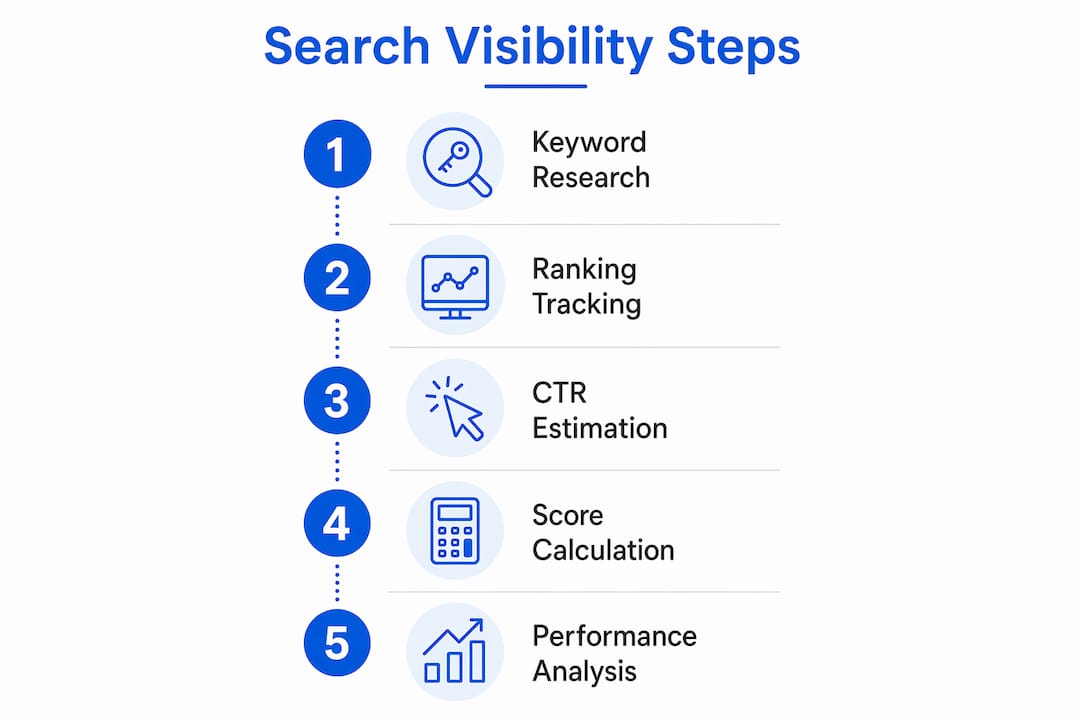
Rank tracking tools pull your positions across all tracked keywords, apply the CTR curve for each position, multiply by search volume, then sum the results and divide by total possible clicks to produce the final percentage. The exact formula varies slightly between platforms, which is why your Semrush visibility score and your Moz score for the same site will rarely match perfectly. What they share is the underlying logic: position times volume times click probability.
Steps most tools follow:
- Pull current organic rankings for every keyword in your tracked list.
- Assign a CTR estimate based on the ranking position (position one typically receives the highest share of clicks).
- Multiply the CTR estimate by the keyword’s monthly search volume to get an estimated click count.
- Sum estimated clicks across all keywords, then divide by total potential clicks if you ranked first for every term.
- Express the result as a percentage.
Pro Tip: When interpreting your score, weight the top-three positions heavily in your analysis. A jump from position four to position two on a high-volume keyword can move your overall visibility score more than gaining ten new rankings in positions eight through fifteen.
Why does search visibility matter for your business?
Visibility is the upstream metric. Before anyone clicks, before anyone converts, your site has to appear. Higher search visibility increases the potential for organic traffic, improves brand exposure in search results, and contributes to business growth through increased leads and conversions. That causal chain is why SEO teams track it as a leading indicator rather than waiting for traffic reports to tell them something went wrong.
The business case for monitoring visibility goes beyond traffic volume:
- Brand awareness at scale. Appearing consistently for relevant queries builds recognition even when users do not click. Repeated exposure in the SERPs trains searchers to associate your brand with a topic.
- Competitive benchmarking. Visibility scores let you compare your share of SERP presence against competitors on the same keyword set, which raw traffic numbers cannot do cleanly.
- Early warning system. A visibility drop often precedes a traffic drop by days or weeks, giving you time to diagnose and respond before revenue is affected.
- Market positioning. Owning the top positions for high-intent keywords signals authority to both search engines and users, which compounds over time as more sites link to the content that ranks.
One honest limitation: visibility does not equal proportional traffic gains. A site can hold strong visibility scores while watching actual clicks stagnate because AI Overviews or featured snippets answer the query without requiring a click. That gap between visibility and traffic is growing, which is why tracking both metrics together gives a more complete picture than either one alone.
What factors influence your search visibility score?
Visibility is a downstream result of nearly everything you do in SEO. Key factors include keyword relevance, content quality, technical SEO, backlinks, and evolving SERP features tied to AI and local results. None of these operates in isolation.
- Keyword targeting and relevance. Ranking for terms your audience actually searches is the foundation. Broad, tangentially related keywords inflate your tracked list without contributing meaningful visibility.
- Content quality and topical authority. Google rewards sites that consistently publish thorough, accurate content on a specific subject. Building topical authority means covering a subject cluster deeply, not just targeting individual keywords in isolation.
- Technical SEO. Site speed, mobile-friendliness, crawlability, and clean URL architecture all affect whether Google can index your pages and rank them competitively. A technically broken page cannot rank regardless of content quality.
- Backlinks and branded mentions. External links from relevant, authoritative sites remain one of the strongest ranking signals. Branded backlinks in particular carry trust signals that generic directory links do not. Similarly, branded mentions across the web reinforce your authority even when they do not carry a hyperlink.
- SERP features and AI integration. Featured snippets, People Also Ask boxes, knowledge panels, and AI Overviews now occupy significant page real estate. Optimizing content to appear in these features can boost visibility even when your traditional blue-link ranking stays flat.
- User engagement signals. Click-through rate from the SERP and on-page engagement metrics feed back into how Google evaluates your content’s relevance, indirectly affecting rankings and visibility over time.
How to improve your website’s search visibility
Improving search visibility comes down to a combination of targeting the right keywords, producing content that earns authority, and keeping your technical foundation solid. No single tactic moves the needle dramatically on its own; the compounding effect of doing several things consistently is what produces lasting gains.
Practical tactics that work:
- Target long-tail keywords. Specific, lower-competition phrases often convert better and are easier to rank for than broad head terms. A new or mid-authority site gains visibility faster by owning a cluster of long-tail terms than by chasing a single high-volume keyword.
- Optimize on-page elements. Title tags, meta descriptions, header structure, and internal linking all influence how Google interprets and ranks your pages. A well-written title tag that matches search intent can lift CTR and, in turn, your visibility score.
- Build topical authority through content clusters. Publish a pillar page on a broad topic, then support it with detailed articles on related subtopics. This signals to search engines that your site is a reliable resource on the subject, not just a one-off page.
- Fix technical SEO gaps. Use tools like Google Search Console and WebPageTest to identify crawl errors, slow load times, and mobile usability issues. Pages that load slowly or render poorly on mobile rank lower, which directly suppresses visibility.
- Earn quality backlinks. A single link from a relevant, high-authority publication outweighs dozens of low-quality directory links. Guest posts, original research, and linkable assets like data studies or free tools are reliable ways to attract them.
- Optimize for SERP features. Structure content with clear headers, concise answers to common questions, and schema markup where appropriate. Pages formatted to answer specific questions are more likely to appear in featured snippets and People Also Ask results.
- Refresh existing content. Updating older articles with current data, expanded sections, and better internal links often produces faster visibility gains than publishing new content from scratch.
Pro Tip: Run a content gap analysis against the top-ranking pages for your target keywords. The sections they cover that you do not are your fastest path to closing the visibility gap.
How is search visibility evolving in 2026?
The definition of search visibility is expanding. Modern SEO experts note that visibility now accounts for more than rank positions; it includes presence in AI-powered search answers, knowledge panels, and local map packs. A site that ranks fifth for a keyword but appears in the AI Overview for that same query may actually receive more brand exposure than the site ranking second in the traditional blue-link results.
The concept of “SERP real estate” captures this shift. Organic search visibility is no longer simply a measure of keyword rankings. It means building a sustainable presence in search results regardless of whether the query drives an organic click. That reframe has practical consequences for how you set goals and measure success.
Key developments shaping visibility in 2026:
- AI Overviews absorb clicks. Google’s AI-generated answer summaries appear above traditional results for a growing share of queries, particularly informational ones. Visibility scores may stay flat or rise while actual clicks fall, because the AI answer satisfies the query without a page visit.
- Local map packs dominate local intent. For searches with geographic intent, the map pack occupies prime SERP real estate. A business not optimized for local SEO is essentially invisible for those queries regardless of its organic ranking.
- Knowledge panels and entity recognition. Brands with strong entity signals, consistent NAP (name, address, phone) data, and Wikipedia or Wikidata presence are more likely to trigger knowledge panels, which provide visibility without a traditional ranking.
- A “good” visibility score is relative. In competitive non-branded categories, a score in the mid-40s percentile range is often considered strong. In a niche with low competition, the same score might indicate underperformance.
Stat to know: A “good” search visibility score in competitive non-branded categories is typically in the mid-40s percentile range, according to industry practitioners tracking visibility benchmarks.
SEO professionals are shifting focus from chasing a 100% visibility score to maximizing the total SERP real estate their brand owns. That means optimizing for featured snippets, local packs, AI citations, and image results alongside traditional organic rankings. Understanding why service pages matter for rankings in this environment is part of that broader strategy.
How does search visibility affect traffic and business outcomes?
Visibility and traffic are related but not the same thing, and confusing the two leads to bad decisions. Search visibility scores are predictive, not direct measures of traffic. Actual organic traffic can diverge because features like AI Overviews and map packs occupy SERP space that previously sent clicks to organic results.
That said, the relationship between visibility and business outcomes is real and measurable across several dimensions. A site with strong visibility for high-intent commercial keywords consistently outperforms lower-visibility competitors in lead volume, because it appears more often in front of users who are actively looking to buy or hire. Brand-awareness queries work differently: visibility for informational terms builds recognition and trust over time, which shortens the sales cycle when those same users later search with commercial intent.
The traffic-to-visibility gap also varies by industry. In sectors where AI Overviews are rare, such as highly technical B2B topics or local service queries, visibility and traffic track closely. In informational categories where AI Overviews are common, a site can hold strong visibility while watching click volume stagnate. Tracking both metrics in parallel, rather than relying on visibility alone, is the only way to catch that divergence early.
For small businesses, the business case for tracking SEO metrics like visibility is straightforward: it tells you whether your SEO investment is building momentum before that momentum shows up in revenue. A rising visibility score on your core commercial keywords is a reliable leading indicator that traffic and conversions will follow, assuming your landing pages convert at a reasonable rate. A flat or falling score, on the other hand, is a signal to act before the revenue impact arrives.
Key Takeaways
Search visibility is the most reliable leading indicator of organic SEO performance: it predicts potential traffic based on keyword rankings, search volume, and position-weighted click-through rates, and it responds to SEO changes faster than actual traffic data does.
| Point | Details |
|---|---|
| Visibility is predictive, not actual | The score estimates potential clicks based on rankings and volume, not clicks already recorded. |
| Calculation uses three inputs | Keyword ranking, monthly search volume, and expected CTR at that position determine the score. |
| A good score is relative | In competitive non-branded categories, a score in the mid-40s percentile range is typically considered strong. |
| Visibility is expanding beyond rankings | AI Overviews, knowledge panels, and local packs now form part of total SERP real estate. |
| Mysearchhero automates visibility growth | Monthly SEO bundles covering articles, backlinks, and mentions build visibility consistently without manual effort. |
Search visibility in 2026 is not what most SEO guides say it is
Most articles on this topic treat search visibility as a single number to chase upward. That framing made sense five years ago, when organic blue links dominated the SERP and a position-one ranking reliably delivered the lion’s share of clicks. The SERP in 2026 looks nothing like that.
AI Overviews now answer a large and growing share of informational queries without sending users anywhere. Local map packs dominate the fold for any query with geographic intent. Knowledge panels pull brand information directly from structured data sources. In that environment, a visibility score built entirely on traditional rank tracking is measuring a shrinking slice of the actual search experience.
The more useful mental model is SERP real estate ownership. How much of the visible page does your brand control across all result types, not just blue links? A site that ranks fourth organically but also appears in the AI Overview, holds a featured snippet on a related query, and shows up in the local pack for nearby searches, owns far more real estate than a site that ranks second in traditional results and nothing else.
What this means practically: your SEO strategy needs to optimize for multiple result types simultaneously. That requires structured content that answers specific questions cleanly (for featured snippets and AI citations), consistent local signals (for map pack inclusion), and entity-level brand recognition (for knowledge panels). Rank tracking alone will not tell you whether you are winning or losing on those fronts.
The other thing most guides understate is the compounding nature of visibility gains. A site that builds topical authority in a niche does not just rank for the keywords it targeted. It starts ranking for adjacent queries it never explicitly optimized for, because Google recognizes it as a trusted source on the subject. That compounding effect is why consistent, high-quality content production outperforms sporadic bursts of optimization activity over any meaningful time horizon. Investing in SEO in 2026 is not about chasing algorithm updates. It is about building the kind of site that search engines want to surface regardless of how the algorithm evolves.
Mysearchhero puts your search visibility on autopilot
Growing search visibility consistently requires publishing quality content, earning backlinks, and maintaining a steady presence across the web month after month. Most businesses have the intent but not the bandwidth to execute that reliably.
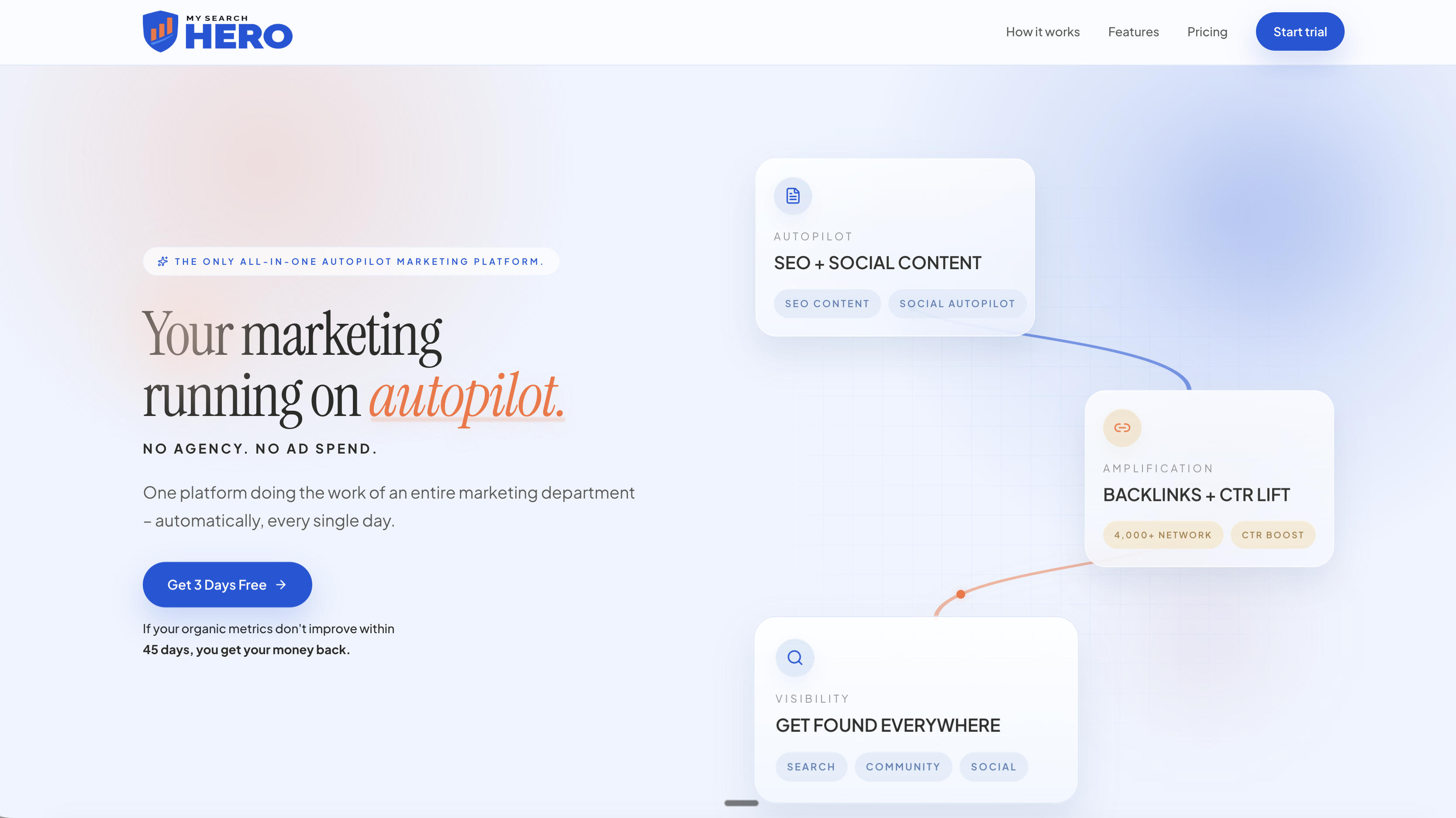
Mysearchhero delivers a done-for-you monthly SEO bundle that covers every major visibility driver: published articles built around your target keywords, branded backlinks from relevant sources, Reddit mentions that extend your reach, and AI-generated social media posts that keep your brand active across channels. Everything ships through an automated pipeline, so your visibility compounds without consuming your team’s time. You get the output of a full SEO operation without the overhead of hiring one.
For businesses that want to grow their organic presence without managing the process themselves, Mysearchhero is the direct alternative to building an in-house SEO team or paying agency retainers.
FAQ
What is search visibility in SEO?
Search visibility is the estimated percentage of organic clicks a website earns based on its keyword rankings, weighted by position and search volume. Tools like Semrush and Moz calculate it by combining rank data, expected click-through rates, and monthly search volumes across your tracked keyword list.
How do you calculate a search visibility score?
The score is calculated by assigning an expected CTR to each keyword based on your ranking position, multiplying that by the keyword’s monthly search volume, summing the results across all tracked keywords, and dividing by the total clicks possible if you ranked first for every term.
How do you increase Google search visibility?
Improving visibility involves targeting relevant long-tail keywords, optimizing title tags and meta descriptions, building topical authority through content clusters, earning quality backlinks, and fixing technical SEO issues that prevent pages from ranking competitively.
What does website visibility mean in practice?
Website visibility measures how prominently your site appears across a defined set of relevant search queries, reflecting your share of potential organic traffic for those terms. A higher score means your site shows up more often and in higher positions for the keywords that matter to your business.
How is search visibility different from impressions or clicks?
Search visibility differs from impressions and clicks because it measures performance across a controlled list of relevant keywords you choose, rather than every query your site ranks for. Impressions in Google Search Console cover all queries; visibility focuses only on the terms aligned with your business goals, making it a more targeted performance signal.