
A digital marketing strategy is a unified plan that connects your business goals to the specific channels, content, and metrics that will actually move revenue. Not a list of tactics. Not a content calendar. A strategy defines why you’re marketing, who you’re reaching, and how every channel decision ties back to a measurable outcome. The businesses that grow predictably online share one thing: they treat digital marketing as a system, not a series of disconnected campaigns.
Building that system starts with five core elements:
- Business objectives: Revenue targets, lead volume, or brand reach goals tied to clear timelines
- Buyer personas: Research-backed profiles of your ideal customers, including pain points and buying triggers
- Channel selection: A focused set of core platforms where your audience actually spends time
- Content and messaging: A plan for what you’ll publish, how often, and why it earns attention
- KPIs and measurement: The metrics that tell you whether the strategy is working, not just whether people clicked
Depth beats breadth at every stage. A business that owns a channel completely will outperform one that shows up weakly across many.
What’s the difference between a strategy, a campaign, and a tactic?
Most marketing failures trace back to this confusion. A strategy is the overarching plan. It answers the big questions: why are you marketing, who are you trying to reach, what position do you want to own in the market, and which channels will get you there. It doesn’t change every quarter.

A campaign lives inside the strategy. It’s a coordinated push toward a specific objective, like generating 200 leads in Q3 or launching a new product to an existing audience. Campaigns have start and end dates, dedicated budgets, and defined success metrics.
Tactics are the individual actions that execute a campaign. Running a Google Ads group, publishing a blog post, sending a promotional email. These are the smallest unit of execution.
The problem is that most businesses substitute tactics for strategy, jumping straight to “we need to post on Instagram” without ever asking whether Instagram is the right channel for their audience or their goals. When tactics drive decisions, budgets fragment, teams lose focus, and results become impossible to attribute. Strategy is the frame that makes every tactic intentional.
What are the key components of a digital marketing strategy?
Every effective marketing strategy plan shares the same structural bones, even when the execution looks completely different across industries.
The table below maps each component to its purpose and a practical example:
| Component | Purpose | Example |
|---|---|---|
| Business objectives | Anchor all activity to measurable outcomes | Grow MQLs by a clear percentage within a defined period |
| Buyer personas | Align messaging and channels to real customer behavior | A SaaS founder who researches on LinkedIn |
| Unique value proposition | Differentiate your offer from alternatives | “The only tool that does X without requiring Y” |
| Channel selection | Focus resources where ROI is achievable | Select core channels such as Search, email, and LinkedIn (SES framework) |
| Content plan | Build consistent audience engagement | Weekly SEO articles, monthly email newsletter |
| Budget allocation | Prevent fragmentation across too many channels | Allocate budget between organic and paid channels based on strategic goals |
| KPIs and attribution | Measure what actually drives revenue | Cost per lead, MQL-to-SQL rate, customer lifetime value |
The SES framework, which stands for Search, Email, and Social, gives most businesses a practical starting point. Businesses prioritizing one strong play per channel gain better ROI and conversion mastery than those spreading thin across every platform. Pick the three channels where your buyers already are, then go deep with a strategic approach like the Timeline Takeover Campaigns that focus on mastering one channel for maximum impact.
Every component needs to connect back to a business outcome. A buyer persona that doesn’t inform channel selection is just a document. A content plan that doesn’t map to a KPI is just publishing. The power comes from alignment across all seven elements.
How to build a digital marketing strategy step by step
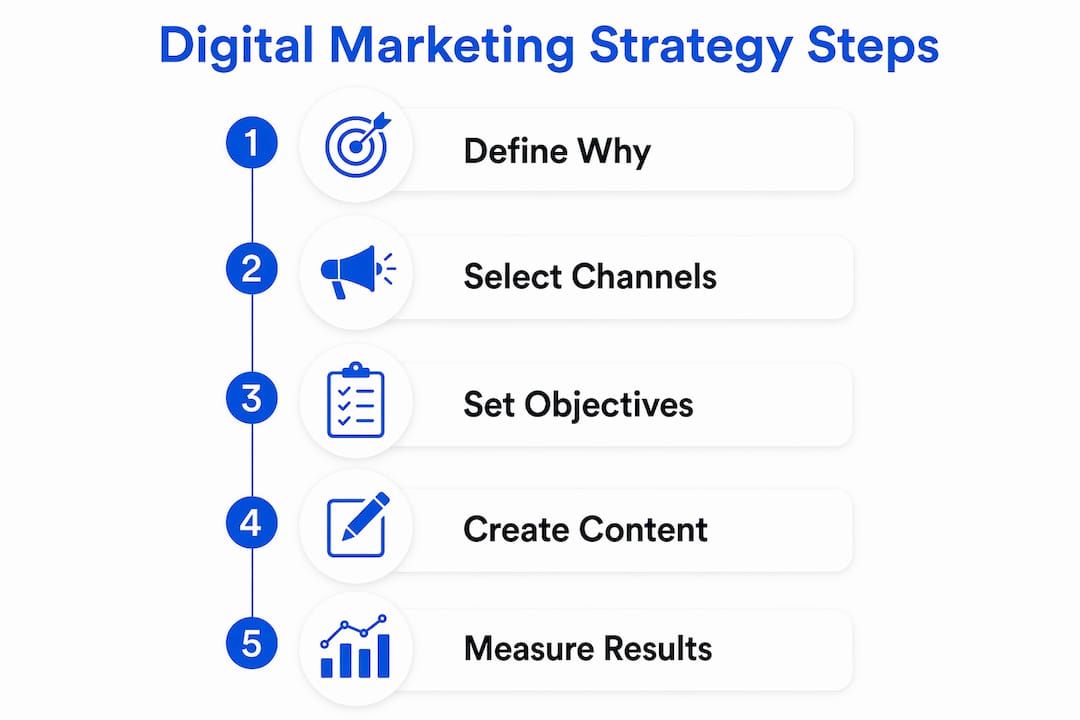
This is where most guides get vague. Here’s a concrete sequence that works.
-
Define your business objectives first. SMART goals anchored to revenue guide every downstream decision. “Increase brand awareness” is not a goal. “Generate 150 qualified leads per month by Q4” is. Start there.
-
Build buyer personas from real data. Talk to your five best customers. Review your CRM. Look at which pages convert on your site. Personas built from actual behavior are far more useful than demographic guesses.
-
Audit your existing digital assets. Before adding anything new, assess what you already have. Crawl your website, review your content library, check your SEO performance, and identify gaps. You’ll almost always find underperforming pages that can be improved faster than building from scratch.
-
Craft your unique value proposition. One sentence that explains what you do, who it’s for, and why it’s better than the alternative. This drives your messaging across every channel.
-
Choose 2–3 core channels. Resist the urge to be everywhere. A focused channel approach selecting 1–3 platforms aligned with your core business goals produces better outcomes than a scattered approach. For most B2B businesses, that means search and email. For B2C, it might be search and Instagram.
-
Develop your content engine. Decide what you’ll publish, at what cadence, and who owns it. A realistic publishing schedule you can maintain beats an ambitious one you’ll abandon in month two.
-
Define your KPIs and set up measurement. Before you launch anything, configure Google Analytics 4, set up conversion tracking, and decide which metrics you’ll review weekly versus monthly. Attribution matters here. First-touch and last-touch attribution models reveal different parts of your funnel, and relying on just one gives you an incomplete picture.
-
Execute, then iterate. Launch the strategy, run it for 90 days, then review performance data and reallocate resources based on what’s working. Not annually. Quarterly.
Pro Tip: Set a calendar reminder for a 90-day strategy review the day you launch. Treat it like a board meeting: bring data, make decisions, and shift budget toward the channels that are actually converting.

How do modern frameworks and AI tools change strategy in 2025–2026?
The RACE framework (Reach, Act, Convert, Engage) gives teams a clear lens for mapping channel activity to funnel stage. Reach covers awareness channels like SEO and paid social. Act covers content that drives consideration. Convert focuses on landing pages, email sequences, and offers. Engage handles retention through email, community, and loyalty programs. Mapping your channels to these four stages reveals gaps fast.
AI has changed the speed of execution more than the logic of strategy. The best use cases right now are market research acceleration, copy variant generation, and reporting automation. AI amplifies human marketer efficiency by handling the repetitive analytical work, freeing strategists to focus on interpretation and decisions.
| AI Application | What it replaces | What humans still own |
|---|---|---|
| Market research synthesis | Manual competitor analysis | Insight interpretation |
| Copy variant generation | A/B test setup time | Creative direction |
| Reporting automation | Manual dashboard building | Strategic response |
| Audience segmentation | Spreadsheet-based analysis | Persona validation |
For a practical look at how AI fits into outreach and content workflows, AI-powered outreach covers the mechanics in detail.
Pro Tip: Use AI to generate five headline variants for every landing page test. Run them for two weeks, pick the winner, and repeat. This compresses a six-month testing cycle into one quarter.
The businesses winning with AI in 2026 aren’t replacing their marketing teams. They’re running faster test-and-learn cycles, publishing more content with the same headcount, and making attribution decisions based on cleaner data.
What are the most common digital marketing strategy mistakes?
The mistakes that kill strategies aren’t usually creative failures. They’re structural ones.
- Budget fragmentation: Spreading spend across six channels with no attribution model means you can’t tell which one is driving revenue. Mapping revenue drivers is the prerequisite for any budget decision.
- Chasing vanity metrics: Impressions, follower counts, and page views feel good but rarely connect to revenue. If your weekly report doesn’t include cost per lead or MQL volume, you’re measuring the wrong things.
- Marketing and sales misalignment: When marketing defines a “lead” differently than sales does, the pipeline leaks at the handoff. Align on lead definitions, SLAs, and feedback loops before you scale any channel.
- Ignoring attribution: Organizations that skip multi-touch attribution risk misallocating budget and watching their pipeline deteriorate despite optimistic surface metrics.
- Attention-chasing over trust-building: Prioritizing viral campaigns over customer trust erodes brand equity over time. Audiences remember how a brand made them feel, not how many times it went viral.
A digital marketing strategy is not a document you write once and file away. It’s a living system that requires quarterly performance reviews, honest budget reallocation, and the willingness to kill tactics that aren’t working. Successful companies reallocate budgets quarterly driven by performance data, not by the plan they wrote in January.
The fix for most of these mistakes is the same: build measurement before you build campaigns. Know what you’re tracking, why it matters, and what action you’ll take when the numbers move.
How Mysearchhero approaches digital marketing strategy in practice
Mysearchhero’s model is built on a specific premise: most businesses don’t fail at strategy because they lack ideas. They fail because execution is inconsistent and measurement is an afterthought.
The approach combines SEO and content marketing automation with a structured planning layer. Each month, clients receive published articles, backlinks, Reddit mentions, and AI-generated social media posts through a fully automated pipeline. The strategy layer defines which topics to target, which keywords map to buyer intent, and how content connects to conversion goals. Execution runs on autopilot from there.
For businesses looking at practical digital marketing examples that have worked for small and mid-sized companies, the pattern is consistent: focused channel selection, content built around buyer intent, and measurement set up before the first piece goes live.
The real role of AI in marketing at Mysearchhero isn’t to replace the strategic thinking. It’s to compress the time between “we have a strategy” and “we have results.”
Pro Tip: Before hiring an agency or buying a tool, map your current content to your buyer’s journey. If you can’t trace a piece of content to a specific stage (awareness, consideration, decision), it probably isn’t doing strategic work.
How do you plan content creation within a digital marketing strategy?
Content creation planning is where strategy meets execution, and where most plans break down. The gap between “we’ll publish weekly” and actually publishing weekly is almost always a planning failure, not a motivation failure.
Start with a content audit. Before creating anything new, identify which existing pages rank in positions 5–15 on Google. Those are faster wins than building from scratch. Improving a page that already has some authority takes less time than ranking a new one.
Map your content to funnel stages. Awareness content (SEO articles, social posts, YouTube videos) brings in cold audiences. Consideration content (case studies, comparison pages, email sequences) moves people toward a decision. Decision content (landing pages, testimonials, free trials) closes. Most businesses over-invest in awareness and under-invest in consideration.
Build a realistic editorial calendar. Assign ownership for every piece, set a publication date, and define the KPI each piece is meant to move. A content plan without assigned owners and deadlines is a wish list. For teams using types of marketing strategies that include content as a primary channel, the cadence matters as much as the quality. Consistency compounds over time in a way that sporadic publishing never does.
Key Takeaways
A focused, measurement-first digital marketing strategy built on 2–3 core channels, SMART objectives, and quarterly iteration consistently outperforms scattered, tactic-driven approaches.
| Point | Details |
|---|---|
| Strategy before tactics | Define your “why” and select 2–3 channels before choosing any individual tactic. |
| SMART objectives anchor everything | Revenue-connected goals guide channel selection, content planning, and budget decisions. |
| Attribution prevents waste | Multi-touch attribution models reveal which channels actually drive pipeline, not just clicks. |
| AI accelerates execution | Use AI for copy variants, research, and reporting to compress test-and-learn cycles. |
| Quarterly reviews are required | Treat strategy as a living system and reallocate budget based on performance data every 90 days. |
FAQ
What is a digital marketing strategy?
A digital marketing strategy is a structured plan that connects business goals to specific online channels, content, and metrics. It defines who you’re targeting, which platforms you’ll use, and how you’ll measure success.
How is a digital marketing strategy different from a campaign?
A strategy is the overarching framework that guides all marketing decisions over time. A campaign is a time-bound, goal-specific effort that operates within that framework.
How many channels should a digital marketing strategy include?
Most businesses perform best with 2–3 core channels where their audience is already active. Focusing on fewer channels produces better ROI than spreading budget thinly across many platforms.
What KPIs should a digital marketing strategy track?
The most useful KPIs connect directly to revenue: cost per lead, MQL volume, MQL-to-SQL conversion rate, and customer lifetime value. Vanity metrics like impressions and follower counts don’t tell you whether the strategy is working.
How often should you review and update your digital marketing strategy?
A quarterly review cycle works best for most businesses. Review performance data every 90 days, reallocate budget toward what’s working, and adjust channel priorities based on results rather than the original plan.
Growing online takes more than a strategy document. It takes consistent execution, published content, and a measurement system that tells you what’s actually working. Mysearchhero handles the execution layer for you: articles, backlinks, Reddit mentions, and social posts, all delivered monthly through an automated pipeline built around your goals. See how it works and start building your online presence on autopilot.