
TL;DR:
- Focusing on high-quality, relevant backlinks from authoritative sources outperforms mass link building in boosting SEO rankings in 2026.
- Modern strategies emphasize earning editorial links through valuable content and genuine relationships, while ignoring manipulative tactics.
Most marketers assume more backlinks always mean better rankings. That belief has cost more than a few sites their Google standing. Understanding what is backlinking at a fundamental level, including how quality and context shape real SEO value, is what separates sites that climb the rankings from those that stall or get suppressed. This guide breaks down what backlinks are, how search engines evaluate them, and which strategies actually move the needle in 2026.
Table of Contents
- Key takeaways
- What is backlinking and how does it work
- What is backlink quality and why it outranks volume
- How backlinking strategies have evolved in 2026
- Practical backlinking strategies for webmasters and marketers
- My honest take on backlinking in 2026
- Let Mysearchhero build your backlink profile for you
- FAQ
Key takeaways
| Point | Details |
|---|---|
| Backlinks are votes of confidence | Search engines treat external links to your site as credibility signals that influence your rankings. |
| Quality beats quantity every time | One topically relevant link from a trusted source outperforms hundreds of low-quality ones. |
| Anchor text diversity matters | A natural mix of branded, generic, and keyword-rich anchors protects your profile from penalties. |
| Nofollow links still have value | Links marked nofollow drive referral traffic and contribute to a healthy, natural-looking profile. |
| Strategy must match 2026 algorithms | AI-driven search rewards earned editorial links, not forced or purchased ones. |
What is backlinking and how does it work
A backlink is a clickable hyperlink on one website that points to a page on your domain. When a food blog links to your recipe ingredient supplier, that is a backlink. When a news outlet cites your research, that is a backlink. Backlinks are critical ranking factors for search engines in 2026, functioning as third-party endorsements of your content’s credibility and relevance.
Think of it like academic citations. When a research paper gets cited by ten other papers, it signals that the academic community trusts that work. Search engines apply the same logic. Every external site that links to yours is effectively saying, “This content is worth reading.” The more credible and relevant the source, the stronger that signal.
Here is what you need to know about how backlinks actually function:
- Dofollow links pass what SEO professionals call “link equity” or “link juice” to your page, directly influencing your ranking potential
- Nofollow links carry a tag telling search engines not to pass ranking credit, though Google treats nofollow as a hint rather than an absolute rule
- Editorial backlinks are earned organically when another site voluntarily links to your content because it is genuinely useful
- Non-editorial backlinks come from directories, comment sections, or paid placements and carry far less weight
- Anchor text is the clickable, visible text of the link. It tells search engines what the linked page is about and plays a measurable role in how your page ranks for related queries
Understanding how does backlinking work means recognizing that not all links are created equal. The source, placement, anchor text, and surrounding content all shape how much value a backlink delivers.
What is backlink quality and why it outranks volume
This is where most webmasters get it wrong. The question is not “how many backlinks do I have?” It is “how good are they?” A single topically relevant, high-authority link can outperform hundreds of low-quality ones from irrelevant or spammy sites.
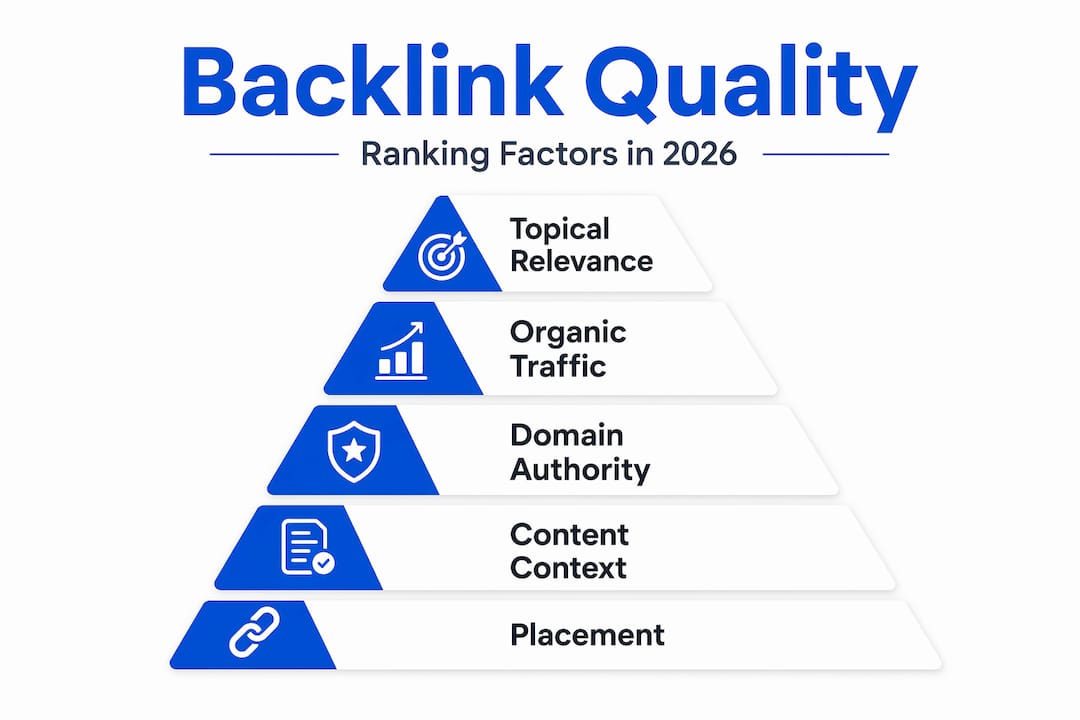
Backlink quality rests on five core factors:
- Topical relevance: A link from a niche-related site carries more SEO value than one from an unrelated high-authority domain. A fitness brand getting a link from a health magazine beats a link from a random auto-parts blog, regardless of domain authority scores.
- Domain authority: The overall trust and strength of the linking site matters. Links from established, well-trafficked sites carry more weight.
- Link placement and context: A link buried in a footer or sidebar is worth less than one embedded naturally within a body paragraph. Context signals editorial intent.
- Anchor text naturalness: Keyword-stuffed anchor text looks manipulative. Natural, varied anchor text signals legitimate endorsement.
- Traffic from the linking page: Pages with real organic traffic pass more practical value. Even a nofollow link from a high-traffic page can drive referral traffic and increase brand exposure.
| Link type | SEO value | Risk level |
|---|---|---|
| Editorial dofollow (relevant site) | High | Low |
| Nofollow (high-traffic source) | Moderate (indirect) | Very low |
| Directory or forum link | Low | Low to moderate |
| Paid link without nofollow tag | Potentially high short-term | Very high |
| Spammy or irrelevant link | Negligible | Moderate |
The good news: most backlinks flagged as toxic by third-party SEO tools are simply ignored by Google rather than penalized. You do not need to panic-disavow every link that looks slightly off. What you do need to watch is any pattern of obviously manipulative link schemes, like paid link networks or excessive exact-match anchor text.

Pro Tip: Do not obsess over your domain authority score alone. Page-level topical relevance can trump site authority in raw link value. A moderately authoritative site in your exact niche often beats a massive general-interest site with no thematic connection to yours.
How backlinking strategies have evolved in 2026
The rules of link building have shifted significantly. AI-powered search is reshaping backlink evaluation, and algorithms are getting sharper at identifying the difference between earned editorial links and manufactured ones. If you are still operating with a “build as many links as possible” mindset, you are working against yourself.
Here is how modern backlinking strategy actually looks:
- Earn links through content worth citing. The most sustainable backlinking strategy is producing content that other sites naturally want to reference. Original research, detailed guides, and unique data attract genuine editorial recommendations from authoritative sources. This is not passive. It requires deliberate content investment.
- Build real relationships with authoritative sites. Guest posts, expert interviews, podcast appearances, and collaborative content create link opportunities that feel natural to both the algorithm and the human editor approving the link.
- Evaluate links beyond DA and DR scores. Tools like Ahrefs and Semrush give you authority scores, but those are proxies, not perfect signals. Look at actual organic traffic to the linking page, the topical alignment, and how the link sits within the content.
- Avoid link velocity spikes. Acquiring 200 backlinks in one week after having a quiet profile for months looks manipulative. Sustainable link growth is gradual and consistent.
- Leverage AI and semantic search knowledge. Modern algorithms understand topic clusters and entity relationships. A link from within a topically related article cluster carries stronger semantic signals than a random mention on an unrelated page. Understanding how AI is changing SEO helps you position your content in the right context.
Pro Tip: When evaluating a potential link opportunity, check whether the linking page ranks for any organic keywords. If it gets no search traffic, it likely offers limited SEO value regardless of the domain’s overall authority score.
Practical backlinking strategies for webmasters and marketers
Knowing what backlinks are is only half the work. The other half is building and maintaining a profile that actually helps your rankings without triggering algorithmic red flags.
Here are the practices that hold up:
- Prioritize relevance over prestige. A backlink from a smaller site in your exact industry is more strategically valuable than a generic mention on a major general-interest site with no topical alignment.
- Diversify your anchor text deliberately. A balanced backlink profile features roughly 60% branded anchors, with the rest split between naked URLs, generic phrases like “click here” or “learn more,” and a small proportion of keyword-rich anchors. Google Penguin specifically targets unnatural anchor text patterns. Keep your keyword anchors below 10% of your total profile.
- Audit your backlink profile regularly. Use tools like Google Search Console alongside third-party platforms to monitor new and lost links. Spot patterns of low-quality acquisition before they accumulate into a problem.
- Never buy links without nofollow tags. Paid links that pass equity violate Google’s guidelines directly. The short-term ranking gains almost never survive the next algorithm update.
- Use internal linking to distribute link equity. Once you earn a backlink to your homepage or a top post, strong internal links push that authority deeper into your site toward pages that need it.
For local businesses and SMBs, the approach needs some tailoring. Understanding the best backlink types for local SEO can make the difference between appearing in local pack results and being invisible to nearby searchers.
| Strategy | Effort level | Expected impact |
|---|---|---|
| Original research and data assets | High | High, long-term |
| Guest posting on relevant sites | Medium | Medium to high |
| Local directory submissions | Low | Low to medium (local SEO) |
| Broken link building | Medium | Medium |
| Buying links (with nofollow) | Low | Low, indirect only |
| Buying links (without nofollow) | Low | High risk, avoid |
The most durable backlink profiles are built the same way strong reputations are built: consistently, ethically, and with a genuine focus on creating something others want to reference.
My honest take on backlinking in 2026
I have reviewed dozens of backlink profiles over the years, and the ones that struggle share one trait. They were built with a scoreboard mentality. More links, higher numbers, faster growth. The sites that consistently ranked well did not chase volume. They focused on being genuinely worth linking to.
What I have found especially interesting is the reaction people have to nofollow links. Most marketers dismiss them immediately because they do not pass direct equity. But nofollow links from high-traffic pages have sent real referral traffic, built brand recognition, and contributed to the kind of natural-looking profile that keeps a site protected during algorithm updates. Treating them as worthless is a mistake.
My contrarian view: the obsession with domain authority scores has made a lot of marketers lazy. They see a high DA number and assume the link is valuable without checking whether the page has any topical connection to their site at all. Page-level relevance is the metric I trust most, and it rarely shows up as a headline number in any tool.
The sites that will win long-term are the ones that attract organic endorsements because they built something genuinely useful. That has not changed since the early days of search. Everything else is just chasing an algorithm that keeps getting better at identifying what is real.
— Mike
Let Mysearchhero build your backlink profile for you
Building a strong backlink profile takes consistent effort, the right relationships, and a clear strategy. Most webmasters and marketers know what needs to be done but simply do not have the bandwidth to do it every month.
That is exactly what Mysearchhero was built for. Through a fully automated done-for-you pipeline, Mysearchhero delivers published articles, high-quality backlinks, Reddit mentions, and social media content every month on autopilot. You get the link-building momentum your site needs without managing outreach, creating content, or tracking placements yourself. Every deliverable is designed to build the kind of natural, diverse, and authoritative link profile that holds up under algorithm scrutiny. If you are ready to grow your search visibility without adding to your workload, Mysearchhero makes that possible.
FAQ
What are backlinks in simple terms?
Backlinks are links from one website that point to a page on your site. Search engines treat them as credibility signals, with higher-quality links from relevant, trusted sources carrying the most SEO value.
How does backlinking work for SEO?
Search engines interpret each backlink as a vote of confidence from the linking site. The quality, relevance, and context of that link determine how much it helps your rankings, with editorial links from authoritative sites carrying the strongest impact.
What is backlink quality and how is it measured?
Backlink quality is determined by five factors: topical relevance of the linking page, domain authority, organic traffic to the linking page, link placement within the content, and anchor text naturalness. A single high-quality link can outperform hundreds of weak ones.
Do nofollow backlinks help with SEO?
Yes, indirectly. Nofollow links do not pass direct ranking equity, but they drive referral traffic, improve brand visibility, and contribute to a natural-looking backlink profile that supports long-term SEO health.
What backlinking strategies work best in 2026?
The most effective backlinking strategies focus on earning editorial links through high-value content, building genuine relationships with relevant sites, diversifying anchor text, and auditing your profile regularly to maintain quality over quantity.