
TL;DR:
- Most marketers use AI superficially for content creation and automation, but few link it to measurable results. Disconnected workflows and poor integration prevent AI efforts from delivering tangible business impact, highlighting a need for operational maturity. To succeed, organizations must scale strategic measurement, governance, and infrastructure around AI-driven marketing initiatives.
Most marketers think they understand the role of AI in marketing. They’ve adopted a tool, generated some content, maybe set up a few automated email sequences. Done. But that surface-level adoption is exactly why only 7% of teams actually use AI to deliver measurable business results. The real story isn’t about which tools you’re running. It’s about whether those tools connect to outcomes, and most organizations are nowhere near that standard yet.
Table of Contents
- Key Takeaways
- The role of AI in marketing today
- Why AI activity doesn’t equal marketing ROI
- How AI reshapes strategy, not just execution
- Practical AI marketing strategies that hold up
- Emerging AI tools changing marketing execution
- My honest take on where most teams go wrong
- Take AI marketing from experiment to results
- FAQ
Key Takeaways
| Point | Details |
|---|---|
| AI adoption is wide but shallow | Most marketers use AI for content creation, yet few connect it to measurable ROI. |
| Operational maturity is the gap | Disconnected workflows and slow feedback loops prevent AI from translating into real business impact. |
| Discovery strategy must evolve | AI-driven search rewards credible third-party signals over brand-only content. |
| Governance is non-negotiable | Separating creative AI use from personalization decisions reduces legal and reputational risk. |
| Budget before you scale | Starting at 5 to 10% of marketing spend on AI tools prevents costly misalignment. |
The role of AI in marketing today
The industry term for what most people call “AI in marketing” is AI-driven marketing automation, but the practice has grown well beyond automation into areas like predictive analytics, content intelligence, and AI-mediated discovery. According to HubSpot’s 2026 research, 86.4% of marketers now use AI tools, with personalized content creation (48.57%) and automation (47.38%) leading the pack.
That widespread adoption sounds like progress. The reality is more complicated.
The primary AI use cases active in most marketing workflows right now include:
- Content drafting and repurposing: AI generates first drafts, reformats long-form content into social posts, and adapts copy across channels at speed.
- Predictive lead scoring: Machine learning models rank prospects by conversion likelihood based on behavioral signals, purchase history, and demographic data.
- Ad optimization: Platforms use AI to adjust bids, creative rotation, and audience targeting in real time based on performance signals.
- Marketing automation: AI personalizes email sequences, product recommendations, and retargeting flows without manual intervention.
What AI doesn’t do is replace the strategic thinking behind these functions. It accelerates execution. The role of machine learning in marketing is to surface patterns humans would miss at scale, not to replace the humans making decisions about what those patterns mean.
Pro Tip: Before adding another AI tool to your stack, map your current workflow gaps. AI amplifies what already works and exposes what doesn’t. Starting with a broken process just makes the mess faster.
Why AI activity doesn’t equal marketing ROI
Here’s the uncomfortable number every marketing leader needs to hear: more than 8 out of 10 marketing teams missed a significant opportunity last quarter because they were too slow to act on signals, despite having AI tools running.
That’s not a technology problem. That’s an operational maturity problem.
The gap between AI activity and business impact lives in three places. First, content creation accelerates, but review cycles, approval workflows, and activation processes stay slow and manual. You gain speed on one end and lose it entirely on the other. Second, data stays siloed. AI tools generate output, but if your CRM, ad platform, analytics suite, and CMS aren’t connected, nobody knows what’s actually working. Third, most teams define no measurable success metrics before they start scaling AI use, so they accumulate high output volume with no ROI signal.
“The biggest failure in AI marketing isn’t poor AI ability. It’s slow measurement feedback loops that prevent rapid creative and activation improvement.” — Adobe 2026 AI Marketing Research
Disconnected AI workflows are the core issue. When your AI content tool doesn’t talk to your analytics platform, you can’t close the loop between what you publish and what converts. You end up optimizing for output volume, which is the wrong metric entirely.
The marketers and business owners gaining ground right now are the ones treating AI as an infrastructure problem, not a content problem. They’re connecting their tools, defining metrics before activation, and measuring AI success by outcomes rather than by posts published or emails sent.
How AI reshapes strategy, not just execution
The impact of AI on marketing goes deeper than saving time on content. It’s reshaping how brands get discovered, how customers make decisions, and what kind of content actually builds trust.

The shift worth understanding is this: you’re no longer only trying to persuade human readers. You’re also trying to influence AI decision systems. Search engines, recommendation engines, and AI-powered shopping tools now synthesize information and surface answers before users even click a link. If your brand’s content isn’t structured for AI synthesis, it simply won’t appear in those early decision moments.
| Traditional marketing approach | AI-era marketing approach |
|---|---|
| Optimize content for human readers | Optimize content for both humans and AI synthesis |
| Brand-owned content drives discovery | Third-party and community content carry more weight |
| Rankings measured by click position | Visibility measured by AI mention and synthesis inclusion |
| Segment-based personalization | Individual-level predictive personalization at scale |
Trusted customer-generated content now holds more weight in AI-driven discovery than most brand content. AI systems are designed to synthesize credible, independent signals, not amplify brand messaging. This means your reviews, forum mentions, earned media, and community discussions are doing more strategic work than your homepage ever did.
Pro Tip: Treat your brand mentions, reviews, and third-party coverage as core marketing assets. Actively generate them, respond to them, and track them. In an AI-mediated discovery world, brand authority signals matter as much as any paid channel.
Practical AI marketing strategies that hold up
Getting the most from AI in digital marketing requires discipline in three areas: budgeting, measurement, and governance.
Budgeting for AI tools without waste
- Start by allocating 5 to 10% of your marketing budget to AI tools before scaling.
- Tie every tool to a specific workflow gap, not a general “efficiency” goal.
- Set a 90-day evaluation window with defined ROI triggers before renewing or expanding any AI subscription.
- Consolidate platforms where possible. Fragmented AI tool stacks create the exact disconnection problems described above.
Measurement frameworks that work
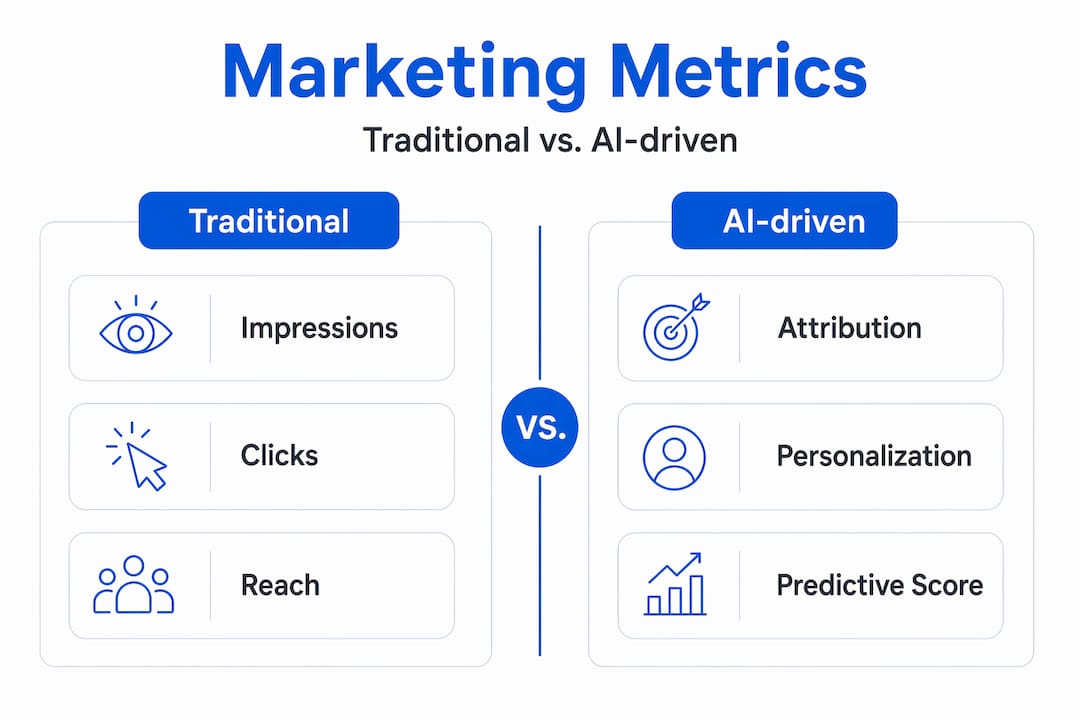
The single biggest mistake in AI marketing strategies is scaling before instrumentation. Define what success looks like before you run a single campaign. That means choosing metrics tied to revenue or pipeline, not activity. Track content-to-conversion rates, pipeline velocity changes, and cost per qualified lead, not word counts or posts per week.
| Metric to track | What it actually tells you |
|---|---|
| Content-to-pipeline attribution | Which AI-generated assets are driving real business opportunities |
| Cost per qualified lead (AI vs. manual) | Whether AI execution delivers efficiency gains at the lead quality level |
| AI discovery inclusion rate | How often your content appears in AI-synthesized answers |
| Activation lag time | How long it takes to go from AI output to live campaign |
Governance: the part most teams skip
AI-powered personalization raises serious risks around privacy, bias, copyright, and content authenticity that most marketing teams aren’t equipped to manage. The legal exposure is real, and it’s growing.
The practical approach is to separate creative acceleration from personalization decision-making. Use AI freely to generate draft copy, repurpose content, and brainstorm. Apply stricter oversight when AI is making decisions about who sees what, especially in sensitive categories like financial services, healthcare, or any targeting based on inferred characteristics.
Emerging AI tools changing marketing execution
The role of AI in marketing in 2026 looks significantly different from even 18 months ago, driven by platform-level AI integration that was experimental then and is now table stakes.
The developments worth tracking right now:
- Google’s Gemini-powered ad formats: Conversational discovery ads use AI to create tailored, context-aware experiences inside search. 75% of users report making faster, more confident decisions when using AI Mode in Search, which has direct implications for how ad content needs to be structured.
- Unified AI agents: Google’s 2026 marketing stack now includes cross-product AI agents that connect ads, analytics, commerce, and measurement into a single workflow. This is the connected infrastructure model that most teams are still trying to build manually.
- AI-powered commerce integration: Universal commerce carts with AI-driven product discovery and payment integrations are collapsing the path from content to conversion. A customer can now go from an AI-synthesized recommendation to a completed purchase without ever visiting a brand website.
- Predictive audience modeling: Machine learning models that update in real time based on behavioral signals are replacing static audience segments, meaning your personalization becomes more precise as campaigns run, not just at the start.
What this means for your strategy is that the gap between brands with connected AI infrastructure and those running disconnected tools will widen significantly through 2026.
My honest take on where most teams go wrong
I’ve watched a lot of organizations spend aggressively on AI tools and come away with very little to show for it. The pattern is consistent. Teams get excited about what AI can produce. They generate content at volume. Then, about six months in, they can’t explain what any of it actually contributed to the business.
The mistake isn’t adopting AI. The mistake is treating adoption as the goal.
In my experience, the organizations getting real returns from AI in digital marketing share one habit: they defined what success looks like before they started, and they built measurement into the workflow from day one. Not as an afterthought. Not as a quarterly report. As a live feedback loop that shapes what gets created next.
The other thing I’d push back on is the assumption that more AI tools mean more efficiency. I’ve seen teams running eight different AI platforms that can’t tell you which one is actually moving the needle. Fewer tools, better connected, with clear ownership, consistently outperform sprawling tool stacks with no governance.
If I had one piece of advice for any marketing professional reading this: pick two or three AI functions that directly connect to revenue-relevant outcomes, measure them rigorously, and scale what works. That’s not exciting. But it’s what actually builds a case for more AI investment, and it’s what separates the 7% who deliver measurable results from the 93% who don’t.
— Mike
Take AI marketing from experiment to results
Building a real AI marketing engine requires more than tools. It requires the right content infrastructure, consistent publishing, and a feedback loop that connects activity to outcomes.
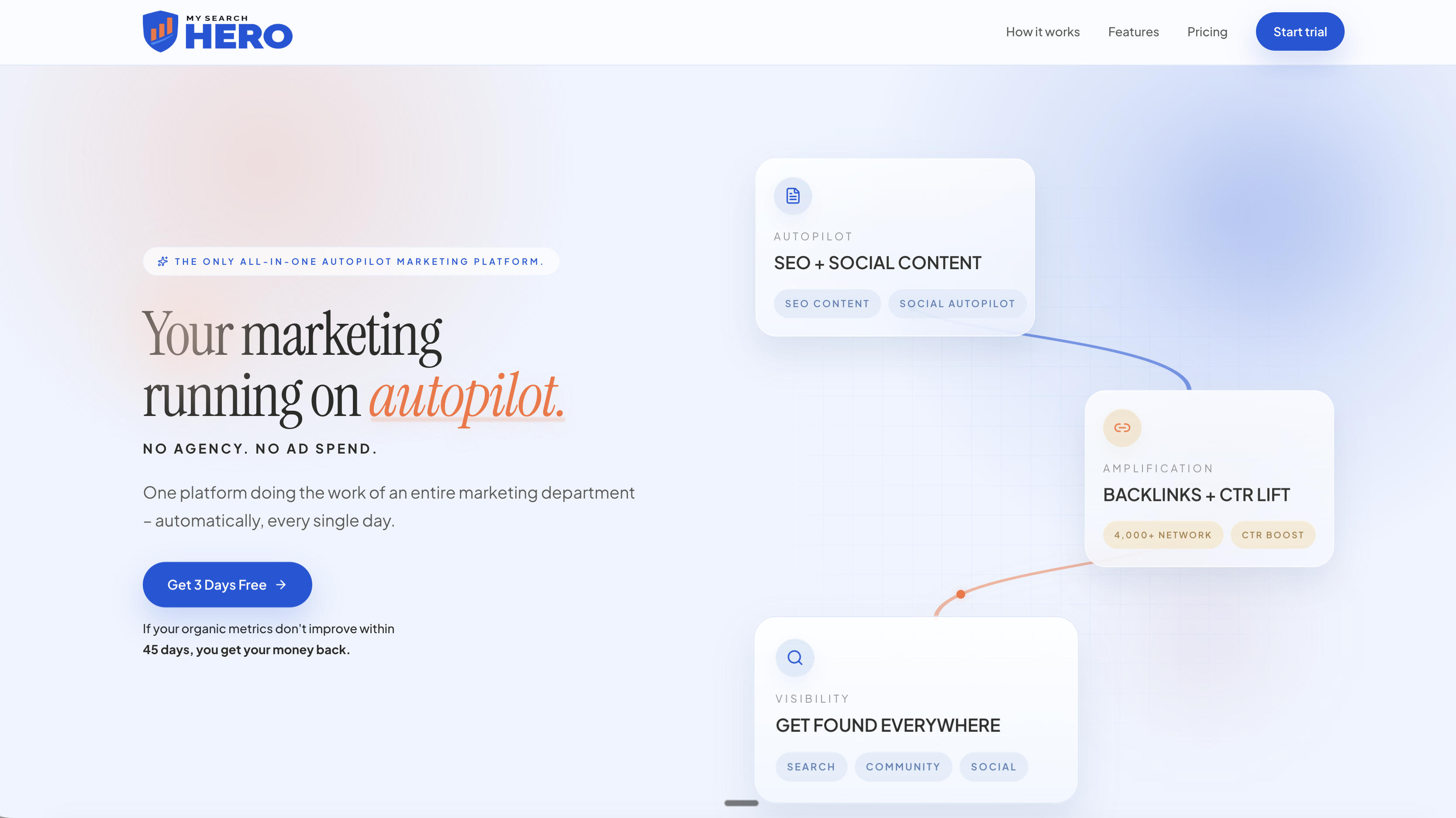
Mysearchhero is built for exactly this. The service gives marketing professionals and business owners a fully managed content and SEO pipeline that runs on autopilot every month, with published articles, backlinks, Reddit mentions, and social content delivered through a connected, automated system. You get the output and the distribution without building the workflow yourself. If you’re ready to move from AI experimentation to consistent marketing results, Mysearchhero is worth exploring.
FAQ
What is the role of AI in marketing today?
AI in marketing covers content creation, predictive lead scoring, ad optimization, and personalization at scale. The real opportunity lies in connecting these functions to measurable business outcomes, not just speeding up production.
Why aren’t most marketers seeing ROI from AI tools?
More than 80% of teams miss opportunities due to slow workflows and disconnected data. AI generates output quickly, but measurement gaps and siloed platforms prevent that output from translating into revenue.
How much should I budget for AI marketing tools?
Start with 5 to 10% of your total marketing budget, then scale based on measurable ROI over a defined evaluation window. Tying every tool to a specific workflow outcome prevents budget waste.
How does AI change content strategy for search?
AI-driven search rewards content that appears credible to AI synthesis systems, which means third-party mentions, reviews, and community content now carry significant strategic weight alongside your owned content.
What governance do I need for AI in marketing?
Keep AI-assisted creative work separate from personalization decision-making. Apply stricter review to any AI that determines who sees what, especially in regulated industries, to manage privacy and legal risks.