
TL;DR:
- Brand amplification is a strategic process that enhances a brand’s visibility and credibility through active promotion across multiple channels. Most companies underfund distribution compared to content creation, which hampers growth, but investing more in amplification creates compounding recognition and trust. Using a coordinated mix of earned media, partnerships, paid promotion, and social media boosts long-term visibility, credibility, and customer engagement.
Brand amplification is the strategic process of expanding a brand’s visibility and credibility by actively promoting its core messaging across multiple platforms and channels beyond organic reach. Most businesses invest heavily in creating content and assets, then spend almost nothing getting those assets in front of the right people. That imbalance is where growth stalls. The role of brand amplification is to close that gap, turning good content into compounding visibility through social media, press, partnerships, and paid promotion. Brands that treat amplification as a core function, not an afterthought, build recognition that compounds over time.
How does brand amplification work in practice?
Brand amplification works by systematically distributing and promoting brand assets across multiple channels, using a deliberate mix of owned, earned, and paid media. The goal is not just reach. It is consistent, repeated exposure across the platforms where your audience already spends time.
The most telling proof of this principle comes from Ferrero India. The company applies a 5x amplification rule, spending five times more on amplification than on asset creation. That ratio reflects a hard truth: creative work without distribution is invisible. Most marketing budgets do the opposite, pouring resources into production and leaving almost nothing for promotion.
Effective amplification runs on four core mechanisms:
- Press and earned media: Placing brand stories in publications your audience trusts builds credibility that paid ads cannot replicate.
- Partnerships and co-marketing: Collaborating with complementary brands shares audiences and reduces acquisition costs.
- Paid promotion: Targeted advertising on platforms like Meta, Google, and LinkedIn puts your message in front of defined audience segments at scale.
- Activations and events: Live or virtual brand moments create concentrated attention that feeds into longer-term media coverage.
Each mechanism works better when the others are running simultaneously. Press coverage amplifies a partnership announcement. Paid promotion extends the reach of earned media. The channels reinforce each other.
Pro Tip: Before you allocate any amplification budget, map out your channel mix. Identify where your audience is most active and weight your spend toward those platforms first. Spreading budget evenly across every channel dilutes impact.
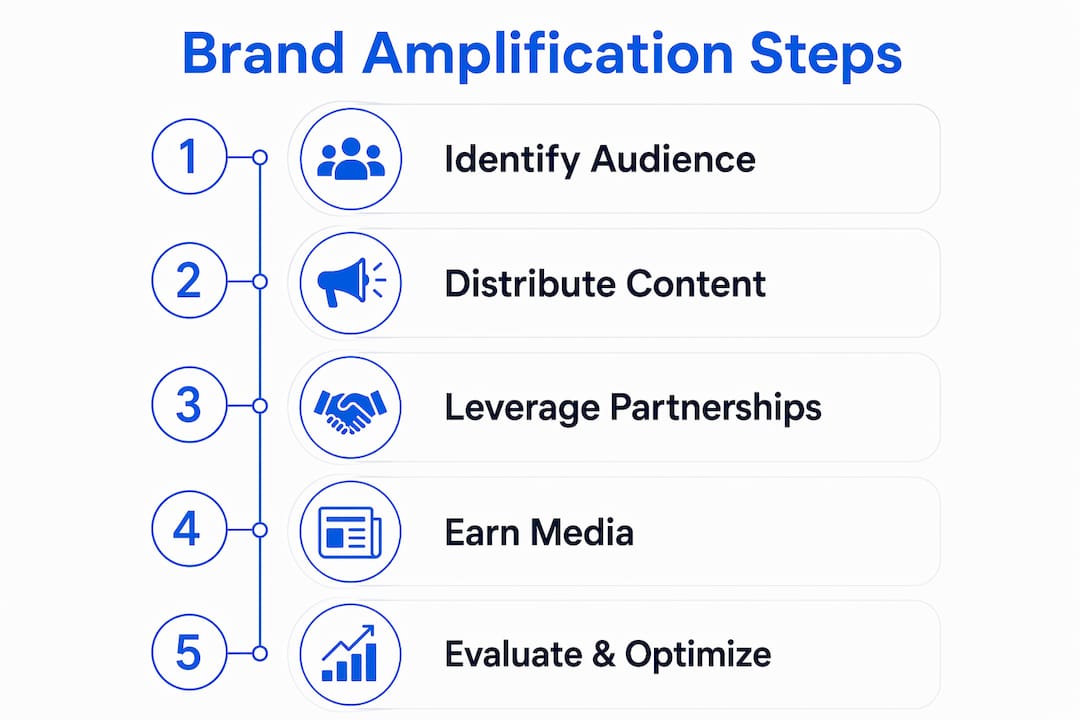
A critical but often overlooked component is the brand home. Without a strong brand home — a well-built website, clear landing pages, and functional email systems — amplification leaks. You drive traffic and attention, but nothing converts. Build the foundation before you scale the promotion.
What are the most effective brand amplification strategies?
The most effective brand amplification strategies combine social media distribution, earned media, partnerships, and paid targeting into a coordinated system. Each strategy serves a different function, and the strongest programs use all four.
1. Social media amplification
Social media is the highest-frequency amplification channel available to most businesses. The average user engages with more than six platforms monthly, which means your brand needs a presence across multiple networks, not just one. That does not mean posting identical content everywhere. LinkedIn audiences respond to data and professional insight. Instagram audiences respond to visual storytelling. TikTok rewards short, direct, and entertaining formats. Tailor the format to the platform while keeping the core message consistent.

2. Partnerships and co-marketing
Partnerships are one of the fastest ways to reach new audiences without building them from scratch. Co-marketing and collaboration strategies can drive 15–25% of a company’s total revenue through partner-sourced channels. That is a significant commercial contribution from a channel that most small businesses underuse. A well-structured partnership places your brand in front of an audience that already trusts your partner, which shortens the credibility gap considerably.
3. Press and earned media
Earned media carries more weight than most marketers realize. 92% of consumers trust earned media more than paid advertising. That trust gap is enormous. A feature in a respected trade publication or a mention in a major outlet does more for brand credibility than a display ad campaign of the same budget. Earned media also has a longer shelf life. Articles and mentions stay indexed and discoverable for years.
4. Paid amplification
Paid promotion gives you control that organic channels cannot. You define the audience, the timing, and the message. Platforms like Meta Ads and Google Ads let you target by interest, behavior, location, and intent. Paid amplification works best when it extends content that already performs well organically, rather than substituting for it.
| Strategy | Primary benefit | Best for |
|---|---|---|
| Social media | Frequency and reach | Ongoing brand presence |
| Partnerships | Audience expansion | New market entry |
| Press and earned media | Credibility and trust | Reputation building |
| Paid promotion | Targeting and speed | Campaign acceleration |
Pro Tip: Repurpose your best-performing organic content into paid ads. Content that already earns engagement organically will almost always outperform content created specifically for paid campaigns.
What is the impact of brand amplification on visibility and growth?
Brand amplification produces three distinct and measurable effects: increased visibility, stronger credibility, and deeper customer engagement. These effects compound over time rather than delivering a single spike.
The most significant shift in 2026 is how amplification affects search visibility. In the AI search era, brand amplification now centers on entity association, building consistent, meaningful mentions across authoritative platforms to strengthen semantic authority. Traditional SEO focused on backlinks. AI-powered search engines like Perplexity and Google’s AI Overviews now evaluate brands based on how consistently and contextually they appear across the web. A brand mentioned frequently in relevant, authoritative contexts gets treated as a recognized entity. That recognition translates directly into search visibility. You can read more about this shift in branded mentions and visibility.
“Amplification is most effective when integrated into a Marketing Engine framework, progressing from brand foundation, through clear positioning and story systems, before scaling visibility with press, partnerships, and activations.” — Wild Woman Haus
Credibility compounds through repetition across trusted sources. A prospect who sees your brand mentioned in a trade publication, then encounters a partner co-marketing piece, then sees a targeted ad is far more likely to convert than one who only sees the ad. Each touchpoint adds a layer of social proof. The importance of brand amplification for trust-building cannot be separated from its role in visibility.
Customer engagement deepens when amplification is consistent. Brands that appear regularly across multiple channels stay top of mind. That presence shortens the sales cycle because prospects arrive with existing familiarity rather than starting from zero.
| Effect | Mechanism | Business outcome |
|---|---|---|
| Increased visibility | Multi-channel distribution | More organic brand searches |
| Stronger credibility | Earned media and entity mentions | Higher conversion rates |
| Deeper engagement | Consistent cross-channel presence | Shorter sales cycles |
| Semantic authority | AI-era entity association | Better AI search inclusion |
Brand amplification best practices worth knowing
The most common amplification mistake is treating it as a campaign rather than a system. Brands that treat amplification as an afterthought fail to optimize return on content investment. Amplification must be integrated with audience targeting and measured for commercial outcomes. That means tracking which channels drive actual pipeline, not just impressions.
Practical best practices that separate effective programs from wasted budgets:
- Build the brand home first. Your website, landing pages, and email capture must be ready before you scale distribution. Amplification without conversion infrastructure wastes every dollar.
- Balance long-term equity with short-term activation. Press and partnerships build brand equity over months. Paid promotion drives immediate traffic. Both are necessary. Neither alone is sufficient.
- Use events as ongoing platforms, not single moments. Successful companies use major events like CES as media launchpads, building momentum for months rather than focusing on immediate sales. The press coverage, social content, and partnership conversations that flow from a well-executed event extend the amplification window far beyond the event itself.
- Measure entity mentions, not just backlinks. In the current search environment, a brand mention in a relevant article on an authoritative site carries real SEO value even without a link. Track mentions across platforms using tools like Google Alerts or Mention.
Pro Tip: Set a quarterly amplification audit. Review which channels drove the most qualified traffic, which earned media placements generated the most referral visits, and where your brand is being mentioned without your involvement. That last category often reveals amplification opportunities you did not create.
The AI-driven changes in marketing make consistent messaging more important than ever. AI search systems build a picture of your brand from aggregated signals across the web. Inconsistent messaging across channels creates a fragmented entity profile, which reduces your chances of appearing in AI-generated answers.
Key Takeaways
Brand amplification is the primary driver of compounding visibility, credibility, and customer engagement when it is treated as a system rather than a one-time campaign.
| Point | Details |
|---|---|
| Invest more in amplification than creation | Ferrero India’s 5x rule shows that distribution spending must outpace content production. |
| Build your brand home first | A strong website and email system converts amplified attention into actual growth. |
| Earned media outperforms paid for trust | 92% of consumers trust earned media more than ads, making press a priority channel. |
| Entity association drives AI search visibility | Consistent brand mentions across authoritative platforms build semantic authority in AI search. |
| Treat amplification as a commercial system | Measure amplification against pipeline and revenue, not just reach and impressions. |
Why amplification is the most undervalued line in your marketing budget
Most business owners I talk to have the ratio backwards. They spend 80% of their marketing budget on content production and 20% on getting that content seen. Ferrero India flips that entirely, and the logic is sound. A mediocre asset with excellent distribution will always outperform excellent content that nobody sees.
The shift I find most significant right now is the move from backlink-focused SEO to entity-based visibility. Brands that are consistently mentioned in the right contexts, across the right platforms, are the ones showing up in AI-generated answers. That is not a future trend. It is already happening. If your brand is not being mentioned regularly in authoritative, relevant contexts, you are invisible to a growing share of search traffic.
The other thing I see marketers get wrong is treating amplification as a separate function from brand strategy. Amplification without clear positioning just spreads confusion faster. You need to know exactly what your brand stands for before you scale its distribution. Get the message right, build the infrastructure to capture attention, then amplify. That sequence matters more than the budget.
— Mike
How Mysearchhero helps you amplify your brand on autopilot
Building a consistent amplification system takes time, coordination, and the right distribution infrastructure. Most business owners do not have all three.
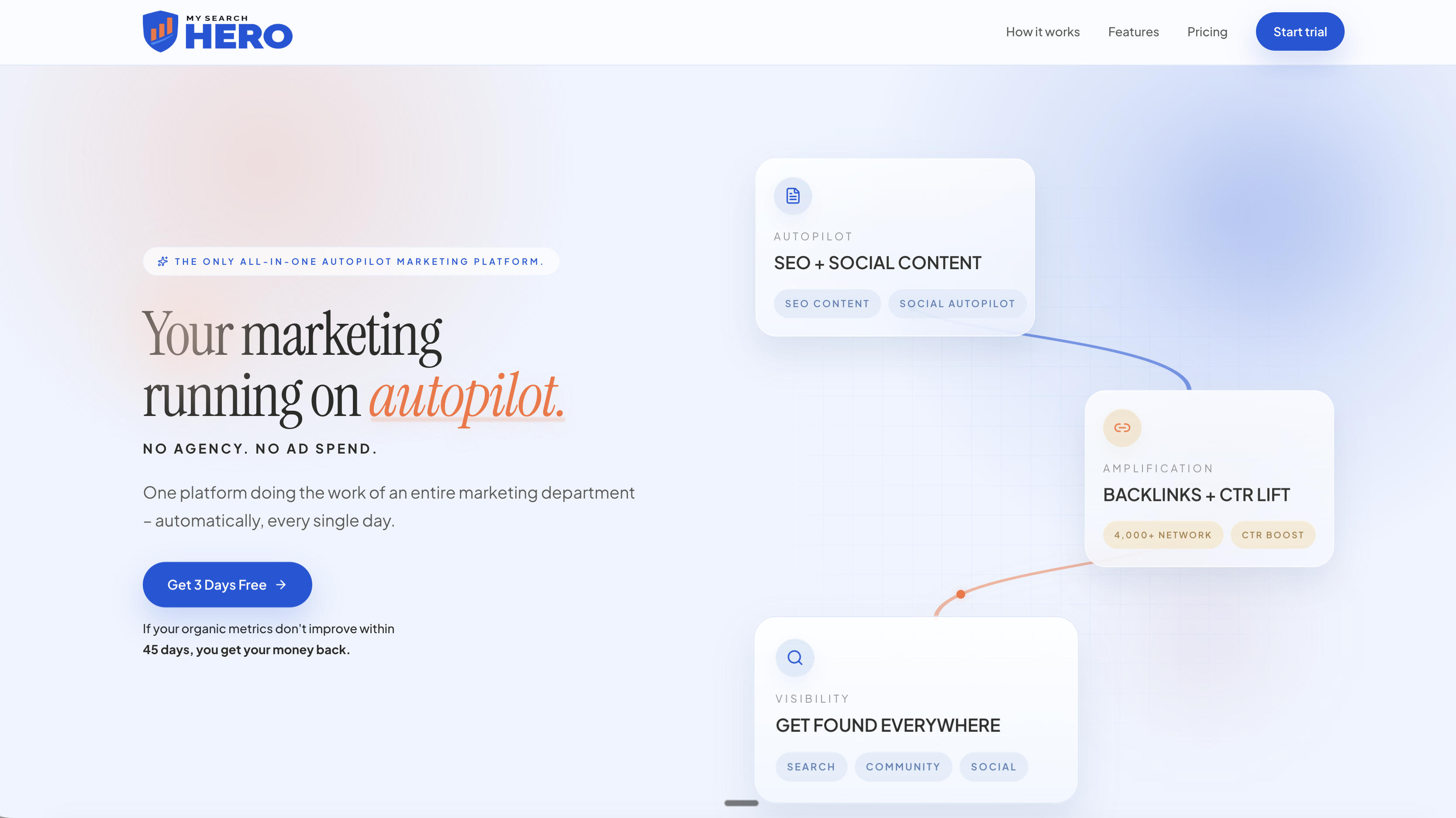
Mysearchhero is a done-for-you SEO and content marketing service built specifically for this problem. Each month, subscribers receive published articles, backlinks, Reddit mentions, and AI-generated social media posts, all pushed through a fully automated pipeline. The result is consistent brand presence across multiple channels without the manual overhead. If you want your brand mentioned in the right places, at the right frequency, without managing it yourself, Mysearchhero is built for exactly that.
FAQ
What is the role of brand amplification?
Brand amplification extends a brand’s reach and credibility by distributing its core message across multiple owned, earned, and paid channels. Its primary role is to convert content investment into compounding visibility and customer engagement.
How much should I spend on brand amplification vs. content creation?
Ferrero India’s model allocates five times more budget to amplification than to asset creation. That ratio reflects the reality that distribution consistently delivers more return than production alone.
Why does earned media matter for brand amplification?
92% of consumers trust earned media more than paid advertising. Press coverage and third-party mentions build credibility that paid channels cannot replicate at the same cost.
How does brand amplification affect AI search visibility?
AI search engines evaluate brands based on consistent, contextual mentions across authoritative platforms. Brands with strong entity association appear more frequently in AI-generated answers and search overviews.
What is the first step to amplifying a brand effectively?
Build a strong brand home first. A well-structured website, clear landing pages, and functional email capture must be in place before scaling distribution, or amplified attention will not convert into growth.