
TL;DR:
- Publishing regularly builds trust, improves SEO, and creates a long-term lead generation asset for small businesses. Consistency and a manageable publishing frequency of 2-4 posts per month are key to sustained growth and effective resource use. Refresh existing content and maintain a predictable schedule to maximize rankings and audience loyalty over time.
Publishing regularly is defined as maintaining a consistent, predictable cadence of content releases that builds audience trust and compounds your brand’s online visibility over time. For small to mid-sized businesses, this practice is the single most cost-effective marketing habit available. Content marketing costs 62% less per lead than traditional outbound marketing. That gap alone makes the case for building a publishing rhythm before spending another dollar on ads.
Why publish regularly: the core business case
Regular publishing delivers three compounding advantages: stronger SEO signals, deeper audience trust, and a growing library of content that generates leads around the clock. Each new article, post, or update tells search engines your site is active and authoritative. Over months, that signal accumulates into real ranking gains.
The SEO benefit is not just about volume. Fresh content increases how often search engine crawlers visit your site. More frequent crawling means new pages get indexed faster, which shortens the time between publishing and ranking. For a small business competing against larger brands, that speed matters.
Trust is the less obvious benefit, and it compounds just as powerfully. When your audience sees new content from you on a reliable schedule, they begin to expect it. That expectation is the foundation of brand loyalty. A business that publishes once a quarter feels like a hobby. A business that publishes every two weeks feels like a professional operation.
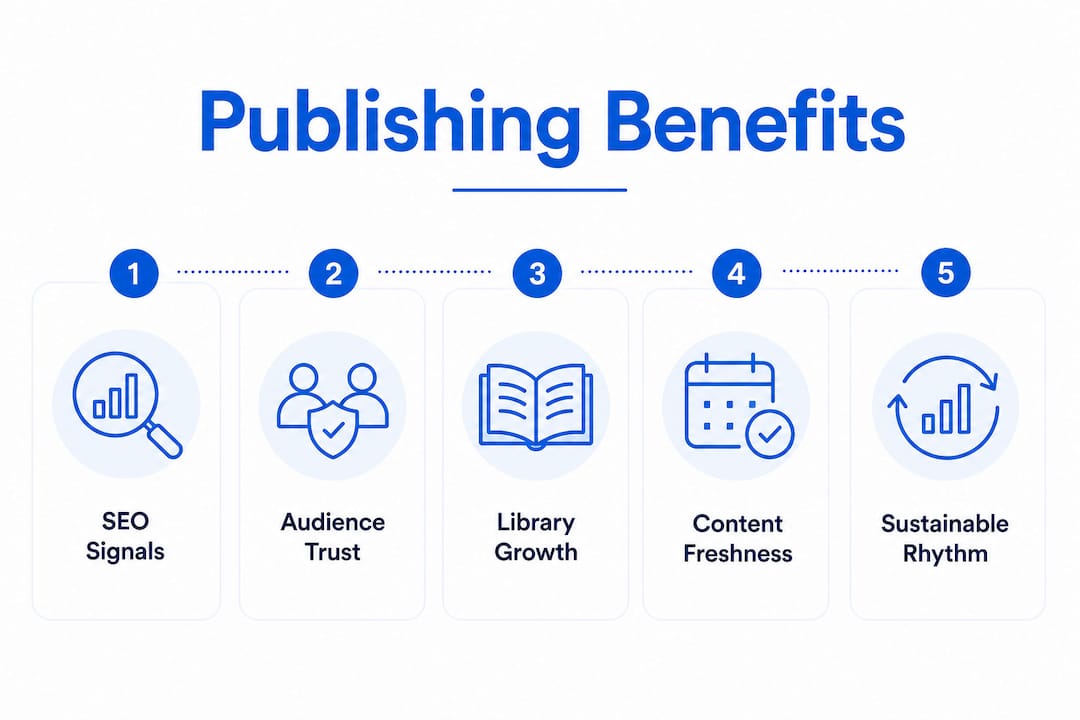
Content also works while you sleep. A blog post published in march can still drive traffic and capture leads in november. The more quality posts you accumulate, the more entry points you create for new customers to find you. This is the compounding effect that makes consistent publishing worth the investment.
Benefits at a glance:
- SEO growth: Fresh content increases crawl frequency and topical authority.
- Lead generation: More indexed pages mean more search queries your site can answer.
- Brand trust: A predictable publishing schedule signals reliability to your audience.
- Cost efficiency: Content marketing’s 62% lower cost per lead outperforms paid channels over time.
- Compounding returns: Older posts continue driving traffic long after publication.
How do consistency and frequency differ?
Consistency means publishing on a predictable schedule. Frequency means publishing often. These are not the same thing, and confusing them is one of the most common mistakes small business owners make with content.
A business that publishes five posts in one week and then nothing for six weeks is high-frequency but deeply inconsistent. Irregular bursts train your audience to ignore you between launches. The audience never forms a habit around your content because there is no pattern to follow.
Steady, reliable publishing builds more long-term brand loyalty than irregular high-intensity bursts. Biweekly publishing, held without exception for six months, outperforms a content sprint followed by silence. The pattern itself is the message.
Frequency signals activity, but consistency signals reliability. Reliability is what builds lasting audience relationships. A business that shows up on schedule earns trust that no single viral post can replicate.
Consistent publishing also lowers cognitive load for your content team. When everyone knows the schedule, planning becomes routine rather than reactive. That structure protects content quality because writers are not rushing to fill gaps after a long silence.
The practical takeaway is simple. Pick a cadence you can hold for twelve months without burning out. A sustainable rhythm of one post per week beats an unsustainable sprint of five posts per week every time.
What is the optimal publishing frequency for small businesses?
The right publishing frequency depends on your domain, your team’s capacity, and your current content library. There is no universal answer, but the data points to a clear starting range.
Sites publishing 2–4 quality posts per month achieve steady ranking gains and traffic growth without overwhelming resources. That translates to roughly one post per week or one every two weeks. For most small to mid-sized businesses, this range is both achievable and effective.

The diminishing returns curve
Every domain has a publishing frequency breakeven point. Publishing beyond that threshold with low-quality content dilutes your crawl budget and weakens your SEO effectiveness. More posts do not automatically mean more traffic. Past a certain point, each additional post adds less value and may actually harm your rankings.
Crawl budget is the number of pages a search engine will crawl on your site within a given period. If you publish faster than your crawl budget allows, new pages sit unindexed. Unindexed content has no SEO value and represents pure cost with zero return. Monitoring your indexation rate in Google Search Console tells you whether your current publishing pace is sustainable.
New posts vs. refreshing existing content
One of the most underused tactics in content marketing is updating older posts. Refreshing existing posts takes 20% of the effort of creating new ones and recovers rankings faster. A post that ranked on page two last year can return to page one with updated statistics, a revised structure, and a few new paragraphs.
For small businesses with limited writing resources, this changes the math entirely. Instead of producing four new posts per month, you might produce two new posts and refresh two older ones. The SEO return on that mix often exceeds a pure new-content strategy.
| Approach | Effort level | SEO impact | Best for |
|---|---|---|---|
| New posts only | High | Gradual, long-term | Building topical authority |
| Refreshing existing posts | Low | Fast ranking recovery | Sites with existing content |
| Mixed (new + refresh) | Medium | Balanced and sustained | Most small businesses |
Pro Tip: Check Google Search Console monthly for pages that dropped from positions 1–10 to positions 11–20. Those are your best refresh candidates. A targeted update often recovers the ranking within four to eight weeks.
How to build a sustainable publishing rhythm
Sustainability is the word most content strategies ignore. A publishing plan that works for three months and then collapses is not a plan. It is a sprint with a bad ending.
The foundation of a sustainable rhythm is an editorial content calendar. A calendar turns publishing from a reactive task into a planned workflow. You assign topics, deadlines, and owners in advance. When the schedule is visible, gaps are obvious before they happen rather than after.
Four steps to a rhythm that holds
-
Set a realistic cadence first. Audit your team’s actual available writing hours per month. Divide that by the average time one quality post takes to produce. That number is your maximum. Start at 70% of that maximum to leave room for revisions and unexpected delays.
-
Batch your content production. Write two or three posts in one focused session rather than one post per week. Batching reduces context-switching and produces more consistent quality. Many small business owners find that a single half-day per month of focused writing covers their entire publishing schedule.
-
Repurpose before you create. A blog post can become a LinkedIn article, a Reddit thread, and three social media captions. A social media content plan built around your existing posts multiplies reach without multiplying effort.
-
Schedule refreshes alongside new posts. Build content updates into your calendar as recurring tasks. Every post older than twelve months is a candidate for a review. This keeps your content library current and your rankings stable.
Pro Tip: Use a simple spreadsheet or a free project management tool to track every post’s status: drafted, edited, scheduled, and published. Visibility into the pipeline prevents last-minute scrambles and keeps your cadence intact.
Internal linking is the final piece of a sustainable rhythm. When you publish a new post, link it to two or three relevant older posts. When you refresh an older post, add links to newer content. This practice distributes authority across your site and keeps readers engaged longer. A content marketing workflow that includes internal linking as a standard step produces measurably better results than one that treats it as optional.
Key Takeaways
Consistent publishing at a sustainable cadence is the single most cost-effective way for small businesses to build online visibility and audience trust over time.
| Point | Details |
|---|---|
| Consistency beats frequency | A steady biweekly schedule builds more trust than irregular content bursts. |
| 2–4 posts per month is the sweet spot | This cadence drives ranking gains without exhausting your team or crawl budget. |
| Refresh existing content | Updating older posts takes 20% of the effort but recovers rankings faster than new posts alone. |
| Monitor indexation rates | Unindexed content has no SEO value; check Google Search Console to confirm your pace is sustainable. |
| Content compounds over time | Each published post becomes a long-term lead generation asset that works without additional spend. |
The pattern is the product
I have watched small business owners pour money into one-off content campaigns and walk away frustrated when the results did not stick. The problem is almost never the quality of the content. It is the absence of a pattern.
Trust in marketing is not built by a single great article. It is built by showing up on the same day, every week or every two weeks, for months on end. Your audience starts to recognize your name in their inbox or their search results. That recognition is worth more than any single viral post.
The businesses I have seen grow steadily through content are not the ones publishing the most. They are the ones publishing the most reliably. A local accounting firm that publishes one solid tax-planning article per month will outperform a competitor that publishes twelve posts in january and then goes silent. The pattern signals that the business is serious, organized, and worth paying attention to.
My honest advice is to resist the urge to chase volume. Pick a cadence that feels almost too easy. Hold it for six months without exception. Then look at your traffic, your leads, and your rankings. The compounding effect will be visible, and it will motivate you to keep going. That momentum is what separates businesses that grow through content from those that try it once and give up.
The importance of consistent publishing is not a theory. It is a pattern you can observe in your own analytics if you give it enough time to work.
— Mike
How Mysearchhero keeps your publishing rhythm on track
Running a small business means content marketing often falls to the bottom of the priority list. Mysearchhero exists to fix that problem without adding to your workload.

Mysearchhero is a done-for-you SEO and content marketing service. Each month, subscribers receive published articles, backlinks, Reddit mentions, and social media posts, all pushed through a fully automated pipeline. You get the benefits of regular publishing without managing writers, editors, or schedules yourself. The cadence stays consistent because the system runs whether or not you have time to think about it. For small to mid-sized businesses that want to grow their online presence without hiring a marketing team, Mysearchhero delivers the rhythm your brand needs to compound its results month after month.
FAQ
Why does publishing regularly improve SEO?
Regular publishing increases how often search engines crawl your site and signals that your content is current and authoritative. More frequent crawling means new pages get indexed faster, which shortens the time between publishing and ranking.
How often should a small business publish content?
Publishing 2–4 quality posts per month is the effective range for most small to mid-sized businesses. This cadence maintains crawl freshness and topical authority without exhausting your team or budget.
Is it better to publish more posts or update existing ones?
Updating existing posts is often the better investment. Refreshing a post takes 20% of the effort of writing a new one and recovers rankings faster, making it a high-return tactic for sites with an existing content library.
What happens if I publish inconsistently?
Inconsistent publishing trains your audience to ignore you between content bursts. It also weakens SEO signals because search engines favor sites with predictable, steady activity over those with irregular spikes.
How do I know if I am publishing too much?
Monitor your indexation rate in Google Search Console. If a growing share of your published pages are not being indexed, your publishing pace has exceeded your site’s crawl budget and you should reduce volume or prioritize content quality.