
TL;DR:
- Small businesses should focus on 2-3 marketing channels, combining digital and traditional tactics for best results. Referral marketing, local SEO, and email marketing provide high ROI and long-term growth. Consistent effort on targeted strategies helps avoid burnout and builds trust with customers.
Types of marketing strategies are specific approaches businesses use to attract and engage customers, each designed to fit different goals, audiences, and budgets. The Four Ps framework — Product, Price, Place, and Promotion — remains the foundation for selecting which channels actually match your business value proposition. SMART goals (Specific, Measurable, Achievable, Relevant, and Time-bound) give those channels direction and accountability. For small to mid-sized business owners, the right mix of digital and traditional methods is not a luxury. It is the difference between scattered spending and a plan that compounds over time.
1. What are the main types of marketing strategies?
Marketing strategy is the industry term for what most owners call a “marketing plan.” The distinction matters. A strategy defines why you choose certain channels. A plan defines when and how you execute them. Small business owners need both, but strategy comes first.

The broadest categories are digital marketing strategies, traditional marketing methods, and specialized approaches. Each category contains multiple tactics. Knowing which category fits your business stage saves time and money before you spend either.
2. Content marketing
Content marketing builds brand authority by publishing useful information your audience is already searching for. Blog posts, how-to guides, videos, and case studies all qualify. The goal is to answer questions before a prospect ever contacts you, so they arrive already trusting your expertise.
Content marketing is a core digital marketing pillar recommended for small businesses because it compounds over time. A blog post written today can generate leads two years from now. That is a return no paid ad can match on a small budget.
Pro Tip: Start with one content format you can publish consistently. A monthly in-depth article beats a daily post you abandon after three weeks.
3. Search engine optimization (SEO)
SEO is the practice of making your website appear higher in unpaid search results. It covers technical site health, keyword targeting, and earning links from other websites. For small businesses, local SEO is often the highest-priority subset.
Local SEO helps small businesses attract nearby customers through an optimized website and a complete Google Business Profile. Targeted keywords, accurate location data, and active review management are the three core levers. A business that ranks on the first page for “plumber near me” does not need a large ad budget to compete.
For a deeper look at how SEO breaks down into specific tactics, the types of SEO strategies guide covers the full spectrum from technical audits to link building.
4. Social media marketing
Social media marketing builds brand awareness and direct engagement through platforms where your audience already spends time. Facebook, Instagram, LinkedIn, and TikTok each attract different demographics. Choosing the wrong platform wastes effort regardless of content quality.
The key is matching platform to audience, not chasing every new channel. A B2B service firm gets more traction on LinkedIn than on TikTok. A local restaurant gets more traction on Instagram than on LinkedIn. Audience presence determines platform priority, full stop.
Consistent posting, responding to comments, and using platform-native formats (Reels, Stories, carousels) all signal to algorithms that your account is active and worth distributing.
5. Email marketing
Email marketing remains one of the most cost-effective channels for direct customer engagement and sales conversion. It reaches an audience that already opted in, which means they are warmer than any cold traffic source. Personalized sequences, promotional campaigns, and newsletters all fit within this channel.
The practical advantage for small businesses is control. You own your email list. Algorithm changes on social platforms do not affect your ability to reach subscribers. That ownership makes email a foundational channel regardless of what other tactics you run alongside it.
6. Paid advertising
Paid advertising covers Google Ads, Meta Ads, and display networks. It delivers immediate visibility in exchange for budget. Unlike SEO or content marketing, paid ads stop generating traffic the moment you stop paying. That makes them a short-term accelerator, not a long-term foundation.
Paid advertising works best when you already know your offer converts. Sending paid traffic to an untested landing page burns budget without useful data. Test your offer organically first, then scale with paid traffic once you know the conversion rate.
For a full breakdown of paid options suited to local businesses, the types of online advertising guide covers the channel options in detail.
7. Referral marketing
Referral marketing enhances trust and credibility, often generating the highest return on investment among all marketing types. Word-of-mouth from a satisfied customer carries more weight than any ad because it transfers trust directly. A formal referral program turns that organic behavior into a repeatable system.
The mechanics are simple. You offer an incentive (a discount, a gift, or a cash reward) for every new customer a current customer sends your way. The incentive cost is almost always lower than the cost of acquiring that same customer through paid channels.
8. Direct mail
Direct mail is a traditional marketing method that sends physical materials (postcards, catalogs, letters) to a targeted list of addresses. Response rates for direct mail consistently outperform email open rates in certain demographics, particularly homeowners and buyers aged 45 and older.
The comparison between direct mail and email shows that each channel has a distinct strength. Direct mail wins on attention and perceived credibility. Email wins on speed and cost. Running both together captures the advantages of each.
9. Event marketing
Event marketing creates personal connections through in-person or virtual experiences. Trade shows, workshops, webinars, and community sponsorships all qualify. The defining feature is that prospects experience your brand directly rather than reading about it.
For service businesses, hosting a free workshop positions you as the expert before any sales conversation begins. That positioning shortens the sales cycle because trust is already established. Even a small local event with 20 attendees can generate more qualified leads than months of social media posting.
10. Partnership and collaboration marketing
Partnership marketing means cross-promoting with a complementary business that shares your audience but does not compete with you. A wedding photographer partners with a florist. A personal trainer partners with a nutritionist. Each business promotes the other to its existing customers.
The cost is near zero. The reach is immediate. You access a warm audience that already trusts the partner who referred them. This is one of the most underused effective marketing techniques available to small businesses.
11. Influencer marketing
Influencer marketing uses trusted voices in a niche to promote your product or service to their audience. Micro-influencers (accounts with 5,000–50,000 followers) deliver higher engagement rates than celebrity accounts and charge far less. For local or niche businesses, a single micro-influencer post often outperforms a broad paid ad campaign.
The selection criteria matter more than follower count. An influencer whose audience matches your customer profile is worth more than one with ten times the followers but no audience overlap.
12. Account-based marketing
Account-based marketing (ABM) targets specific high-value clients with personalized campaigns rather than broadcasting to a wide audience. It is a B2B tactic best suited to businesses where landing one large client justifies significant upfront effort. A consulting firm targeting five specific companies runs ABM. A retail shop does not.
ABM requires research, customized messaging, and coordinated outreach across email, LinkedIn, and direct contact. The payoff is a higher close rate on high-value deals because every touchpoint is built around that specific prospect’s needs.
13. How to choose and combine the right strategies
A simplified, one-page marketing plan is sufficient for most small business owners who manage their own marketing. The plan needs one measurable goal, a defined audience, a core offer, and 2–3 primary channels. Common goals include generating 25 more leads per month or booking 10 new clients in 30 days.
Focusing on 2–3 channels and three key audience messages prevents resource dilution and increases effectiveness. This “3 3 3 rule” keeps small teams from spreading effort across too many platforms with too little depth on any of them.
A proven combination for local service businesses is local SEO plus email marketing plus referral marketing. Local SEO brings in new organic traffic. Email nurtures existing contacts. Referrals convert warm leads at low cost. Each channel reinforces the others without requiring a large team or budget.
Pro Tip: Pick your 2–3 channels based on where your audience already spends time, not where you personally prefer to be. Then track one KPI per channel monthly and cut what does not move.
Insight-driven content that uses customer data and search intent aligns each piece of content with a specific stage of the buyer journey. That precision is what separates businesses that get results from those that just stay busy.
Combining traditional and digital marketing creates campaigns that reach diverse audiences and reinforce brand awareness across multiple touchpoints. A local business running direct mail alongside local SEO and email covers offline, search, and inbox simultaneously.
Key takeaways
The most effective marketing strategy for a small to mid-sized business combines 2–3 focused channels, measurable SMART goals, and a mix of digital and traditional methods suited to the specific audience.
| Point | Details |
|---|---|
| Start with SMART goals | Define specific, measurable targets before choosing any channel or tactic. |
| Apply the 3 3 3 rule | Focus on 2–3 channels and 3 core messages to avoid spreading resources too thin. |
| Combine digital and traditional | Pairing local SEO with direct mail or referral programs reaches more audience segments. |
| Referral marketing delivers the highest ROI | Word-of-mouth from satisfied customers converts at lower cost than paid acquisition. |
| Track one KPI per channel | Monthly measurement tells you what to keep, what to cut, and where to invest more. |
What I have learned from watching small businesses pick their marketing channels
Most small business owners I work with make the same mistake at the start. They try to be everywhere at once. They set up Instagram, start a newsletter, run Google Ads, and attend three networking events, all in the same month. Then they burn out and abandon everything by month three.
The businesses that grow consistently do the opposite. They pick one or two channels, get genuinely good at them, and only add a third once the first two are producing results. That discipline is harder than it sounds when every marketing article tells you that you need to be on every platform.
The other thing I have noticed is that traditional methods still work, especially for local businesses. A well-designed postcard sent to 500 households in a specific zip code often outperforms a Facebook ad campaign targeting the same area. The physical object gets attention in a way a digital ad simply does not.
My honest recommendation is to start with local SEO and referral marketing if you are a service business. Both are low cost, both compound over time, and both build the kind of trust that paid advertising cannot buy. Add email once you have a list worth nurturing. Add paid ads only when you have a proven offer and a budget you can sustain for at least 90 days without expecting a return.
The local business marketing tips that actually move the needle are rarely the flashy ones. They are the consistent, unglamorous ones that most owners skip because they want faster results.
— Mike
How Mysearchhero helps you put this into practice
Choosing the right marketing strategies is one challenge. Executing them consistently every month is another.
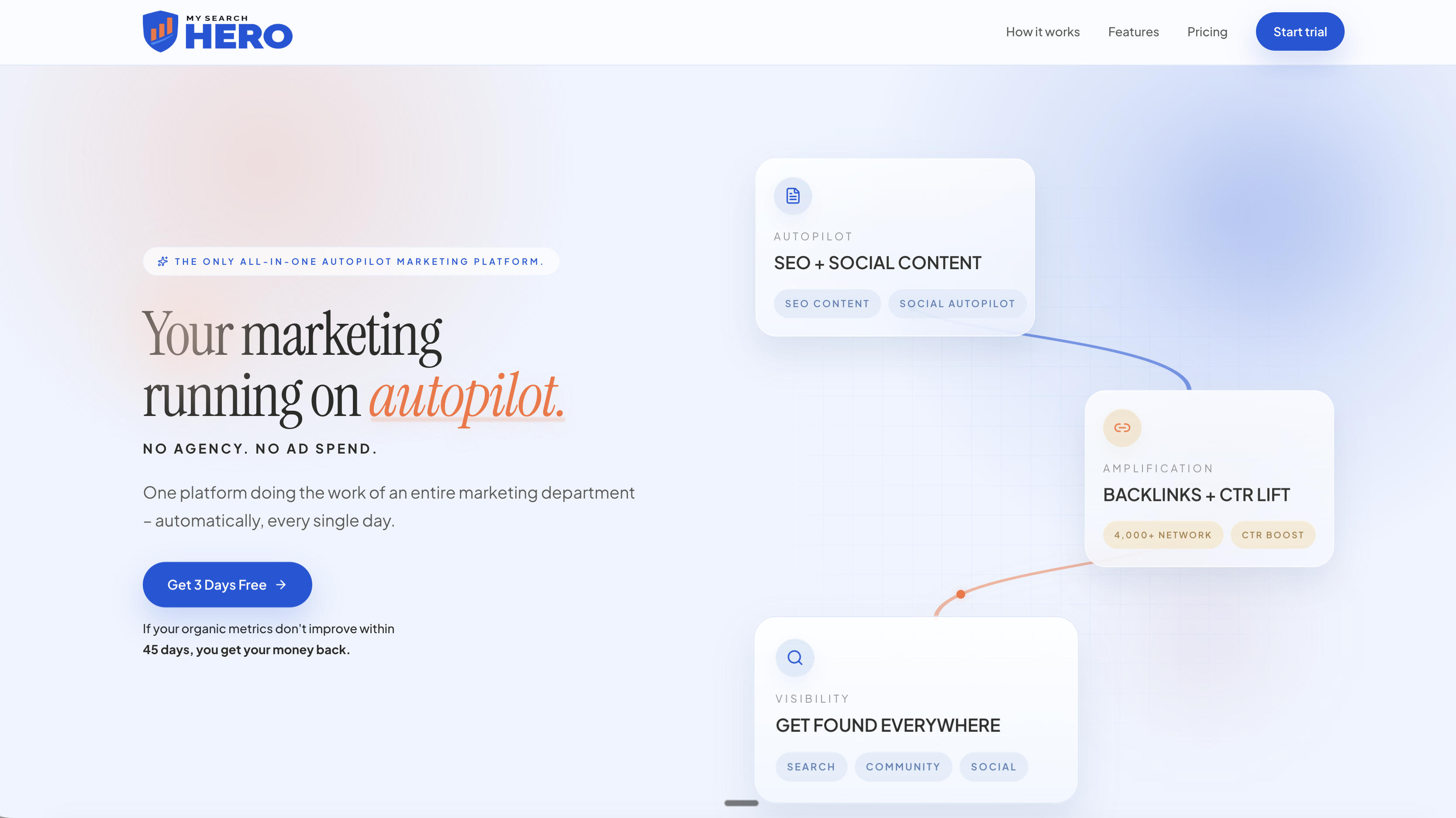
Mysearchhero is a done-for-you SEO and content marketing service built for small and mid-sized businesses that want to grow without managing a full marketing team. Each month, subscribers receive published articles, backlinks, Reddit mentions, and social media posts, all pushed out through an automated pipeline. You get the output of a full content operation without the overhead. If you are ready to put your online marketing on autopilot, Mysearchhero handles the execution while you run your business.
FAQ
What are marketing strategies, exactly?
Marketing strategies are specific approaches a business uses to attract, engage, and convert customers. They define which channels, messages, and tactics a business will use to reach its goals.
How many marketing strategies should a small business use at once?
Most small businesses perform best with 2–3 primary channels. Focusing on fewer channels with consistent effort produces better results than spreading budget and time across many platforms.
What is the most cost-effective marketing strategy for small businesses?
Referral marketing consistently delivers the highest return on investment because it converts warm leads at near-zero acquisition cost. Local SEO and email marketing are close seconds for long-term, low-cost growth.
How does local SEO differ from general SEO?
Local SEO targets customers in a specific geographic area through optimized Google Business Profiles, location-based keywords, and review management. General SEO targets broader, non-location-specific search traffic.
How do I measure whether my marketing strategy is working?
Set one measurable KPI per channel before you launch, such as leads generated, email open rate, or website traffic from organic search. Review each metric monthly and adjust tactics based on what the data shows.