
TL;DR:
- Seasonal SEO involves optimizing website content with keywords aligned to predictable demand spikes each year. Success depends on early planning, maintaining evergreen URLs, and tracking performance against previous years to build long-term authority. Consistent yearly updates and strategic timing ensure high rankings during peak seasonal periods.
Seasonal SEO is defined as the practice of aligning your website content, keywords, and technical setup with predictable spikes in search demand tied to holidays, weather shifts, or recurring events. Businesses that follow a structured guide to seasonal SEO consistently capture traffic that reactive competitors miss entirely. The core principle is simple: search demand for “Christmas gift ideas” or “summer lawn care” rises on a predictable schedule every year. Getting your content indexed and ranked before that wave arrives is what separates businesses that win organic traffic from those that watch it pass. This guide covers every stage, from identifying seasonal trends to measuring year-over-year performance.
What is a guide to seasonal SEO and why does it matter?
Seasonal SEO is not a separate discipline from standard SEO. It is the application of the same ranking principles, keyword research, content creation, and technical optimization, timed to match cyclical search behavior. The payoff is disproportionate: a well-ranked seasonal page can generate the majority of a business’s annual organic traffic in a compressed window of weeks.
Three types of seasonal demand drive most campaigns. Calendar-based seasonality follows fixed dates: Black Friday, Valentine’s Day, tax season. Weather-based seasonality tracks temperature and climate shifts: “best snow blower” peaks in october and november, “air conditioner repair” in may and june. Event-based seasonality ties to recurring cultural moments: the Super Bowl, back-to-school, graduation season. Each type requires a different lead time and content approach.
The business case is straightforward. Brands that publish seasonal content at the right time rank during peak demand, convert at higher rates, and build page authority that compounds year over year. Brands that publish late rank after the peak, if at all.
How do you identify and analyze seasonal trends and keywords?
Google Trends is the starting point for any seasonal keyword research. Enter a broad term, set the time range to five years, and look for recurring annual spikes. A term that peaks every december is a reliable seasonal keyword. A term that spiked once in 2022 is a trend, not a season.

Google Search Console adds a second layer. Filter your existing pages by date ranges from prior years and identify which queries drove traffic during specific months. This reveals seasonal demand you are already partially capturing, and shows you where to push harder.
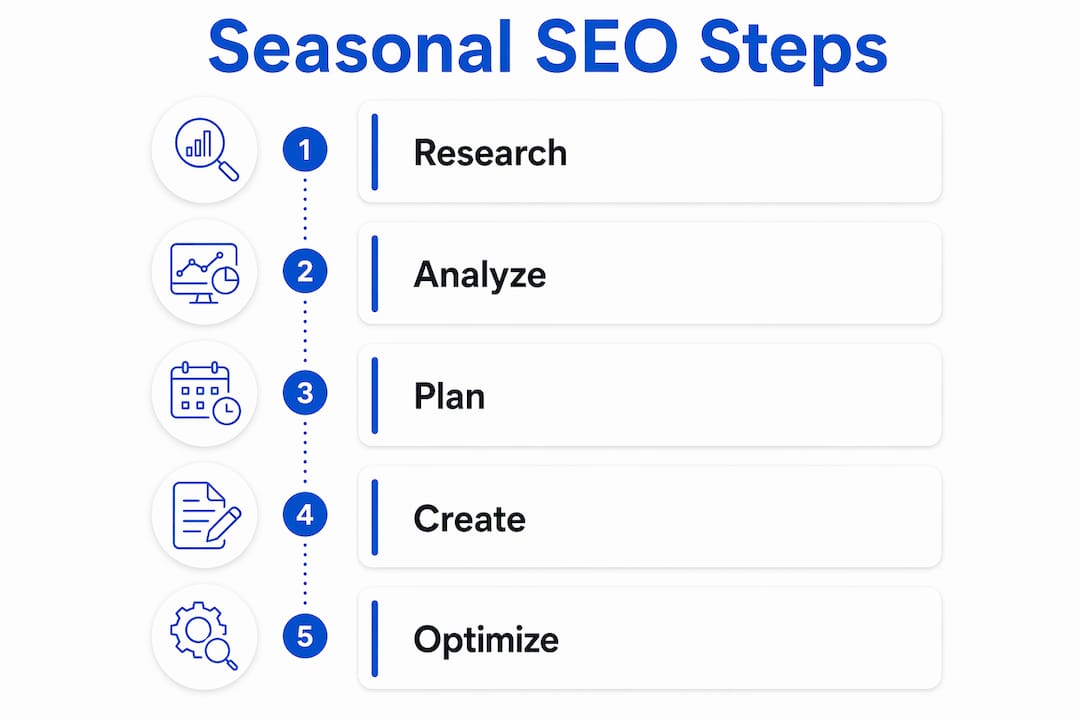
Keyword modifiers sharpen your targeting. Adding words like “best,” “deals,” “near me,” or the current year to a seasonal root term creates long-tail variants with clearer buyer intent. “Best outdoor heater for fall” converts better than “outdoor heater” because the searcher is ready to buy.
Lead times vary significantly by competition level. Low-competition seasonal keywords need 2–3 months of lead time. Medium-competition terms need 3–4 months. High-competition major holidays like Christmas or Black Friday require 4–6 months of preparation. That timeline accounts for content creation, indexing, and link acquisition.
- Calendar-based keywords: Fixed dates, predictable demand, high competition (e.g., “Christmas gifts for dad”)
- Weather-based keywords: Regional and climate-driven, moderate competition (e.g., “best rain jacket for fall”)
- Event-based keywords: Tied to recurring cultural events, variable competition (e.g., “Super Bowl party food ideas”)
Pro Tip: Run a multi-year Google Trends comparison for your top seasonal terms. If the spike appears in the same month for three or more consecutive years, you have a confirmed seasonal pattern worth building a dedicated page around.
How do you build an effective seasonal content calendar?
A seasonal content calendar is a 12-month planning document that maps every piece of seasonal content to a publication date, a target keyword, and a performance review milestone. Planning 12 months in advance gives your team time for research, writing, link building, and technical review before each peak arrives.
The most common mistake marketers make is treating seasonal content like a campaign: create it, run it, delete it. That approach destroys accumulated SEO value. The correct model treats each seasonal page as a permanent asset that gets refreshed annually.
Publishing 6–8 weeks before peak demand gives search engines enough time to crawl, index, and rank your pages. For a page targeting “best Halloween costumes,” that means publishing in early september, not late october.
Shoulder seasons deserve dedicated calendar slots. Search interest rises progressively before the peak month, meaning early-season content captures readers who are researching before they buy. A “summer travel planning” article published in march reaches a different, often more valuable audience than one published in june.
| Month | Content Focus | Target Keyword Example | Publish Deadline |
|---|---|---|---|
| January | Post-holiday sales, New Year goals | “New Year fitness deals” | December 1 |
| March | Spring cleaning, Easter prep | “Spring cleaning checklist” | February 1 |
| July | Back-to-school early research | “Back-to-school supplies list” | June 1 |
| September | Halloween, fall products | “Best Halloween costumes 2026” | August 1 |
| October | Black Friday early content | “Black Friday deals preview” | September 1 |
| November | Christmas gift guides | “Christmas gifts for him” | October 1 |
- Include a review milestone for each page 30 days before its publish date
- Schedule off-season updates for every major seasonal page in the months following its peak
- Mix content formats: long-form guides, product roundups, infographics, and social media posts tied to the same seasonal theme
Pro Tip: Build your seasonal content calendar in a shared spreadsheet with columns for keyword, URL, publish date, last updated, and peak month. Review it quarterly and adjust based on prior-year performance data.
What are the best practices for seasonal content creation?
The single most important rule in seasonal content creation is to use evergreen URLs. Use permanent URLs like /summer-sale instead of dated versions like /summer-sale-2026. Dated URLs force you to create a new page every year, splitting your backlink equity and starting your authority from zero each cycle.
Update metadata every year instead of creating new pages. Refresh the title tag, meta description, and any year references in the body copy. Search engines reward freshness, and returning visitors see current, relevant content.
Internal linking connects your seasonal and evergreen pages in both directions. Strategic internal linking passes authority from high-traffic evergreen pages to seasonal pages before their peak, and from seasonal pages back to evergreen content to retain visitors after the season ends.
Off-season is not downtime. The off-season is the right time to update content, improve internal linking structures, and prepare next year’s keyword targets. Businesses that treat the off-season as a planning window consistently outrank those that only activate during peak months.
- Write seasonal keywords naturally into H1, H2, meta descriptions, and the first 100 words of body copy
- Add multimedia: product images, infographics, and short videos increase time on page and reduce bounce rates
- Refresh statistics, product recommendations, and pricing annually to maintain accuracy
- Balance timely hooks with long-term value so the page stays useful between peaks
Pro Tip: Before each seasonal peak, run a pre-launch content review on your top seasonal pages. Check that all links work, images load correctly, and the metadata reflects the current year.
What technical SEO factors support seasonal campaigns?
Technical SEO failures during a seasonal peak cost more than they do during any other period. A slow page or a crawl error during Black Friday week can erase months of preparation in days.
Site performance is the first priority. Seasonal traffic spikes can overwhelm servers that handle average daily loads without issue. Test your hosting capacity before peak periods and use a content delivery network to distribute load.
Structured data accelerates seasonal SEO results. Use Product schema for seasonal product pages, Event schema for time-bound promotions, and SaleEvent schema for discount campaigns. These markup types generate rich results in Google Search, which increases click-through rates without requiring higher rankings.
Submit an updated sitemap to Google Search Console every time you publish or significantly update a seasonal page. This prompts faster crawling and reduces the risk of your page sitting unindexed during its peak window.
- Audit for noindex tags on seasonal pages before each campaign launches
- Use clean, descriptive URLs with no session IDs or unnecessary parameters
- Prioritize mobile optimization: seasonal shopping searches skew heavily toward mobile devices
- Check Core Web Vitals scores specifically on your highest-traffic seasonal pages
How do you measure seasonal SEO performance and avoid common mistakes?
Year-over-year comparison is the correct method for measuring seasonal SEO success. Comparing october traffic to november traffic tells you nothing useful. Comparing this october to last october tells you whether your seasonal strategy is working.
Track three metrics for each seasonal page during its peak window: organic ranking position for target keywords, organic traffic volume, and conversion rate. A page that ranks well but converts poorly signals a content-to-intent mismatch. A page that converts well but receives low traffic signals a ranking opportunity worth pursuing with additional link building.
Deleting seasonal pages after a campaign ends is one of the most damaging mistakes in SEO. Keeping seasonal pages live and updated yearly preserves link equity and builds topical authority that compounds over multiple seasons. A page that has existed for three years with consistent updates will almost always outrank a new page, regardless of content quality.
Common mistakes that undermine seasonal SEO campaigns:
- Publishing seasonal content during or after the peak instead of 6–8 weeks before
- Creating new dated URLs each year instead of updating existing pages
- Deleting seasonal pages after the campaign ends
- Ignoring shoulder seasons and missing early-rising search interest
- Failing to track seasonal keyword groups separately in Google Analytics
Pro Tip: Track seasonal keyword groups as distinct segments in your analytics platform. Grouping “Christmas gift” queries separately from “Black Friday deals” queries reveals behavioral differences between seasonal audiences and sharpens your optimization for each.
Key Takeaways
Seasonal SEO success requires proactive planning, evergreen URL structures, and year-over-year performance tracking to build compounding organic authority across every seasonal cycle.
| Point | Details |
|---|---|
| Plan 12 months ahead | Start seasonal keyword research and content creation at least a year before each peak. |
| Publish 6–8 weeks early | Give search engines time to index and rank your pages before demand peaks. |
| Use evergreen URLs | Keep permanent URLs like /summer-sale and update content yearly to preserve link equity. |
| Never delete seasonal pages | Keeping pages live and refreshed builds authority that compounds over multiple years. |
| Measure year-over-year | Compare seasonal periods to the same period last year, not to adjacent months. |
What three years of seasonal campaigns taught me
Most marketers treat seasonal SEO like a sprint. They scramble in october to publish Christmas content, panic when rankings don’t appear by december, and delete the pages in january to “start fresh” next year. That cycle is the single biggest reason seasonal SEO fails for most businesses.
The counterintuitive truth is that your weakest seasonal page today becomes your strongest page in three years, if you keep it alive and update it. I have watched pages that barely ranked in year one climb to position three or four by year three, purely because they accumulated backlinks and topical signals while competitors kept resetting their URLs. The compounding effect of maintained seasonal pages is real, and most businesses never experience it because they give up too early.
The other lesson is that shoulder seasons are where the real opportunity sits. Everyone targets the peak. Almost no one targets the six weeks before the peak, when search intent is rising and competition is lower. A “gift ideas for Christmas” article published in early october faces a fraction of the competition it would face in november, and it has time to rank before the peak arrives.
The 2026 SEO environment rewards freshness and technical soundness more than ever. AI-powered keyword research and predictive analytics now make it possible to anticipate seasonal demand shifts before they appear in traditional tools. Businesses that adopt these methods early will hold a real advantage over those still relying on manual trend spotting alone.
— Mike
How Mysearchhero supports your seasonal SEO strategy
Seasonal SEO requires consistent execution across keyword research, content creation, technical audits, and link building. Most business owners and marketers have the strategy but lack the bandwidth to execute it month after month.
Mysearchhero delivers a fully managed SEO and content pipeline that handles every stage of seasonal optimization on your behalf. Each month, subscribers receive published articles timed to seasonal demand, backlink outreach to support seasonal pages, and social media content aligned to upcoming peaks. The entire system runs on autopilot, so your seasonal content goes live on schedule without requiring your team to manage production. Visit Mysearchhero to see how the service fits your annual SEO calendar.
FAQ
What is seasonal SEO?
Seasonal SEO is the practice of aligning website content and keywords with predictable spikes in search demand tied to holidays, seasons, or recurring events. The goal is to rank before peak demand arrives and capture traffic during high-intent periods.
How far in advance should I publish seasonal content?
Publish seasonal content 6–8 weeks before the peak demand period. High-competition keywords tied to major holidays like Christmas or Black Friday require 4–6 months of total preparation time, including research and link building.
Should I delete seasonal pages after the campaign ends?
Never delete seasonal pages after a campaign ends. Keeping pages live and updating them annually preserves backlink equity and builds topical authority that compounds over multiple seasons, producing stronger rankings each year.
How do I measure seasonal SEO performance accurately?
Compare organic traffic, rankings, and conversion rates for each seasonal period against the same period in the prior year. Month-to-month comparisons do not account for seasonal variation and produce misleading conclusions.
What URL structure works best for seasonal pages?
Use evergreen URLs without year references, such as /black-friday-deals instead of /black-friday-deals-2026. Update the page content and metadata annually to maintain freshness while preserving accumulated link equity.