
TL;DR:
- Effective seasonal content planning relies on a multi-horizon calendar and a balanced content mix to maximize results.
- Focusing on five to eight high-impact moments and early preparation improves visibility and engagement for small businesses.
Seasonal content planning is the practice of scheduling marketing content around predictable calendar events, consumer buying cycles, and industry moments to drive engagement and revenue. A solid guide to seasonal content planning gives small business owners a repeatable system instead of a reactive scramble every time a holiday approaches. Brands that plan ahead consistently outperform those that create content on the fly, because search engines reward early, relevant content and consumers respond to timely messaging. Mysearchhero helps businesses build exactly this kind of system, publishing content on autopilot so no seasonal moment gets missed.
What are the key components of a seasonal content plan?
A content calendar template is the backbone of any seasonal planning system. Effective calendars track at least eight fields: publication date, platform, content format, topic, keyword, content owner, approval status, and confirmation. Each field removes a decision from the execution phase, which is where most small businesses lose time.

The strongest calendars work across three time horizons. Quarterly themes set the strategic direction. Monthly publication grids assign specific content to specific dates. Weekly execution trackers keep the team accountable day to day. Multi-horizon planning like this prevents the common problem of knowing a holiday is coming but having no content ready for it.
Data drives the best seasonal decisions. Search trend tools like Google Trends reveal when consumer interest in a topic starts rising, often weeks before the actual event. Historical performance data shows which past campaigns drove real results. Combining both lets you prioritize the moments worth investing in and skip the ones that never moved the needle for your audience.
| Feature category | What to look for |
|---|---|
| Calendar management | Drag-and-drop scheduling, recurring event support |
| Analytics integration | Search trend data, historical performance tracking |
| Collaboration tools | Role-based access, approval workflows |
| Distribution support | Multi-channel publishing, email and social scheduling |
| Content batching | Bulk upload, template reuse across campaigns |
Pro Tip: Keep one shared document as your single source of truth for the entire calendar. When the plan lives in multiple spreadsheets and inboxes, execution falls apart fast.
How do you identify the right seasonal moments for your business?
Not every holiday deserves a campaign. Seasonal marketing works best when you “board the train” where it fits your business niche and customer behavior, rather than chasing every trend on the calendar. A tax preparation firm should own april content. A swimwear brand should dominate february through may. Trying to be relevant to every moment dilutes both your budget and your message.
Start by mapping three categories of recurring moments:
- Calendar holidays: Christmas, Valentine’s Day, Mother’s Day, Black Friday, and other nationally recognized dates with proven consumer spending spikes.
- Industry events: Trade shows, product launch cycles, annual reports, and sector-specific awareness months that matter to your specific audience.
- Business milestones: Anniversaries, new product releases, and seasonal promotions unique to your brand.
Audience research sharpens the list further. Look at your website analytics to see which months drive the most traffic and conversions. Review your email open rates by send date. Check your social media insights for engagement patterns across the year. These signals tell you which seasonal moments your audience already responds to, before you spend a dollar on content.
Aligning seasonal content to consumer buying cycles is the step most small businesses skip. A customer searching “best gifts for dad” in early june is in discovery mode. The same customer searching “Father’s Day gift delivery” on june 14 is ready to buy. Your content strategy for holidays needs to address both stages, with awareness content published weeks before the event and conversion content ready as the date approaches.
Pro Tip: Pick five to eight high-impact seasonal moments per year and execute them well. A focused calendar beats a crowded one every time.
What is the step-by-step process for building a seasonal content calendar?
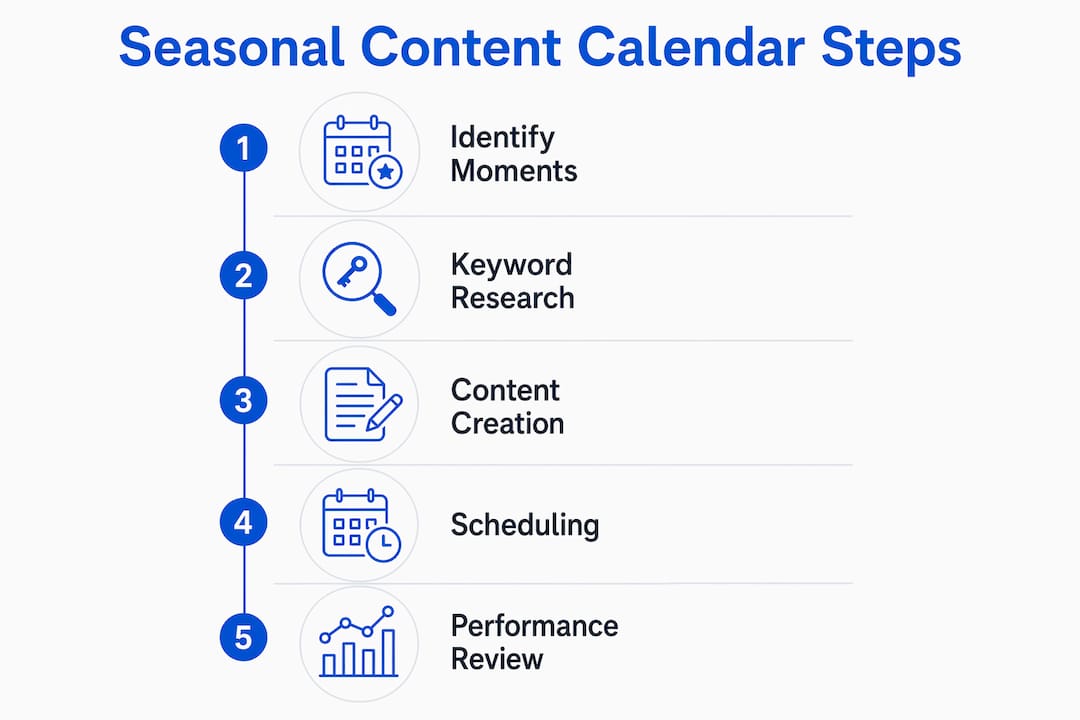
Planning seasonal content at least 12–16 weeks ahead of peak moments gives your content enough time to rank in organic search before demand peaks. Most small businesses start too late and end up publishing the day before the event, when search rankings are already locked in.
Work backward from each target date using this sequence:
- Week 16 before the event: Identify the seasonal moment and confirm it fits your audience and goals.
- Week 14: Complete keyword research. Find the specific phrases your audience searches during this period.
- Week 12: Write content briefs for every piece in the campaign, including blog posts, emails, and social content.
- Week 8: Draft all content. Review and revise with enough time for multiple rounds of feedback.
- Week 4: Schedule all content across channels. Set up email sequences and social posts in advance.
- Week 1: Final review. Confirm links, images, and CTAs are working correctly.
- Day of and after: Publish anchor content, monitor performance, and respond to real-time engagement.
The 60-20-20 content distribution framework is the most practical structure for a yearly content planning guide. Sixty percent of your content should be evergreen, meaning it stays relevant year-round and builds long-term search authority. Twenty percent should be planned seasonal hooks tied to specific dates. The remaining twenty percent stays flexible for real-time trend responses. This ratio prevents burnout and keeps your content mix balanced between predictability and opportunity.
Batch content creation is the execution method that makes this framework work. Batch creating 20–30 social posts or 4–6 blog posts at once creates a consistent rhythm and eliminates last-minute rushes. A retailer preparing for the holiday season, for example, can write all november and december blog posts in september, schedule all email sequences in october, and spend november and december focused entirely on engagement and optimization.
| Step | Timeline | Owner |
|---|---|---|
| Identify seasonal moments | 16 weeks out | Marketing lead |
| Keyword research | 14 weeks out | SEO specialist |
| Content briefs | 12 weeks out | Content strategist |
| Draft and review | 8 weeks out | Writers and editors |
| Schedule and publish | 4 weeks out | Content manager |
| Monitor and optimize | Ongoing | Analytics lead |
Pro Tip: Owned channels like email and your website consistently outperform social media algorithms for seasonal conversions. Build your distribution plan around email first, social second.
How do you measure and improve your seasonal content over time?
Measurement turns a one-time campaign into a repeatable system. The key performance indicators worth tracking for seasonal content are organic traffic by page, email open and click rates, social engagement rate, conversion rate by campaign, and revenue attributed to specific seasonal pushes. Each metric answers a different question about what worked and what to change.
Multi-tiered review cycles keep the plan sharp throughout the year. Weekly reviews catch execution problems early, like a scheduled post that failed to publish or an email sequence with a broken link. Monthly reviews assess whether the content mix is hitting traffic and engagement targets. Quarterly reviews are where you make bigger decisions: which seasonal moments to expand next year, which to cut, and where to shift budget.
The most underused source of seasonal insight is your own historical data. After every major campaign, document what you published, when you published it, and what results it drove. Build a simple log that you review each year before planning the next cycle. This log becomes more valuable every year as patterns emerge.
- Track organic traffic spikes by month to identify your highest-demand periods.
- Compare email open rates across seasonal campaigns to find your strongest subject line angles.
- Review conversion rates by content type to see whether blog posts or emails drive more sales for each seasonal moment.
- Note which pieces of evergreen content spiked during seasonal periods, since those are candidates for seasonal updates.
Balancing evergreen content with trend-driven posts sustains momentum between peak seasons. A blog post written for Valentine’s Day can be refreshed and republished the following year with updated statistics and examples. That compounding effect is what separates businesses with a real content strategy from those starting from scratch every season.
Pro Tip: Schedule a 30-minute “season debrief” within two weeks of every major campaign. Memories fade fast, and the insights you capture immediately after a campaign are far more accurate than what you reconstruct months later.
Key Takeaways
Effective seasonal content planning requires a multi-horizon calendar, a 60-20-20 content mix, and review cycles that turn each campaign into a smarter next one.
| Point | Details |
|---|---|
| Plan 12–16 weeks ahead | Starting early gives content time to rank before peak demand arrives. |
| Use the 60-20-20 framework | Sixty percent evergreen, twenty percent seasonal hooks, twenty percent trend response keeps the mix balanced. |
| Batch content creation | Creating 20–30 posts at once prevents last-minute rushes and maintains consistent output. |
| Prioritize owned channels | Email and your website drive more reliable seasonal conversions than social media algorithms. |
| Review after every campaign | A post-campaign debrief within two weeks captures the most accurate performance insights. |
What I’ve learned from years of watching seasonal plans succeed and fail
The biggest mistake I see small business owners make is treating seasonal content as a separate project instead of a built-in part of their marketing rhythm. They scramble in november to create Christmas content, publish it too late to rank, and then wonder why it didn’t perform. The fix is not more effort. It’s earlier planning and a calendar that runs on autopilot.
The second mistake is trying to be everywhere. A small team cannot execute 20 seasonal campaigns a year at a high level. Picking five to eight moments and doing them properly, with real keyword research, well-written content, and a distribution plan, will always outperform a calendar stuffed with half-executed ideas.
The mindset shift that changes everything is moving from reactive to proactive. When you have a content schedule built three months ahead, you stop feeling behind. You start making deliberate choices about where to invest your content budget. You also give yourself room to respond to unexpected trends without blowing up the whole plan, because the 20 percent trend window in the 60-20-20 framework already accounts for that flexibility.
Seasonal planning is not glamorous work. It is spreadsheets, editorial calendars, and debrief meetings. But it is the work that compounds. Every year you run this system, your historical data gets richer, your timing gets sharper, and your results get better.
— Mike
How Mysearchhero handles seasonal content for you
Building and executing a seasonal content calendar takes real time and consistent effort. Mysearchhero removes that burden entirely with a done-for-you content marketing service built for small businesses and marketers who want results without managing the process themselves.
Each month, Mysearchhero delivers published articles, backlinks, Reddit mentions, and social media posts through a fully automated pipeline. The system handles content strategy planning and execution so your seasonal moments are covered without last-minute scrambles. If you want your marketing running on autopilot year-round, Mysearchhero is built exactly for that.
FAQ
What is seasonal content planning?
Seasonal content planning is the process of scheduling marketing content around predictable calendar events, consumer buying cycles, and industry moments. The goal is to publish relevant content early enough to rank in search and reach customers when their intent is highest.
How far in advance should I plan seasonal content?
Plan seasonal content at least 12–16 weeks before each peak moment. This lead time allows for keyword research, drafting, review, and enough time for search engines to index and rank the content.
What is the 60-20-20 content framework?
The 60-20-20 framework allocates sixty percent of content to evergreen topics, twenty percent to planned seasonal hooks, and twenty percent to real-time trend responses. This balance keeps content consistent and flexible at the same time.
How many seasonal moments should a small business target?
Five to eight high-impact seasonal moments per year is the right range for most small businesses. Focusing on fewer moments with full execution beats spreading a limited team across every holiday on the calendar.
Which channels work best for seasonal campaigns?
Owned channels like email and your website consistently outperform social media for seasonal conversions. Build your distribution plan around email sequences and optimized landing pages first, then use social media to amplify reach.