
Writing SEO content that actually ranks comes down to one discipline: answer the reader’s question first, then prove it. The most effective approach in 2026 combines an answer-first format, strategic keyword placement, and a structure that both human readers and AI search engines can parse without effort. Here is what that looks like in practice:
- Write for readers first. Google’s people-first guidelines reward content that genuinely helps, not content engineered to game rankings.
- Place your primary keyword in the title, opening paragraph, at least one H2 heading, and the closing paragraph.
- Use a logical heading hierarchy (H1 → H2 → H3) with no skipped levels. Pages with clean heading structure perform noticeably better on the metrics AI Overview citation algorithms use.
- Open each major section with a 40–60 word self-contained answer block. That is the format AI systems extract most reliably for featured snippets.
- Add trust signals: attributed expert quotes, verifiable statistics with named sources, and inline citations to authoritative third parties.
- Keep pages technically accessible: fast load times, crawlable HTML, valid schema markup, and a visible “Last updated” date.
- Update content regularly. AI models weigh freshness as a trust signal, so stale pages lose ground even when they once ranked well.
How to write SEO content that ranks and gets cited
The steps below cover the full workflow, from research through publication and maintenance. Each one addresses a specific gap that keeps otherwise solid content off the first page.

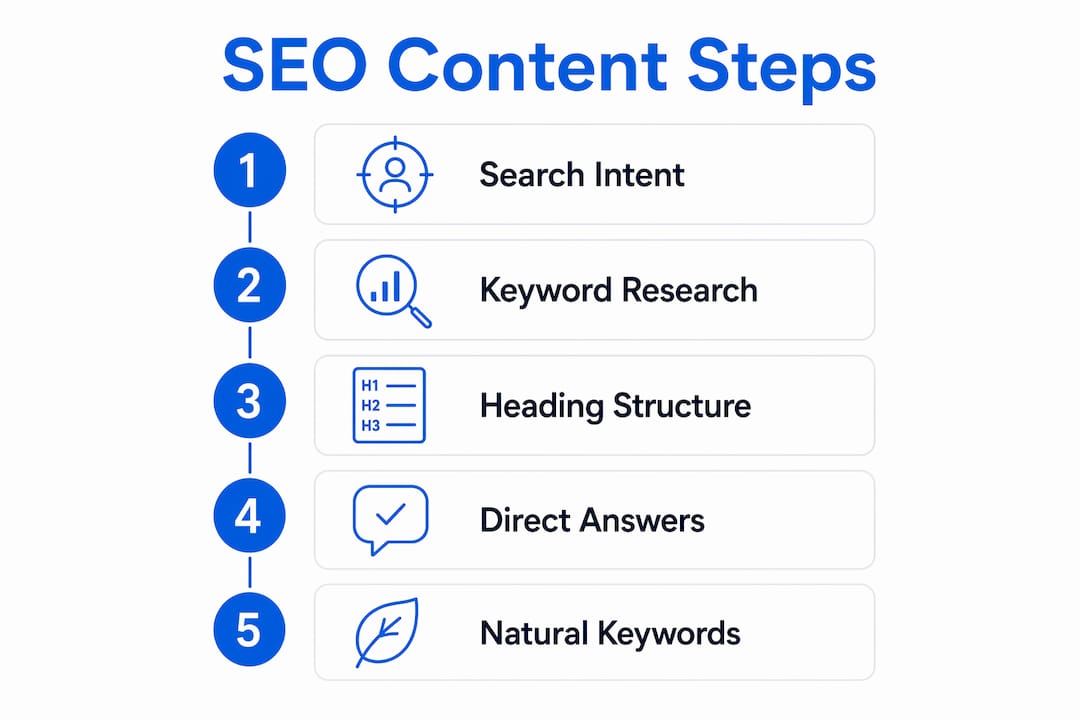
1. Start with search intent, not a keyword list
The most common mistake in SEO content creation is starting with a keyword and trying to fit content around it. Effective writing in 2026 begins by identifying the question behind the query. Search your target keyword and examine the top five results. What format do they use? A listicle, a long-form guide, a product page? That format is what Google considers the correct intent match for that query.
Check the “People Also Ask” box next. Those questions reveal sub-intents users have after their initial search, and they are free heading ideas. Then search your keyword in Google’s AI Mode or Perplexity and note which sources get cited. That tells you what format AI systems consider most trustworthy for that topic.

2. Conduct keyword research that goes beyond volume
Volume matters, but so does context. Use Google Search Console to find queries where you already have impressions but low click-through rates. Those are pages where better writing, not more links, will move the needle. For new topics, tools like Google Keyword Planner surface related terms and semantic variations you can weave naturally into the body.
Pro Tip: Target one primary keyword per page and cluster three to five related terms around it. Forcing two competing primary keywords onto a single page splits the page’s topical focus and confuses both readers and search engines.
Primary keywords should appear in the title, first paragraph, at least one H2, and the closing paragraph. Use natural variations throughout the body rather than repeating the exact phrase. If an insertion feels forced, rewrite the sentence around the idea the keyword represents.
3. Build a logical heading hierarchy
Your heading tags function as a table of contents for both readers and machines. One H1 per page, H2s for major sections, H3s and H4s nested logically beneath their parent H2. Never skip levels. Jumping from H2 directly to H4 harms accessibility and confuses AI parsers, which reduces the chance your content gets cited in AI-generated answers.
Format headings as real questions your audience types into search. “How do I optimize images for SEO?” outperforms “Image Optimization” every time, both for featured snippet selection and AI citation probability. Avoid stacking six near-identical H2s built around the same phrase. Semantic variety across headings signals genuine topical depth.
4. Open every section with a direct answer block
Immediately beneath each question-formatted heading, place a concise, complete answer in 40–60 words. This is the format AI systems extract most reliably for featured snippets and AI Overview citations. Follow the direct answer with expanded detail, evidence, and examples. Think of it as the inverted pyramid: conclusion first, then context.
This structure also helps human readers. Eye-tracking research consistently shows that web users scan before they read. If your core point is buried in paragraph four, most readers never find it.
5. Integrate keywords naturally with semantic variation
Keyword integration works best when it mirrors how people actually talk about a topic. If you are writing about SEO content writing tips, your body should also include phrases like “writing for search engines,” “content optimization,” and “search-friendly articles.” These semantic variations tell Google your page covers the topic thoroughly, not just the exact phrase.
What to avoid: repeating the exact primary keyword in every other sentence, bolding it every time it appears, or inserting it into sentences where it reads awkwardly. Google’s systems identify relevance beyond exact keyword matching, and forced repetition reads as manipulation.
6. Write meta titles and descriptions that earn the click
Your meta title is the first thing a searcher sees. Keep it under 60 characters, place the primary keyword near the front, and communicate a clear value proposition. “SEO Content Writing Guide for 2026” beats “A Comprehensive Overview of Writing Content for Search Engines” on every dimension.
Meta descriptions should stay under 155 characters to avoid truncation. Lead with the primary keyword, use an active verb, and tell the reader exactly what they will gain. A well-written description does not guarantee a click, but a vague one almost guarantees the reader skips past.
7. Use compelling headings and subheadings throughout
Beyond the heading hierarchy rules, the quality of individual headings matters. A good H2 describes a real decision or question the reader faces. A good H3 narrows the issue without repeating the parent heading’s exact phrase. Headings that read like feature labels (“Content Optimization Overview”) do less work than headings that address the reader directly (“How do you optimize content for AI search?”).
Vary heading length and structure across a page. Some can be short and punchy. Others can be a full question. The goal is a page where a reader scanning only the headings can follow the argument from top to bottom.
8. Structure content for readability
Short paragraphs, two to four sentences each, reduce bounce rate. Dense text blocks push readers away before they reach your key points. Use bullet points and numbered lists for sequences, options, or checklists. Bold key phrases so scanners can grasp your argument without reading every word.
Logical section order matters too. Define terms before using them. Present context before analysis. A reader who has to scroll back to understand a term you used three sections earlier is a reader who is about to leave.
9. Add internal links to build topical authority
Internal linking within content clusters builds the topical authority that both AI and traditional search favor. A pillar page links to all related posts addressing specific questions and subtopics, and those posts link back to it. This structure demonstrates deep, sustained expertise on a topic rather than a single isolated article.
When you add an internal link, use descriptive anchor text that tells the reader and search engine what the linked page covers. “Learn more here” wastes the signal. “Content marketing workflow for small businesses” earns it. For a practical look at how this fits into a broader content marketing workflow, the approach scales whether you are managing five pages or five hundred.
10. Optimize images with descriptive alt text
Every image on a page should carry alt text that is descriptive, concise, and keyword-aware when the keyword accurately describes what the image shows. Proper alt text aids accessibility for screen readers and gives search engines additional context about the page’s topic. Aim for one to two sentences, under 125 characters.
High-quality images and video also improve user engagement, which sends positive behavioral signals to search engines. A page with relevant visuals tends to hold readers longer than a wall of text. For a deeper look at how video fits into this picture, the role of video in marketing is worth understanding alongside written content strategy.
11. Build trust with citations, statistics, and expert quotes
Content containing attributed expert quotes increases AI citation likelihood significantly, and verified statistics with inline third-party citations raise citation probability. These are not just tactics for AI visibility. They also build the E-E-A-T signals (Experience, Expertise, Authoritativeness, Trustworthiness) that Google’s quality raters use to evaluate content.
Link to primary sources: government data, academic papers, industry reports from organizations like Pew Research or Forrester. Avoid linking to aggregator roundups that themselves lack original data. Every statistic you cite should carry a named source and a publication date.
12. Follow URL best practices
Short, descriptive URLs outperform long ones. Use your primary keyword as the URL slug and strip unnecessary words. “/how-to-write-seo-content” is better than “/blog/post-1234-a-complete-guide-to-writing-content-for-search-engines-in-2026.” Keep slugs lowercase, use hyphens between words, and avoid parameters or session IDs that make URLs harder to read and share.
A clean URL structure also supports your internal linking strategy. When a URL clearly signals the page’s topic, anchor text choices become more natural and the link’s topical signal is stronger.
13. Build content clusters and pillar pages
A single well-written article is rarely enough to establish authority on a competitive topic. AI engines favor sources that demonstrate deep, sustained expertise through consistent, comprehensive coverage. Organize your content around topic clusters: one pillar page that acts as the hub, linking to supporting posts that address specific questions, subtopics, and use cases.
This structure also protects against traffic loss. If one supporting page drops in rankings, the cluster as a whole retains authority because the internal linking distributes topical signals across multiple pages.
14. Plan for content maintenance and freshness
Publishing is not the finish line. AI models weigh freshness as a trust signal, so pages with stale statistics or outdated screenshots lose ground over time. Conduct a content gap analysis every quarter: look for queries where competitors get cited in AI Overviews that your content does not cover, and for pages that rank in Google but lack the clear answer blocks needed for AI extraction.
When you update a page, add a visible “Last updated” date. Update statistics to the most recent available data. Add new sections for emerging subtopics you are seeing in search data. Update internal links to point to newer, relevant content. These freshness signals matter to both crawlers and readers who want to know they are reading current information.
15. Ensure technical accessibility for crawlers
Writing quality alone cannot save a page that search engines cannot crawl. Check your robots.txt file to confirm you are not accidentally blocking AI crawlers. Fix 4XX and 5XX errors. Prioritize Core Web Vitals, especially Largest Contentful Paint (LCP) and First Contentful Paint (FCP). Serve static HTML wherever possible because AI bots do not execute JavaScript.
Add schema markup where relevant. Article, FAQ, and Author schema help AI models understand content type, authorship, and topic relationships. Schema should describe the page accurately, not exaggerate it. A mismatch between what users see and what schema claims is a credibility problem, not a ranking shortcut. For a broader view of how AI is reshaping technical SEO, AI in local SEO covers the overlap between these technical signals and visibility in AI-powered search.
Common SEO writing mistakes that hurt your rankings
Even experienced writers fall into patterns that quietly undermine their content’s performance. The mistakes below are more common in 2026 than they were two years ago, partly because AI writing tools make some of them easier to commit at scale.
Keyword stuffing and over-optimization. Repeating the primary keyword in every paragraph, bolding it every time it appears, or building multiple near-identical headings around the same phrase signals manipulation. Google’s systems identify relevance beyond exact keyword matching, and forced density hurts more than it helps.
Thin, repetitive pages. Generic summaries that restate the same thesis in slightly different ways add little value and reduce citation chances in AI search. A page that says “AI search is changing SEO” without showing a concrete example, a before-and-after audit, or a verifiable claim gives both readers and AI systems nothing to work with.
Skipping heading levels. Jumping from H2 to H4 harms accessibility and AI parsing. This is one of the structural errors that directly reduces a page’s heading-hierarchy score, which affects AI Overview citation probability.
Ignoring author credibility. Content attributed to “the editorial team” or published with no author bio performs worse in AI citation than content with a named author whose expertise is verifiable. E-E-A-T signals now affect citation probability across AI platforms, not just Google’s quality rater evaluations.
Publishing and forgetting. A page that ranked well in 2024 on outdated statistics is a liability in 2026. AI models weight content from roughly the last 13 weeks more heavily for fast-moving topics. Pages without visible update dates look stale to both crawlers and readers.
Statistic to know: Adding citations, quotations from credible sources, and statistics can boost source visibility in AI-generated responses by up to 40%, according to the Princeton/ACM SIGKDD GEO study. Generic content without verifiable claims earns none of that lift.
Over-relying on AI drafting tools without fact-checking. AI writing tools produce fluent prose quickly, but they hallucinate statistics and misattribute quotes. Treat any AI-generated draft as a first pass. Verify every factual claim against a primary source before publishing. The cost of a fabricated statistic is not just a correction. It is a credibility problem that affects every page on your domain.
Sacrificing readability for optimization. A page optimized for machines but painful to read will not hold visitors long enough to generate the behavioral signals that reinforce rankings. Short paragraphs, clear headings, and plain language serve both audiences. The practices that help human readers also help AI parsers.
Mysearchhero does the SEO work so you can focus on your business
Most content creators understand what good SEO writing requires. The harder problem is doing it consistently, at volume, while running everything else. Mysearchhero is a done-for-you SEO and content marketing service built for exactly that gap: you get published articles, backlinks, Reddit mentions, and AI-generated social media posts delivered every month through a fully automated pipeline, without hiring an agency or managing a team of freelancers.
Every deliverable is designed around the same principles this article covers: answer-first structure, strategic keyword integration, trust signals, and fresh content that stays current. If you are a content creator or small business owner who wants consistent organic growth without spending 20 hours a week on it, Mysearchhero is the practical alternative to doing it all yourself. The pipeline runs on autopilot. You keep the results.
Key Takeaways
Writing SEO content that ranks in 2026 requires answer-first structure, clean heading hierarchy, verifiable trust signals, and regular freshness updates across both traditional and AI search surfaces.
| Point | Details |
|---|---|
| Answer first, always | Place a 40–60 word direct answer immediately after each question-based heading for AI extraction. |
| Heading hierarchy matters | Never skip heading levels; pages with a clean H1–H2–H3 structure perform noticeably better on the metrics used by AI Overview citation algorithms. |
| Trust signals lift citations | Attributed expert quotes increase AI citation likelihood by 41%; verified statistics raise it by roughly 30%. |
| Freshness is a ranking signal | Add visible update dates and refresh statistics regularly, since AI models weight recent content more heavily. |
| Mysearchhero automates delivery | Mysearchhero publishes articles, backlinks, and social posts monthly so your SEO runs without manual effort. |
FAQ
How do I start writing SEO content?
Begin by identifying the search intent behind your target keyword, then open with a direct answer to the reader’s core question. Place the primary keyword in the title, first paragraph, at least one H2 heading, and the closing paragraph.
How do you write SEO-friendly content?
Use a logical heading hierarchy (H1, H2, H3 with no skipped levels), write short paragraphs of two to four sentences, add verifiable statistics with named sources, and structure each major section with a 40–60 word answer block directly beneath the heading.
What are some SEO content writing examples?
A how-to guide that opens with a direct answer, uses question-based H2 headings, cites primary sources inline, and includes a visible update date is a strong example. Pillar pages that link to supporting cluster articles are another format that performs well in both traditional and AI search.
How do I improve my SEO writing over time?
Conduct a quarterly content gap analysis to find queries where competitors get cited in AI Overviews that your content does not cover. Update stale statistics, add new sections for emerging subtopics, and refresh internal links to newer content. Consistent maintenance compounds over time in ways that one-time optimization does not.