
Social proof is the fastest trust signal you can add to any page, and the data backs that up: testimonials on landing pages lift conversions by roughly 34%, and video testimonials pull about four times the engagement of text alone. Before you read another word, here are three copy-ready snippets you can drop in today:
- “4.8★ from 3,214 verified reviews” — place in your hero section, right under the headline
- “23 people are viewing this right now” — place near the Add-to-Cart button or CTA
- “Reduced onboarding from 7 days to 2 — VP of Operations, Acme Corp” — place directly above your pricing CTA or checkout button
Each one works because it answers the visitor’s unspoken question: Can I trust this? The rest of this guide shows you exactly which proof to use, where to put it, and how to measure whether it’s working.
Key Takeaways
Specificity, placement at decision points, and matching proof to the visitor’s peer group are the three variables that separate social proof that converts from social proof that decorates.
| Point | Details |
|---|---|
| Place proof at decision points | Testimonials at checkout and above CTAs drive the largest conversion lifts. |
| Specificity beats volume | Named customers with quantified outcomes outperform anonymous or vague claims. |
| Match proof to the buyer | Peer-targeted proof outperforms generic crowd claims, especially in narrow segments. |
| Video outperforms text | Video testimonials generate roughly 4x the engagement of text testimonials. |
| Mysearchhero automates distribution | Monthly content, backlinks, and social posts keep your proof circulating without manual effort. |
Table of Contents
- What social proof examples actually prove about buyer psychology
- The main types of social proof, with one copy-ready example each
- Channel-by-channel social proof playbook
- How to pick the right proof and implement it step by step
- How to measure social proof impact and run A/B tests
- B2B vs. B2C priorities and advanced tactics
- Best practices and what to avoid
- What actually moves the needle for small businesses
- Mysearchhero puts your proof to work automatically
- Sources
- FAQ
What social proof examples actually prove about buyer psychology
Social proof is the tendency to treat other people’s choices as evidence of the right choice, especially when you’re uncertain. Robert Cialdini, who named the principle in Influence, explains that it operates most powerfully under uncertainty and when the people doing the influencing are perceived as similar to the decision-maker. That second part is the one most marketers ignore.
Generic crowd claims (“over 1 million users!”) move the needle far less than proof from someone who looks like your buyer. A solo consultant trusts a testimonial from another solo consultant more than a Fortune 500 logo wall. Statista’s consumer-trust data confirms that third-party reviews and user-generated content rank among the highest-trust signals available, precisely because they’re harder for brands to control.
Pro Tip: Before choosing a proof type, write one sentence describing your ideal buyer’s biggest fear at the moment of decision. Then pick the proof that speaks directly to that fear from someone who shares it.
The main types of social proof, with one copy-ready example each
Marketful’s marketing guide identifies six core types of social proof, and each one fits a different channel and buyer stage. Here’s the full taxonomy with a paste-ready example and the best channel for each:
- Customer reviews: “★★★★★ — Best purchase I’ve made this year. Arrived fast, works perfectly.” Best on product pages and Google Business Profile.
- Case studies: “Airbnb’s host onboarding redesign cut support tickets by 30% in 90 days.” Best on B2B landing pages and sales decks.
- Expert endorsements: “Recommended by the American Dental Association.” Best in hero sections and email headers.
- Influencer/celebrity proof: Glossier built its early growth almost entirely on micro-influencer UGC, seeding product to real users before paying anyone. Best on Instagram, TikTok, and paid social.
- Crowd counts: “Join 47,000 marketers who get our weekly brief.” Best in email opt-in forms and SaaS signup flows.
- Peer/personal referrals: “Your colleague Sarah Chen uses this tool.” Best in outbound email and account-based ads.
- Certifications and awards: “SOC 2 Type II Certified” or “G2 Leader — Spring 2026.” Best in footers, pricing pages, and enterprise sales proposals.
- UGC (photos and video): HelloFresh reposts customer unboxing videos on Instagram Stories every week. Best on social feeds, product pages, and retargeting ads.
Video works best for emotional or complex products (skincare, SaaS demos, fitness). Text snippets work best for quick-scan contexts like checkout pages and email footers.
Channel-by-channel social proof playbook
Different channels reward different proof types. Here’s where to place what, and what to watch.
| Channel | Best proof type | Placement | KPI to watch |
|---|---|---|---|
| Homepage / hero | Crowd count + logo strip | Under headline | Scroll depth, time on page |
| Product page | Star rating + review count | Near price | Add-to-cart rate |
| Checkout | Short testimonial + trust badge | Above “Pay now” | Checkout completion rate |
| Landing page | Named case study + video testimonial | Above and below CTA | Form submission rate |
| Star rating snippet + review excerpt | Below main CTA | Click-through rate | |
| Paid social ads | UGC photo/video + review pull-quote | Ad creative | CTR, ROAS |
| Outbound/ABM | Peer referral + named ROI stat | Opening line | Reply rate |
Website hero: Casper’s homepage has long led with a review count and aggregate star rating before any product description. Copy: “Rated 4.8★ by 52,000+ sleepers.” Place it within 100px of your headline.
Product pages: Shoppers read about 10 reviews before buying, and showing five or more reviews can increase purchase likelihood substantially. Rare Beauty displays a running review count next to every product’s star rating, updated in real time.
Checkout: One short, specific testimonial placed above the payment button addresses last-second doubt. “I was nervous about the price. Three months later, I’d pay double.” Keep it under 20 words.
Email: SEMrush regularly includes a pull-quote from a named customer in their nurture sequences, right below the primary CTA button.
Paid social: UGC ads consistently outperform polished brand creative. Glossier’s paid social relies heavily on screenshots of real customer texts and DMs, which feel unscripted because they are.
How to pick the right proof and implement it step by step
The right proof depends on three variables: where the buyer is in the funnel, what they’re afraid of, and how much they’re spending.
Decision checklist before you choose:
- Early funnel (awareness): use crowd counts and media logos to establish credibility fast
- Mid funnel (consideration): use case studies, video testimonials, and expert endorsements
- Late funnel (decision): use named reviews, third-party platform ratings, and trust badges
- High-ticket or enterprise: use auditable ROI case studies and reference calls
- Low-ticket or impulse: use star ratings, review counts, and real-time activity notifications
Implementation steps:
- Collect: Send a post-purchase email within 48 hours asking for a review. For video, provide a three-question script: What was the problem? What happened after? Would you recommend it?
- Verify: Get written consent and a photo release. For B2B, confirm the customer approves the company name and any metrics you plan to publish.
- Place: Follow the channel table above. Put proof at every decision point, not just the homepage.
- Personalize: Segment by visitor type. Personalized logo displays and segmented proof have produced conversion lifts far beyond the baseline 8% a generic logo strip delivers. If you know a visitor came from a healthcare campaign, show them a healthcare customer’s testimonial. Practical content personalization techniques make this manageable even for small teams.
Pro Tip: For video capture, give customers a three-question script and let them record on their phone. Rough, authentic footage converts better than a polished studio shoot because it reads as real.
How to measure social proof impact and run A/B tests
You can’t optimize what you don’t track. Here’s the measurement framework:
Measurement checklist:
- Define one primary metric per test before you start.
- Run the test for at least two full business cycles (usually two weeks minimum).
- Reach statistical significance before calling a winner — gut feel at day three is not a result.
- Segment results by traffic source. Paid traffic and organic traffic often respond differently to the same proof.
- Track micro-conversions (scroll depth, hover time on testimonial blocks) alongside macro ones.
For a deeper look at how AI tools are reshaping how marketers interpret behavioral signals, the real role of AI in marketing covers the measurement side in detail.
B2B vs. B2C priorities and advanced tactics
The proof that closes a $200 impulse buy is almost never the proof that closes a $50,000 annual contract.
B2C priorities: Star ratings, UGC, real-time activity notifications, and influencer content. HelloFresh and Rare Beauty both lean on volume: thousands of reviews, constant UGC reposts, and aggregate ratings front and center. Speed and volume matter more than depth.
B2B priorities: Named case studies with quantifiable outcomes, third-party platform reviews on G2 or Trustpilot, and reference calls. Enterprise buyers distrust aggregated star counts because they know they can be gamed. What they trust is a case study they can verify and a peer they can call.
Advanced tactics:
- Visitor-segmented proof: Show a SaaS visitor a SaaS case study, not a retail one. Tools like Mutiny make this automatable. The lift from matched proof versus generic proof is substantial.
- Verification badges: SOC 2, ISO 27001, and G2 Leader badges are “hard-to-invent” proof. An attacker can fake a testimonial; they can’t fake a third-party audit certificate.
- Structured case-study format: Problem → Solution → Quantified Outcome → Named Contact. Keep it to one page. “Acme Corp reduced churn by 22% in 90 days using [Product]. — Jane Smith, VP Customer Success” is more persuasive than three paragraphs of narrative.
Pro Tip: For enterprise sales, ask your happiest customers for a 15-minute reference call rather than a written quote. A live reference is the hardest proof to fake and the most persuasive signal a late-stage buyer can get.
AI-powered outreach can help automate the initial ask for case study participation and reference calls without making it feel cold.
Best practices and what to avoid
Most proof fails not because it’s absent but because it’s stale, vague, or unverifiable.
Do:
- Attach a full name, photo, company, and date to every testimonial. Anonymous reviews carry almost no weight.
- Rotate reviews regularly. A five-star review from 2021 signals neglect, not quality.
- Respond to negative reviews publicly. Trustpilot’s guidance on review transparency shows that how you handle criticism matters as much as your average rating.
- Disclose paid partnerships and sponsored content. The FTC requires it, and audiences increasingly spot undisclosed sponsorships anyway.
Don’t:
- Fabricate or incentivize fake reviews. Beyond the legal exposure, AI-era buyers are increasingly skeptical of suspiciously uniform five-star clusters. HBR’s analysis of influence misuse documents how manufactured consensus backfires when discovered.
- Stack too many proof types on one page. Three strong, specific proofs beat twelve generic ones.
- Use misleading aggregates (“customers love us” with no number or source).
- Publish a testimonial without written consent, especially if it includes a photo or company name.
The one-line rule: if you wouldn’t show the proof to a journalist, don’t show it to a customer.
What actually moves the needle for small businesses
Most small businesses overthink the proof they don’t have and underuse the proof sitting in their inbox.
The single most consistent pattern across real deployments: specificity wins. “Saved 4 hours a week” outperforms “saves time.” A named customer with a job title outperforms an anonymous quote. A before-and-after metric outperforms a vague endorsement. This isn’t a theory — it’s what you see when you look at which testimonials actually get clicked and which get scrolled past.
For SMBs with limited resources, the starter plan is simple. First, email your five happiest customers this week and ask for a one-sentence quote with their name and title by using AI to automate marketing tasks for home service businesses. Second, add your aggregate star rating and review count to your homepage hero and your email signature. Third, pick one page with a CTA and run a two-week test: testimonial above the fold versus below. That’s it. Those three steps take less than a day and give you something real to measure.
The temptation is to wait until you have a polished video testimonial or a Fortune 500 logo. Don’t. A genuine quote from a real local business owner, placed at the right moment, will outperform a borrowed logo every time. Mysearchhero’s approach to content publishing is built around exactly this principle: get real proof out into the world consistently, not perfectly.
Mysearchhero puts your proof to work automatically
Collecting testimonials is one thing. Getting them in front of the right visitor, on the right page, at the right moment, is where most small businesses stall.
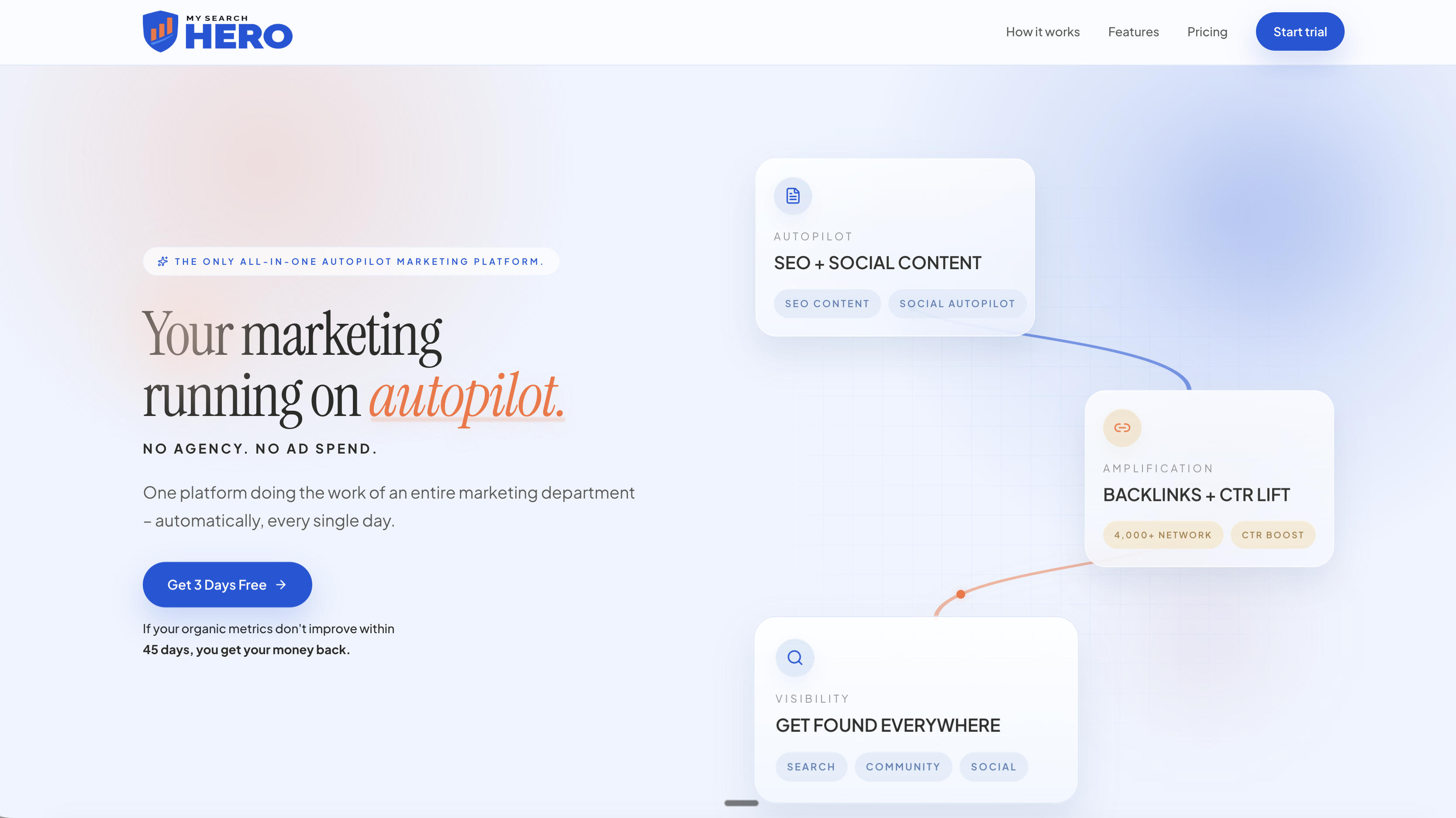
Mysearchhero handles the content side of that equation for you. Each month, your subscription delivers published SEO articles, authority backlinks, Reddit brand mentions, and social media posts, all pushed through an automated pipeline so your proof reaches buyers whether or not you have time to manage it. Instead of a static testimonials page nobody visits, your best proof gets woven into content that ranks and circulates. Start your free trial at Mysearchhero and see what consistent, automated content delivery does for your visibility in 30 days.
Sources
- The State of Social Proof in 2026 – Statistics & Data | Opinafy
- Social Proof: The Complete Marketing Guide (2026)
- Influence: Science and Practice (Ch. 4: Social Proof)
- Consumer trust in different types of advertising | Statista
FAQ
What is social proof in marketing?
Social proof is the use of other people’s choices, reviews, or endorsements to signal that a product or service is trustworthy. It works because buyers under uncertainty look to similar others for guidance, as Cialdini’s research on influence documents.
Which social proof examples convert best?
Named testimonials with specific outcomes, video testimonials, and third-party star ratings placed at decision points (pricing, CTA, checkout) consistently produce the largest lifts.
How many reviews do buyers read before purchasing?
Shoppers read about 10 reviews on average before making a purchase decision, and showing five or more reviews substantially increases purchase likelihood compared to showing none.
How do I measure whether social proof is working?
Run an A/B test with one variable changed (testimonial above vs. below the fold, for example), track a single primary metric like form submission rate or add-to-cart rate, and wait for at least two weeks and 95% statistical confidence before drawing conclusions.
What’s the difference between B2B and B2C social proof?
B2C buyers respond to volume signals like star ratings, UGC, and real-time activity counts. B2B buyers, especially in enterprise deals, trust named case studies with auditable ROI numbers and third-party platform reviews on G2 or Trustpilot far more than aggregated star counts.