
Fix deliverability first, then automate your lifecycle flows, then personalize where behavior justifies it. Those three moves, in that order, produce the fastest measurable lift in opens, clicks, and revenue per send. Everything else on this list matters, but it matters less than getting these right.
Here’s the priority list to work through this week:
- Lock down authentication. SPF, DKIM, and DMARC aren’t optional anymore. Skip them and half your other tactics won’t matter because your mail never reaches the inbox.
- Build your welcome flow before anything fancier. Lifecycle flows generate roughly 41% of email revenue from about 5.3% of total sends, and welcome sequences are usually the biggest single piece of that.
- Segment by behavior, not just demographics. Recency and purchase frequency beat age and location almost every time.
- Rewrite your subject lines for clarity, not cleverness. Aim for 30 to 50 characters so they don’t get cut off on mobile.
- Switch to single-column, mobile-first templates. Most opens now happen on a phone screen, and cramped layouts kill tap-through rates.
- Add one-click unsubscribe everywhere. Making it hard to leave a list does more damage to your sender reputation than the unsubscribe itself.
- Prune your list every 60 to 90 days. Contacts who haven’t opened or clicked in that window are dragging down your deliverability, not padding your reach.
- Test one variable per send, not five. Subject line, CTA color, or send time. Pick one, measure it, move on.
Every one of these fits into a longer game plan, and the sections below break down exactly how to build it out.
Key Takeaways
Deliverability, lifecycle automation, and behavior-based segmentation, built in that order, drive the fastest measurable gains in email performance.
| Point | Details |
|---|---|
| Fix authentication first | Set up SPF, DKIM, and DMARC before investing in any other tactic. |
| Build the welcome series | A 4 to 6 email sequence over 14 days typically delivers the strongest activation lift. |
| Prune your list every 60 to 90 days | Remove contacts with no opens or clicks to protect sender reputation. |
| Test one variable at a time | Run single-variable A/B tests with a clear hypothesis before scaling any change. |
| Consider automated content amplification | Mysearchhero pairs email efforts with automated SEO articles, backlinks, and social posts to extend reach beyond the inbox. |
Table of Contents
- Email Marketing Tips for Smarter Segmentation
- Automation That Scales: Build These Lifecycle Flows First
- Subject Lines, Preview Text, and From Name: What Gets the Open
- Design Rules That Turn Opens Into Clicks
- Deliverability Fundamentals You Can’t Skip
- Testing and Metrics: What to Track and Why
- Cadence: How Often to Send and When
- Your Pre-Send Checklist and Ready-to-Use Templates
- What Research Says Beyond the Usual Advice
- Amplifying Email Through Other Marketing Channels
- Staying Compliant: GDPR, CAN-SPAM, and What They Actually Require
- Why We Prioritize Deliverability and Automation First
- A Complementary Way to Amplify What Your Emails Drive
- Sources
- FAQ
Email Marketing Tips for Smarter Segmentation
Segmentation only pays off when it’s built on signals that actually predict behavior. Lifecycle stage, purchase frequency, and how someone found you in the first place tell you far more than age bracket or job title ever will.
Start with four segments before you build anything more elaborate: new subscribers who haven’t converted, active customers who buy on a predictable cycle, high-value customers who’ve spent above your average order, and dormant contacts who haven’t engaged in 90 days. Each group needs a different message, a different offer, and often a different sending frequency.
The behavioral signals worth building around are the ones that update automatically. Capturing interests or product preferences at signup and refreshing them as people click through campaigns keeps segmentation dynamic rather than static. A list segmented once at signup and never touched again decays fast. One built on rolling behavioral data stays sharp.
| Segment Type | Best Signal to Use | Where It Pays Off Most |
|---|---|---|
| Lifecycle stage | Signup date, first purchase timing | Onboarding and activation emails |
| Purchase frequency | Order history, days between purchases | Replenishment and loyalty offers |
| Engagement level | Opens/clicks in last 30 to 90 days | Deciding who gets promotional volume |
| Source of signup | Landing page, referral, in-store form | Matching tone and offer to intent |
Personalization tools such as those covered in content personalization tactics work best layered on top of this kind of behavioral segmentation, not as a replacement for it.
Pro Tip: Only personalize where the behavioral signal is strong. A subscriber who bought twice in the same category is worth a tailored recommendation. A subscriber who opened one email is not. Guessing based on thin data reads as intrusive, not helpful.
Automation That Scales: Build These Lifecycle Flows First
Five flows cover most of the revenue opportunity in automated email, and they should be built roughly in this order:
- Welcome series. Trigger: signup. A sequence of four to six emails over the first 14 days that sets expectations, delivers any promised lead magnet, and asks for a first conversion. Track: activation rate within 30 days.
- Abandonment or lead nurture. Trigger: cart abandonment or incomplete form. Send within one to three hours, then follow up at 24 and 72 hours if no action. Track: recovery rate as a percentage of abandoned sessions.
- Post-purchase. Trigger: completed order. Send a confirmation immediately, then a check-in at 7 to 14 days with cross-sell or how-to content. Track: repeat purchase rate.
- Re-engagement/win-back. Trigger: 60 to 90 days of inactivity. One or two emails offering a reason to come back before the contact gets suppressed. Track: reactivation rate.
- Transactional. Trigger: order status, shipping updates, receipts. These aren’t marketing emails, but they’re your highest open rate and worth a small branded touch. Track: click rate on any secondary CTA.
If you can only build one flow this quarter, build the welcome series. It touches every new contact and typically has the clearest, fastest lift in activation.
A simple flow map works better than a complex one when you’re starting out:
- Trigger event (signup, purchase, inactivity)
- Wait period
- Email 1 with a single goal
- Branch based on open/click behavior
- Email 2 tailored to that branch
Marketing automation platforms can help visualize and build these flows without custom development, and a step-by-step automation guide is worth reading before you commit to a tool. AI can help draft the copy variants inside each flow, but it needs human review to catch tone problems and factual errors before anything ships.
Subject Lines, Preview Text, and From Name: What Gets the Open
Clarity beats cleverness almost every time. A subject line that tells someone exactly what’s inside outperforms a clever tease more often than most marketers expect, and the practical length target is 30 to 50 characters so nothing gets truncated on a phone screen.
Here are templates by email type you can adapt today:
- Welcome: “Welcome, [Name] — here’s your first step” / Preview: “Plus a quick tip most people miss”
- Promo: “20% off ends Friday” / Preview: “No code needed, it’s already applied”
- Newsletter: “3 things worth reading this week” / Preview: “Number two surprised us too”
- Cart recovery: “Still thinking it over?” / Preview: “Your cart’s saved, but not for long”
The From name matters more than most marketers give it credit for. A recognizable person’s name paired with the company (“Sarah at [Brand]”) often beats a generic company-only sender in open rates, especially for smaller lists where familiarity carries weight. Test it the same way you’d test a subject line: hold everything else constant, split your list, and measure opens over at least two send cycles before drawing conclusions.
Design Rules That Turn Opens Into Clicks
Every email should assume the reader is on a phone with one thumb free. That means single-column layouts, large tap targets, and one primary call-to-action per email, not three competing for attention.
Run new templates through this checklist before they go live:
- One primary CTA, placed above the fold and repeated once lower in long emails
- Buttons sized at least 44 by 44 pixels for reliable tapping
- Body text at 14px minimum, headlines larger and high-contrast
- Images with alt text, since many clients block images by default
- A dark-mode check, since inverted colors can make logos or text disappear
- Total email under 600px wide to avoid horizontal scrolling
Layout choices that work in broader digital marketing campaigns translate directly to email: fewer choices per screen, one clear next step, and enough white space that the CTA doesn’t compete with anything else for attention.
Pro Tip: Build a small library of modular content blocks (header, one CTA block, one text block, one footer) instead of designing every campaign from scratch. It cuts production time and keeps rendering consistent across email clients that handle code differently.
Deliverability Fundamentals You Can’t Skip
Inbox placement depends on trust signals your mail server sends before a human ever sees the subject line. SPF, DKIM, and DMARC verify that you are who you say you are, and these authentication protocols are treated as a prerequisite before scaling send volume, not an optional add-on.
Consent matters just as much as authentication. Double opt-in, where a new subscriber confirms via a second click, reduces deliverability risk by keeping fake or mistyped addresses off your list from day one. Pair that with a clear preference center so subscribers can adjust frequency instead of unsubscribing outright, and a one-click unsubscribe link that actually works in one click.
List hygiene is the maintenance work most teams skip because it doesn’t feel urgent:
- Remove hard bounces immediately; they signal a dead or invalid address
- Prune contacts with no opens or clicks in 60 to 90 days
- Warm new sending domains or IPs gradually rather than blasting full volume on day one
- Monitor complaint rates weekly, not just at the end of a campaign
Lifecycle flows generate roughly 41% of email revenue from just 5.3% of sends, according to benchmark data compiled by WordStream. That gap is the clearest argument for fixing deliverability first, since none of that automated revenue lands if your welcome series ends up in spam.
| Deliverability Action | Frequency | Risk If Skipped |
|---|---|---|
| Authenticate with SPF/DKIM/DMARC | One-time setup, review annually | Mail routed to spam or blocked entirely |
| Prune inactive contacts | Every 60 to 90 days | Inflated complaint rate, lower sender score |
| Warm new sending domain | Gradual over 2 to 4 weeks | Sudden reputation drop, bulk filtering |
| Audit unsubscribe flow | Quarterly | Higher spam complaints, ISP penalties |
Testing and Metrics: What to Track and Why
Click-through rate tells you whether your content and CTA worked, but click-to-open rate tells you whether the people who opened found what they expected. Track both, because a high open rate with a weak click-to-open rate usually means the subject line overpromised.
The metrics worth a dashboard slot, roughly in order of business importance:
- Revenue per send — the clearest tie to business goals, especially for ecommerce
- Conversion rate — completed the intended action, not just clicked
- Click-to-open rate (CTOR) — content relevance among people who actually opened
- Unsubscribe and complaint rate — early warning signs of list fatigue or targeting misses
- Raw open and click rates — useful for trend-spotting, less useful in isolation
For testing discipline, follow a simple sequence:
- Write one specific hypothesis (“shorter subject lines increase opens for our promo segment”)
- Change exactly one variable and hold everything else constant
- Run the test with a sample large enough to detect a real difference, not a handful of sends
- Let it run a full send cycle before calling a winner
- Document the result and apply it to the next campaign, even if the answer was “no difference”
Testing discipline matters more than testing volume: running five sloppy tests a month teaches you less than running one clean test with a clear hypothesis. AI tools can help generate subject-line variants or predict send times, but treat those outputs as drafts to review, not final answers, especially on smaller lists where predictive features have less data to work with.
Report results against business goals, not vanity metrics. A stakeholder dashboard should lead with revenue per send and conversion rate, then show open and click rates as supporting context, updated on whatever cadence matches your send frequency, usually weekly or monthly.
Cadence: How Often to Send and When
Start conservative and let engagement data tell you when to increase frequency. A weekly newsletter is a safe baseline for most small businesses; promotional sends layered on top should stay spaced at least 48 to 72 hours apart so subscribers don’t feel bombarded.
Segment frequency by engagement tier instead of applying one cadence to everyone:
- Highly engaged subscribers (opened in the last 30 days): can handle 2 to 3 emails per week
- Moderately engaged (opened in the last 90 days): drop to weekly
- Low engagement (no opens in 90+ days): move to a win-back sequence, not regular cadence
Tuesday and Thursday show up repeatedly as strong average send days in industry data, but that’s a starting point, not a rule for your list. Test send times against your own engagement history for a month before locking anything in; a B2B list often responds better midweek during business hours, while a consumer list might open more on weekend mornings.
A preference center that lets subscribers choose “weekly” versus “monthly” instead of unsubscribing outright captures people who like your content but not your frequency. That single feature, paired with steady, predictable cadence practices, tends to lower unsubscribe rates more than almost any content change.
Your Pre-Send Checklist and Ready-to-Use Templates
Run every campaign through this before it ships:
- Preview rendering across at least two email clients and one mobile device
- Click every link, including footer and social icons
- Confirm UTM tracking parameters are attached correctly
- Check personalization tokens with test data (a broken “[First Name]” tag is an easy miss)
- Run a spam-score check on subject line and body copy
- Verify alt text exists on all images
- Confirm the unsubscribe link works in one click
Pre-send checklists that cover rendering, tracking, and token validation catch the errors that turn a good campaign into a support ticket flood.
Quick copy snippets to keep on hand:
- Urgency CTA: “Claim your spot” / “Save my seat”
- Low-commitment CTA: “See how it works” / “Take a quick look”
- Newsletter CTA: “Read the full story” / “Catch up on this week”
- Win-back subject: “We miss you (and we fixed a few things)”
If you’re setting up automation from scratch, a small business guide to marketing automation basics walks through the foundational setup before you start building templates like these.
What Research Says Beyond the Usual Advice
The gap between average email programs and high-performing ones usually comes down to where the budget and attention go first. Deliverability foundations, then lifecycle automation, then personalization: that order isn’t arbitrary. It follows where the leverage actually sits.
| Investment Area | Share of Effort Typically Needed | Revenue Leverage |
|---|---|---|
| Deliverability setup | Low (one-time, then maintenance) | High (protects all other revenue) |
| Lifecycle automation | Medium (build once, runs continuously) | High (41% of revenue from 5.3% of sends) |
| Personalization/segmentation | Medium to high (ongoing refinement) | Medium, scales with data quality |
| One-off promotional campaigns | High (constant new creation) | Variable, often lowest ROI per hour spent |
Teams that skip straight to fancy personalization before fixing deliverability or building basic lifecycle flows are optimizing the smallest lever in the system. The math doesn’t work in their favor.
Pro Tip: Sender reputation is cumulative and slow to rebuild once damaged. A single aggressive list purchase or a broken unsubscribe flow can undo months of careful sending, so treat unsubscribe simplicity and list hygiene as protection for everything else you build on top.
Amplifying Email Through Other Marketing Channels
Email performs better when it isn’t working alone. Retargeting ads that mirror your email offers reinforce the message for subscribers who saw it but didn’t act, and social posts that echo a campaign’s core hook extend its reach to people who never opened the email at all.

The simplest integration is content repurposing: turn your best-performing newsletter section into a social post, or use a blog article’s key insight as the hook for next week’s email. This works in both directions. A complete guide to marketing funnels is useful here because email rarely sits alone in a customer’s path. It’s usually one touchpoint among several, and mapping where it fits relative to ads, organic search, and social helps you time sends to reinforce rather than compete with other channels.
Cross-channel automation tools that manage replies across messaging platforms, such as auto-reply systems for WhatsApp and Instagram, show where the same lifecycle logic used in email, trigger, wait, respond, applies to other channels too. The underlying discipline transfers even when the channel changes.
Staying Compliant: GDPR, CAN-SPAM, and What They Actually Require
Compliance isn’t optional, and the rules differ depending on where your subscribers live. In the United States, CAN-SPAM requires accurate From/To information, a clear way to opt out, honoring opt-out requests within 10 business days, and identifying the message as an advertisement when applicable. It does not require double opt-in, though double opt-in is still good practice for list quality.
For subscribers in the European Union, GDPR requires clear, affirmative consent before sending marketing email, meaning pre-checked consent boxes don’t count. It also gives subscribers the right to access and delete their data on request. If your list includes EU contacts, treat GDPR’s stricter consent standard as your baseline rather than trying to run two separate compliance systems.
The unsubscribe requirement is the one point where both frameworks agree in spirit: making it easy to opt out protects subscribers and protects your sender reputation. This is general guidance, not legal advice. Confirm your specific obligations with current regulatory guidance or a qualified compliance professional, since requirements can change and enforcement varies by jurisdiction.
Why We Prioritize Deliverability and Automation First
Most advice about email marketing tips buries the highest-leverage work under a pile of tactics that feel more exciting to write about: subject-line psychology, send-time astrology, design trends. None of that matters if the email never reaches an inbox, and that’s the uncomfortable truth most guides skip past.
The data backs this up plainly. If lifecycle flows really do generate a disproportionate share of revenue from a small fraction of sends, the obvious move is to protect those flows first, not to chase incremental gains on one-off campaigns. Deliverability is the floor everything else stands on. Get it wrong, and your best subject line, your smartest segment, and your most beautifully designed template all land in a spam folder nobody checks.
At Mysearchhero, we think about content and campaign amplification the same way: automation should handle the repeatable, high-leverage work so people can spend their attention on judgment calls, not repetitive execution. That’s the same logic behind prioritizing lifecycle automation over one-off email blasts. Build the system once, let it run, and put human attention where it actually changes outcomes.
A Complementary Way to Amplify What Your Emails Drive
Email marketing tips like the ones above get you further inboxes and more clicks, but clicks still need somewhere good to land, and your brand still needs visibility outside the inbox. That’s a separate problem from email itself, and it’s the one Mysearchhero was built to solve.
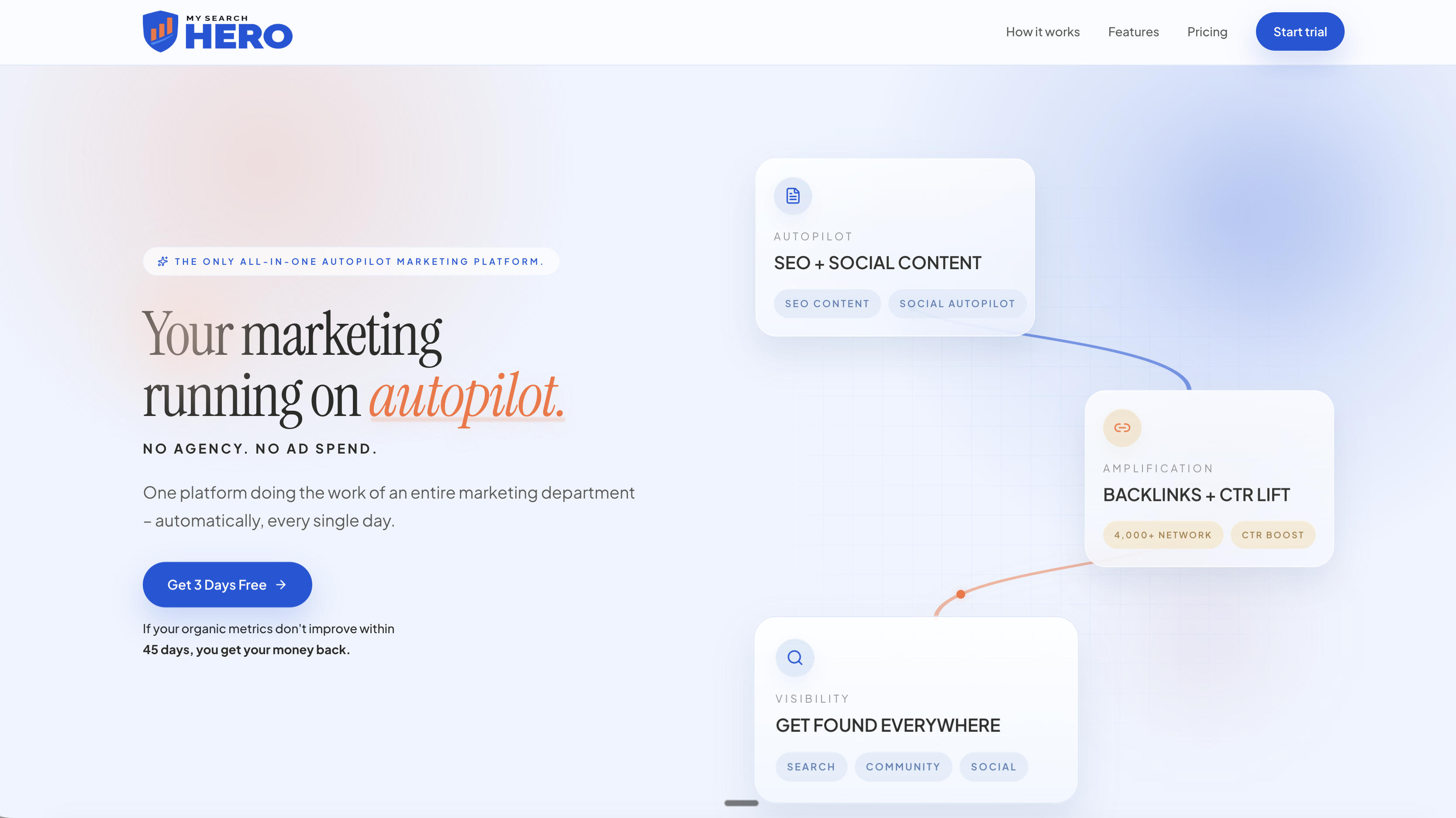
If your email campaigns are driving traffic to a website that isn’t ranking anywhere or a brand that has no presence outside your subscriber list, the emails are doing more work than they should have to. Mysearchhero publishes SEO articles, builds authority backlinks, generates Reddit mentions, and pushes out social posts automatically each month, so the pages your emails link to keep gaining organic visibility between sends instead of relying on email alone to drive every visit. It’s a different lever than the one covered in this article, but it pulls in the same direction: more qualified traffic finding your business, with less manual work on your end.
If that sounds useful alongside the email fixes you’re already planning, check out what a subscription includes and see which plan matches how much content and outreach volume your business needs.
Sources
Deliverability and list health:
- Ultimate Guide to Email Marketing in 2026 (+Free Tools) | WordStream
- AI-powered Email Marketing Strategy For 2026 | Braze
- Constant Contact blog — Email list management
- 37 Email Marketing Best Practices and Tips for 2026 | Twilio
- Sender
Lifecycle automation and benchmarks:
Subject lines and personalization:
FAQ
What Are the 5 T’s of Email Marketing?
The 5 T’s, a common framework in email marketing training, are Tease, Target, Teach, Test, and Track, referring to hooking interest, reaching the right segment, providing value, experimenting with variables, and measuring results.
What Is the 80/20 Rule in Email Marketing?
What Are the 4 P’s of Email Marketing?
Definitions vary, but a common version covers Permission (consent to email someone), Personalization (relevant content based on data), Promotion (the offer or message itself), and Performance (measuring and optimizing results).
What Is the Best Strategy for Email Marketing?
The most reliable strategy prioritizes deliverability fundamentals like authentication and list hygiene first, then builds lifecycle automation flows such as welcome and abandonment sequences, since these flows generate a large share of email revenue from a small share of sends.
How Often Should I Send Marketing Emails?
Start with a weekly newsletter as a baseline and segment frequency by engagement, sending more often to highly engaged subscribers and less to those who haven’t opened in 90 days, adjusting based on your own test data.