
Social signals don’t directly move your Google rankings. Likes, shares, and comments aren’t ranking factors Google feeds into its algorithm. But social activity still shapes your SEO outcomes indirectly, through referral traffic, earned backlinks, branded search volume, faster crawl discovery, and now, exposure in AI-generated answers.
If you’re chasing likes hoping they’ll lift your rankings, stop. Redirect that effort toward making your content discoverable and citation-worthy, the kind of asset a journalist links to or an AI model quotes.
Three metrics tell you whether social is actually paying off for SEO:
- Branded search volume in Google Search Console
- Referral traffic and engaged sessions in GA4
- New referring domains in your backlink tool
Key Takeaways
Social signals influence SEO through referral traffic, earned backlinks, branded search growth, and crawl discovery, not through direct algorithmic weight on likes or shares.
| Point | Details |
|---|---|
| Not a direct ranking factor | Google engineers confirm engagement metrics like likes and shares aren’t used in the core algorithm. |
| Correlation isn’t causation | The 0.27 correlation between shares and rankings reflects shared content quality, not a causal link. |
| Canonical-first wins | Publish full content on your site first, then repurpose native formats across social to drive backlinks. |
| Measure the right layers | Track branded search, engaged referral sessions, and new referring domains, not likes or follower counts. |
| Managed pipelines close the gap | Mysearchhero automates publishing, backlinks, Reddit mentions, and social posts around this exact workflow. |
Table of Contents
- What Are Social Signals in SEO?
- Does Google Use Social Signals as a Ranking Factor?
- How Social Activity Drives SEO Results Indirectly
- Best Practices for Turning Social Into an SEO Amplifier
- Platform-Specific Tactics That Actually Move the Needle
- How to Measure Whether Social Is Actually Helping Your SEO
- How a Managed SEO and Social Pipeline Handles This
- The Real Lesson Buried in the Social Signals Debate
- How Mysearchhero Turns Social Activity Into SEO Results
- Sources
- FAQ
What Are Social Signals in SEO?
Social signals are the engagement and distribution metrics a piece of content generates across social platforms: the digital footprint of how people interact with your posts. That’s different from in-platform search signals, like how a YouTube video ranks inside YouTube’s own search results, which behaves more like traditional SEO than a social signal.
Common social signal types include:
- Likes and reactions
- Shares, retweets, and reposts
- Comments and replies
- Saves and bookmarks
- Follows and subscriber growth
- Watch time and completion rate
- Profile clicks and link taps
Some of these are public and indexable, meaning search engines and AI crawlers can see them, which makes them more useful for discovery. A public Reddit thread or an indexed X post can surface in search results. A private Instagram share or an ephemeral Story disappears after 24 hours and leaves no trace for any crawler to find.
Does Google Use Social Signals as a Ranking Factor?
No. Google’s own engineers have said this directly, more than once. The evidence here isn’t ambiguous, it’s a rare case where the company answers the question outright instead of hedging, as explained in How Google Ranks Social Media Posts.
Google engineers have explained that they avoid using social engagement metrics like likes, shares, and follower counts as direct ranking signals because social platforms are external systems Google can’t control or verify. Engagement numbers on a rival platform are too easy to inflate with bots and purchased engagement, so building them into the core ranking algorithm would introduce a variable Google can’t audit.
That distrust of external, manipulable data explains why Google keeps ranking signals in-house.
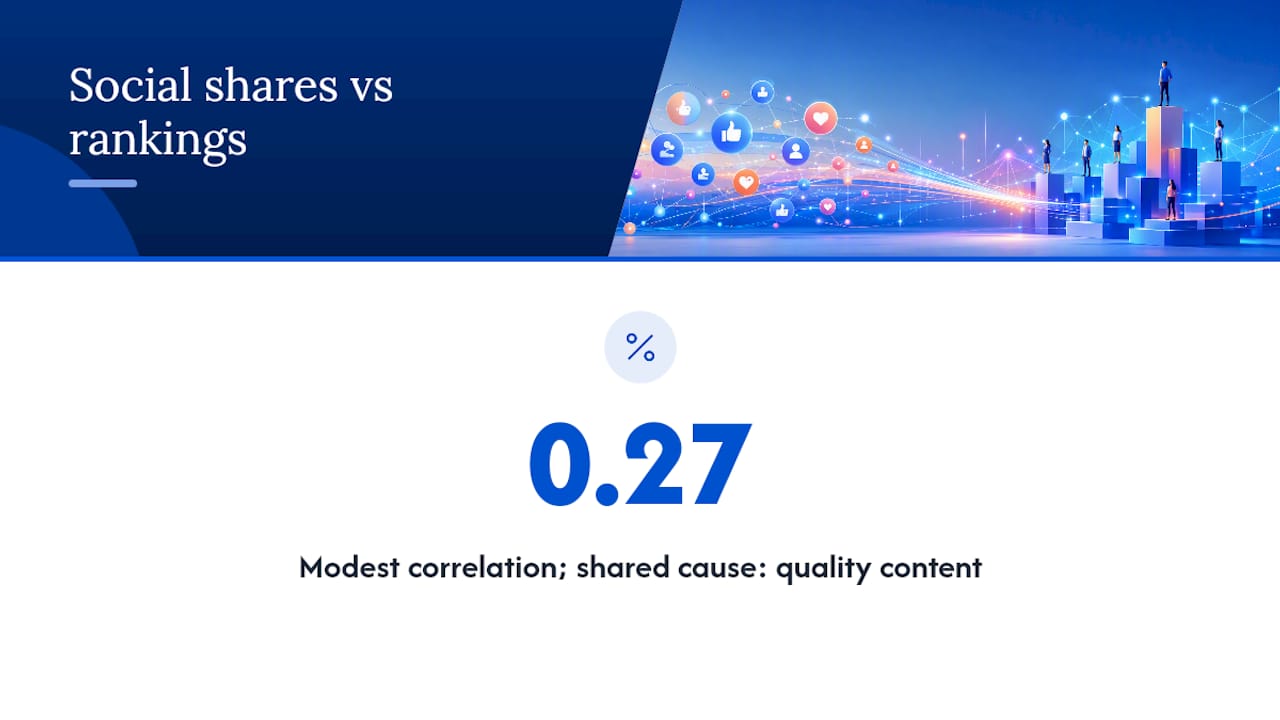
Statistic: A widely cited Moz-linked analysis found a correlation coefficient of 0.27 between social shares and search position, a real but modest relationship. The researchers concluded the link was driven by a shared cause, not a direct one: good content tends to earn both shares and links, so the two move together without one causing the other.
The practical shift this demands: stop optimizing for likes and start optimizing for discoverability. A post that gets shared 500 times but never gets linked to does nothing for your rankings. A post that gets shared 50 times and lands in front of one blogger who links to your site does.
How Social Activity Drives SEO Results Indirectly
Five mechanisms connect your social activity to measurable search outcomes. None of them involve Google reading your like counter.
- Referral traffic and engagement quality. Tag your social links with UTM parameters and watch GA4’s engaged sessions metric, not just clicks. A visitor who reads for two minutes and clicks deeper into your site signals real interest, and that behavior data feeds into how Google evaluates your site’s overall quality over time.
- Editorial backlinks. Social exposure puts your work in front of journalists and bloggers who are actively looking for sources. A well-distributed LinkedIn post or a data-driven X thread often becomes the reason someone finds and links to your original article instead of a competitor’s.
- Branded search volume. When people see your brand on social and later Google your company name, that branded search volume tells Google your brand carries independent demand and recognition, a signal that correlates strongly with authority.
- Faster crawl and discovery. URLs shared on public, indexable platforms get discovered by crawlers faster than pages that sit quietly on your site waiting for a scheduled crawl.
- AI citation exposure. Public platforms like Reddit and YouTube increasingly feed AI-generated answers. Reddit’s content licensing deal with Google means genuine, useful contributions on these platforms can now surface inside AI Overviews and chatbot answers, an emerging discovery channel that didn’t exist five years ago.
Pro Tip: Don’t cross-post the same caption everywhere. A Reddit comment that reads like an ad gets removed and can get your account banned. Write for the platform you’re on, then link back to your canonical page only when it genuinely helps the reader.
Best Practices for Turning Social Into an SEO Amplifier
The workflow that actually works starts on your own site, not on social. Publish the full asset, the complete article, guide, or data study, on your domain first. Then create native variants for each platform that link back to that canonical URL. This canonical-first approach, recommended across current practitioner guides, keeps your site as the single source of truth while social does the amplifying.
Before you post anything, get your technical foundation right:
- Set Open Graph and Twitter Card metadata so shared links preview correctly
- Add schema
sameAsmarkup connecting your site to your official social profiles - Confirm canonical tags point to the right URL on every page you plan to share
- Make sure the page loads fast and reads clean on mobile, since most social traffic arrives there
From one article, you can generate a week of content: a LinkedIn summary post, a carousel breaking down the key points, a short vertical video, an X thread, a Reddit comment in a relevant community, and a pinned post on your profile. Each format speaks to a different audience segment on the same platform.
Engagement rules matter as much as content. Post natively instead of just dropping a link, since most algorithms suppress reach on posts that send users off-platform immediately. Put the canonical link in the first comment when the platform allows it, a tactic that preserves reach while still guiding interested readers to your site. Participate in communities before you promote in them; a Reddit account with zero post history and one promotional link reads as spam.

Pro Tip: Mine your own comment sections for content ideas. The questions people ask under your social posts are often the exact phrases they type into Google. Turn the three most repeated ones into new H2 headings on your site.
Platform-Specific Tactics That Actually Move the Needle
Not every platform earns SEO value the same way, so spreading effort evenly across all of them wastes resources.
- YouTube functions as a search engine in its own right. Write structured descriptions, upload full transcripts, add chapters, and put your canonical link in the first two lines, since YouTube results frequently appear directly inside Google’s own search pages.
- LinkedIn rewards carousels and long-form posts that prompt discussion, particularly for B2B brands looking to build backlink relationships and branded search recognition among decision-makers.
- X favors timely threads and fast news commentary, useful for getting discovered by journalists scanning for sources and for accelerating crawl velocity on fresh content.
- TikTok and Instagram reward searchable captions, on-screen text, and relevant hashtags, since both platforms’ internal search functions weigh these elements heavily and influence save and share rates.
- Reddit requires genuine participation over time. Share real data, answer questions honestly, and let citations happen organically, since a community that smells self-promotion downvotes and buries your links fast.
- Pinterest works differently than the rest: keyworded pins and rich pins generate durable referral traffic to evergreen content for years, not days, unlike the short shelf life of a typical social post.
How to Measure Whether Social Is Actually Helping Your SEO
Measure this across three layers: visibility (did people see it), useful engagement (did they act on it), and value (did it produce referrals, links, or branded searches).
- Pull GA4 acquisition reports filtered by UTM source to isolate engaged sessions from each platform.
- Check Search Console’s branded query data monthly to track whether impressions for your company name are climbing.
- Run your backlink tool’s new referring domains report and cross-reference dates against your social posting calendar.
| Timeframe | What to Expect |
|---|---|
| Days to 2 weeks | Faster crawl and indexing for URLs shared on public platforms; early YouTube visibility |
| 6 to 12 weeks | Measurable lift in referring domains and branded search volume |
| 3+ months | AI citation exposure from platforms like Reddit, probabilistic and harder to isolate |
Build a simple tracking spreadsheet with checkpoints at D+7, D+14, and D+30 after each major campaign, so you catch search visibility trends before they get lost in monthly noise.
How a Managed SEO and Social Pipeline Handles This
A managed pipeline treats canonical publishing, social distribution, backlink outreach, and tracking as one connected system rather than four separate jobs handed to four different tools.
The pipeline works because nothing in it depends on one person remembering to do a repetitive task on schedule, which is where most in-house social-SEO efforts quietly stall out.
Mysearchhero runs this exact loop for local and service businesses: published articles, backlink placements, Reddit mentions, and AI-generated social posts, coordinated so social activity consistently points back to canonical content. If your team already publishes consistently but can’t keep social distribution and backlink outreach running in parallel, that’s the specific gap a managed service closes.
The Real Lesson Buried in the Social Signals Debate
Here’s what most guides get backward: they treat the direct-versus-indirect debate as the interesting question, when the actual insight is that chasing vanity metrics and building genuine discoverability require almost opposite habits. Optimizing for likes rewards content that’s emotionally punchy in the first three seconds. Optimizing for citations and backlinks rewards content that’s useful enough for a journalist or a fellow marketer to reference weeks later. Most teams can’t do both well, and most default to the wrong one because likes show up faster.
The correlation data backs a specific, narrow claim: quality content earns shares and links together, not that shares cause links. Treat that distinction as your filter for every piece of content you plan to promote. Ask whether it’s something a stranger would cite in their own work, not whether it’s something a stranger would tap a heart on.
If you take one thing from this guide, prioritize the canonical-first workflow before you touch a single platform-specific tactic. Getting the foundation right, a strong asset on your own domain with clean metadata, makes every downstream repurposing effort worth doing. Skip that step and you’re just distributing noise faster.
— Mike
How Mysearchhero Turns Social Activity Into SEO Results
Running the canonical-first workflow this guide describes, publishing consistently, repurposing across six platforms, chasing backlinks, tracking branded search, takes real hours every week. Mysearchhero automates that entire loop so the work happens on autopilot instead of competing with everything else on your plate.
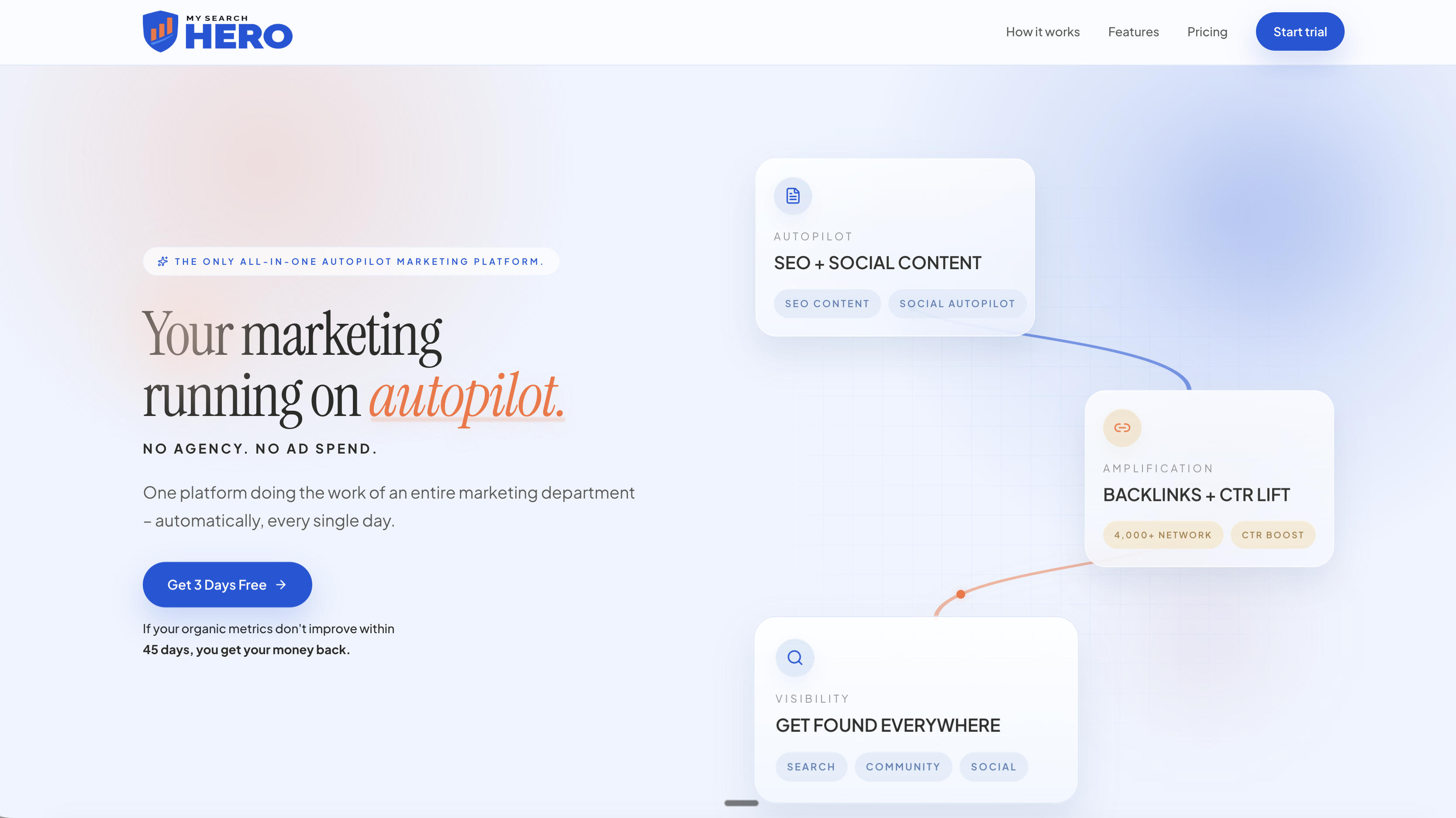
Each month, subscribers get a coordinated bundle built around the exact mechanisms covered above:
- SEO articles published directly to your site as canonical assets
- Authority backlinks placed through an established publisher network
- Reddit mentions woven into relevant, real conversations
- AI-generated social posts distributed across multiple platforms
- CTR signal boosting and performance reporting included
If you’re a local or service business owner who wants the branded search growth and referring-domain lift this article describes without hiring a team to manage six platforms by hand, start with Mysearchhero and see what the pipeline can push out for your site this month.
Sources
- Google explains why they need to control their ranking signals — Search Engine Journal
- Social signals impact search ranking — Smart Insights
- Social media & SEO: Complete guide — Bloomwise
FAQ
Does Social Media Engagement Directly Affect Google Rankings?
No. Google’s engineers have stated they don’t use likes, shares, or follower counts as direct ranking signals, since social platforms are external systems Google can’t reliably control or verify.
What Does “Social SEO” Mean?
Social SEO refers to optimizing your social profiles, captions, and content for discoverability, both within a platform’s internal search and as a driver of external SEO outcomes like referral traffic and backlinks.
How Long Does It Take to See SEO Results From Social Campaigns?
Crawl discovery and YouTube visibility can happen within days to two weeks, while backlink and branded search lift typically take 6 to 12 weeks to show up measurably.
Can a Managed Service Like Mysearchhero Handle Social-to-SEO Amplification?
Yes. Mysearchhero runs a coordinated pipeline of canonical article publishing, backlink placement, Reddit mentions, and AI-generated social posts specifically designed to produce the indirect signals this guide covers.