
Most small businesses land between $1,500 and $3,000 a month for real, results-driven SEO, with agency rates typically running $75 to $150 an hour. The rule that matters more than the number: budget for at least 6 to 12 months of consistent spending, because that’s the window in which SEO actually compounds. Anything shorter, and you’re paying for a test you can’t finish.
TL;DR:
- Small businesses typically spend around $1,500 to $3,000 per month on SEO, with a recommended commitment of at least 6 to 12 months to see results.
- The most common pricing models are monthly retainers, which include ongoing work, and project-based fees for specific tasks like site audits or migrations.
- SEO results usually start showing between 3 to 6 months, but attaining meaningful ROI requires a 6 to 12-month period, with consistent KPIs tracked monthly.
- Factors such as keyword competition, site size, platform complexity, and number of locations significantly influence the cost of SEO proposals.
- Automated SEO services offer a lower-cost alternative for steady content and distribution needs but are limited for technical and highly competitive markets.
Table of Contents
- How Much Does Small Business SEO Cost? A Pricing Snapshot
- Retainer, Hourly, Project, or Performance: Which SEO Pricing Model Fits?
- What Does $1,000 vs. $3,000 a Month Actually Buy?
- What Actually Drives SEO Costs Up or Down?
- How Long Until SEO Pays Off?
- How Do You Choose the Right SEO Pricing Model and Vendor?
- How Does Automated, Done-For-You SEO Change the Cost Equation?
- What Should You Do This Week to Set Your SEO Budget?
- Get Started With Mysearchhero
- Sources
- FAQ
How Much Does Small Business SEO Cost? A Pricing Snapshot
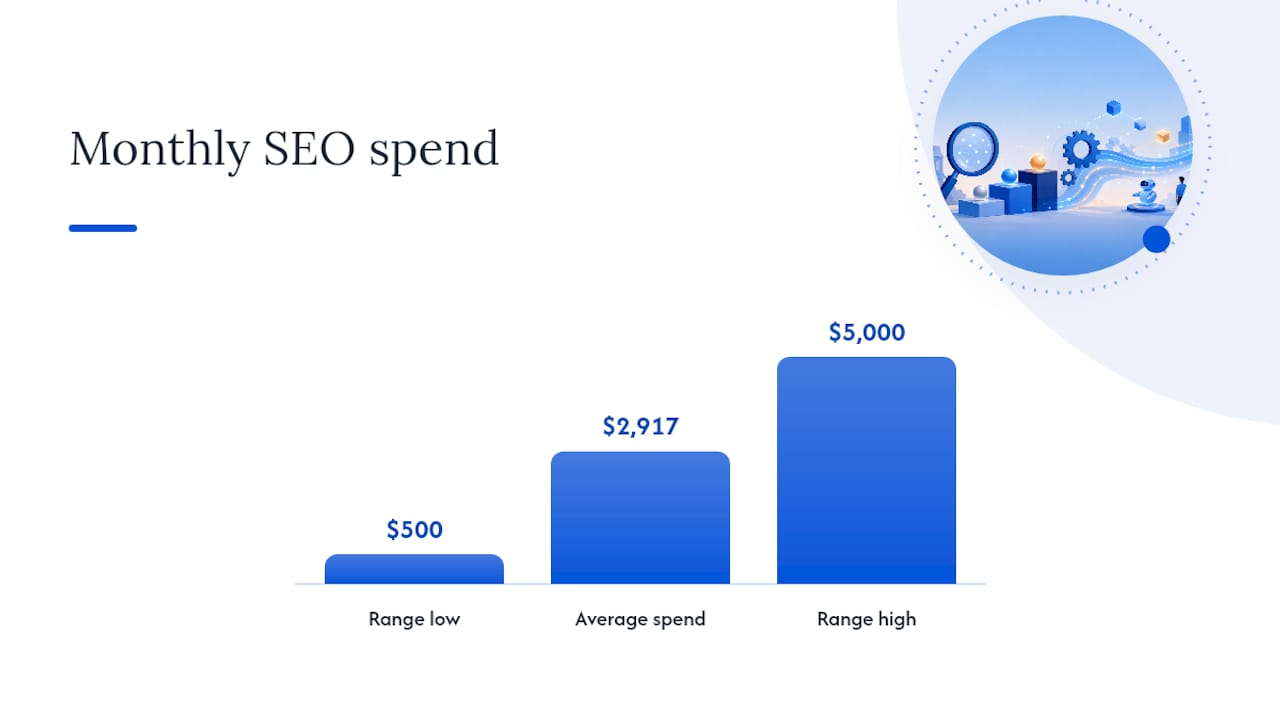
Numbers help more than adjectives here, so let’s start with what businesses are actually paying. Across the U.S., the average monthly SEO spend sits around $2,917, and 63% of businesses spend somewhere between $500 and $5,000 a month. That range is wide because “SEO” covers everything from a freelancer doing keyword research part time to a full agency team running technical audits, content production, and link outreach simultaneously.
Hourly work follows a similar spread. Average rates come in around $111 per hour, with most providers charging somewhere in the $75 to $150 range depending on experience and location. Project-based fees, common for one-time audits or website migrations, usually run from $1,000 to $10,000 depending on scope.
Here’s how the tiers typically break down:
| Tier | Monthly range | What it usually means |
|---|---|---|
| Starter | $500–$1,000 | Basic optimization, limited content, freelancer or micro-agency |
| Small business | $1,500–$3,000 | Consistent content, on-page fixes, local SEO, monthly reporting |
| Growth | $3,000–$5,000 | Multi-channel work, stronger link building, faster content output |
| Professional/Enterprise | $5,000+ | Multi-location, competitive industries, dedicated strategist |
Backlinko’s pricing research confirms the same pattern: monthly retainers dominate the market, and small-business plans almost always fall inside that $500 to $5,000 band. If a quote lands wildly outside this range, in either direction, that’s worth a second look before you sign anything.
Retainer, Hourly, Project, or Performance: Which SEO Pricing Model Fits?
Every SEO cost conversation eventually runs into the same question: how is this actually billed? The four common models each solve a different problem, and picking the wrong one is how businesses end up disappointed with SEO that was never structured to deliver what they expected.
Monthly retainers are the default for a reason. You pay a fixed fee, usually $1,500 to $5,000 for small businesses, and get an ongoing bundle of work: content, technical maintenance, link building, and reporting. Retainers work because SEO isn’t a one-time fix. Rankings erode without upkeep, competitors publish new content, and algorithm updates shift what’s working. A retainer keeps someone accountable to the account month over month.
Hourly billing suits narrow, defined problems. If you need someone to fix a specific crawl error, clean up duplicate content, or consult on a redesign, paying $75 to $150 an hour for a few hours makes more sense than locking into a retainer you don’t need yet. The risk: hourly work rarely covers strategy, and hours can add up fast on messy sites.
Project-based pricing covers one-time deliverables with a defined start and end. Common examples:
- A full technical SEO audit, typically $1,000 to $5,000 depending on site size
- A website migration or redesign SEO review, often $2,000 to $8,000
- A content strategy and keyword roadmap, usually $1,500 to $4,000
- Local SEO setup for a new location, generally $500 to $2,000
Performance-based pricing ties fees to results, like rankings hit or leads generated. It sounds appealing on paper, but it’s rare among reputable providers, because SEO outcomes depend on factors outside any agency’s control (algorithm changes, competitor behavior, your own site’s history). When you do see it, read the fine print carefully. Some “performance” contracts define success so loosely that you pay full price for minimal work.
For most small businesses, the sequencing looks like this: start with a project-based audit to understand what’s broken, then move into a retainer once you know what ongoing work actually needs doing. Jumping straight into a retainer without an audit means you’re paying someone to discover problems you could have identified up front.
What Does $1,000 vs. $3,000 a Month Actually Buy?
Two SEO quotes can differ by thousands of dollars and still both be “legitimate.” The difference is almost always scope, not padding. Here’s what typically shows up at each level.
-
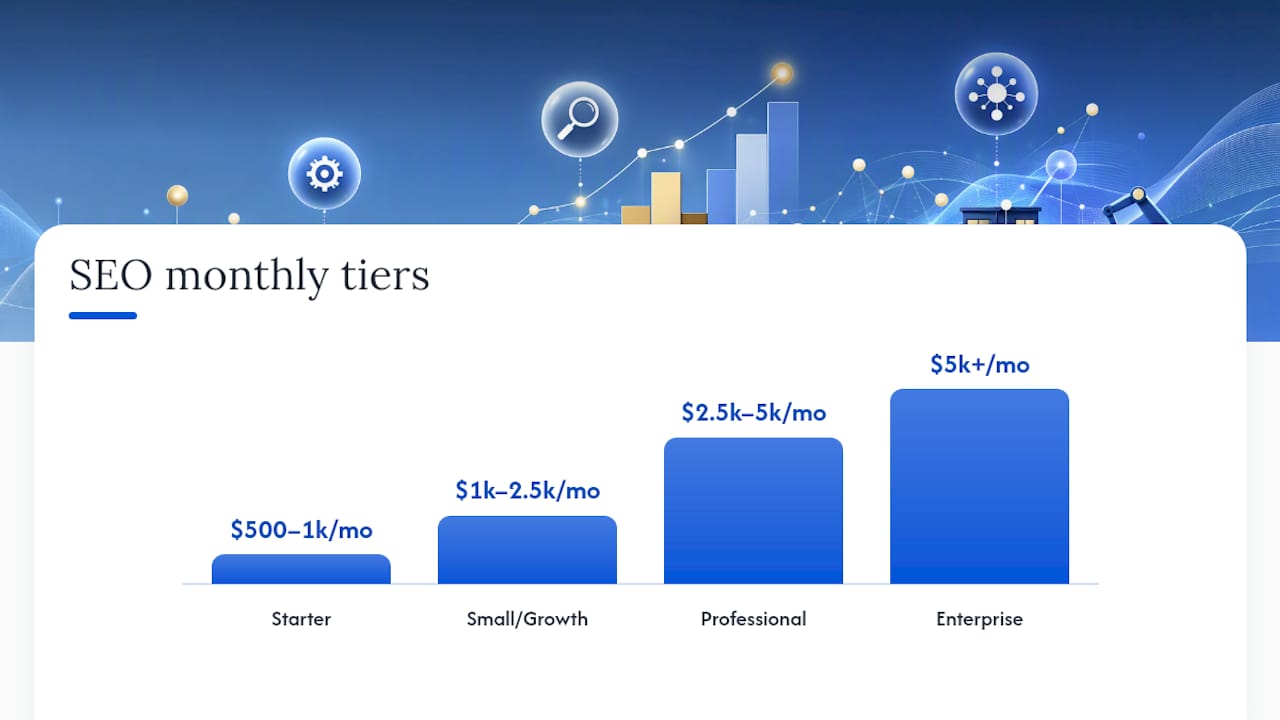
Starter ($500–$1,000/month). Expect 5 to 10 hours of monthly work: basic on-page fixes, one or two blog posts, minimal link outreach, and a simple monthly report. This tier suits a business with a small website, low competition, and modest goals, like a single-location service business in a less contested market.
-
Small business / Growth ($1,000–$2,500/month). This is where most functioning SEO programs live. Expect 10 to 20 hours monthly: two to four pieces of content, ongoing technical monitoring, local SEO management (Google Business Profile, citations, reviews), and a handful of quality backlinks per month. Local SEO tactics like these tend to show up first in this tier because they’re the fastest path to visible movement for location-based businesses.
-
Professional ($2,500–$5,000/month). Expect 20 to 40 hours: a dedicated strategist, weekly or biweekly content, an active link-building campaign, competitor tracking, and conversion rate work alongside pure ranking work. Businesses with real competition, multiple service lines, or several locations tend to need this level just to keep pace.
-
Enterprise ($5,000+/month). Full-time strategist involvement, content teams producing weekly output, digital PR for high-authority links, and technical SEO work on large or complex sites (think e-commerce catalogs with thousands of product pages). Most small businesses don’t need this tier, and paying for it before you’ve outgrown the Professional level is money spent on capacity you’re not using.
A useful sanity check comes from a common budgeting rule: allocate 5% to 10% of revenue to marketing overall, and if SEO is a primary growth channel, put 20% to 30% of that marketing budget toward it. A business doing $500,000 in annual revenue with a $30,000 marketing budget might reasonably spend $6,000 to $9,000 a year on SEO, which lands right around that Starter to Small Business tier.
Pro Tip: Push your budget toward technical fixes and a small number of high-quality backlinks in the first one to three months, even if that means fewer blog posts early on. Front-loaded technical work tends to drive the majority of early ranking movement, while content volume compounds more slowly over time.
What Actually Drives SEO Costs Up or Down?
Two businesses in the same city can get quotes $2,000 apart for what looks like the same service. The gap almost always comes down to five factors, and understanding them lets you sanity-check any proposal you receive.
- Keyword competition. “Plumber near me” in a major metro area costs more to rank for than a specialty service in a smaller town, because more agencies are actively fighting for that traffic.
- Site size and technical debt. A 15-page site with clean code costs far less to optimize than a 500-page site built on an outdated platform with years of unresolved errors.
- CMS and platform complexity. WordPress sites are generally cheaper to work on than custom-built platforms, simply because more SEO tools and plugins integrate natively.
- E-commerce vs. service business. Product catalogs multiply the number of pages needing optimization, which multiplies the hours required.
- Number of locations. Multi-location businesses need Google Business Profile management, localized content, and citation consistency for every single location, which scales cost close to linearly.
Before requesting quotes, answer these for yourself: How many pages does your site actually have? How many locations need individual optimization? Are your competitors running active content and link campaigns (a quick look at their blog’s publish frequency tells you a lot)? Is your current site on a modern platform, or has it accumulated a decade of unfixed technical issues? The answers to these four questions will explain most of the price variation you see across quotes.
How Long Until SEO Pays Off?
SEO is slow by design, and any provider promising overnight rankings is telling you something false. The realistic pattern: first visible signals arrive around 3 to 6 months in, things like improved rankings for lower-competition keywords, more impressions in Search Console, small upticks in organic traffic.
Meaningful ROI, the kind that shows up as leads or revenue you can point to, typically takes 6 to 12 months. That’s not a stall tactic. It reflects how search engines build trust in a domain over time, how content needs to accumulate before it earns authority, and how backlinks take months to fully register their impact.
Businesses that expect ROI inside 90 days are set up to quit right before the payoff window opens. The 6 to 12 month minimum isn’t a sales pitch. It’s the actual mechanics of how search rankings shift.
Track these KPIs monthly, not weekly: organic traffic (Search Console or Google Analytics), keyword rankings for your priority terms, lead or conversion volume attributed to organic search, and Google Business Profile actions if you’re a local business. Tracking the right metrics from month one gives you a baseline to judge whether month six actually represents progress.
Interpret early months as leading indicators, not verdicts. A jump in impressions with flat clicks in month 3 often means your content is getting found but your titles or meta descriptions need work, not that the strategy has failed.
How Do You Choose the Right SEO Pricing Model and Vendor?
Picking a provider comes down to matching their model to your actual situation, then verifying they’ll do what they claim before money changes hands. Run through this checklist before signing anything:
- Does the proposal define exact deliverables (number of articles, backlinks, technical fixes) rather than vague “ongoing optimization”?
- Is reporting cadence specified, and does it include real metrics, not just ranking screenshots?
- Can they describe their link-building approach in plain language without deflecting?
- Will they provide client references you can actually contact?
- Is the contract month-to-month, or does it lock you into a long term with penalty clauses?
- Do they set expectations around the 6 to 12 month timeline, or promise fast results?
When you get on a call, these eight questions cut through most of the noise:
- What exactly will you deliver in the first 90 days?
- How do you measure success, and how often will you report it?
- Where do backlinks come from, and can you show examples?
- What happens if I want to cancel after three months?
- Who specifically will work on my account?
- What’s your experience in my industry?
- How do you handle content that underperforms?
- What’s outside the scope of this monthly fee?
Omnivance Media’s breakdown of small-business SEO pricing covers similar ground on how business size and site condition shape vendor quotes, useful reading before your first vendor call.
Red flags worth walking away from: guaranteed rankings (no one controls Google’s algorithm), pricing far below the $500 monthly floor most legitimate providers work from, refusal to explain their link sources, and contracts that penalize you for canceling. If you see any of these, treat it as a decision made for you, not a negotiation point.
Pro Tip: Ask every vendor the exact same eight questions in the same order. Inconsistent or evasive answers become obvious fast once you’re comparing responses side by side instead of judging each pitch in isolation.
How Does Automated, Done-For-You SEO Change the Cost Equation?
Traditional agency retainers charge for hours: strategist time, writer time, outreach time. Mysearchhero works differently. It’s a subscription service that delivers a fixed monthly bundle: AI-generated SEO articles published directly to your site, backlinks through a publisher network, Reddit brand mentions in relevant conversations, and AI-generated social posts across platforms, all through an automated pipeline rather than billable hours.
That structure suits a specific kind of business well: local and service-based companies that need consistent content and distribution but don’t have the budget or need for a dedicated strategist managing a bespoke campaign. If your biggest gap is content velocity, having someone showing up in relevant discussions online, and steady backlink activity, an automated model can deliver that output at a lower cash cost than staffing an in-house team or retaining a full-service agency.
It has real limits, though, and worth saying plainly. AI-driven tools reduce the cash cost of content production, but agencies and specialists still matter for deep technical work: site migrations, complex crawl error diagnosis, and manual outreach requiring judgment calls a pipeline can’t make. A business with a badly broken technical foundation needs that fixed first, by a human, before content velocity alone can do much.
The practical split: choose automation when your core need is steady output and distribution at a predictable monthly cost. Choose an agency or in-house hire when you’re dealing with structural technical problems, a major redesign, or a highly competitive market that needs custom strategy work no automated bundle covers.
What Should You Do This Week to Set Your SEO Budget?
Start by pulling your current numbers. Check Google Search Console for your organic traffic trend over the last six months and note your top three landing pages. That baseline tells you whether you’re starting from zero or already have momentum worth protecting.
Next, pick a monthly number you can commit to without flinching for a full year, not a number you’ll cut the first slow quarter. If $1,500 a month for 12 months is realistic and $3,000 for three months isn’t, choose the smaller number. Consistency beats intensity here.
Pick one primary KPI, organic traffic, leads, or bookings, and ignore the rest for decision making purposes. Then decide your next move: request quotes from two or three vendors using the questions above, or start a trial with an automated service if content and distribution are your real gap. Either way, put a date on your calendar six months out to review the 12-step checklist against what’s actually been delivered.
— Mike
Get Started With Mysearchhero
Some automated SEO services offer a fixed monthly subscription model, so you can know your SEO cost will remain consistent without hourly overages or scope creep. For small businesses seeking predictable monthly SEO costs without hiring a strategist or negotiating new contracts frequently, a fixed subscription model can provide an advantage over some traditional providers.
Some subscription SEO services provide monthly deliverables such as published SEO articles, backlinks, Reddit brand mentions, and AI-generated social posts through automated pipelines, rather than billing by the hour. This approach suits local and service-based businesses that need consistent content and distribution without managing a full agency relationship. Before reaching out, have three things ready: access to your website, your current organic traffic numbers from Search Console, and a realistic monthly budget range in mind. Check out the Mysearchhero plans and see which deliverable bundle fits where you landed in the pricing tiers above.
Sources
- SEO pricing in USA 2026: What agencies, freelancers, charge?
- SEO Pricing — Backlinko
- SMB SEO Statistics 2026: 75+ Benchmarks on Budgets, ROI, Time-to-Result, Churn & GEO
- How Much Does SEO Cost for a Small Business? (Full Breakdown) | LLaMaRush
FAQ
How Much Does It Cost to Do SEO for a Small Business?
Most small businesses pay between $1,500 and $3,000 a month for ongoing SEO, though the broader market range runs $500 to $5,000 monthly, with an average around $2,917.
Is Hourly or Retainer Pricing Better for a Small Business?
Retainers work better for ongoing growth since SEO requires continuous upkeep, while hourly billing, typically $75 to $150 an hour, fits narrow, one-time fixes better.
How Long Before SEO Shows Results?
Expect first visible signals in 3 to 6 months and meaningful ROI in 6 to 12 months; anything faster is unusual and worth questioning.
What’s a Reasonable Minimum Commitment for an SEO Contract?
Plan on 6 to 12 months minimum. Shorter engagements rarely give SEO enough time to build the domain trust and content history that drive rankings.
Can Automated SEO Services Replace a Traditional Agency?
For steady content, backlinks, and social distribution, an automated service like Mysearchhero can cover that need at a lower monthly cost, though complex technical fixes still benefit from specialist involvement.