
Fix your Google Business Profile first, then lock down consistent listings, launch a review system, and publish real local pages, in that exact order. Profile fixes can shift map-pack placement within two to six weeks, while pages and links take one to three months to show up. A managed service can run this entire sequence for you; either way, watch profile views and search impressions weekly.
TL;DR:
- Fixing your Google Business Profile and ensuring NAP consistency can significantly boost local rankings within two to six weeks, but pages and backlinks may require months to show full effect.
- Building unique, local-specific pages with proof of local work and proper schema is essential for ranking well for specific services and areas.
- Implementing a review system that prompts reviews immediately after service and responds promptly can improve search visibility and customer trust over time.
- Prioritizing the sequence of profile completion, citation cleanup, content creation, and backlinks leads to faster results than rushing links or reviews first.
- Maintaining weekly GBP updates and monthly content or backlink efforts ensures steady progress, especially for crowded or competitive local markets.
Table of Contents
- How Do You Run a Fast Local SEO Audit?
- Complete Your Google Business Profile the Right Way
- What Makes a Local Page Actually Rank?
- How Do You Build a Review System That Actually Works?
- Why Does NAP Consistency Matter So Much?
- Do You Need Schema Markup for Local SEO?
- Where Do Local Backlinks Actually Come From?
- How Long Until You See Results?
- How Mysearchhero Applies This Playbook
- What Actually Moves the Needle Here
- A Practical Next Step If You’d Rather Not Do This Alone
- Key Documentation and Tools
- Sources
- FAQ
How Do You Run a Fast Local SEO Audit?
An audit is only useful if it ends with a priority list, not a spreadsheet nobody opens again. Spend an hour checking these areas, then sort what you find into “fix today,” “fix this month,” and “fix this quarter.”
Here’s the sequence that actually surfaces problems fast:
- Google Business Profile status. Is it claimed, verified, and using the correct primary category?
- NAP consistency. Does your name, address, and phone number match exactly across your website, GBP, and top directories?
- Page speed. Run your homepage and one service page through a speed tool. Anything loading slower than three seconds on mobile needs attention.
- Mobile usability. Can someone tap your phone number and get directions without pinching to zoom?
- Service and city pages. Do you have a dedicated page for each service and location combination you actually serve?
- Structured data. Is LocalBusiness schema present and error free?
- Review volume and recency. How many reviews in the last 90 days, and what’s your average rating?
- Citation accuracy. Are your top 15 to 20 directory listings correct?
- Backlink profile. Do you have any links from local news, sponsorships, or partner sites?
Quick wins live in the first two items. GBP fields and NAP corrections take minutes and often move the needle within weeks. Medium-effort items, like building out service pages or setting up a review system, take a few weeks of steady work. Backlinks and domain authority are the long game, often three to six months before you see the payoff. For the tools, GBP Insights and Google Search Console tell you what’s already working, a speed testing tool flags technical drag, and a citation scanner catches the directory mismatches you’d never find by hand.
Complete Your Google Business Profile the Right Way
Google itself says local rankings depend on relevance, distance, and prominence, and a complete, accurate profile is the single fastest way to influence all three. Most businesses claim their listing and stop there, leaving half the fields blank. That gap is the opportunity.
Work through these fields deliberately:
- Primary category: pick the most specific match for what you actually do, not the broadest one.
- Address and service area: accurate down to the suite number, with service-area radius set if you don’t have walk-in traffic.
- Hours, including special hours: update these before holidays, not after a customer shows up to a locked door.
- Phone and website: use a local number when possible, and link to a page that matches the profile’s category.
- Services and products: list them individually rather than lumping everything into one description.
- Attributes: check every box that applies, from wheelchair access to free Wi-Fi.
- Photos and video: add new ones monthly. Listings with fresh photos tend to earn more clicks than static ones.
Beyond the static fields, GBP Posts, booking links, product listings, and the Q&A section all function as trust signals. Answering your own likely questions before a competitor or a confused customer does it for you keeps the narrative accurate. Responding to every review, as Google recommends, tells both the algorithm and future customers that someone’s paying attention.
Pro Tip: Set a recurring 15-minute calendar block every Monday just for GBP upkeep. New photo, one Q&A answered, one review replied to. That small habit beats a once-a-year profile overhaul.
What Makes a Local Page Actually Rank?
A real local page has unique copy, specific proof you’ve worked in that area, and details a searcher can act on. A page that swaps one city name into an otherwise identical template is a doorway page, and both search engines and readers can tell the difference.

Start with intent mapping. Someone searching “[service] near me” wants proof you’re close and available now. Someone searching “how much does [service] cost in [city]” wants pricing context and a reason to trust your estimate over a stranger’s. Build separate pages for these different intents rather than cramming everything onto one page.
Solid local pages typically include:
- A specific description of how you deliver the service in that particular area, not generic company boilerplate.
- Proof of local work: a project photo, a neighborhood mentioned by name, a permit or inspection detail specific to that city.
- A short FAQ section addressing the three or four questions locals actually ask.
- LocalBusiness or Service schema tied to that specific location.
For ongoing content, case studies (“How we handled a burst pipe in neighborhood] during last winter’s freeze”) outperform generic blog posts because they double as local proof. Local news roundups and simple how-to posts tied to your service area round out a content calendar without demanding a full-time writer. Tools built around [AI-assisted content production can help you keep that publishing cadence steady without burning your own hours.
Pro Tip: Write the FAQ section on your local pages using the actual questions from your call logs or booking form, not guesses. Real language matches real searches.
How Do You Build a Review System That Actually Works?
Reviews compound. They influence map-pack visibility and they’re often the last thing a customer checks before calling, so a system beats sporadic asking every time.
- Ask at the moment of delight. Right after a job is finished and the customer says thanks, not three days later in a generic email blast.
- Send a one-tap link. Fewer clicks between “yes I’ll leave a review” and the review actually posting means more reviews finished.
- Follow up once, not five times. A single reminder a few days later catches people who meant to do it and forgot.
- Respond to every review, positive or negative, within 48 hours. Thank the good ones specifically; address the bad ones calmly, offer to fix it offline, and never get defensive in public.
- Track trends monthly. Watch your average rating and review velocity in GBP Insights. A sudden drop signals an operational issue worth investigating before it shows up in your rankings.
This kind of repeatable ask-link-respond loop is one of the few local SEO levers that improves rankings and conversion at the same time.
Why Does NAP Consistency Matter So Much?
Pick one canonical format for your name, address, and phone number and use it byte-for-byte everywhere, including abbreviations. “Street” versus “St.” across different listings sounds trivial, but inconsistent NAP creates confusion that search engines read as a reliability problem.
Prioritize your cleanup in this order:
- Your own website’s footer, contact page, and schema markup first, since everything else should mirror it.
- Google Business Profile, matched exactly to your canonical format.
- Major map and navigation platforms.
- Industry-specific directories relevant to your field (a plumbing directory, a legal directory, a restaurant platform).
- Local niche sites: chamber of commerce listings, local business associations, neighborhood directories.
For detection, a citation scanner will surface mismatches faster than manually searching your business name across dozens of sites. Fixing them by hand works fine for a handful of listings; once you’re managing more than 20 or 30, an aggregator service or a managed provider saves real hours. This internal local SEO checklist walks through the cleanup sequence in more detail.
Do You Need Schema Markup for Local SEO?
Yes, and it’s one of the lowest-effort wins available. LocalBusiness schema tells search engines your business name, address, phone, opening hours, and the services you offer in a format they can parse instantly, rather than inferring it from paragraph text.
Prioritize these additions:
- LocalBusiness schema with name, address, phone, and openingHours filled in completely.
- Service schema listing exactly what you offer, matched to your GBP categories.
- FAQ markup on pages where you’ve already written a genuine FAQ section, since this is what makes answers liftable into rich results.
- Page speed and mobile checks: compress images, eliminate render-blocking scripts, and confirm tap targets are large enough on a phone screen.
Structured data also helps AI-driven answer surfaces understand who you are and what you do, which matters more every quarter as more local searches get answered inside a chat interface instead of a traditional results page.
Where Do Local Backlinks Actually Come From?
Forget cold outreach campaigns. The best local links usually come from relationships you already have.
- Sponsorships: a youth sports team, a local festival, or a school fundraiser almost always links back to sponsors on their website.
- Suppliers and partners: ask the vendors you already work with if they maintain a partner or client page.
- Chambers of commerce and business associations: often an easy, low-cost membership link with real domain authority.
- Local press: a genuinely useful story angle, like a hiring milestone, a community project, or a seasonal safety tip, gives a local reporter something to write about.
- Event participation: hosting or speaking at a local event often earns a mention on the organizer’s site afterward.
These links matter more than generic guest-post backlinks because they carry geographic and topical relevance search engines can verify. A single link from your local chamber of commerce, tied to your actual address, does more for prominence than ten unrelated links from sites with no connection to your city.
How Long Until You See Results?
Different levers move on different clocks, and setting the wrong expectation is the fastest way to abandon a strategy right before it starts working.
Check these weekly:
- GBP profile views and search impressions
- Website clicks and phone calls originating from the profile
- Direction requests
Review these monthly instead of weekly, since they move more slowly:
- Organic rankings for your city and service pages
- Organic traffic to those pages
- Leads or booked jobs attributable to search
On timeline, quick fixes like completing your profile and correcting NAP issues can show movement in two to six weeks. Local pages and early backlinks generally need one to three months before rankings respond. Competitive terms in crowded categories, like “plumber near me” in a large metro area, often take several months of consistent work before you see a meaningful jump. Patience isn’t optional here; it’s the actual mechanism.
How Mysearchhero Applies This Playbook
A managed pipeline runs this same sequence on a monthly schedule: fresh local content tied to your service pages, ongoing profile upkeep, steady backlink placement, and a report showing what moved and why.
- Businesses juggling day-to-day operations with no marketing staff usually benefit most from a done-for-you approach.
- Businesses with an in-house marketer who has a few hours a week can often handle the audit and GBP work themselves, using resources like this step-by-step local SEO checklist.
- Either path works. The deciding factor is usually whether you have consistent hours to give it every month, not just once.
What Actually Moves the Needle Here
Most local SEO advice buries the one fact that matters: sequence beats intensity. A business that perfects its Google Business Profile before touching backlinks will outperform one that chases links first, every time, because the profile is the fastest lever available and most competitors leave it half-finished.
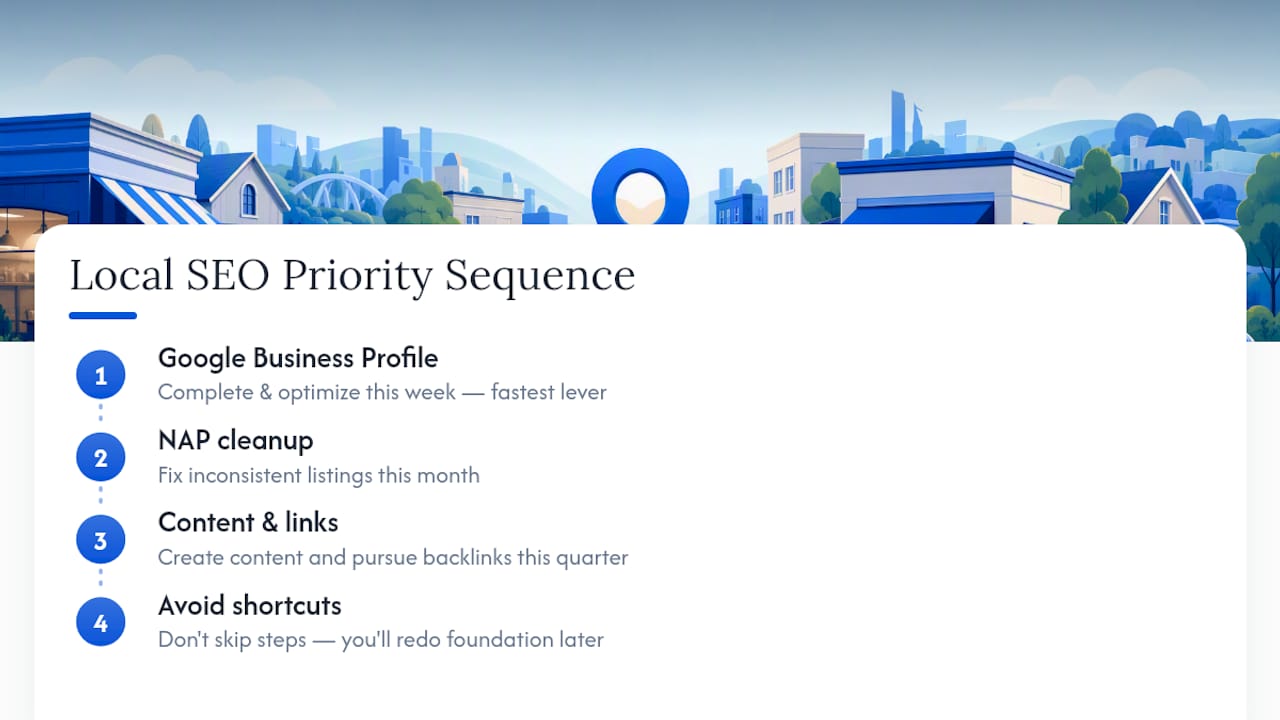
The conventional advice oversells backlinks and undersells consistency. A dozen mediocre directory links do less for you than fixing three inconsistent NAP entries that were quietly confusing search engines. And review systems get treated as a reputation tactic when they’re really a ranking tactic wearing a reputation costume.
If you’re starting from zero, prioritize the profile this week, NAP cleanup this month, and content plus links this quarter. Skipping steps to chase a shortcut usually means redoing the foundation later anyway.
— Mike
A Practical Next Step If You’d Rather Not Do This Alone
Everything above works, but it takes real hours every single month: writing local pages, chasing reviews, cleaning up citations, and tracking what moved. Some services are built for business owners who want that entire sequence handled without hiring an agency or blocking off a weekend to learn schema markup.
Some monthly subscription services provide published local content, authority backlinks, Reddit mentions in relevant conversations, and social posts, all pushed out on a set schedule with reporting attached, so you can see what moved without digging through five different tools yourself. It fits best for owners who already know this playbook works but don’t have the weekly hours to run it. If that’s you, check out what Mysearchhero delivers and see whether a done-for-you plan fits your business better than doing it solo.
Key Documentation and Tools
- Google Business Profile Help: official guidance on verification, ranking factors, and review response.
- Local SEO checklist: a 12-step guide for structuring your own audit.
- SEO best practices for local businesses: technical and content priorities in one reference.
Sources
- Tips to improve your local ranking on Google – Google Business Profile Help
- Local SEO in 2026: The Complete Playbook for Small Businesses | EMOR AI
FAQ
What Is the 3-3-3 Rule for Marketing?
There’s no single agreed-upon definition of a “3-3-3 rule” specific to local SEO; the phrase gets used loosely across different marketing contexts. If you’ve seen it applied to your niche, treat it as a general framework rather than an official standard, and focus instead on the profile, citations, reviews, and pages sequence outlined above.
Can I Do Local SEO Myself?
Yes. A solo owner can realistically handle the Google Business Profile setup, NAP cleanup, and a basic review system without outside help. Local pages, ongoing content, and backlink outreach take more consistent time, which is where a done-for-you service like Mysearchhero often makes sense.
How Can I Increase My Visibility on Google?
Start with a fully verified and complete Google Business Profile, since Google explicitly ties local ranking to profile completeness, then fix NAP consistency, build a review system, and publish genuine local service pages in that order.
Is PPC Better Than SEO?
They serve different purposes. PPC delivers immediate visibility for a price you pay every click, while local SEO builds compounding, mostly free visibility that takes weeks to months to mature. Most small businesses get the best return running both, using PPC for immediate gaps while SEO work builds underneath it.
How Long Does It Take to Rank Locally?
Profile and NAP fixes can show movement in two to six weeks, local pages and early backlinks typically take one to three months, and competitive terms often need three to six months of consistent work.