
The highest-impact local SEO tactics are: claiming and fully optimizing your Google Business Profile (GBP), mapping local keywords to specific pages, building consistent citations, earning reviews at a steady pace, creating location pages with structured data, and keeping your site fast and mobile-ready. Here is what each looks like in practice:
- Google Business Profile (quick win, days 1–7): Verify your listing, select the most specific primary category (e.g., “Emergency Plumber” not “Plumber”), and add service items like “Water Heater Replacement — same-day service.”
- Local keyword mapping (quick win, days 1–14): Target “AC repair Austin TX” on your service page and “HVAC near me” on your homepage.
- Location pages (medium-term, weeks 2–6): Build a dedicated page for each city you serve with a unique headline, local FAQs, and LocalBusiness schema.
- Citations and NAP (quick win, days 1–21): Audit Yelp, Apple Maps, and Bing Places for name, address, and phone number mismatches and fix them.
- Reviews (ongoing): Send a post-service SMS: “Happy with your repair? A quick Google review helps us a lot: [link].”
- Photos and GBP posts (ongoing): Upload five fresh photos per month and post one weekly update (offer, event, or tip).
- Local links (medium-term, months 1–3): Sponsor a local Little League team and ask for a link from the league’s website.
- Mobile and speed (quick fix, week 1): Run PageSpeed Insights and compress images above 200KB.
- Measurement (ongoing): Track direction clicks and calls inside GBP Insights weekly.
Table of Contents
- 1. Claim and optimize your Google Business Profile first
- 2. How to find and map local keywords to the right pages
- 4. How to audit and maintain consistent local citations
- 5. Reviews: scripts, response templates, and what not to do
- 6. Photos, posts, and GBP features that actually drive clicks
- 8. Mobile friendliness, site speed, and technical local signals
- 9. Research-backed priorities: your 30/60/90-day local SEO plan
- Key Takeaways
- The local SEO mistake most businesses keep making
- Mysearchhero handles local SEO on autopilot for small businesses
- Useful sources and further reading
- FAQ
1. Claim and optimize your Google Business Profile first
GBP optimization is the single highest-leverage move in local SEO. Google’s own guidance lists verification, complete information, photos, and review responses as the core steps that improve relevance and prominence in local results. Miss any of them and you are handing positions to competitors who did not.
Start with verification. Without it, you cannot edit your listing, and Google will not rank an unverified profile in the Local Pack. Once verified, work through this checklist:
- Primary category: Choose the most specific option available. “Emergency Plumber” outperforms “Plumber” for high-intent searches. The ICG GBP optimization guide identifies primary category as the single most influential lever on a profile.
Pro Tip: After your first 30 days, open GBP Insights and check “Direction requests.” That single metric tells you how many people were close to buying. If it is flat after a full profile build-out, your primary category may still be too broad.
The 2026 Rio SEO local search report makes the stakes clear: AI Overviews are shortening the buyer journey, so your listing must answer questions directly rather than just pointing people to your website. Accurate services, attributes, and photos are no longer optional polish.
Maintenance rhythm: post once per week, add at least five photos per month, and seed two or three Q&A entries with questions your customers actually ask (“Do you offer free estimates?”).
2. How to find and map local keywords to the right pages
The goal is to match a specific keyword to the page best positioned to rank for it. Sending every local keyword to your homepage wastes authority and confuses Google about what each page covers.
Start with seed phrases: your core service plus your city. Then expand using Google’s autocomplete, the “People also ask” box, and tools like Google Search Console (filter by location) to find what your existing pages already rank for. Sort by intent: transactional queries (“emergency electrician Dallas”) belong on service pages; informational queries (“how much does rewiring a house cost in Dallas”) belong on blog posts or FAQ pages.
| Keyword phrase | Intent | Target page type |
|---|---|---|
| “plumber Austin TX” | Transactional | Service page |
| “emergency plumber near me” | Transactional | Homepage or service page |
| “water heater replacement Austin” | Transactional | Service-specific page |
| “how long does water heater installation take” | Informational | Blog post / FAQ |
| “best plumber in South Austin” | Navigational/local | Location page |
| “Austin plumber reviews” | Navigational | Reviews page or GBP |
On-page execution for each target page:
- LocalBusiness schema: — Add it to every location and service page (more on this in the next section).
4. How to audit and maintain consistent local citations
Inconsistent NAP (name, address, phone) across directories is a quiet ranking killer. Google cross-references your listings across the web to confirm your business is legitimate and located where you say it is. Conflicting data creates doubt, and doubt costs you Local Pack positions.
Run the audit in three steps:
- Step 1 — Define your canonical NAP. Pick one exact format and stick to it everywhere. “Suite 200” or “Ste. 200” — choose one. “Avenue” or “Ave.” — choose one. Write it down.
- Step 2 — Check priority directories. Start with Google Business Profile, Yelp, Apple Maps, Bing Places, Facebook, and your industry-specific directories (Houzz for contractors, Healthgrades for medical, Avvo for legal). Search your business name and phone number on each.
- Step 3 — Use a data aggregator check. Services like Neustar Localeze and Data Axle push your NAP to hundreds of downstream directories. Submitting your canonical NAP to these aggregators fixes many inconsistencies automatically.
Repair workflow:
- Claim every unclaimed listing before editing it.
- Log each directory, its current NAP, and the corrected version in a simple spreadsheet.
- Fix the highest-traffic directories first (Google, Yelp, Apple Maps), then work down the list.
- Check for duplicate listings and request removal or merge them.
Maintenance cadence: Re-audit your top 10 directories every quarter. After any address or phone number change, update GBP first, then work through your priority list within 48 hours.
Pro Tip: Search your old phone number on Google. If listings still show it six months after you changed numbers, those are the exact citations dragging your local signals down.
For a full local SEO checklist that covers citation audits alongside the other ranking factors, that resource walks through each step in order.
5. Reviews: scripts, response templates, and what not to do
Review velocity matters. A business that collects 10 reviews this month outperforms one that collected 50 reviews two years ago and stopped. BrightLocal’s local SEO research consistently shows that review recency and volume are among the strongest trust signals for both consumers and local ranking algorithms.
Three ways to ask for reviews:
- Post-service SMS (highest conversion rate): “Hi [Name], thanks for choosing [Business]. If we did a great job today, a quick Google review means the world to us: [direct link]. It takes 60 seconds.”
- Email follow-up (24–48 hours after service): Same message, slightly longer. Add one line: “Feel free to mention what service we did and your neighborhood — it helps other locals find us.”
- In-person / QR code: Print a small card or receipt insert: “Love our work? Scan to leave a Google review.” Place QR codes at your front desk, on invoices, and on service vehicles.
Response templates:
Positive review: “Thank you, [Name]! We’re glad the [specific service] went smoothly. We appreciate you taking the time to share your experience — it helps our Austin neighbors find us when they need help.”
Negative review: “Hi [Name], we’re sorry your experience didn’t meet our standards. Please call us at [number] so we can make this right. We take every concern seriously and want the chance to fix it.”
Dos and don’ts:
- Do ask every customer, not just the ones you think are happy.
- Do ask them to mention the specific service and neighborhood (“roof repair in Pflugerville”).
- Do respond to every review, positive or negative, within 48 hours.
- Do NOT offer discounts or gifts in exchange for reviews. Google’s policies prohibit review gating and incentivizing.
- Do NOT ask employees or friends to post fake reviews.
6. Photos, posts, and GBP features that actually drive clicks
Fresh media and regular posts convert profile views into calls and direction requests. Flento’s GBP optimization checklist recommends weekly posts, product listings, and seeded Q&A as tactics that improve both visibility and engagement.
Photo guidelines:
- Upload at least five photos per month. Categories to cover: exterior (storefront or job site), interior, team in action, completed work (before/after), and product or equipment shots.
- Name files descriptively before uploading:
kitchen-remodel-austin-tx-before.jpg. - Add captions where the platform allows. “Our team finishing a kitchen remodel in the Mueller neighborhood, Austin” is more useful than no caption.
Six GBP post ideas you can use this week:
- Offer post: “Book your AC tune-up before June and save $30. Offer ends May 31.”
- Event post: “We’ll be at the Cedar Park Home Show on Saturday — stop by booth 14 for a free estimate.”
- Product spotlight: “New service: EV charger installation for Austin homeowners. Permitted, inspected, and done in one day.”
- Seasonal hours: “We’re open Memorial Day weekend, 8 AM–2 PM.”
- New service announcement: “Now offering duct cleaning in the Round Rock area.”
- Social proof post: “Completed our 500th job in Travis County this month. Thank you, Austin!”
Product and service listings: If you offer discrete products or packages, add them under the Products tab. A landscaping company might list “Spring Cleanup Package — $299, includes bed edging, mulch, and debris removal.” These appear directly on your profile and give searchers a reason to click before they even reach your website.
8. Mobile friendliness, site speed, and technical local signals
Mobile and speed are table stakes. According to Shopify’s local SEO statistics, the majority of local searches happen on mobile devices, and a slow or broken mobile experience kills conversions before a visitor ever reads your services. Google’s local ranking algorithm also factors in page experience signals, so technical issues can suppress your Local Pack eligibility.
Quick technical checklist:
- Core Web Vitals: Focus on Largest Contentful Paint (LCP) under 2.5 seconds and Cumulative Layout Shift (CLS) under 0.1. Both are measurable in Google Search Console under the “Core Web Vitals” report.
- Caching: — Enable browser caching and use a CDN if your host supports it. Most WordPress hosts include this in their plans.
- LocalBusiness schema on every location page: — Covered in section 3, but worth repeating here: structured data is a technical signal, not just an SEO nicety.
Tools to use:
- Local rank trackers: — Tools like BrightLocal or Whitespark let you track your Local Pack position by zip code, so you can see whether technical improvements move the needle.
Non-engineers can handle image compression, caching plugins (WP Rocket, W3 Total Cache), and click-to-call links without developer help. Hand the Core Web Vitals report to your developer with the specific failing URLs and let them prioritize from there.
9. Research-backed priorities: your 30/60/90-day local SEO plan
Start with GBP, reviews, and local keyword mapping. These three deliver the fastest measurable lift. Content and links compound over months, so plant those seeds early but do not expect overnight results.
SEOScaleUp’s local SEO ROI data frames GBP as effectively a free storefront: fully optimized profiles capture a disproportionate share of local traffic compared to thin or incomplete ones. BrightLocal’s research shows that Local Pack positions deliver significantly more actions than organic-only results for the same query.
30/60/90-day plan:
- Days 1–30 (quick wins):
- Verify and fully complete your GBP (all fields, photos, services, attributes).
- Fix NAP inconsistencies on Google, Yelp, Apple Maps, Bing Places, and Facebook.
- Set up a review request workflow (SMS or email template, QR code).
- Run PageSpeed Insights on your homepage and top service pages; fix images.
- Install Google Search Console if not already active.
-
Days 31–60 (stabilization):
- Build or improve location pages for your top two or three cities.
- Add LocalBusiness schema to all location and service pages.
- Publish two blog posts targeting informational local keywords.
- Begin weekly GBP posts and a monthly photo upload routine.
- Audit and claim your top 20 citation directories.
-
Days 61–90 (growth):
- Pursue three to five local links (Chamber, sponsorship, local press).
- Expand location pages to remaining service cities.
- Analyze GBP Insights: which queries drive direction clicks? Double down on those service pages.
- Check Search Console for local keyword ranking movement and adjust title tags where needed.
Measurement milestones to expect:
- By day 30: GBP actions (calls, direction clicks, website clicks) should increase as your profile fills out.
- By day 60: Local Pack visibility for your primary service-plus-city keyword should improve or appear for the first time.
- By day 90: Organic local rankings for long-tail keywords should start moving, and review count should be noticeably higher.
Key Takeaways
Consistent execution across GBP, local keywords, citations, reviews, and technical signals is what separates local businesses that dominate the Local Pack from those that never appear in it.
| Point | Details |
|---|---|
| GBP is your highest-leverage asset | Fully complete your profile, choose the most specific primary category, and post weekly to drive direction clicks and calls. |
| NAP consistency removes ranking friction | Audit Google, Yelp, Apple Maps, and Bing Places first; fix mismatches before building new citations. |
| Review velocity beats review volume | A steady flow of recent reviews outperforms a large but stale count; build a repeatable ask workflow. |
| Location pages earn city-level rankings | One dedicated page per city, with localized content and LocalBusiness schema, turns each market into a separate ranking opportunity. |
| Mysearchhero automates the content and signals | For businesses that want monthly articles, backlinks, and GBP signal boosts without managing it themselves, Mysearchhero handles the pipeline. |
The local SEO mistake most businesses keep making
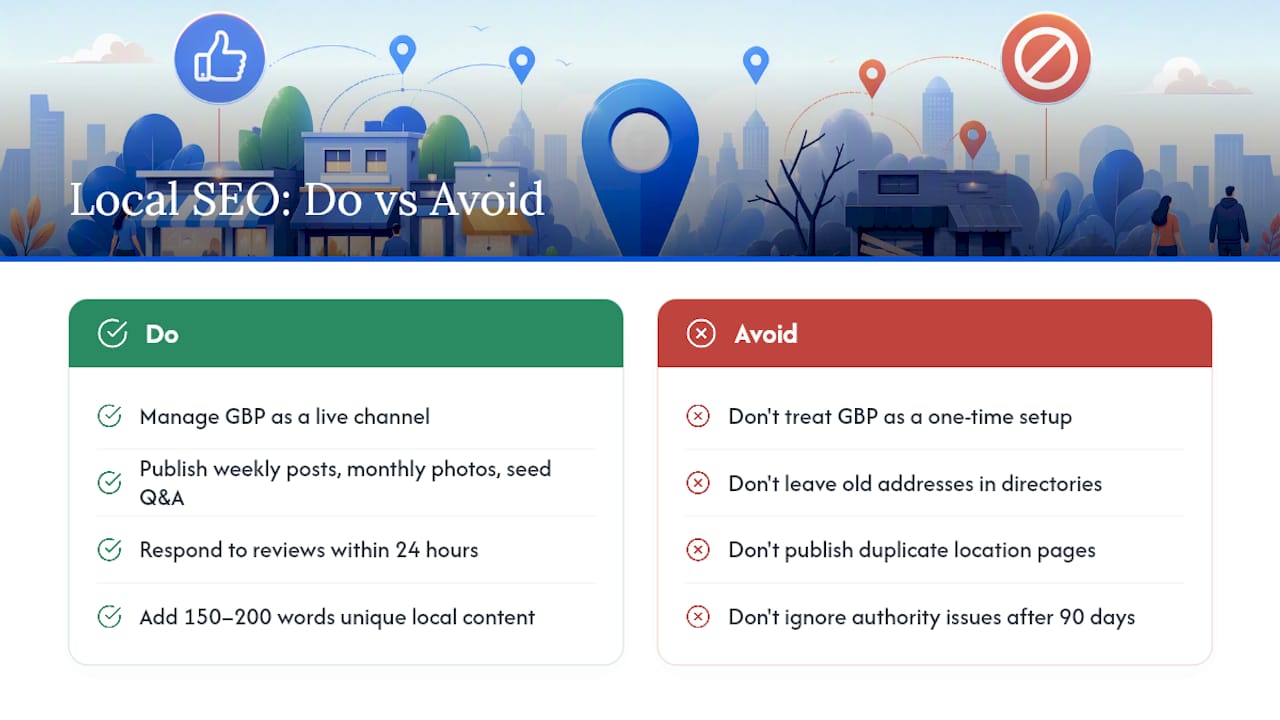
Most local businesses treat GBP as a one-time setup task. They claim the listing, fill in the basics, and never touch it again. Then they wonder why a competitor with half their experience is ranking above them.
The businesses I see pulling ahead consistently are the ones treating their GBP like a live channel, not a directory entry. Weekly posts. Fresh photos every month. Q&A entries seeded with the questions their customers actually ask. Review responses written within 24 hours. It is not glamorous work, but it compounds.
The second blind spot is citation chaos after a phone number or address change. One client moved locations and updated Google immediately but left 40 other directories showing the old address for eight months. Their Local Pack rankings dropped noticeably within weeks. Once we fixed the citations, rankings recovered. The fix itself took about three hours of work.
The third mistake: building location pages that are identical except for the city name swapped in. Google catches thin content fast, and a page that reads like a mail-merge template will not rank. The fix is to add 150–200 words of genuinely local content per page: a neighborhood FAQ, a local landmark reference, a city-specific trust signal. That small investment is usually enough to differentiate.
When should you bring in professional help? When the tactical work is done correctly but results are still flat after 90 days, the issue is usually authority: not enough backlinks, not enough review velocity, or both. That is when a managed service pays for itself faster than continued DIY effort.
Mysearchhero handles local SEO on autopilot for small businesses
Hiring an agency locks you into a retainer and a project manager you have to chase. Doing it yourself means carving out hours every week that most business owners simply do not have. Mysearchhero is the third option: a subscription that ships monthly SEO articles published to your site, authority backlinks through a publisher network, and GBP signal boosts, all through an automated pipeline that runs without you managing it.
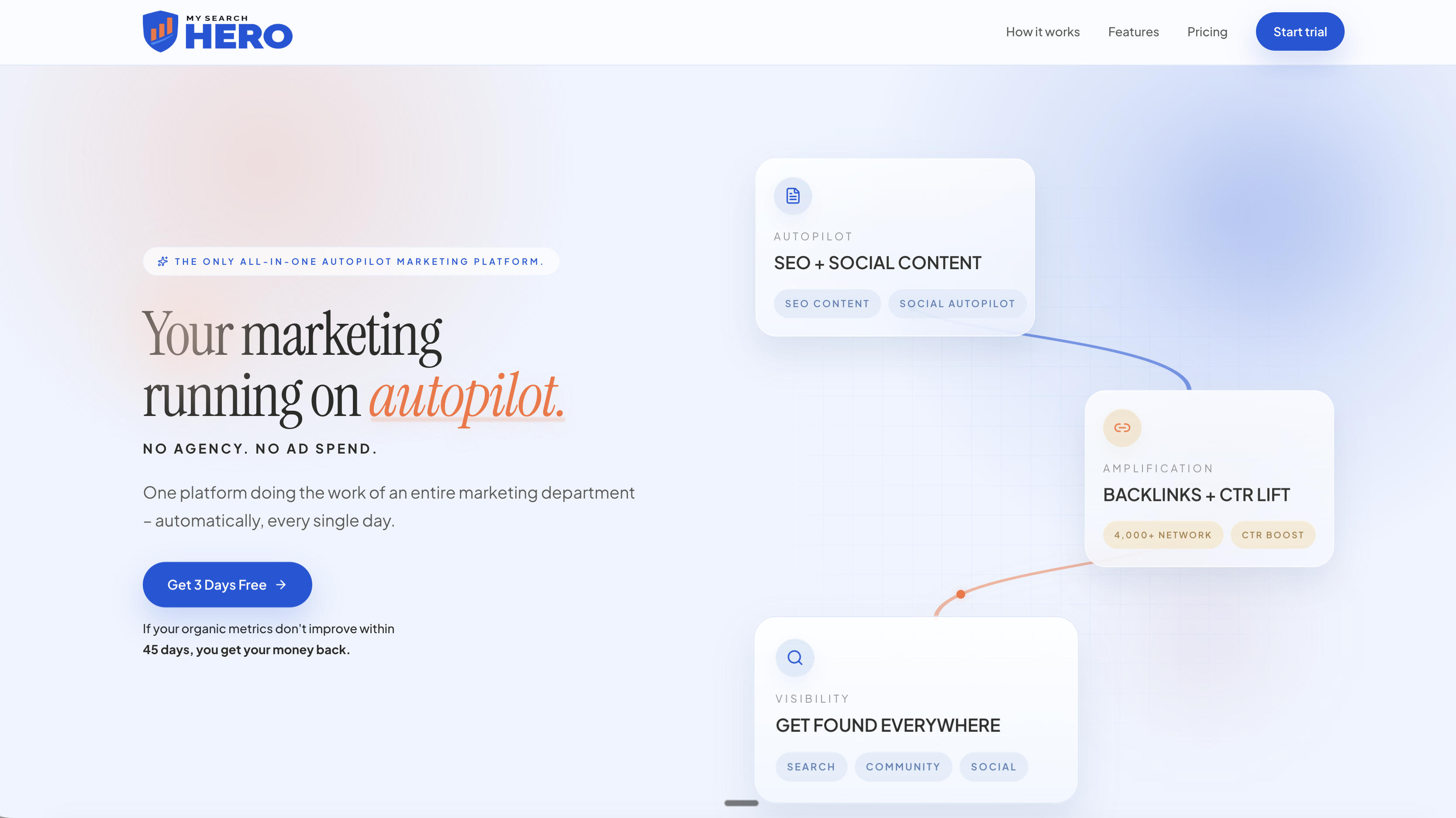
Each month you get a bundle of deliverables: SEO-optimized articles targeting your local keywords, backlinks that build your domain authority, Reddit brand mentions in relevant conversations, and social media posts across your platforms. The reporting shows you exactly what shipped and what moved. For local service businesses that want to grow their search presence without adding it to their to-do list, start your free trial at Mysearchhero and see what the first 30 days delivers.
Useful sources and further reading
- 2026 Local search report: AI and what’s working | Rio SEO
- Google Business Profile Optimization 2026 — Complete Guide | ICG
- LocalBusiness — schema.org
- Local SEO statistics you need for 2026 | Shopify
- Local SEO ROI Statistics 2026: 60+ Data Points That Will Change How You Invest | SEOScaleUp
- Google Business Profile Optimization: The Complete 2026 Checklist | Flento
- 35+ Local SEO statistics you need for 2026 – BrightLocal
- Get your business to appear on Google — Google Business Profile help
FAQ
What is the best strategy for local SEO?
The highest-impact local SEO strategy combines a fully optimized Google Business Profile, consistent NAP citations across directories, a steady review acquisition workflow, and location-specific pages with LocalBusiness schema. Start with GBP and citations for the fastest measurable lift, then layer in content and links for compounding gains.
How long does local SEO take to show results?
Most businesses see GBP action improvements (calls, direction clicks) within 30 days of a full profile build-out. Local Pack ranking movement typically appears within 60–90 days. Organic ranking gains from content and links usually take three to six months of consistent effort.
What are the most important ranking factors for the Google Local Pack?
Google uses relevance, distance, and prominence to rank Local Pack results. Relevance is driven by your primary category, services, and on-page signals. Prominence is influenced by review count and recency, backlinks, and citation consistency. Distance is fixed by your location relative to the searcher.
How do I get more Google reviews for my local business?
Send a direct review link via SMS or email within 24 hours of service completion. Ask customers to mention the specific service and their neighborhood in the review, which makes the review more useful for both AI systems and future customers. Never offer incentives, as Google’s policies prohibit review gating.
Can Mysearchhero help with local SEO content and GBP signals?
Yes. Mysearchhero’s monthly subscription delivers SEO articles targeting your local keywords, published directly to your site, along with backlinks and GBP signal boosts through an automated pipeline. It is built for local service businesses that want consistent output without managing the work themselves.