
An authority backlink placement is an editorial, contextual link embedded in the body copy of a topically relevant page, not a footer credit or a paid directory listing. Prioritize that one property first: contextual body placement on a page that already covers your subject matter. Everything else, domain rating, traffic, social shares, matters less than where the link sits and what it sits next to.
TL;DR:
- Placing backlinks within relevant editorial content in the main body of high-traffic pages is more effective than footer or sidebar links for ranking impact.
- Topical relevance and co-citation with credible sources influence rankings more than domain authority, with relevance demonstrated by organic traffic and placement context.
- Digital PR campaigns that produce original research or newsworthy content typically deliver higher-quality editorial backlinks than guest posts or niche edits.
- Outreach success depends on clear, value-driven pitches featuring unique assets, tailored follow-ups, and targeting high-relevance, well-trafficked pages.
- Managed backlink services automate sourcing, vetting, and placement, providing a cost-effective alternative to manual outreach, especially at scale.
Table of Contents
- What Makes Authority Backlink Placements Work in 2026?
- How Do You Evaluate a High-Value Link Placement?
- Which Acquisition Tactics Actually Produce Editorial Placements?
- What Should Your Outreach Pitch Actually Say?
- How Do You Score and Scale Backlink Prospects?
- How Long Until Authority Placements Move Rankings?
- How Mysearchhero Puts This Playbook Into Practice
- Where Marketers Get Backlink Strategy Wrong
- Get Managed Authority Backlink Placements Without the Outreach Grind
- Sources
- FAQ
What Makes Authority Backlink Placements Work in 2026?
Search engines still treat links as endorsements, but the calculation has changed. Google’s own guidance singles out links inside primary content as the ones that carry weight, while it actively flags manipulative link patterns built around navigation, footers, or paid schemes. That’s not new information, but it’s more consequential now that AI systems are reading the same web.
Large language models build their answers from co-citation patterns: how often a brand or claim gets mentioned alongside credible sources, not just how many links point at a domain. Semrush’s 2026 guidance notes that original data and consistent mentions across the web increase the odds a brand shows up inside an AI-generated answer. A link buried in a comment thread does nothing for that. A mention inside an article’s actual paragraphs, where a model’s retrieval layer can parse context, does a lot.
The data backs up what placement-obsessed link builders have argued for years. A Backlynk study of 18,000 backlinks across 320 niches found topical semantic proximity correlated with ranking impact at 0.31, compared to just 0.14 for domain authority. Relevance beat raw authority by more than double.
That has one clear operational implication: chase placements that are retrievable, meaning they live in body text, podcast transcripts, or show notes rather than sidebars or link farms.
- Body copy mentions get crawled and quoted; footer links mostly don’t.
- Transcripts and show notes are increasingly indexed as standalone text assets.
- Co-citation with recognized sources matters more than a single big-DR link.
A key stat: topical proximity correlates with ranking outcomes more than twice as strongly as domain authority (0.31 vs.
How Do You Evaluate a High-Value Link Placement?
Domain Rating and Domain Authority are useful filters, not verdicts. Moz is explicit that Domain Authority is a third-party metric Google doesn’t use internally, so treating it as gospel skips the questions that actually predict impact.
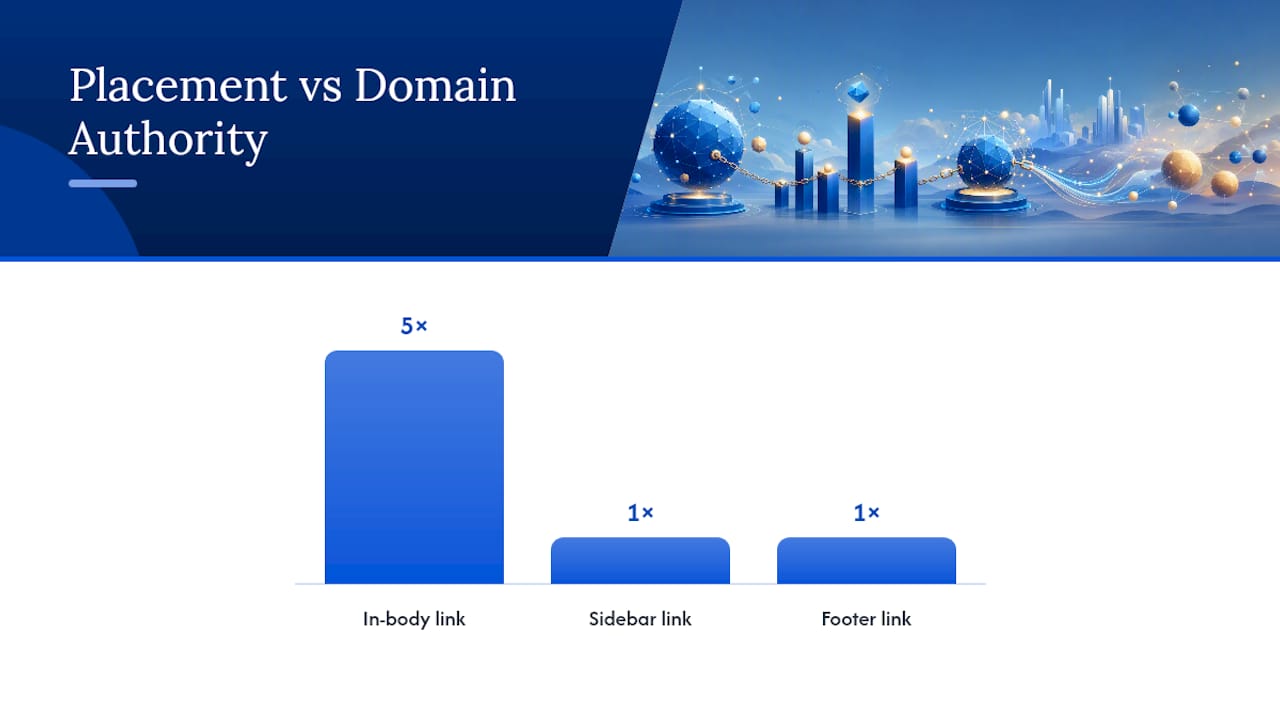
Placement location comes first. A link inside the article body can pass up to five times more ranking value than the same link sitting in a sidebar or footer on the identical domain, according to Backlinko’s placement research. That single variable often outweighs a ten-point gap in DR.
Page-level signals matter next: does the page pull organic traffic, does it stay tightly focused on your topic, and how many outbound links does it already carry? A page stuffed with forty outbound links to unrelated niches is diluting whatever equity it has left. Editorial signals round it out: a named author, visible editorial standards, and no obvious pattern of rotating in paid links every few months.
Here’s a five-step vetting pass you can run in under ten minutes per prospect:
- Pull the page into a browser and confirm the link would sit in body copy, not a widget or footer.
- Check organic traffic estimates and confirm the page ranks for terms related to your topic.
- Scan for a byline, an editorial policy page, or an “about the author” block.
- Count outbound links on the page; anything past 15 to 20 dilutes value.
- Search the domain for footprints of paid link networks (identical anchor patterns across unrelated niches).
Pro Tip: Keep a shared spreadsheet with a “placement type” column (body, sidebar, footer, resource list) and sort by it before you sort by DR. You’ll cut a surprising number of “high authority” prospects immediately.
Which Acquisition Tactics Actually Produce Editorial Placements?
Different tactics buy you different things: speed, editorial depth, or volume. Mixing them deliberately beats betting everything on one channel.
Digital PR produces the highest-value placements because journalists cite original research inside body copy, often with your brand name attached. Expect a 4 to 8 week cycle from asset creation to placements landing, and budget for either a data study, a survey, or a newsworthy stunt. Cost bands vary widely, but a solid data-driven campaign typically runs into four figures once design and distribution are counted.
Guest posting still works when you pitch topically matched publications with a genuinely useful angle. Expect rejection on most cold pitches. A realistic bar: one accepted placement for every 15 to 20 well-targeted pitches, with a two to four week turnaround once accepted.
Niche edits, getting your link inserted into an existing published article, move faster than guest posts but carry more risk. Vet the page using the checklist above before agreeing to anything; a site that inserts niche edits for every buyer who emails is usually thin on editorial standards.
Reclaiming unlinked mentions is the most underused tactic on this list. If a publication already names your brand without linking it, that’s a warm outreach opportunity, not a cold pitch. The Backlynk research on branded mentions shows these conversions run far higher than fresh guest post pitches because the editor already decided you were worth mentioning once.
Round out the mix with resource page outreach, podcast guest appearances (transcripts count as placements), and fixing broken links pointing at competitor content, redirecting that authority toward your own resource. Cloud stacking can add volume fast, but it lacks topical depth. Treat it as a base layer, never your main strategy.

What Should Your Outreach Pitch Actually Say?
The asset you’re pitching determines your acceptance rate more than the pitch copy does. Original data, calculators, and evergreen guides with genuine depth get cited; recycled listicles don’t. Editors link to things they can’t easily produce themselves.
A pitch that converts follows a predictable anatomy:
- Subject line names the specific article you’re referencing, not a generic “collaboration opportunity.”
- Opening line states the value in one sentence: what data, tool, or angle you’re offering that improves their existing piece.
- Asset preview links or embeds the actual resource, no attachments the editor has to download.
- The offer to the editor goes both ways: a quote for their piece, exclusive access to unpublished data, or a custom chart built for their audience specifically.
- A short, no-pressure close that leaves the decision with them.
Track everything in a simple sequence: initial pitch, one follow-up at day 5, a final follow-up at day 12 with a new angle, then archive.
Pro Tip: Send your follow-up from a different angle than your original pitch, not just “following up on my email below.” Editors ignore repeat asks; they respond to a fresh reason to care.
How Do You Score and Scale Backlink Prospects?
A simple weighted scoring model keeps outreach focused on placements that actually move rankings, instead of chasing every domain with a high DR badge.
Score each prospect across five components: topical relevance (0 to 3), page authority (0 to 3), placement value with body copy scoring highest (0 to 3), estimated organic traffic (0 to 2), and editorial integrity (0 to 2), for a possible total of 13.
| Score range | Recommended action |
|---|---|
| 10 to 13 | Prioritize for outreach immediately |
| 6 to 9 | Queue for outreach after top-tier prospects |
| 3 to 5 | Consider only if the niche edit is cheap and fast |
| 0 to 2 | No-go, regardless of DR |
This is where scoring models that weight relevance over raw DR cut wasted effort. When you’re ready to scale, extend into partnerships, integration directories, and affiliate relationships that mirror your existing standards. The mistake most teams make when scaling is quietly lowering the score threshold to hit a monthly link quota. Hold the line instead. A documented backlink type breakdown can help you diversify channels without diversifying away from quality.
How Long Until Authority Placements Move Rankings?
Track five KPIs per campaign: target keyword rank, organic sessions to the linked page, referral traffic from the placement itself, SERP feature appearances, and periodic checks of whether AI tools mention your brand for related queries.
Timing varies sharply by channel. Cloud and directory links can show minor movement in 2 to 4 weeks. Editorial placements, guest posts, digital PR hits, reclaimed mentions, typically need 6 to 16 weeks before you see a durable ranking shift, since Google needs to crawl, index, and weigh the new signal against everything else changing on both domains.
- Run before/after comparisons only on pages where nothing else changed (content, technical SEO, internal links).
- Watch Search Console for crawl and indexing confirmation before assuming a placement “didn’t work.”
- Correlate ranking moves with content updates too. A backlink rarely acts alone.
A key stat: placement location alone can swing link value by roughly 5x between body copy and sidebar or footer spots on the same page, per Backlinko’s analysis. Attribute results accordingly: a flat link count tells you almost nothing about expected impact.
How Mysearchhero Puts This Playbook Into Practice
Running this system by hand, sourcing prospects, scoring them, pitching, tracking, takes hours every week. Mysearchhero automates the deliverable side: monthly editorial backlink placements sourced through a publisher network, paired with published articles and Reddit brand mentions that build the co-citation pattern AI systems look for.
- Monthly editorial backlinks placed on topically vetted publisher sites, not link farms.
- AI-generated articles published directly to the client’s own site, building the body-copy placements this article argues for.
- Reddit mentions and social posts layered on top to reinforce co-citation signals across the web.
The editorial backlinks workflow documented on the Mysearchhero blog walks through how a managed pipeline handles sourcing and vetting at volume, something a solo marketer running the five-step checklist above will hit a ceiling on eventually. Managed programs trade some hands-on control for consistency; DIY trades consistency for full oversight of every placement.
Where Marketers Get Backlink Strategy Wrong
Most link-building budgets get spent backwards: volume first, quality as an afterthought. That’s the wrong order. A handful of contextual placements on topically tight pages will outperform fifty cloud links every time, and the research on topical proximity backs that up directly.
The clearest red flag in vendor pitches is a guaranteed link count with no mention of placement type or niche relevance. That’s a link farm wearing a service agreement. Ask where the link sits on the page before you ask how many domains are in the network.
Adjust as your outreach conversion rates improve.
— Mike
Get Managed Authority Backlink Placements Without the Outreach Grind
A single monthly subscription service can replace the outreach spreadsheet, vetting checklist, and follow-up cadence by producing editorial placements, published articles, and Reddit mentions on autopilot.
Instead of hiring separate vendors for content, backlinks, and social mentions, some services offer all three from a single pipeline for a flat monthly rate starting in the low hundreds with a money-back guarantee if organic metrics don’t move. That kind of pricing transparency is rare in an industry built on vague retainers and mystery link packages.
If you’ve been vetting niche edits one by one using the checklist above, compare that hourly cost against a flat subscription that runs the same acquisition logic at scale. Check current plan details and start with Mysearchhero to see which tier fits your monthly placement goals.
Sources
A few sources shaped the framework in this article and reward a closer read if you want the underlying methodology:
- How to Get Backlinks in 2026: 10 Tactics That Actually Work
- High-quality backlinks: Backlinko
- Domain authority (Moz)
- Google developers – spam policies
FAQ
What Are Authority Backlinks?
Authority backlinks are links from credible, topically relevant pages placed inside editorial body content rather than paid directories or footers. Their value comes from the combination of topical relevance and placement, not from domain metrics alone, since topical proximity correlates more strongly with ranking impact than domain authority.
Are Backlinks Still Relevant in 2026?
Yes. Backlinks continue to influence traditional rankings and now also shape how often AI tools cite a brand, since co-citation patterns feed into LLM answer generation. The mechanism has expanded rather than disappeared.
What Is a Good Backlink Authority Score?
There’s no single universal threshold, since Domain Authority and Domain Rating are third-party proxy metrics that Google itself doesn’t use. A more reliable signal combines topical relevance, real organic traffic, and body-copy placement rather than chasing a specific DR number.
Does a Backlink Actually Build Authority?
A backlink builds authority when it sits in relevant editorial content on a page that already ranks for related terms, since placement location alone can shift link value by roughly 5x between body and sidebar spots. A link on an unrelated, low-traffic page contributes far less regardless of its domain score.
How Much Does Mysearchhero Cost for Backlink Placements?
Mysearchhero offers tiered monthly subscription plans with editorial backlinks, published articles, and social mentions bundled together. For the most accurate and current pricing and plan details, visit the Mysearchhero site.