
Yes, if a page already gets steady impressions and a stable position in Search Console, testing its title is one of the lowest-risk ways to improve click-through rate. The catch is patience: title testing produces incremental CTR lifts, not overnight traffic spikes, and it only works once you have enough impressions to trust the numbers.
TL;DR:
- Title testing only yields meaningful CTR improvements on pages with steady impressions and stable rankings over at least 90 days.
- Small sites often lack enough traffic to generate statistically reliable results within a short testing period.
- Proper test setup requires changing only one element at a time, keeping other variables like description and content consistent, and running tests for multiple weeks.
- Evaluating results with two-proportion statistical tests prevents false positives, especially when testing multiple variants simultaneously.
- Using Search Console’s Performance report is essential to identify credible test candidates, verify ranking intent, and monitor long-term engagement post-test.
Table of Contents
- Why testing titles is worth your time
- What to measure and where to find it
- Setting up your A/B title test
- Reading your results without fooling yourself
- What makes a title actually win
- When to test it yourself and when to hand it off
- If you would rather not run this yourself
- Sources
- FAQ
Why testing titles is worth your time
A higher CTR means more of the people who already see your page in search results actually click it, and that extra engagement can feed back into rankings over time, a relationship explored in this look at how CTR moves SEO rankings. But testing only works on pages that already have impressions and a ranking that holds steady long enough to isolate the title’s effect. A page bouncing between position 4 and position 14 week to week will confuse any test, because ranking shifts, not wording, are driving the CTR swings.
Some marketers try to shortcut this with PPC ads or surveys to guess which title will win organically. A live test at Wayfair found that PPC and crowdsourced proxies often mispredicted the organic winner, because paid and survey audiences tend to reward promotional language that doesn’t always convert the same way in organic search.
Before testing anything, check that a page clears these bars:
- It has consistent impressions over the past few weeks, not a single traffic spike.
- Its average position has stayed within a narrow band during that time.
- Its current title still matches the intent the page actually satisfies.
What to measure and where to find it
Search Console’s Performance report is where this entire process lives. It tracks four numbers you need: impressions (how often your listing appeared), clicks (how often someone clicked it), CTR (clicks divided by impressions), and average position (where you typically rank for that query). The report breaks this down by queries, pages, devices, and date ranges, which is exactly what you need to find good test candidates.
Here’s a simple process for finding them:
- Open the Pages tab and sort by impressions to find your highest-visibility pages.
- Cross-check each candidate’s CTR against pages with a similar average position. A page ranking at position 5 with a CTR well below others at that same position is underperforming its title.
- Switch to the Queries tab for that page to confirm the ranking keyword still matches the page’s actual content and title.
- Filter by device, since mobile and desktop often show different CTR patterns for the same page.
Pro Tip: Filter your date range to at least 90 days before picking a candidate. A page that looks stable over four weeks can still be riding out a seasonal spike.
For deeper guidance on configuring this report, see this breakdown of what a Search Console report needs to deliver.
Setting up your A/B title test

Once you’ve picked a candidate page, the setup matters more than the creativity of your title ideas.
Selecting the page:
- Confirm it clears the impressions and stability bars from the section above.
- Confirm the ranking query’s intent still matches what the page delivers, since a mismatched title will tank both variants equally.
Designing the variant:
- Change one element at a time: length, an emotional cue, or an evidence cue like a number or credential.
- Keep the meta description, URL, and on-page content untouched so you know the title caused any CTR shift.
- Write a variant you would actually publish if it won, not an exaggerated version you’d change back later.
Choosing a delivery method:
- A server-side split that shows different titles to different search crawls is the cleanest method but requires development support.
- A staging swap, where you change the live title for a fixed window and compare before-and-after periods, works for most small sites without any code.
- A controlled rollout across similar pages (one title style on page A, another on page B) can work when you don’t want to touch a single page twice, though it trades some precision for simplicity.
Sample size and duration:
Small sites rarely have the traffic for a same-week verdict. Plan for multiple weeks of data, since live SEO title tests take longer to stabilize than a paid ad test would, partly because of how search engines recrawl and re-index changed titles.
Pro Tip: Write your test plan before you touch the title: which page, what’s changing, how long you’ll run it, and what counts as a win. It keeps you from calling the test early just because the numbers look good on day three.
Finally, freeze everything else on that page for the test window. A new internal link, an image swap, or a content edit during the test muddies your read on what actually moved the needle.
Reading your results without fooling yourself
CTR is a proportion, clicks over impressions, so the right way to compare two titles statistically is a two-proportion test (a chi-square test or a two-proportion z-test both work). If you’re testing more than two variants at once, apply a correction like Bonferroni before declaring a winner, since running several comparisons at once inflates your odds of a false positive even when nothing real changed.
A page with a low number of weekly impressions and a modest CTR gets very few clicks a week, making it difficult to detect meaningful changes., which is far too small a sample to detect anything but a dramatic swing, a limitation confirmed by the kind of large-scale randomized headline testing that only becomes reliable at much larger volumes.
Watch for these failure patterns:
- A “winner” declared after a few days, before indexing has caught up with the new title.
- A big CTR swing on a low-impression page that’s really just noise.
- A win that boosted clicks but not time on page, which suggests the new title attracted the wrong searchers.
Once you do have a real winner, hold it in place, give Google time to re-crawl and stabilize the new title in results, and check on-site engagement afterward to confirm the extra clicks are staying and converting, not just inflating your bounce rate.
What makes a title actually win
Google’s own guidance is blunt: write titles that are clear, descriptive, and concise, and avoid stuffing them with repeated keywords, since repetition reads as spammy rather than helpful. That’s the floor. Above it, research into what makes headlines earn clicks points to a consistent set of features: short, simple phrasing over dense wording, evidence or numbers that signal proof, language that triggers a physical or emotional reaction, and framing around positive human behavior rather than negativity or vague hype.
Randomized headline experiments that hold the image and content constant let you attribute CTR differences to wording alone, which is the same discipline a small business should apply to its own title tests.
A few templates worth testing on local service pages:
- Service plus locality: “[Service] Near You: What to Expect”
- Benefit-first: “Fix [Problem] in One Visit, No Guesswork”
- Evidence-led: “[Service]: 15 Years of [Credential/Certification]”
- Direct question: “Need [Service]? Here’s What It Actually Costs”
Similar principles apply beyond your own site: title wording for product listings and headline performance in newsletters follow the same core logic of clarity, evidence, and restraint.
When to test it yourself and when to hand it off
Running a valid title test takes real attention: picking the right page, freezing other variables, waiting out the indexing lag, and running the math correctly before declaring a winner. For an owner juggling the actual business, that’s a lot of overhead for one page at a time.
The practical move for a small or local service business is to concentrate on a handful of high-impression pages rather than trying to test broadly across a thin site. If you don’t have the traffic volume or the hours to do this properly, a managed approach that handles content, monitoring, and CTR reporting together can get you statistically sound answers faster than a manual, page-by-page effort.
— Mike
If you would rather not run this yourself
A service can handle parts of this process that eat the most time: publishing monthly SEO articles, tracking CTR and impressions, building backlinks, and pushing Reddit mentions and social posts on autopilot, all from one subscription.
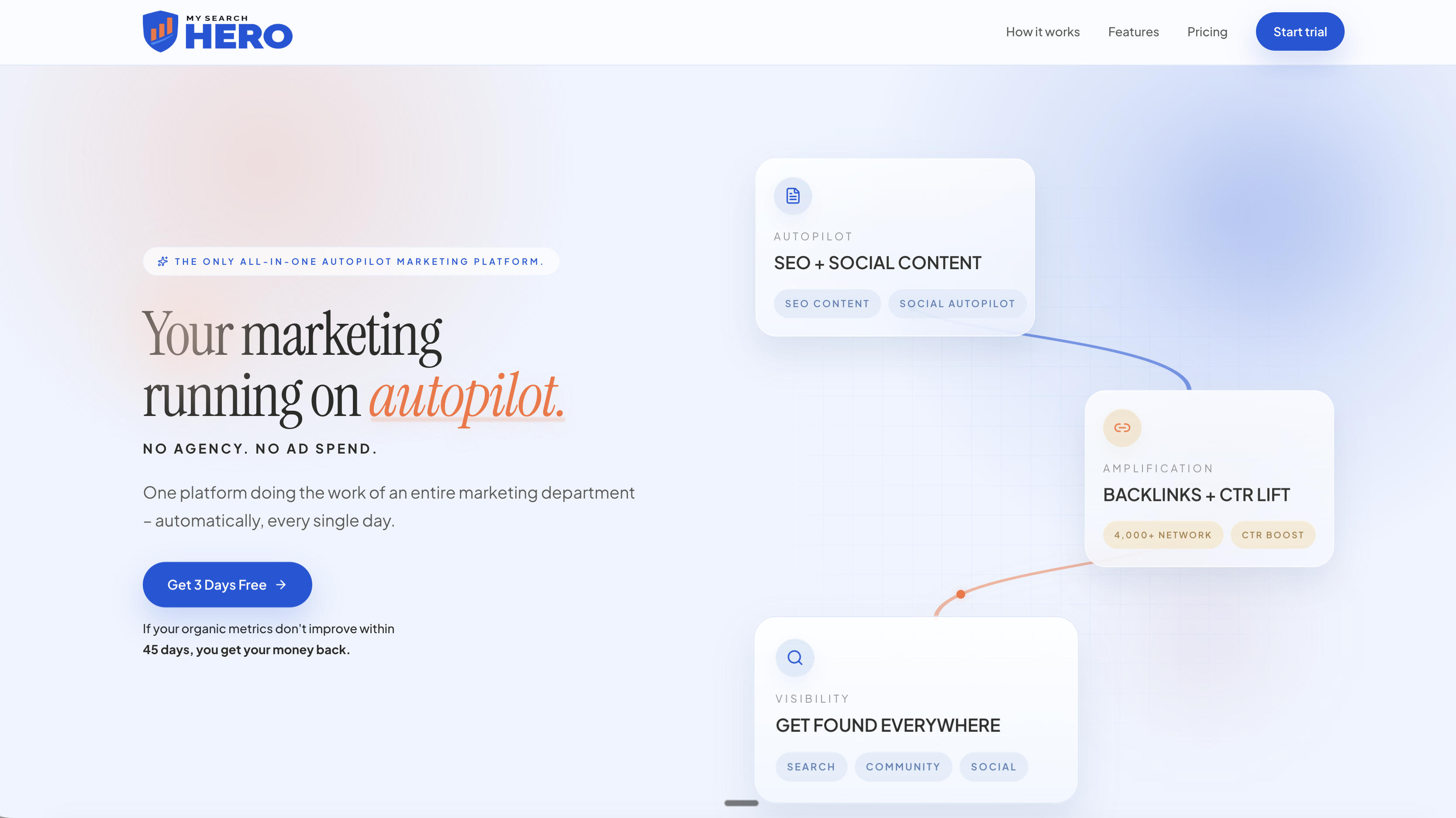
It’s designed for local service business owners who may not have a marketing team to run title tests, monitor Search Console weekly, and chase backlinks on the side. What you can expect from services like this:
- Monthly content and CTR monitoring handled without managing a testing calendar.
- Backlinks and Reddit mentions built in the background alongside published articles.
Plans start at Spark, Authority, Hero, or Enterprise, with Hero priced at $397 per month for the full bundle of SEO, CTR, backlink, and social automation. Check current plan details and see which tier fits your site.
Sources
- Title link – Google Search Central
- Performance report (Search results): Overview and basic setup – Search Console Help
- Text as signal: A large-scale study of headline success (Upworthy dataset analysis) – PLOS One / associated paper
- Study: PPC cannot accurately identify winning organic titles (Search Engine Land)
FAQ
Is A/B testing page titles actually worth the effort for a small site?
It’s worth it for pages that already have steady impressions and a stable ranking, since that’s where you can isolate the title’s effect on CTR. For low-traffic pages, the sample size is usually too small to produce a trustworthy result.
How long should an A/B title test run?
Plan for multiple weeks rather than days, since search engines need time to recrawl and stabilize a changed title, and short windows tend to capture noise rather than a real signal. Check your Search Console data weekly rather than calling the test early.
Can I use PPC ads to predict which organic title will win?
Not reliably. A Wayfair test found that PPC and survey proxies often favored promotional language that didn’t hold up in live organic search, so treat proxy results as a way to filter out weak ideas, not a final answer.
What’s the biggest mistake people make running title tests?
Calling a winner too early, often based on a tiny sample size or before the new title has finished indexing. Combine that with testing multiple variants at once without a correction like Bonferroni, and you get a false winner more often than a real one.
Where do I find the data to run these tests?
Search Console’s Performance report is the source for impressions, clicks, CTR, and average position, broken down by page, query, and device. It’s the same report referenced throughout Google’s own documentation for diagnosing underperforming titles.