
Click signals influence rankings, but CTR is not a lever you can pull on demand. Google’s NavBoost system reads click quality over time and weighs it against what similar queries typically get, so a raw click spike does nothing on its own. Your first move should be tactical, not theoretical: pull your Google Search Console data, find pages with high impressions and low CTR, and rewrite the title tag and meta description before you touch anything else. Never try to buy or fake clicks. That gets normalized away or flagged.
TL;DR:
- Improving click-through rates requires rewriting title tags and meta descriptions for pages with high impressions and low CTR, not manipulating clicks artificially.
- Google’s NavBoost system evaluates click signals over a 13-month window and filters out manipulated or superficial clicks, making genuine content quality essential.
- SERP features like AI Overviews and snippets often reduce CTR for standard listings, but being the cited source within these features can sustain or boost traffic.
- Internal benchmarks for CTR should be based on query and position data from Search Console, tailored to your specific SERP environment, rather than relying on industry averages.
- Regular, controlled testing of title and meta description changes over six to eight weeks provides the most accurate measure of actual CTR improvements.
Table of Contents
- What Is Click-Through Rate in SEO and How Do You Calculate It?
- Does CTR Affect Google Rankings? The NavBoost Evidence
- What Counts as a Good CTR? Why Benchmarks Vary So Much
- How AI Overviews and SERP Features Change What CTR Even Means
- The Tactical Playbook: Titles, Meta Descriptions, and Schema That Actually Move CTR
- How to Test CTR Changes Without Fooling Yourself
- Why Click Manipulation Backfires and What to Do Instead
- How a Done-For-You SEO Program Handles CTR Work at Scale
- Where CTR Fits in Your 2026 SEO Priorities
- Get Snippet and CTR Work Off Your Plate
- Sources
- FAQ
What Is Click-Through Rate in SEO and How Do You Calculate It?
CTR is clicks divided by impressions, expressed as a percentage. A page that shows up 10,000 times in search results and gets 400 clicks has a 4% CTR. That’s the whole formula. The complexity comes from where you measure it and how you slice the data.
Google Search Console reports CTR two ways: at the page level and at the query level. Page-level CTR aggregates every keyword a URL ranks for into one number, and that average hides more than it reveals. The blended average might land at 3.5% and look “fine,” while masking a real snippet problem.
Query-level CTR is where the actual diagnostic work happens. It shows you exactly which search terms are underperforming relative to their position, which is the only way to know if a title rewrite is even worth attempting.
A few reporting traps distort the numbers if you’re not careful:
- Multi-keyword pages blend high-intent and low-intent queries into one score, flattening the signal you need.
- Impression windows in GSC default to the last three months, which can bury seasonal spikes or dips.
- Device segmentation matters enormously. Mobile and desktop CTR often differ by several points on the same query, and averaging them together erases that gap.
Filter by query, filter by device, and only then decide whether a page has a real CTR problem or just a good average hiding a bad reality.
Does CTR Affect Google Rankings? The NavBoost Evidence
Yes, but not the way most SEO advice implies. Google’s ranking systems don’t take your raw CTR and plug it into a formula. They process click data through a layer called NavBoost, confirmed in DOJ antitrust testimony and detailed in the 2024 Content Warehouse API leak, which categorizes clicks into types like “good clicks” and “last longest clicks” rather than counting them at face value.
NavBoost operates on a rolling window of roughly 13 months of click history and applies normalization functions specifically designed to resist manipulation. The system isn’t asking “did this get clicked a lot?” It’s asking “did users who clicked this actually stay, or did they bounce back and try something else?”
That distinction changes how you should think about optimization. A few things follow from how NavBoost actually works:
- Click signals are query-dependent, not universal. A CTR that helps one query type may be irrelevant for another.
- The system rewards pages that already deserve traffic. It filters out noise rather than rewarding volume alone.
- Manipulated clicks get “squashed” through normalization, according to the same leaked documentation, which is why click farms and bot traffic rarely move anything.
The practical takeaway, backed by Search Engine Journal’s review of the evidence, is that click signals are real but noisy inputs into a re-ranking layer, not a standalone ranking factor you can game directly. CTR helps when the underlying page already earns the click. If your content is genuinely useful and undersold by a weak title, fixing the packaging can surface a real signal. If the content itself is thin, no amount of snippet polish will fool a system built to detect exactly that gap.
The only honest way to know if a change worked is controlled testing with a treatment group and a control group, run long enough for the 13-month click window to register a pattern.

What Counts as a Good CTR? Why Benchmarks Vary So Much
Position 1 on a clean SERP still pulls close to 39.8% average CTR, according to recent 2026 benchmark analysis. Same ranking position, completely different reality, and it’s why treating “good CTR” as a fixed number across your whole site is a mistake.
Benchmarks shift based on a few forces working together:
- SERP feature presence. A query with a featured snippet, knowledge panel, or AI Overview redistributes clicks away from the traditional blue links, even at position 1.
- Search intent. Navigational queries (someone searching your brand name) post enormous CTR because there’s no real competition for attention. Informational queries with multiple credible answers spread clicks thinner.
- Result type diversity. Video carousels, image packs, and shopping modules all compete for the same eyeballs your organic listing wants.
Pro Tip: Build your own benchmark table by exporting query-level data from Search Console, grouping by position, and segmenting each group by whether an AI Overview or featured snippet showed up for that query. Your internal benchmark will always beat a generic industry number, because it reflects your actual SERP mix.
Context decides the grade, not the raw percentage.
How AI Overviews and SERP Features Change What CTR Even Means
SERP features don’t affect CTR uniformly. Some suppress it outright. Others redirect it in ways that can still work in your favor if you position correctly.
Analysis across 67,000 keywords and 6 million clicks found that SERP features measurably alter CTR distribution, sometimes lowering position-1 CTR while increasing clicks for results that get featured inside the SERP feature itself. Getting cited inside an AI Overview or featured snippet can partially offset the traffic that feature would otherwise siphon away.
| SERP feature | Typical effect on organic CTR | When it helps you instead |
|---|---|---|
| AI Overviews | Suppresses clicks on standard organic listings below it | When your content is the cited source inside the overview |
| Featured snippets | Can pull clicks away from position 1 | When you win the snippet itself, especially for informational queries |
| Knowledge panels | Reduces click need for simple factual queries | Rarely helps unless you control the entity data |
| Rich results (review stars, FAQ, recipe) | Increases visual footprint and often lifts CTR | Nearly always, when implemented correctly |
The audit that matters here isn’t “am I ranking well.” It’s “which of my queries have a SERP feature sitting above me, and am I the source being cited or the listing being buried.” Pull your top 100 queries by impressions, check each one manually or with a rank-tracking tool that flags SERP features, and separate them into “feature present” and “clean SERP” buckets before you decide where to spend effort.
The Tactical Playbook: Titles, Meta Descriptions, and Schema That Actually Move CTR
The fastest wins come from pages that already earn impressions but underperform on clicks, according to practitioner audits on packaging fixes. Rewriting a title tag costs nothing and can be tested within weeks. Here’s the priority order:
- Match your title pattern to intent. Decision-stage queries respond to specificity (“Best CRM for 5-Person Teams: 2026 Comparison”). Evaluative queries respond to numbers and honesty (“We Tested 12 Standing Desks: 4 Failed”). Informational queries respond to clarity over cleverness.
- Write meta descriptions in three beats. Confirm the searcher’s problem, clarify your specific angle, and promise the format (list, comparison, step-by-step). Skip the CTA unless the query is clearly transactional.
- Add structured data that matches your content type. Review, FAQ, and how-to schema physically expand your SERP footprint, and that added visual space is one of the more reliable drivers of organic CTR gains.
- Target featured snippets deliberately. Write a 40 to 60 word direct answer immediately under the relevant subheading, matching the exact phrasing of the question, then expand below it.
- Prioritize by opportunity score. Multiply impressions by your CTR gap versus the position-appropriate benchmark. Fix the pages where that number is largest first, not the pages that are easiest to edit.
A tool like the meta description generator from AmmarAI can speed up drafting when you’re rewriting dozens of pages at once, though the three-beat structure above still needs a human check for accuracy.
Pro Tip: Never rewrite a title without checking what’s actually ranking above and below you for that query. A clever headline that doesn’t match what the SERP already rewards will underperform a boring one that does.
How to Test CTR Changes Without Fooling Yourself
Pick your test queries carefully. Pages ranking around positions 4 through 15 are the sweet spot, because they have enough visibility for NavBoost to have click data worth reprocessing, but enough room to move that a change is detectable. Testing a page with almost no impressions wastes a testing cycle on a page with no signal to measure.
Structure the test as treatment versus control: change the title and meta on your target pages, leave a comparable set of pages untouched, and pre-register your success threshold before you look at results. Given NavBoost’s rolling click window, run the test for a minimum of six to eight weeks, and expect some tests to need longer.
Track more than just CTR:
- Query-level CTR compared against your pre-change baseline
- Average position, since a genuine ranking shift can distort your CTR reading independently
- Impressions, to rule out seasonal or algorithmic volatility as the actual cause
- Downstream conversion or engagement metrics, not just clicks, since a click that bounces immediately isn’t a win
Pro Tip: Report inconclusive results honestly. If a title change produced no measurable CTR shift after eight weeks, that’s useful data. It tells you the page’s problem wasn’t packaging.
Why Click Manipulation Backfires and What to Do Instead
Buying clicks, running click farms, or using bots to inflate CTR almost never works, and the mechanism explains why. NavBoost’s normalization functions are built specifically to discount traffic patterns that don’t resemble organic behavior, a process often described as squashing. A burst of clicks with no corresponding engagement or a suspicious traffic source gets filtered before it ever influences anything.
The risk isn’t just wasted spend. Anomalous click patterns can trigger the same spam detection systems, tied to broader signals like link velocity that Google monitors for manipulation attempts.
Sustainable alternatives cost less and actually compound:
- Improve snippet fidelity so the title and meta accurately preview what’s on the page, reducing pogo-sticking back to the SERP.
- Earn citations and mentions that build genuine engagement signals rather than manufactured ones.
- Get featured in structured data and snippet formats organically, where the CTR lift is a byproduct of real content quality.
How a Done-For-You SEO Program Handles CTR Work at Scale
Running query-level CTR audits across dozens of pages every month is tedious work most in-house teams don’t have bandwidth for. The process builds this directly into monthly deliverables: published articles, backlinks, Reddit mentions, and social posts all ship alongside CTR signal boosting and reporting, so snippet work doesn’t fall through the cracks between content sprints.
The workflow follows the same three steps outlined above, just automated:
- Identify pages with high impressions and low CTR relative to position, pulled from ongoing performance reporting.
- Rewrite titles and meta descriptions using the intent-matched formulas covered in this guide, applied to content built to rank.
- Monitor query-level CTR shifts over the following weeks and roll findings into the next reporting cycle.
For teams also working on earned visibility, resources on backlink strategy and broader search visibility fill in the pieces that support CTR gains beyond the snippet itself.
Where CTR Fits in Your 2026 SEO Priorities
CTR work deserves a place in a measurement-led program, not a starring role. Spend your effort on pages where impressions are already healthy and the CTR gap against a fair benchmark is wide. That’s where a title rewrite has the best odds of paying off.
Structured-data inclusion and AI Overview citation deserve more attention than they’re getting from most teams right now. Being the cited source inside an overview can matter more than winning position 1 on a SERP where an overview has already claimed the top real estate.
Keep every experiment small, query-specific, and honestly reported, including the ones that fail. That discipline is what separates real optimization from guessing dressed up as strategy.
— Mike
Get Snippet and CTR Work Off Your Plate
This service replaces the manual grind of pulling GSC exports, flagging underperforming pages, and rewriting titles one at a time. Instead of squeezing CTR audits between client work or content deadlines, you get it handled as part of a monthly subscription that also covers published articles, backlinks, and Reddit mentions.
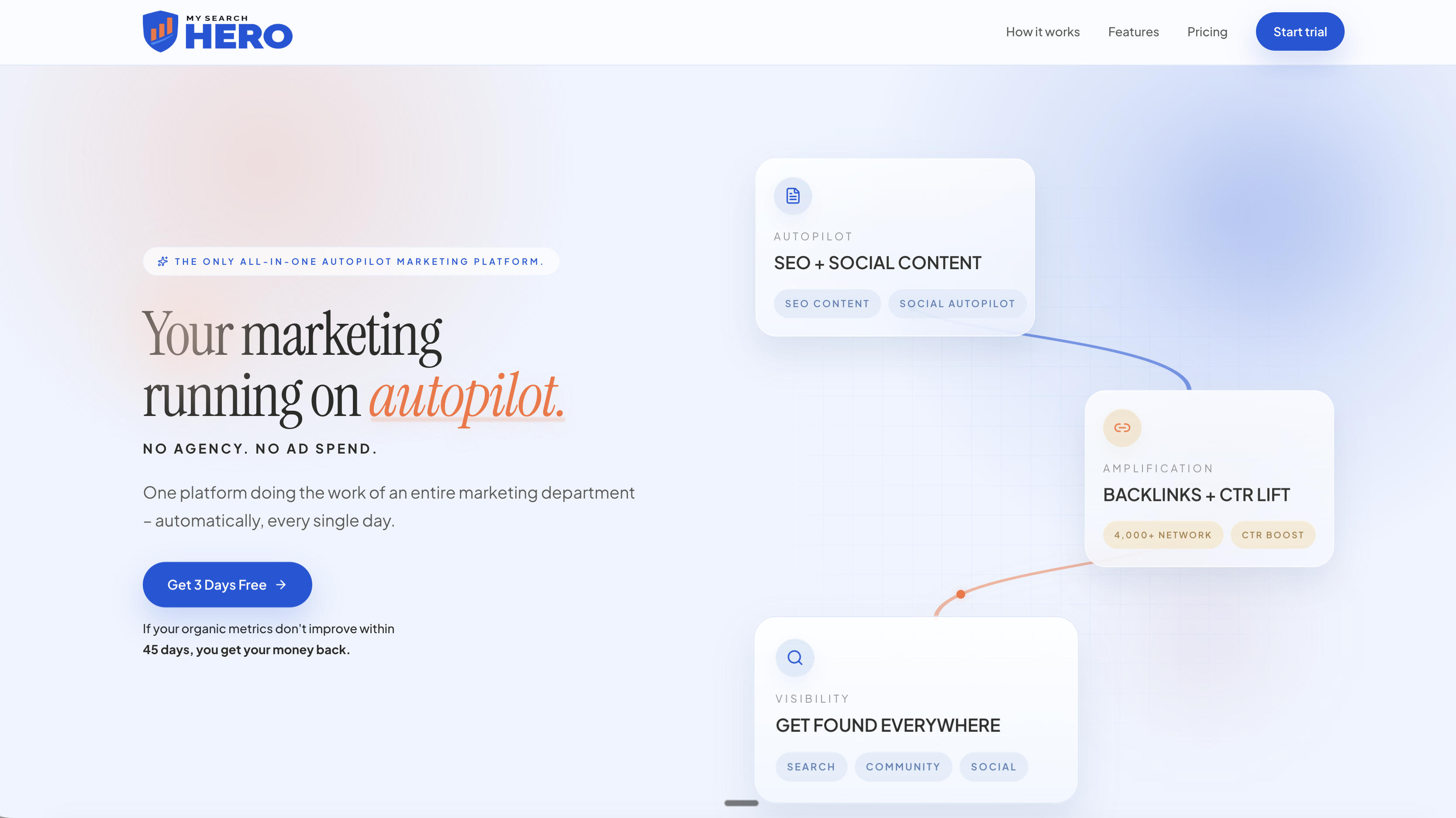
The service is designed for local and service-based business owners who need consistent search visibility without hiring an in-house team or managing a patchwork of freelance specialists. Snippet rewrites and CTR reporting happen alongside content publishing, so packaging improvements never get deprioritized in favor of “bigger” projects. If your current setup means CTR audits happen once a quarter, if they happen at all, this closes that gap on autopilot.
Check whether it fits your situation by visiting the Mysearchhero landing page and reviewing what’s included in each monthly plan.
Sources
- Does CTR Really Move Rankings? How We Design an Honest Test | Serplify
- Click-Through Rate (CTR): Is It a Google Ranking Factor? | Search Engine Journal
- Organic CTR optimization: A complete guide for SEO teams in 2026 | Atomic AGI
FAQ
What Is a Good Click-Through Rate for SEO?
There’s no single good number since it depends heavily on position, intent, and SERP features.
Is 6% Click Rate Good?
Judge it against your own position and query type, not a flat industry average.
What Is a Good CTR Ratio?
A good CTR ratio compares your actual clicks-to-impressions rate against the expected rate for your ranking position and SERP feature context, not against a universal target. Building this benchmark from your own Search Console query exports gives a far more accurate read than any generic figure.
Is $20 CPM High?
CPM is a paid media cost metric, not an organic CTR metric, so the two aren’t directly comparable. A $20 CPM sits toward the higher end for many display placements, but it depends entirely on the platform, audience targeting, and ad format involved.