
Optimize your Google Business Profile, fix NAP consistency across directories, publish one neighborhood landing page per service area, and collect reviews steadily. Do those four things and you will see measurable movement in local website traffic. GBP changes typically show ranking movement in 2–6 weeks; reviews build prominence over 3–6 months; local content authority compounds over 6–12 months. The top three local results capture roughly 75%+ of clicks, so getting into that pack is not a vanity goal.
Start in the next 48 hours:
- Claim and verify your Google Business Profile if you have not already
- Search your business name on Google Maps and the top five directories (Yelp, Bing Places, Apple Maps, Facebook, BBB) and flag any NAP mismatches
- Run your homepage through Google PageSpeed Insights and note the three biggest speed issues
- Text or email your last 10 satisfied customers with a direct Google review link
Mysearchhero’s local SEO checklist covers each of these steps in detail if you want a guided walkthrough.
Key Takeaways
Growing local website traffic requires a phased approach: GBP and NAP fixes move rankings in weeks, while local content and review momentum compound over 6–12 months.
| Point | Details |
|---|---|
| GBP is the fastest lever | Complete every GBP field and add UTM to your website link; expect ranking movement in 2–6 weeks. |
| NAP consistency matters | Fix your name, address, and phone on the top 10 directories before anything else. |
| One location page per city | Build a unique page per service area with local photos, landmarks, and area-specific reviews. |
| Reviews need a steady cadence | Aim for 2–4 new reviews per month consistently; a one-time burst fades quickly. |
| Mysearchhero automates the system | Automated articles, backlinks, and reputation signals handle the ongoing work for local service businesses. |
Table of Contents
- What’s the best 30/90/180-day roadmap to grow local website traffic?
- How do you find the keywords nearby customers actually search?
- On-page and site structure that captures local searcher clicks
- How do you use Google Business Profile to drive more website clicks?
- What local content formats actually attract nearby searches?
- How do local backlinks and citations build your authority?
- How do reviews improve your rankings and click-through rate?
- Technical checklist: what’s blocking your local pages from ranking?
- How do you measure whether local traffic tactics are working?
- When should you DIY vs. hire a local SEO service?
- What I’ve seen actually work for local service businesses
- Mysearchhero handles local traffic growth while you run your business
- Sources
- FAQ
What’s the best 30/90/180-day roadmap to grow local website traffic?
Most local service businesses try to do everything at once and move nothing. A phased schedule fixes that.
| Phase | Key Actions | Estimated Cost (DIY) | Estimated Cost (SaaS/Agency) | Realistic Traffic Lift |
|---|---|---|---|---|
| 30 days | Claim/verify GBP, fix NAP on top 5 directories, run PageSpeed fixes, request reviews from last 10 customers | 4 hours of your time | $0–$100 per month for citation tools | GBP profile views up; minimal organic lift yet |
| 90 days | Publish 1–3 neighborhood/service pages, optimize meta titles and LocalBusiness schema, begin citation cleanup and local link outreach | 10 hours plus content time | $300 per month for managed SEO | Early local ranking movement; 10–30% more organic local sessions |
| 180 days | One neighborhood post per month, steady review cadence, backlink growth, performance review | 4–6 hours/mo ongoing | $500 per month full-service | Compounding gains; 30–60%+ lift in local organic sessions for competitive markets |
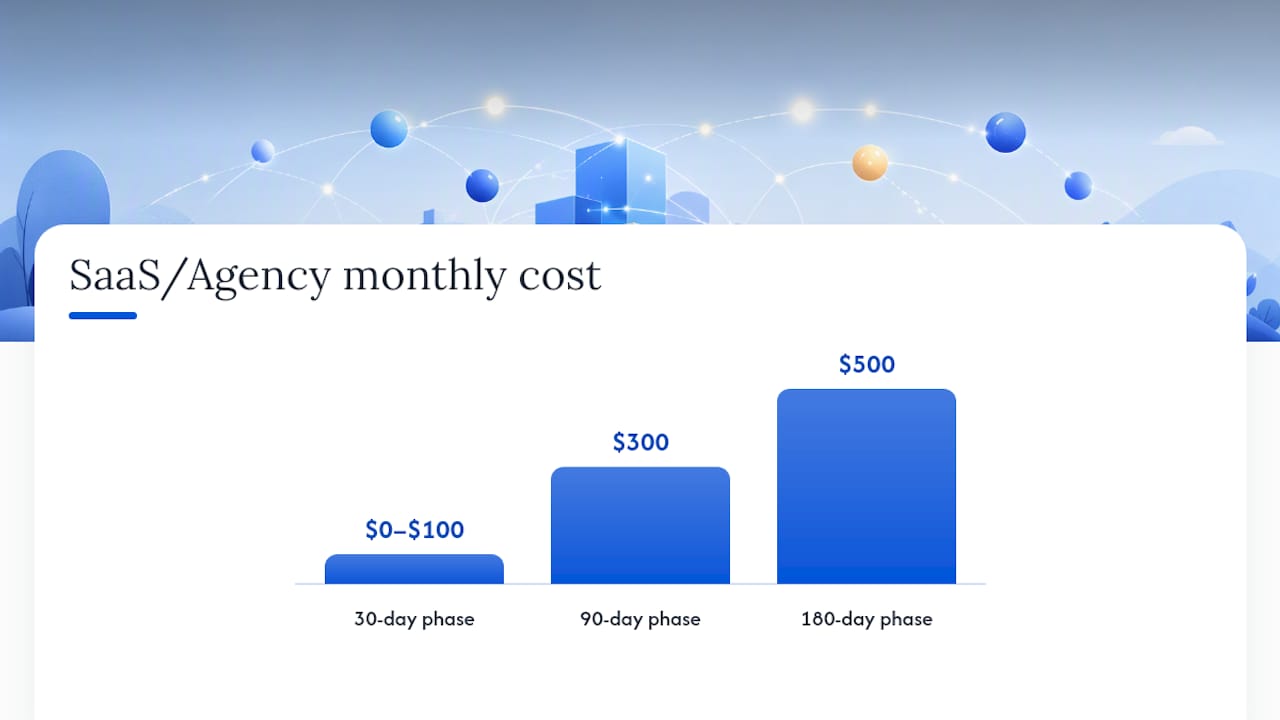
The 30-day phase is almost entirely free. The cost comes later, when you need volume and consistency that is hard to sustain manually.
How do you find the keywords nearby customers actually search?
Local keyword research is less about search volume and more about proximity intent. A phrase like “roof repair Austin TX” converts at a completely different rate than “how roofs are built,” even if the second one gets more monthly searches.
Tools and how to use them specifically for local discovery:
- Google Search Console: Filter the Queries report by your city name or zip code. Any query you already rank for in positions 4–20 is a fast-win optimization target.
- Google Keyword Planner: Set location targeting to your metro area or zip code. Look for service + city combinations and “near me” variants.
- Google Trends: Compare two local phrase variants (e.g., “HVAC repair Dallas” vs. “AC repair Dallas”) to see which has stronger seasonal demand in your region.
- Local rank trackers: Tools like BrightLocal or Whitespark let you track rankings from a specific zip code, which is how your customers actually experience search results.
Prioritize keywords that combine a service name, a city or neighborhood name, and a transactional signal (“cost,” “near me,” “same day,” “free estimate”). Those phrases indicate someone ready to hire, not just browse.
Pro Tip: Mine your own past jobs. Pull the last 50 invoices, look at the neighborhoods and services, and write down how customers described the problem when they called. That language is often more accurate than any keyword tool.
On-page and site structure that captures local searcher clicks
NAP consistency, local landing pages, and site speed are critical signals that back up your GBP. Your website and your Business Profile need to tell the same story.
The one-page-per-location rule: Build a separate page for each city or neighborhood you serve. Each page needs a unique H1 that includes the service and location (“Plumbing Repair in Naperville, IL”), references to local landmarks or neighborhoods, area-specific photos, and at least one review from a customer in that area. Generic “areas we serve” pages with a list of city names do almost nothing for rankings.
On-page checklist:
- NAP in the footer on every page, matching your GBP exactly (same abbreviations, same phone format)
- H1 includes service + city on every location page
- Meta title template:
[Service] in [City, State] | [Business Name](under 60 characters) - Meta description template:
[Business Name] provides [service] in [City]. Call for a free estimate. [Differentiator].(under 155 characters) - Internal links from your homepage and service pages to each location page
For LocalBusiness schema, include: name, address, telephone, url, openingHours, geo, areaServed, and priceRange. Service-area businesses should hide a street address in GBP when they don’t serve customers at a physical location, and the schema on the site should reflect that same setup.
How do you use Google Business Profile to drive more website clicks?
Google’s local results rely on relevance, distance, and popularity. Completing your profile is the single fastest lever on all three.
Fields that directly affect website clicks:
- Primary category: Choose the most specific category that matches your core service. A “Plumber” who also does water heaters should list “Plumber” as primary, not “Water Heater Repair Service.”
- Services list: Add every service with a short description. This text is indexed and appears in profile search results.
- Photos: Upload at least 10 photos of completed work, your team, and your service vehicles. Profiles with photos get more clicks.
- Posts: Publish a GBP post weekly. Seasonal offers, completed projects, and FAQs all work. Posts can be indexed within days.
- Website link with UTM: Set your GBP website URL to
https://yoursite.com/?utm_source=google&utm_medium=gbp&utm_campaign=profile. In GA4, filter sessions by that UTM to see exactly how much traffic your profile drives.
Track GBP performance in the “Performance” tab: look at website clicks, direction requests, and call clicks. Cross-reference with GA4 to confirm those clicks are converting.
What local content formats actually attract nearby searches?
Neighborhood-specific content that references local conditions and completed projects attracts higher-converting searchers than generic service pages. One focused neighborhood post per month beats four thin, generic posts every time.
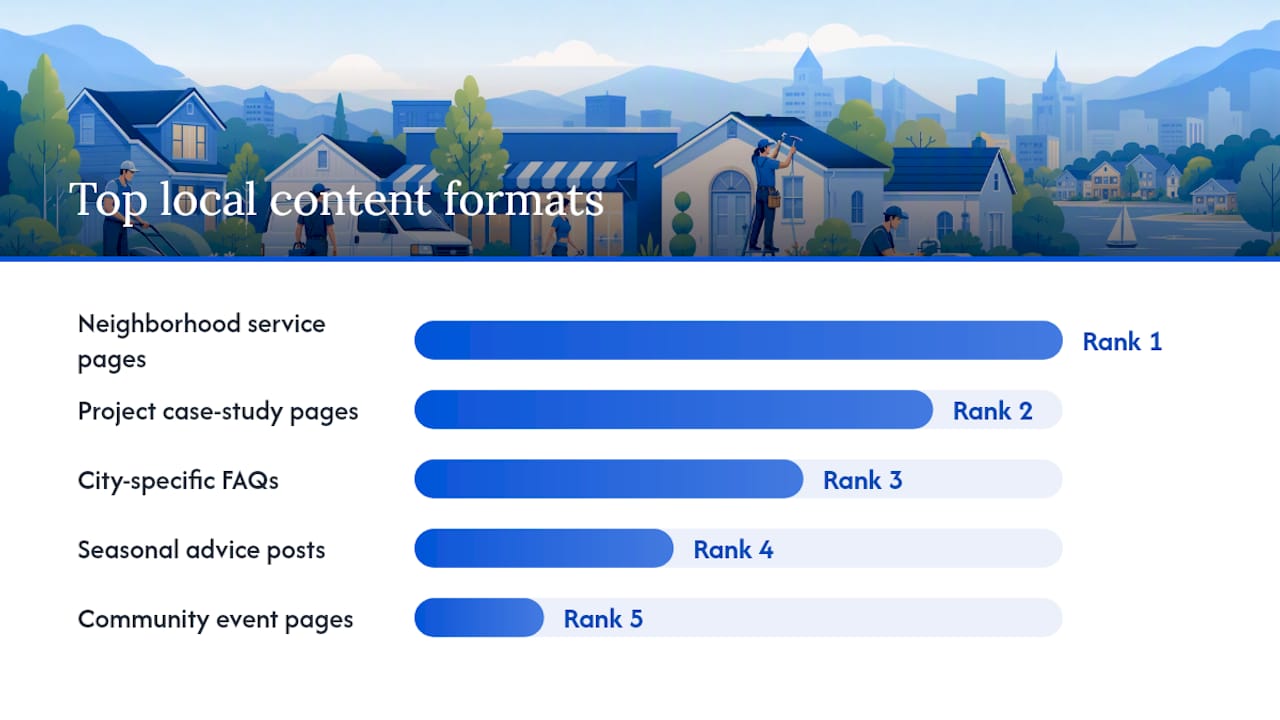
Highest-value formats, in priority order:
- Neighborhood service pages: “Deck Building in Lincoln Park, Chicago” with photos of actual projects in that neighborhood.
- Project or case-study pages: “How We Replaced a 1960s Electrical Panel in Oak Park” with before/after photos, timeline, and cost range.
- City-specific FAQs: “What permits do I need for a bathroom remodel in Scottsdale?” These capture informational searches from people early in the buying process.
- Seasonal advice posts: “When to Schedule AC Maintenance in Phoenix Before Summer” ties your service to a local timing need.
- Community event or sponsorship pages: “We’re sponsoring the Riverside Little League this spring” earns a local link from the league’s site and builds brand recognition.
Simple editorial calendar: Pick one high-value neighborhood per month. Write one post targeting the top question that neighborhood’s residents ask about your service. Share it in the local Facebook group for that neighborhood, post it to GBP, and include it in your email newsletter. That is the whole system.
For promotion, the content promotion guide from Mysearchhero covers how to amplify each post across channels without paid ads.
How do local backlinks and citations build your authority?
Citations are mentions of your business name, address, and phone number on other websites. Inconsistent citations confuse search engines about which location details are correct, which suppresses local rankings.
Citation audit checklist: Check Google Business Profile, Yelp, Bing Places, Apple Maps, Facebook, BBB, Angi, HomeAdvisor, and any industry-specific directories. Your NAP must match exactly, including abbreviations (“St.” vs. “Street,” “Suite” vs. “Ste.”).
Where to earn local backlinks:
- Your local chamber of commerce (most offer member directory listings)
- Sponsorships of local sports teams, school events, or charity runs
- Local press coverage (pitch a “before and after” project story to the neighborhood paper or local news site)
- Trade organization directories (NARI, PHCC, ACCA, depending on your trade)
- Partner referral pages (a plumber and an HVAC company can each list the other as a trusted partner)
Referral traffic from these links is often as valuable as the ranking benefit.
How do reviews improve your rankings and click-through rate?
Consistent review generation of 2–4 reviews per month outperforms a one-time burst. Google’s algorithm treats review velocity as a freshness signal.
Review request system:
- Ask within 24 hours of job completion, when satisfaction is highest
- Send a direct link:
https://search.google.com/local/writereview?placeid=[YOUR_PLACE_ID] - SMS works better than email for most trades; keep the message under three sentences
- Add a QR code to your invoice or leave-behind card that links directly to the review page
Reply to every review. For positive reviews, thank the customer by first name and mention the specific service. For negative reviews, acknowledge the issue, offer to resolve it offline, and keep the reply under 75 words. Displayed reviews on your website (via schema markup or an embedded widget) also increase organic CTR by showing star ratings in search results.
Technical checklist: what’s blocking your local pages from ranking?
A well-structured website with local pages and proper schema markup delivers stronger long-term local performance than an incomplete site, and mobile performance matters most for “near me” queries.
Core Web Vitals targets: Largest Contentful Paint under 2.5 seconds, Cumulative Layout Shift under 0.1, and Interaction to Next Paint under 200ms. Run Google PageSpeed Insights on every location page, not just the homepage.
Crawlability checklist:
- Confirm your robots.txt is not blocking location pages
- Submit an XML sitemap that includes all location and service pages
- Set canonical tags on city pages to avoid duplicate content issues if you use similar templates
- Check Google Search Console’s Coverage report for any “Excluded” or “Crawled but not indexed” location pages
If a location page is not being indexed, the most common causes are thin content (under 300 words of unique text), a noindex tag left in by accident, or a canonical pointing to a different URL.
How do you measure whether local traffic tactics are working?
Tracking the right metrics separates businesses that iterate and grow from those that guess and stall.
UTM discipline: Tag every GBP link, every local directory link, and every email newsletter link with UTM parameters. In GA4, create a custom report filtered by utm_source=google and utm_medium=gbp to isolate profile-driven traffic. Set up GA4 events for phone number clicks, form submissions, and direction requests.
To test what drives clicks, run two versions of a GBP post (one with a photo of a completed project, one with a seasonal offer) in alternating weeks and compare click rates in the GBP Performance tab.
When should you DIY vs. hire a local SEO service?
DIY works well when you have one location, a low-competition market, and 6–10 hours per month to spend on SEO. Hire help when any of those conditions break down.
Decision criteria:
- You serve more than two cities and need multiple location pages built and maintained
- Competitors in your market have 100+ reviews and established local content
- You have tried the basics for 90 days and rankings have not moved
- You cannot consistently produce one piece of local content per month
Questions to ask any vendor before signing:
- What specific deliverables do I receive each month?
- How do you build backlinks, and can you show me examples of the sites you use?
- Will I have access to GA4 and Google Search Console, or do you control the accounts?
- What does a realistic 6-month outcome look like for a business in my category and market?
Red flags: guaranteed ranking positions, link sources they won’t name, no access to your own analytics accounts, and pricing that seems too low to cover real content or link work.
What I’ve seen actually work for local service businesses
The businesses that grow local website traffic fastest are not the ones with the biggest budgets. They are the ones that do the unglamorous work first: a complete GBP, consistent NAP, and one real neighborhood page per service area. That foundation moves rankings in weeks, not quarters.
The timeline reality is worth repeating plainly. GBP changes show movement in 2–6 weeks. Review momentum builds over 3–6 months. Content authority, the kind that puts you in the top three for competitive local searches, takes 6–12 months of consistent publishing. Owners who expect overnight results from content end up quitting before the compounding starts.
For owners who want the system running without managing it themselves, Mysearchhero’s automated model handles the monthly content, backlinks, and reputation signals that make this work at scale.
Mysearchhero handles local traffic growth while you run your business
Hiring an agency means retainers, account managers, and monthly calls. Doing it yourself means 6–10 hours a month you probably don’t have. Mysearchhero is the third option: automated monthly SEO deliverables, published to your site and distributed across the web, without the agency overhead.
Each month, subscribers get SEO articles published directly to their site, authority backlinks through a vetted publisher network, Reddit brand mentions in relevant local conversations, and social media posts across platforms. The pipeline runs on autopilot. It is built specifically for busy local service businesses and multi-location operators who want consistent output without managing a content team.
Start with a free audit at Mysearchhero to see your GBP health score, NAP consistency gaps, and the quick wins your market offers right now.
Sources
- Tips to improve your local ranking on Google – Google Business Profile Help
- Local SEO for Service Based Businesses: Complete Guide
- Local SEO for Service Businesses: The Complete 2026 Guide | Buildrok
FAQ
How long does it take to grow local website traffic?
GBP changes typically show ranking movement within 2–6 weeks. Review momentum builds over 3–6 months, and local content authority takes 6–12 months of consistent publishing to compound.
What is the single highest-impact action for local SEO?
Completing and verifying your Google Business Profile is the fastest single action, since Google’s local results rely primarily on relevance, distance, and popularity, and a complete profile improves all three.
How many reviews do I need to rank locally?
Consistent generation of 2–4 reviews per month outperforms a one-time spike. Volume and recency both matter; a steady cadence signals ongoing activity to Google’s algorithm.
Do I need a separate page for every city I serve?
Yes. A unique location page per city, with local photos, an area-specific H1, and local references, outperforms a single generic “areas we serve” page for local search rankings.
When does it make sense to use a service like Mysearchhero?
When you serve multiple cities, face established competitors, or cannot consistently produce local content each month, an automated service like Mysearchhero handles the ongoing deliverables without the overhead of a traditional agency.