
Link building typically costs between $77 and $600 per link depending on method and site quality, with most active monthly programs spending between $1,000 and $5,000 a month. Rather than anchoring on a per-link price, the smarter approach is to budget against your referring-domain gap against the top five competitors in your niche. One caveat worth stating upfront: paying for links purely to pass ranking credit violates Google’s spam policies.
TL;DR:
- Ahrefs’ outreach tests put guest posts at $77.80 per link and niche edits at $361.44, partly because guest posts require content creation.
- Compare referring domains with your top five competitors, then aim to close 60% of the gap in year one, budgeting $300 to $600 per domain.
- Rankings typically respond one to six months after placement; tag each link to its target page and assess changes at 90 days, not weekly.
- Avoid buying links solely to pass ranking credit, which violates Google’s spam policies; require proper sponsored tags and reject guaranteed ranking positions.
Table of Contents
- What link building costs in 2026: per-link and monthly price ranges
- How the link-building method you choose changes the price
- In-house teams vs agencies vs freelancers: what each really costs
- Why one quote costs more than another
- Two frameworks for calculating your link-building budget
- How long links take to move rankings, and how to measure it
- How MySearchHero structures link and content costs into one bundle
- What a realistic campaign costs by business size and goal
- Ongoing link building costs vs one-time costs
- What to expect in pricing transparency and contract terms
- Why I’d rather see you budget for a gap than for a price
- A simpler way to budget for ongoing link building
- FAQ
- Sources
What link building costs in 2026: per-link and monthly price ranges
Quote ranges vary widely because “a link” is not a standardized product. A $50 link and a $600 link can both be real placements, just on wildly different sites with different traffic, editorial standards, and outreach effort behind them.
Based on 2026 practitioner data, typical quality backlinks run in the $300 to $600 range, with bulk or low-quality links often priced under $100 and higher-authority or niche-specific placements climbing well past $600. Ahrefs’ own outreach experiments found niche edits averaged $361.44 per link while paid guest posts averaged $77.80, a gap that reflects the extra content creation work guest posts require.
Monthly program spending clusters into a few recognizable bands:
- Entry-level programs ($1,000 to $3,000 a month) typically buy a handful of guest posts or niche edits on moderate-authority sites.
- Mid-tier programs ($3,000 to $8,000 a month) usually combine guest posting, digital PR pitching, and some HARO-style journalist outreach.
- Competitive programs ($10,000 or more a month) often fund dedicated PR campaigns, higher-DR placements, and faster link velocity.
Reporter Outreach’s 2026 industry research found that 64% of SEO teams now spend $3,000 or more monthly on link building, and 47% say they’ll pay $500 or more for a single high-quality link. That shift reflects a broader move away from cheap bulk links toward fewer, better-placed ones.
Niche and YMYL verticals (finance, health, legal) almost always cost more. Publishers in these spaces face higher editorial scrutiny and know their placements carry more weight, so they price accordingly.
How the link-building method you choose changes the price
Each acquisition method comes with its own cost structure and its own reason for existing in your mix.
- Guest posts combine content creation with outreach and sometimes a placement fee; they averaged $77.80 per link in Ahrefs’ testing, though that figure excludes the writer’s time.
- Niche edits (adding a link into existing content) skip the content cost but often carry a higher placement fee, averaging $361.44 in the same study.
- Digital PR trades a larger upfront investment (research, data, a journalist-worthy hook) for links that come from genuine earned coverage rather than a paid placement.
- HARO and journalist outreach mostly cost time rather than cash, though the hit rate is lower and less predictable.
- Podcast mentions and sponsorships typically bundle a link with brand exposure, priced more like advertising than classic link building.
Guest posts fit well when you want topical control and a steady drip of links. Niche edits work when you’ve found an existing page with real traffic and relevance to your target keyword. Digital PR makes sense once you have a budget for content production and a story worth pitching.
Pro Tip: Prioritize sites with real, relevant organic traffic over sites with an inflated authority score. A lower-DR site that ranks for topics near yours usually passes more real value than a higher-DR site with no relevant audience.
In-house teams vs agencies vs freelancers: what each really costs
Hiring in-house feels cheaper until you add up every line item. A 2026 analysis from Social Animal found that fully loaded in-house link-building costs, including salary, payroll taxes, benefits, tooling, and ramp time, commonly land between $110,000 and $200,000 or more per year for a single dedicated hire.
That figure includes costs easy to forget when comparing to an agency retainer:
- Benefits and payroll taxes typically add roughly 30% on top of base salary.
- Tooling subscriptions (Ahrefs, Semrush, outreach platforms like BuzzStream) add several thousand dollars annually.
- Ramp time before a new hire produces consistent link volume often runs several months, during which output is minimal.
Agencies and freelancers skip most of that overhead. Freelancers typically charge per link or per project, agency retainers commonly fall in the $1,500 to $10,000+ monthly range depending on scope, and specialist boutique agencies focused on digital PR or niche-specific outreach often price at the higher end given the research work involved. For a workflow comparison of what outreach actually involves at each price point, our backlink outreach strategy guide breaks down the steps.
The break-even point tends to favor outsourcing until a business has enough budget and scale to justify a full-time hire, roughly once monthly link spend would otherwise exceed $8,000 to $10,000. A hybrid model, one in-house strategist managing outsourced execution, often captures the best of both.
Why one quote costs more than another
Price differences between two quotes for “the same” link usually come down to a handful of measurable factors.
- Publisher traffic and relevance: ask for the site’s actual organic traffic and whether it ranks for topics near yours, not just a domain authority score.
- Placement context: an in-content editorial link surrounded by relevant text is worth more than a footer or sidebar mention, which is also the kind of link pattern Google’s spam policies flag when distributed at scale.
- Niche competition: competitive, high-value verticals command higher prices because demand for quality placements outstrips supply.
- YMYL status: finance, health, and legal sites apply stricter editorial review, which raises the cost of getting a link approved.
Negotiated prices often land well below a publisher’s list rate, so ask for recent placement examples and real pricing before accepting the first number offered.
Two frameworks for calculating your link-building budget
The referring-domain gap method ties your budget directly to a measurable competitive target instead of a per-link price:
- Identify your top five organic competitors for your priority keywords.
- Measure the average number of referring domains they have versus your own.
- Set a target to close 60% of that gap within the first year.
- Convert the number of domains needed into a blended cost per domain (using the $300 to $600 range as a baseline).
- Divide the annual total by 12 to get your monthly budget.
A business generating $50,000 a month in organic revenue allocating 8% would budget $4,000 a month, which lines up with the mid-tier program band most 2026 campaigns fall into.
How long links take to move rankings, and how to measure it
Ranking movement from new links typically shows up one to six months after placement, not immediately. That lag reflects crawl timing, how long it takes a new link to get indexed, and how search engines weigh accumulated signals over time.
To avoid wasted spend while waiting:
- Tag each link to the specific page it targets so you can trace movement back to the placement.
- Check rankings at the 90-day mark rather than week to week, since early fluctuation is mostly noise.
- Calculate cost-per-position-gained once you have enough data, dividing total spend by average position improvement across target keywords.
Switching tactics before the 90-day window closes usually means abandoning links before they’ve had time to work, which wastes the spend already committed.
How MySearchHero structures link and content costs into one bundle
Rather than pricing links one at a time, we build backlinks into a fixed monthly bundle alongside published articles, Reddit mentions, and AI-generated social posts, so clients know exactly what a month of visibility work costs before they commit.
- Published articles go out automatically on a monthly schedule, each paired with supporting backlinks from our publisher network.
- Reddit mentions place the brand into relevant conversations rather than relying on link placements alone.
- AI-generated social posts extend each piece of content across multiple platforms without separate line items.
That structure maps naturally onto the program bands discussed above: a flat monthly subscription replaces the need to price out guest posts, niche edits, and content separately. For a closer look at how a monthly editorial backlink cadence works in practice, see our editorial backlinks workflow guide.
What a realistic campaign costs by business size and goal
A local service business aiming to rank for a handful of city-specific keywords can often work within an entry-level program, $1,000 to $3,000 a month, since the referring-domain gap against local competitors is usually smaller than in a national market.
A regional business competing across several cities or a growing e-commerce brand typically needs the mid-tier band, $3,000 to $8,000 a month, to close a wider domain gap while also producing enough content to support those links contextually.
A national brand or a company in a YMYL vertical facing well-linked, established competitors usually needs $10,000 or more a month to make a measurable dent in the referring-domain gap within a reasonable timeframe, given how much higher placement costs run in those niches.

The common thread across all three is that the budget should scale with the size of the gap being closed, not with an arbitrary target spend. A business with a small gap overspending on an aggressive program wastes money just as surely as one with a large gap underspending and expecting fast results.
Ongoing link building costs vs one-time costs
Most link-building spend is ongoing rather than one-time, because rankings erode as competitors keep building their own links and content keeps aging.
One-time costs typically cover setup work: an initial audit of your current referring domains and gap versus competitors, a content inventory, and outreach list building. These are front-loaded but don’t repeat monthly.
Ongoing costs cover the recurring work: outreach and placement fees, content production for guest posts and digital PR pitches, and the tooling subscriptions needed to track rankings and referring domains over time. Treating link building as a one-time project rather than an ongoing budget line is one of the more common ways businesses underinvest and then see results plateau once the initial push ends.
What to expect in pricing transparency and contract terms
A trustworthy link-building quote should break down what the price actually includes: content creation, outreach effort, and the placement fee itself, rather than one bundled number with no explanation.
Reasonable contract terms typically specify a minimum monthly link volume or deliverable count, a cancellation window, and whether links are guaranteed to stay live for a minimum period. Be cautious of any contract that guarantees specific ranking positions, since no legitimate provider controls search engine algorithms directly.
Ask providers directly whether placements involve paid exchanges that could run afoul of Google’s spam policies, and whether sponsored links are properly tagged. For context on what durable, compounding link value looks like contractually, our evergreen backlink guide is a useful reference point. Clear pricing structures, like the transparent service tiers covered in this small business pricing strategy guide, tend to correlate with providers who are confident in the value of their work.
Why I’d rather see you budget for a gap than for a price
Chasing the cheapest per-link price is how businesses end up with a folder full of low-value placements and no ranking movement to show for it. The referring-domain gap method forces a more honest conversation: how far behind are you, and what does closing that distance actually require.
Patience matters here too. Links that look unremarkable in month one often compound by month six, provided they were relevant in the first place. Relevance and measurable movement beat volume every time.
— Mike
A simpler way to budget for ongoing link building
If calculating referring-domain gaps and negotiating per-link prices sounds like more than you want to manage, our monthly plans fold backlinks, published articles, Reddit mentions, and AI social posts into one predictable price.
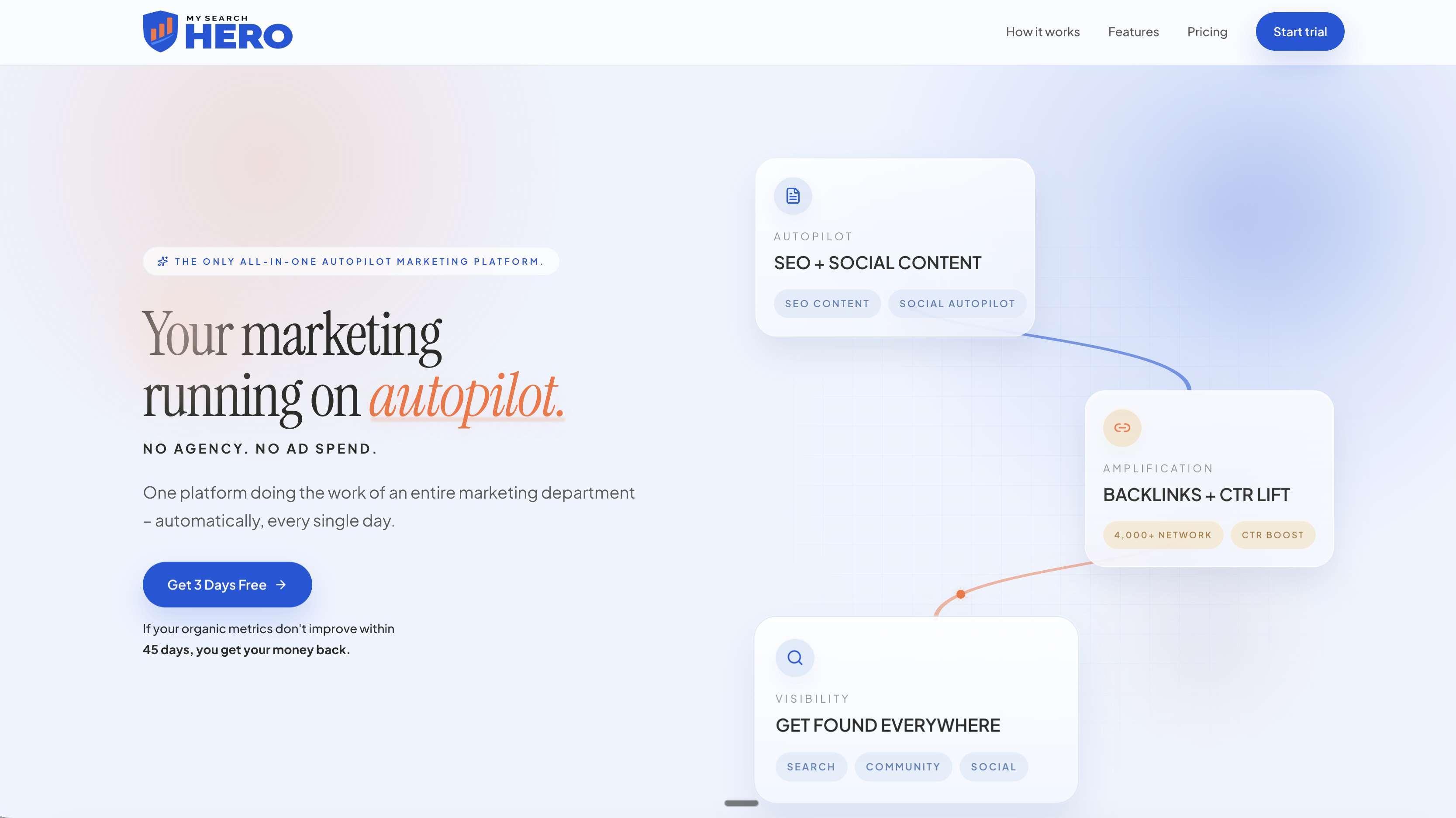
Spark starts at $197 a month, Authority at $297, and Hero at $397, with an Enterprise tier at $2,997 for larger programs, each covering a full bundle of ongoing visibility work instead of separate per-link invoices. Annual billing is also available, including Hero at $3,970 a year. Every plan is backed by a 45-day money-back guarantee if your organic metrics don’t improve.
Visit our MySearchHero plans page to see which bundle fits your current referring-domain gap.
FAQ
How much do backlinks cost on average?
Backlink prices typically range from about $77.80 for a guest post to $361.44 for a niche edit, based on real outreach experiments, with higher-authority or niche-specific placements often costing more.
What do link builders do?
Link builders research relevant publishers, pitch content or placements through outreach, negotiate terms, and track the resulting links to confirm they stay live and contextually relevant. Many also handle the content creation that guest posts and digital PR pitches require.
Is it worth paying for backlinks?
Paying for placements can be worth it when the link comes from a relevant, trafficked site and the arrangement avoids the manipulative patterns Google’s spam policies flag, such as bulk paid links with no editorial standard. Quality over volume consistently produces better results than cheap, high-volume packages.
How much does it cost to build a website?
Website costs vary widely by platform and complexity and fall outside what this guide covers, since it focuses specifically on link-building pricing rather than site development. A web developer or agency quote is the most reliable way to get a figure for your specific project.
How long before link building shows results?
Most ranking movement from new links appears one to six months after placement, so tracking at the 90-day mark gives a more accurate read than checking weekly. Switching strategies before that window closes often means abandoning links before they’ve had time to work.
Sources
- Spam Policies for Google Web Search | Google Search Central
- Should You Buy Backlinks in 2024? It Depends — Ahrefs
- Link building cost — AngleTutoring (2026)