
TL;DR:
- Monitoring online presence involves tracking brand mentions, reviews, social media, and AI summaries across all platforms, as consumer reliance on reviews rises. Effective management requires layered tools, quick responses to feedback, and ongoing evaluation of digital content, including AI-generated summaries and external mentions. Businesses must proactively oversee their reputation ecosystem to prevent negative narratives from impacting their brand image and search visibility.
Online presence monitoring is defined as the continuous tracking of brand mentions, reviews, social media activity, and AI-generated search summaries across every platform where your business can be found or discussed. The reason to monitor online presence is direct: 93% of consumers rely on online reviews to make purchasing decisions, and positive reviews boost consumer trust by up to 74%. That means your brand’s reputation is being built or destroyed in places you may never visit unless you’re actively watching. Tools like Google Alerts and Social Mention give businesses a starting point, but the scope of what needs monitoring has expanded far beyond a simple keyword alert. Online reputation management (ORM) now includes AI-powered search engines, Reddit threads, niche forums, and review platforms that collectively shape how buyers perceive you before they ever reach your website.
Why monitor online presence: the core business case
The benefits of monitoring brand image go well beyond catching a bad review before it spreads. Consistent monitoring creates a feedback loop that sharpens your marketing, protects your credibility, and gives you real data on how customers actually feel about your business.

Brand credibility compounds over time. Every positive signal you collect and amplify, whether a five-star Google review or a favorable Reddit mention, adds to what reputation experts call your “reputation signal.” The consistency of reviews, ratings, and social proof across the web is the primary validation modern buyers rely on. Monitoring lets you see where that signal is strong and where it’s breaking down.
Negative feedback is manageable when caught early. Businesses that respond quickly to customer feedback improve trust and reduce escalation of negative incidents. Business response rates have grown from 63% to 73%, and the data shows that faster engagement directly reduces reputational damage. A one-star review left unanswered for two weeks does far more harm than the same review answered within 24 hours.
Customer engagement improves when you understand public sentiment. Monitoring surfaces patterns in what customers praise and what frustrates them. That intelligence feeds directly into product decisions, messaging, and service improvements. Without it, you’re guessing.
Pro Tip: Set up separate monitoring alerts for your brand name, your top products, your key executives, and your main competitors. Each alert category surfaces different intelligence and serves a different strategic purpose.
One more reason the importance of online reputation has grown sharply: AI-driven search results now cite online reputation signals as inputs. 80% of brands are cited at least once in AI-driven search results, which means your reputation directly shapes whether AI tools recommend you or ignore you. That’s a new and significant reason to monitor web visibility that didn’t exist three years ago.
What tools and methods are most effective for tracking online presence in 2026?
Knowing how to track online presence requires matching the right tool to the right channel. No single platform covers everything, which is why most serious marketers use a layered approach.
| Tool | Best For | AI Monitoring |
|---|---|---|
| Google Alerts | Basic brand name mentions across the web | No |
| Brand24 | Real-time social and web monitoring with sentiment analysis | Limited |
| Awario | Competitor tracking and influencer discovery | Limited |
| ReviewTrackers | Centralized review management across 100+ sites | No |
| ReplySocial | Multi-platform brand monitoring with AI signal tracking | Yes |
Google Alerts is free and easy to set up, but it misses a large portion of social media activity and has no sentiment analysis. Brand24 and Awario fill that gap with real-time alerts and basic sentiment scoring. ReviewTrackers consolidates feedback from over 100 review platforms into one dashboard, which is critical given that review volume has grown 30.7% year-over-year with Google accounting for 79.4% of reviews per location in 2025. That growth means the volume of content you need to track is accelerating, not stabilizing.
The channel scope also matters. Monitoring must extend beyond social media to include forums, review platforms, AI engines, and customer feedback sites to avoid losing control of your brand narrative. That means checking Reddit, Quora, industry-specific forums, and the outputs of AI engines like ChatGPT and Perplexity, not just your Twitter mentions and Google reviews.
Pro Tip: Monitor up to page 3 of Google search results for your brand name every month. Negative content often climbs from page 3 to page 1 gradually, and catching it early is far cheaper than suppressing it after it ranks.
For businesses that want a consolidated view, centralized monitoring platforms that pull alerts, reviews, and social mentions into a single dashboard reduce the time cost of monitoring significantly. The goal is to see everything in one place so nothing slips through.
How does AI change online presence monitoring?
The shift from traditional monitoring to AI-aware monitoring is the most significant change in digital reputation management since the rise of social media. Understanding it is not optional for any business that wants to control its narrative in 2026.
AI search engines like ChatGPT and Perplexity generate summary answers based on aggregated signals from forums, social media, and review sites. Brand identity now depends on aggregated public mentions, not just your official website. If the dominant public conversation about your brand is neutral or negative, that’s what AI tools will reflect when a potential customer asks about you. Your homepage copy is irrelevant to that calculation.
Here are the four specific challenges AI monitoring introduces:
- AI summaries are invisible to traditional tools. Google Alerts won’t tell you what ChatGPT says about your brand. You need to manually query AI engines or use specialized tools that track AI outputs.
- Reddit and X threads now outrank brand pages. User-generated content on these platforms frequently appears in both traditional search and AI summaries, giving third-party opinions more authority than your own marketing.
- Historical negative content resurfaces in AI results. A critical article from three years ago that fell off page one of Google can still be cited by an AI engine as a current reference.
- Correction is slow. Once a negative narrative is embedded in AI training data or frequently cited sources, displacing it requires a sustained volume of positive, authoritative content published over months.
“What AI engines say about your brand is shaped by publicly available web content, not your website, meaning businesses outsource their identity if they don’t monitor external mentions.” — Online Brand Monitoring: 2026 Guide
Understanding how AI summarizes brands and the marketing implications is now a core competency for any business owner or marketer who wants to stay ahead of reputation threats.
What practical steps can businesses take to implement effective monitoring?
Implementing a monitoring system that actually protects your brand requires more than setting up a few alerts. Here’s a structured approach that covers the full scope of why digital presence is important to manage actively.
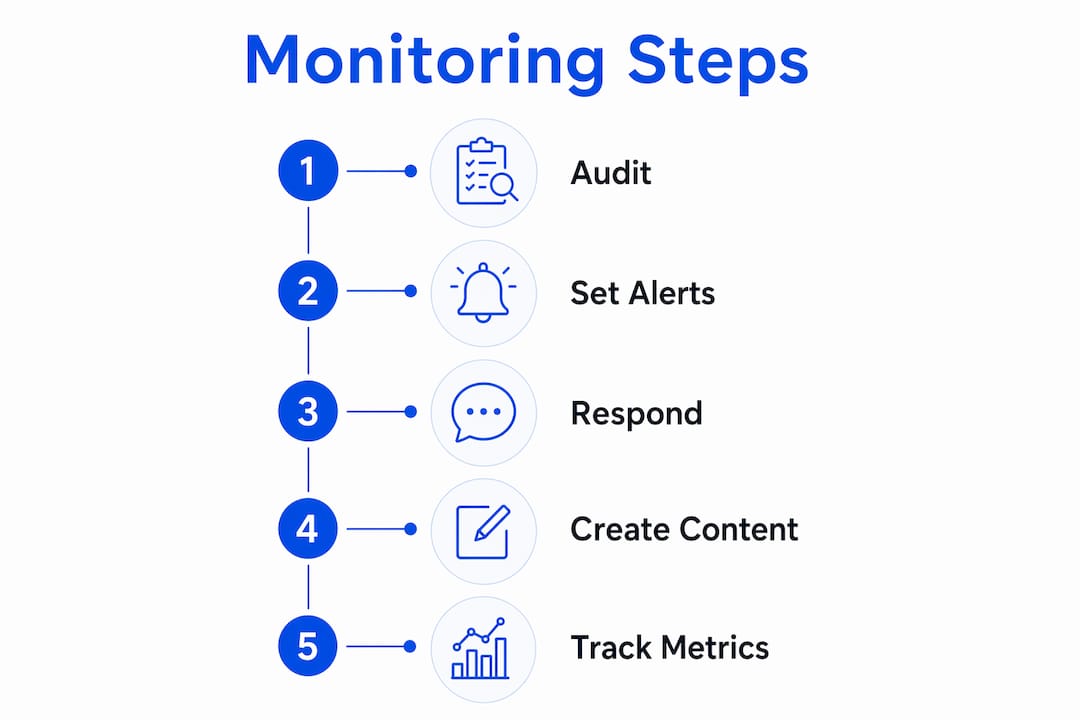
Step 1: Audit your current online presence. Search your brand name on Google, Bing, ChatGPT, and Perplexity. Check pages 1 through 3 of search results. Note what review platforms list your business and what your average ratings are. This baseline tells you where you stand before you start tracking changes.
Step 2: Set up ongoing monitoring systems. Configure alerts in Google Alerts, Brand24, or Awario for your brand name, key products, and executive names. Add monitoring for your top competitors so you can benchmark your reputation signal against theirs. Brand mentions drive trust and growth, and you can’t manage what you don’t measure.
Step 3: Develop a response plan. Decide in advance who responds to reviews, what tone to use, and how quickly. Positive reviews deserve acknowledgment. Negative reviews require a calm, specific, public response that demonstrates accountability. 95% of first impressions are formed through search results, which means your responses are part of your brand presentation to every future customer who reads them.
Step 4: Create authoritative positive content. Publish articles, case studies, and customer success stories that give AI engines and search algorithms positive, factual content to cite. This is the most durable way to shift your reputation signal over time. Social proof strategy built on real customer outcomes outperforms any paid campaign for long-term credibility.
Step 5: Track performance metrics and adjust. Monitor your average review rating, review volume growth, sentiment trends, and your position in AI-generated summaries quarterly. Use that data to identify which content and engagement tactics are moving the needle.
Pro Tip: Assign one team member as the “reputation owner” each week. Rotating the responsibility keeps the task from being ignored and ensures fresh eyes catch issues that familiarity might miss.
Key takeaways
Monitoring your online presence is the only way to control what buyers, search engines, and AI tools say about your brand before they reach your website.
| Point | Details |
|---|---|
| AI monitoring is now mandatory | 80% of brands appear in AI search results, making external mention tracking critical. |
| Reviews drive purchasing decisions | 93% of consumers rely on reviews, so tracking and responding to them directly impacts revenue. |
| Multi-platform scope is required | Monitoring must cover search, social, forums, review sites, and AI engines to prevent narrative loss. |
| Early detection saves money | Negative content on page 3 can climb to page 1 fast; catching it early is far less costly to fix. |
| Response speed builds trust | Businesses that respond quickly to feedback reduce escalation and improve customer trust measurably. |
The part most businesses get wrong about reputation monitoring
I’ve worked with enough business owners to know the most common mistake: they assume their website is their reputation. They’ve invested in a clean design, good copy, and maybe some SEO, and they believe that’s the full picture. It isn’t even close.
Your website is one input. What Reddit says, what a disgruntled former employee posted on Glassdoor two years ago, what a mid-tier blogger wrote after a bad experience with your product, and what ChatGPT synthesizes from all of that combined. That’s your actual reputation. And most businesses have no idea what it looks like because they’ve never looked.
The AI dimension makes this more urgent, not less. I’ve seen brands with excellent websites and terrible AI summaries because the external content ecosystem around them was never managed. When a potential customer asks ChatGPT “Is [Brand] worth it?” and the answer is built from three-year-old forum complaints and one negative press piece, no amount of homepage polish fixes that.
My honest advice: spend 30 minutes this week querying your brand name in ChatGPT, Perplexity, and Google through page 3. What you find will either reassure you or give you a clear action list. Either outcome is more useful than not knowing. The real role of AI in marketing is reshaping how buyers form opinions, and the businesses that adapt their monitoring to match that reality will have a significant advantage over those that don’t.
— Mike
How Mysearchhero keeps your brand visible and protected
Managing your online presence across search engines, review platforms, forums, and AI tools is a full-time job. Mysearchhero handles it for you.
Each month, Mysearchhero delivers published articles, backlinks, Reddit mentions, and AI-optimized social posts through a fully automated pipeline. These deliverables work together to build the positive, authoritative content signal that shapes what search engines and AI tools say about your brand. You get consistent output without hiring a content team or managing a dozen tools. If you’re ready to stop guessing what your digital footprint looks like and start controlling it, explore Mysearchhero to see how the platform protects and grows your brand reputation on autopilot.
FAQ
Why is monitoring online presence important for businesses?
Monitoring your online presence lets you catch reputation threats early, respond to customer feedback before it escalates, and understand how AI tools and search engines represent your brand to potential buyers.
What is online reputation management?
Online reputation management (ORM) is the practice of tracking, influencing, and improving how a business appears across search engines, review platforms, social media, forums, and AI-generated search summaries.
How do I track my online presence effectively?
Use a combination of Google Alerts for basic mentions, Brand24 or Awario for real-time social monitoring, ReviewTrackers for review consolidation, and manual queries in ChatGPT and Perplexity to check AI-generated brand summaries.
How does AI affect my brand’s online reputation?
AI engines like ChatGPT synthesize brand reputation from aggregated public mentions across forums, social media, and review sites. If that external content is negative or outdated, AI summaries will reflect it regardless of what your website says.
How often should businesses audit their online presence?
A full audit covering search results through page 3, AI engine outputs, and review platform ratings should be conducted monthly. Real-time alerts through tools like Brand24 or Google Alerts should run continuously between audits.