
TL;DR:
- Automated marketing uses software to handle repetitive tasks like emailing and lead scoring, saving time and improving results. It provides a strong ROI, increases sales productivity, and enhances customer engagement through personalized, timely messages. Starting with simple sequences helps small businesses build effective, scalable automation without overcomplicating their marketing efforts.
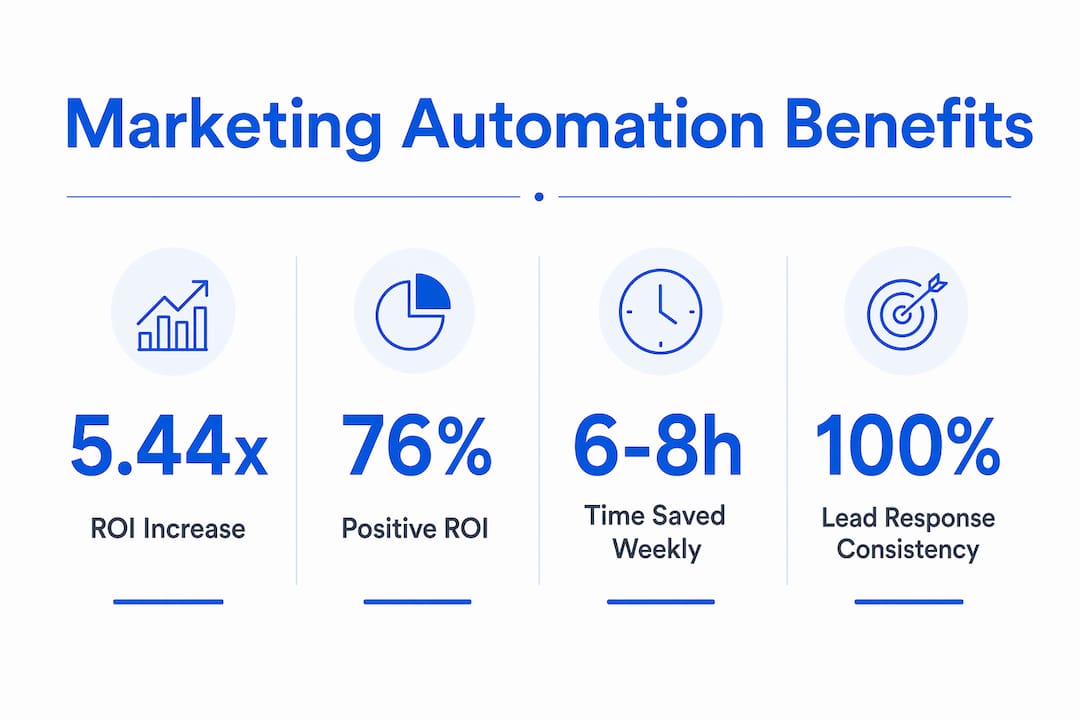
Automated marketing is the use of software to handle repetitive marketing tasks, from sending emails to scoring leads, without manual effort. Local business owners who adopt marketing automation report an average ROI of $5.44 for every $1 spent, with 76% seeing positive returns within the first year. That kind of efficiency is why choose automated marketing has become a serious question for any owner trying to grow without hiring a full marketing team. This article breaks down the real benefits, how it works in practice, and how to start without overcomplicating things.
Why choose automated marketing for your business?
The core advantage of marketing automation is that it replaces time-consuming manual work with software-driven processes that run around the clock. A local plumber, a boutique retailer, or a dental practice all share the same problem: not enough hours to follow up with every lead, send every email, and post on every channel. Automation solves that problem directly.

Marketers who use automation reclaim 6–8 hours of work per week. That time shifts from repetitive tasks to strategy and creative work, which is where real business growth happens.
The financial case is equally strong:
- ROI: Businesses see $5.44 returned for every $1 invested in automation, with 76% hitting positive ROI within 12 months.
- Sales productivity: Automation boosts sales productivity by 14.5% while cutting marketing overhead by 12.2%.
- Sales intelligence: Teams capture 54% more sales intelligence through automated data collection, giving them clearer insight into what buyers actually want.
These numbers reflect a structural shift, not a marginal improvement. When your follow-up emails go out automatically, your leads don’t go cold while you’re busy with a job site or a customer call. That consistency compounds over time into measurable revenue.
Beyond the numbers, automation gives local business owners access to data they never had before. Every email open, link click, and form submission gets tracked and tied back to a campaign. That closed-loop reporting connects your marketing spend directly to revenue outcomes, so you stop guessing which efforts are working.
How does automated marketing improve customer engagement?
Personalization is the biggest shift automation brings to customer engagement. Manual marketing treats everyone the same because there’s no practical way to customize messages for hundreds of contacts by hand. Automation removes that constraint entirely.
AI-powered marketing automation enables what’s called “segment of one” personalization, where each contact receives messages tailored to their specific behavior, preferences, and stage in the buying process. A customer who browsed your HVAC maintenance page gets a different follow-up than someone who requested a quote. That relevance drives higher open rates, more clicks, and faster conversions.
Behavioral triggers are the engine behind this. When a contact fills out a form, visits a pricing page, or abandons a cart, the system fires a pre-built message automatically. No one on your team has to monitor inboxes or set reminders.
Predictive send timing takes this further by analyzing when each individual contact is most likely to engage, then delivering messages at that exact moment. The result is less marketing noise and lower acquisition costs because you’re reaching people when they’re already receptive.
Pro Tip: Pair every automated sequence with quality content. Automation without strong content is just noise delivered efficiently. Write emails and landing pages that actually help your audience, and automation multiplies that value.
Cross-channel coordination is another major benefit. A single customer interaction can trigger a coordinated response across email, SMS, and social media without any manual handoff. Platforms like Valiz explore how real-time cross-channel engagement works at scale, which gives local owners a useful benchmark for what’s possible.
What operational efficiencies does automation create?
Automation standardizes your marketing processes, which eliminates the inconsistency that comes from doing things manually. When one team member handles follow-ups differently than another, leads fall through the cracks and the customer experience suffers. A standardized automated workflow removes that variability entirely.
Consistent lead handling is one of the clearest operational wins. Every new lead gets the same prompt, professional response regardless of when they come in, whether that’s 2:00 PM on a Tuesday or 11:00 PM on a Saturday. That reliability builds trust before you’ve even spoken to the prospect.
Automation also connects marketing, sales, and customer service through a shared data layer. Closed-loop reporting links campaign activity to revenue outcomes, so your sales team knows exactly which campaigns generated their best leads. That alignment reduces friction between departments and makes budget decisions much easier to justify.
Pro Tip: Before building complex workflows, map your current lead handling process on paper. Identify where leads go quiet or where follow-up is inconsistent. Those gaps are exactly where automation delivers the fastest results.
Scalability is the operational benefit that surprises most local business owners. You can double your lead volume without doubling your workload because the system handles the volume increase automatically. That’s a structural advantage that manual processes simply cannot match. For a deeper look at how automation connects sales, marketing, and service operations, the SMB automation guide at Mysearchhero covers the mechanics in practical terms.
How can local business owners implement automated marketing strategies?
The biggest mistake local business owners make with automation is starting too complex. Building a 12-step multi-channel workflow before you’ve tested a single email sequence is a recipe for wasted time and frustration. The right approach is to start simple and build from there.
Effective implementation almost always begins with two basic workflows: a welcome email sequence for new contacts and an automated follow-up for leads who haven’t responded. These two alone will outperform most manual processes immediately.
A practical starting sequence looks like this:
- Set up a welcome email. When someone joins your list or fills out a contact form, send an automatic reply within minutes. Introduce your business, set expectations, and offer something useful.
- Build a lead follow-up sequence. If a lead doesn’t respond to your first message, schedule two or three follow-ups over the next week. Most conversions happen after the second or third touch.
- Add a review request workflow. After a job is complete or a purchase is made, trigger an automatic message asking for a Google review. This one workflow alone can significantly lift your local search rankings.
- Layer in content. Once the basic sequences run reliably, add educational emails that address common customer questions. Quality content paired with automation is what separates businesses that see strong results from those that don’t.
- Choose a platform that scales. Pick a tool aligned with your business goals that can handle more complex workflows as you grow. Switching platforms later is expensive and disruptive.
The small business marketing guide at Mysearchhero walks through platform selection and time-saving setup in detail. Businesses still relying on fully manual processes struggle to meet modern consumer expectations for real-time, personalized engagement. Starting with even one automated sequence puts you ahead of that curve.
Key Takeaways
Marketing automation delivers measurable ROI, consistent lead handling, and personalized customer engagement that manual processes cannot replicate at scale.
| Point | Details |
|---|---|
| Strong financial returns | Businesses average $5.44 ROI per $1 spent, with 76% seeing positive returns within 12 months. |
| Significant time savings | Automation reclaims 6–8 hours per week, freeing owners to focus on growth activities. |
| Consistent lead follow-up | Standardized workflows eliminate human error and ensure every lead gets a timely response. |
| Personalization at scale | AI-driven segmentation delivers tailored messages based on individual behavior and timing. |
| Start simple, then scale | Begin with welcome emails and lead follow-ups before building complex multi-channel sequences. |
Automation amplifies what you already do well
I’ve worked with enough local business owners to know that the word “automation” triggers one of two reactions: excitement or dread. The excited ones think it will do everything for them. The dreading ones think it will make their marketing feel robotic. Both groups are wrong in the same way.
Automation doesn’t replace your voice, your relationships, or your judgment. It removes the friction between having a good idea and executing it consistently. The owner who writes a genuinely helpful email sequence and automates it will always outperform the one who relies on a generic drip campaign they downloaded from a template library.
The biggest challenge I see isn’t technical. It’s that most business owners try to automate before they’ve clarified what they want their marketing to actually do. They set up workflows without a clear goal, then wonder why the results are underwhelming. Automation amplifies your existing strategy. If the strategy is vague, the automation just delivers vague messages faster.
My honest advice: write down the three things you want every new lead to know about your business within their first week of contact. Build your first automated sequence around those three things. Measure what happens. Then iterate. That cycle of clarity, execution, and refinement is what separates businesses that get real results from automation and those that don’t.
— Mike
How Mysearchhero puts your marketing on autopilot
Running a local business means your time is always the constraint. Mysearchhero is built for exactly that reality.
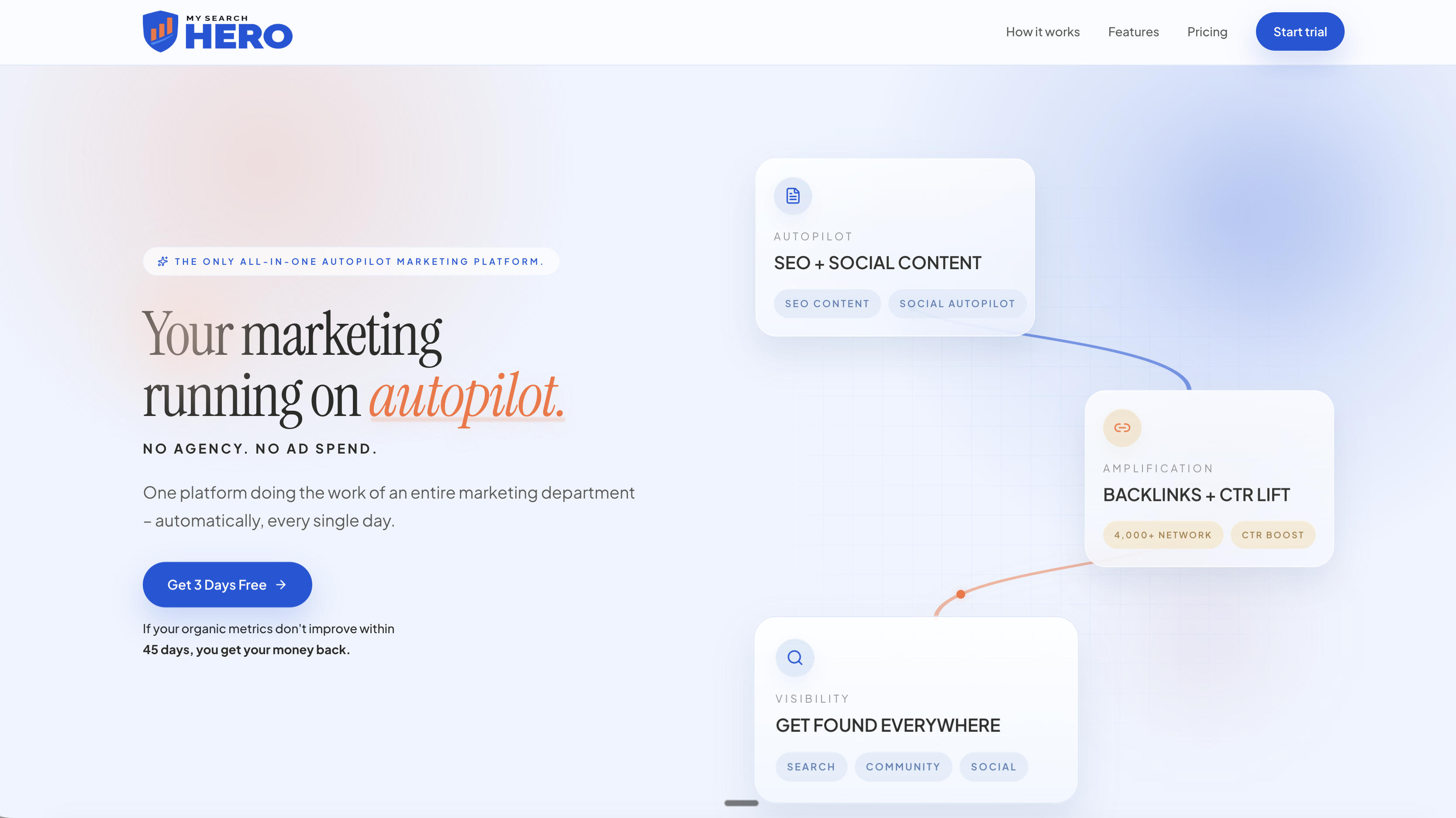
Every month, Mysearchhero delivers a full bundle of done-for-you marketing: published articles, backlinks, Reddit mentions, and AI-generated social media posts, all pushed out through a fully automated pipeline. You don’t manage the workflow. You don’t write the content. You don’t chase the distribution. The system runs while you run your business. Local business owners who want consistent online growth without adding headcount will find Mysearchhero’s model worth a close look.
FAQ
What is automated marketing?
Automated marketing uses software to execute repetitive marketing tasks, such as sending emails, scoring leads, and posting content, without manual effort. It runs predefined workflows triggered by contact behavior or time-based rules.
How does marketing automation improve ROI?
Businesses using marketing automation see an average return of $5.44 for every $1 spent, with 76% achieving positive ROI within the first year. The gains come from reduced overhead, faster follow-up, and more consistent lead conversion.
How much time does automation actually save?
Marketers report reclaiming 6–8 hours per week through automation. That time typically shifts from repetitive tasks like manual follow-ups to higher-value work like strategy and content creation.
Is marketing automation suitable for small local businesses?
Yes. The most effective starting point for local businesses is a simple welcome email sequence and an automated lead follow-up workflow. These two alone outperform most manual processes and require minimal technical setup.
What is the biggest risk of marketing automation?
The biggest risk is automating without a clear strategy or quality content. Automation without strong, relevant content delivers irrelevant messages at scale, which damages your brand rather than building it.