
TL;DR:
- Tracking SEO metrics helps small businesses measure how well their SEO efforts drive business results. It focuses on key indicators like keyword rankings, organic traffic, CTR, and conversions to guide marketing decisions. Regularly reviewing these metrics enables businesses to identify growth opportunities and improve their return on investment.
Tracking SEO metrics means systematically measuring specific data points to understand how well your SEO efforts drive visibility, attract quality visitors, and generate real business results. The five core metrics every small business should monitor are keyword rankings, organic traffic, click-through rate (CTR), conversions from organic search, and Google Business Profile performance. Understanding why track SEO metrics matters comes down to one fact: without measurement, you cannot tell whether your SEO investment is working or wasting money. Mysearchhero builds its entire approach around this feedback loop, treating measurement not as an afterthought but as the engine of every marketing decision.
Why track SEO metrics for your business?
SEO metrics are the industry’s standard term for key performance indicators (KPIs) tied specifically to search engine performance. They translate abstract activity, like publishing blog posts or building backlinks, into concrete numbers you can act on. Without them, you are running a marketing program with no scoreboard.
The importance of SEO metrics goes beyond curiosity. They tell you which pages attract buyers, which keywords drive calls, and where your website loses visitors before they convert. A business owner who checks these numbers monthly makes decisions based on evidence. One who skips them makes decisions based on gut feeling, and gut feeling does not scale.

Mysearchhero treats metric tracking as a feedback loop. Every deliverable, whether a published article, a backlink, or a Reddit mention, feeds data back into the system. That data then shapes the next month’s work. The result is a marketing program that gets sharper over time rather than spinning in place.
What are the most important SEO metrics small businesses should track?
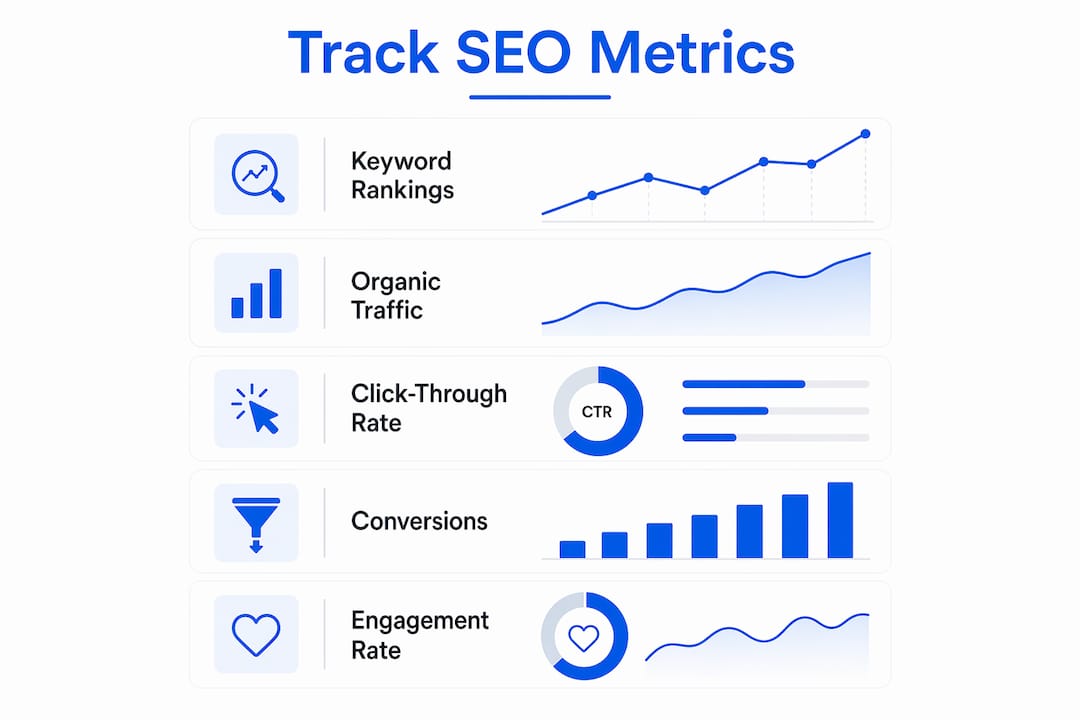
The most important SEO metrics for small businesses fall into five categories. Each one answers a different business question.
- Keyword rankings show where your pages appear in Google search results for specific terms. Treat them as a trend indicator, not a daily scoreboard. A page climbing from position 18 to position 9 over three months signals real progress, even if you are not yet on page one.
- Organic traffic volume measures how many visitors arrive from search engines each month. The goal is gradual month-over-month growth. A sudden drop almost always points to a technical issue or a Google algorithm update, and catching it early limits the damage.
- Click-through rate (CTR) tells you what percentage of people who see your page in search results actually click on it. A low CTR on a high-ranking page means your title tag or meta description is not compelling enough. Fixing the snippet can double your traffic without touching your rankings.
- Engagement metrics in Google Analytics 4 (GA4) replace the old bounce rate with Engagement Rate. This measures whether visitors actually read your content or leave within seconds. 50 engaged visitors spending three minutes on your site are worth more than 10,000 visitors who leave immediately.
- Conversions from organic search are the most direct measure of SEO value. These include phone calls, form submissions, purchases, and appointment bookings that originate from a Google search. If your traffic grows but conversions stay flat, something is broken in the path from visitor to customer.
- Google Business Profile performance tracks search queries, calls, direction requests, and website clicks from your local listing. For service businesses, this dashboard often reveals more leads than your website analytics does.
Pro Tip: Prioritize conversions and engagement rate over raw traffic numbers. A page with 200 monthly visitors and a 12% conversion rate outperforms a page with 5,000 visitors and a 0.1% conversion rate every time.
How does tracking SEO metrics translate into real ROI?
The SEO ROI formula is straightforward: (Gain from Investment minus Cost of Investment) divided by Cost of Investment. The hard part is identifying the gain accurately.
Vanity metrics mislead small business owners constantly. Impressions, total users, and average position all sound meaningful, but none of them pay bills. The metrics that connect to ROI are leads generated, revenue attributed to organic search, and customer lifetime value (CLV). CLV matters because a customer who spends $200 per visit and returns six times per year is worth $1,200 annually. An SEO campaign that costs $500 per month and generates five such customers per month delivers a strong positive return.
SEO also follows a J-curve pattern. Results are slow in the first three to six months, then accelerate as content gains authority and rankings compound. Business owners who measure only in month one almost always conclude that SEO does not work. Those who track trends over twelve months see the curve bend upward.
Tracking leads instead of traffic is the single most important shift a small business owner can make in how they measure SEO success. Traffic is an input. Leads are an output. Only outputs pay for your marketing budget.
A practical example: a local plumber runs SEO for six months. Organic traffic grows from 200 to 600 monthly visitors. Conversions hold at 5%. That means 30 leads per month from organic search, up from 10. At an average job value of $350, that is $10,500 in monthly revenue attributable to SEO, compared to $3,500 six months earlier. The SEO investment cost $800 per month. The math is clear.
Common pitfalls when monitoring SEO performance
Most small business owners make the same measurement mistakes. Knowing them in advance saves months of wasted effort.
- Overvaluing keyword rankings. A page ranked number three for a term nobody searches is worthless. Always pair ranking data with search volume and conversion intent.
- Ignoring engagement quality. High traffic with a low engagement rate signals a mismatch between what searchers expect and what your page delivers. Fix the content before chasing more traffic.
- Missing phone call conversions. More than 60% of local business leads arrive via phone calls, and most businesses never track them. Google Business Profile call insights and Dynamic Number Insertion (DNI) close this gap. Without call tracking, you are undercounting your SEO results by more than half.
- Skipping bot traffic filters in GA4. Unfiltered data inflates traffic numbers and distorts engagement metrics. GA4 filters known bots automatically, but reviewing your traffic sources monthly catches anomalies.
- Misattributing conversions. A customer who finds you on Google, leaves, sees a social ad, and then calls you may be credited to social in your analytics. Multi-touch attribution models give a more accurate picture of how SEO contributes to the sale.
- Ignoring technical SEO signals. A sudden traffic drop in GA4 paired with a spike in crawl errors in Google Search Console points to a technical problem, not a content failure. Checking both tools together prevents misdiagnosis.
Pro Tip: Set up a dedicated “SEO Leads” goal in GA4 that tracks form submissions, phone click events, and appointment bookings separately from other traffic sources. This gives you a clean number to report each month.
How to set up SEO metrics tracking step by step
Getting the right data flowing takes less than a day of setup. The payoff is months of clear, reliable reporting.
- Connect Google Search Console to your website. Search Console provides keyword rankings, impressions, clicks, CTR, and average position, plus alerts for technical issues like crawl errors and manual penalties. Verify your site, submit your sitemap, and check the Coverage report for errors within the first week.
- Link GA4 with Search Console. This connection pulls organic search data directly into GA4, so you can see which landing pages drive the most engaged visitors from Google. The combined view shows traffic source, engagement rate, and conversion events in one place.
- Set up conversion tracking in GA4. Mark your most valuable user actions as Key Events: form submissions, phone number clicks, purchase completions, and appointment bookings. Without this step, GA4 shows you traffic but not results.
- Check your Google Business Profile dashboard weekly. The dashboard shows search queries, direct vs. discovery searches, calls, and direction requests. For local businesses, this is often the fastest signal of whether your local SEO is working.
- Run a monthly review, not a daily one. Monthly comparisons smooth out the normal day-to-day ranking fluctuations that cause unnecessary panic. Compare month-over-month and year-over-year to spot real trends.
| Metric to review | Tool | Red flag to watch |
|---|---|---|
| Keyword rankings and CTR | Google Search Console | CTR below 2% on top-ranked pages |
| Organic traffic and engagement | GA4 | Month-over-month traffic drop above 15% |
| Conversions from organic | GA4 Key Events | Flat conversions despite traffic growth |
| Local leads and calls | Google Business Profile | Declining call volume with stable rankings |
| Technical health | Google Search Console | Spike in crawl errors or coverage issues |
One practical habit that compounds over time: pick one metric to act on each month. If CTR is low, rewrite title tags. If engagement rate drops, improve the page content. This one-action-per-month approach builds a stronger SEO strategy without requiring a full-time analyst.
Key Takeaways
Tracking SEO metrics is the only reliable way to connect your SEO spending to real business outcomes like leads, revenue, and customer growth.
| Point | Details |
|---|---|
| Prioritize conversions over traffic | Leads and revenue tied to organic search are the metrics that prove SEO value. |
| Use engagement rate, not bounce rate | GA4’s Engagement Rate shows whether visitors actually interact with your content. |
| Track phone calls as conversions | Over 60% of local leads arrive by phone; missing them means undercounting results. |
| Review monthly, not daily | Monthly trend comparisons reveal real growth and prevent ranking-fluctuation panic. |
| Connect Search Console and GA4 | Linking both tools gives a complete picture of traffic source, behavior, and conversions. |
What I’ve learned from watching small businesses measure SEO wrong
Most small business owners I work with start in the same place: they check their Google ranking for one keyword every morning and call it “tracking SEO.” That single habit creates more anxiety than insight. Rankings fluctuate daily for reasons that have nothing to do with your content quality, and chasing that number distracts from the metrics that actually reflect business health.
The shift that changes everything is moving from ranking obsession to conversion focus. When you start asking “how many leads did organic search generate this month?” instead of “where do I rank for this keyword?”, the entire conversation changes. You start making decisions that grow revenue, not just rankings.
Call tracking is the single most overlooked piece of local SEO measurement. I have seen service businesses attribute zero leads to their SEO program simply because nobody set up call tracking. Their SEO was working. Their measurement was broken. Once they added Dynamic Number Insertion and connected Google Business Profile call insights, the true picture emerged: SEO was their top lead source.
Start small. Connect Search Console. Set up one conversion event in GA4. Check your Google Business Profile dashboard once a week. Build the habit before you build the dashboard. The data will tell you exactly where to focus next, and that focus compounds into real growth over time. For a broader view of how measurement fits into your overall marketing, digital marketing examples for SMBs show what this looks like in practice.
— Mike
How Mysearchhero makes SEO tracking work for you
Running a business leaves little time for monthly SEO audits, GA4 configuration, and Search Console reviews. Mysearchhero handles all of it through a fully automated pipeline that publishes articles, builds backlinks, and tracks performance without requiring you to become an analytics expert.

Every Mysearchhero subscriber gets a clear picture of what their SEO investment is producing each month. The service connects content output to measurable traffic and lead growth, so you always know what is working. For business owners who want sustainable traffic growth without managing a dozen tools, Mysearchhero delivers the results and the reporting in one place. Visit Mysearchhero to see how the platform turns SEO data into business growth on autopilot.
FAQ
What does tracking SEO metrics actually mean?
Tracking SEO metrics means regularly measuring data points like keyword rankings, organic traffic, CTR, and conversions to understand how well your SEO efforts produce business results. It turns SEO activity into evidence you can act on.
How often should small businesses review their SEO metrics?
Monthly reviews work best for most small businesses. Daily checks create unnecessary concern because normal ranking fluctuations are common, while monthly comparisons reveal genuine trends.
Which SEO metric matters most for local businesses?
Conversion tracking, especially phone calls, matters most for local businesses. More than 60% of local leads arrive by phone, so tracking calls alongside form submissions gives the most accurate picture of SEO performance.
What is the difference between impressions and clicks in SEO?
Impressions count how many times your page appeared in search results. Clicks count how many people actually visited your site. A high impression count with low clicks signals a weak title tag or meta description.
How do I know if my SEO is actually working?
SEO is working when organic traffic grows month over month, engagement rate stays above 50% in GA4, and conversions from organic search increase over a three-to-six-month window. Ranking improvements alone are not sufficient proof.