
Social proof is the psychological tendency to copy other people’s actions or opinions when deciding how to behave, especially when the right choice feels uncertain. Marketers use the term to describe any signal, a review, a testimonial, a “500 people bought this today” badge, that shows other humans already made the choice you’re weighing.
Here’s the quick version:
- Psychology: Humans default to a consensus heuristic under uncertainty. If enough people do something, our brains treat it as evidence of correctness.
- Marketing effect: Peer signals (reviews, UGC, activity counts) consistently outperform brand-authored claims because they carry less perceived bias.
- Measurement cue: Conversion lift from social proof shows up fastest on high-traffic pages where visitors are already close to deciding.
If you want a five-minute win, add one specific, verified customer review or a live customer count to your highest-traffic landing page today. That single change is often enough to see a measurable shift within a few weeks.
Key Takeaways
Social proof works because it replaces uncertainty with evidence from people the buyer already trusts, and specificity beats volume every time.
| Point | Details |
|---|---|
| Similar others outperform celebrities | Cialdini’s research shows peer relevance drives more compliance than fame or reach. |
| Placement determines impact | Trust badges and reviews convert best near checkout, not on a separate testimonials page. |
| Specific proof beats vague counts | “26 to 33 percent lift from similar-guest messaging” beats “thousands of happy customers.” |
| Verification prevents backlash | Fake or unverified reviews risk FTC scrutiny and long-term reputation damage. |
| Measurement requires real testing | Track conversion lift, review sentiment, and micro-conversions with proper A/B controls. |
Table of Contents
- What Is Social Proof and Where Does It Come From?
- What Are the Main Types of Social Proof?
- Why Does Social Proof Actually Change Buying Behavior?
- Where Should Businesses Display Social Proof?
- How Do You Get More Reviews and Testimonials?
- How Do You Measure Whether Social Proof Is Working?
- What Are the Ethical Risks of Using Social Proof?
- Three Short Case Studies Worth Studying
- A 30-Day Plan to Start Collecting Social Proof
- The Editorial Take: What Actually Deserves Your Attention
- Sources
- FAQ
What Is Social Proof and Where Does It Come From?
The term traces back to psychologist Robert Cialdini, whose research on influence identified social proof as one of the core principles that drive compliance and decision-making. Cialdini didn’t invent the behavior. Humans have copied each other’s choices for as long as we’ve lived in groups. He gave it a name and built a framework marketers still use decades later.
The mechanism underneath it is called informational social influence: when a situation is ambiguous, people look to others’ behavior as data. You don’t know which restaurant on the block is good, so you pick the one with a line outside. You don’t know if a headline claim is true, so you check if a thousand other buyers left five-star reviews. The uncertainty is the trigger. Remove it, and social proof loses most of its power.
Two things intensify the effect: the number of people involved, and how similar those people are to you. A stranger’s opinion matters less than a peer’s. Cialdini’s own commentary on the principle makes this explicit, noting that social proof is strongest when the model is a “similar other”, meaning someone who shares the decision maker’s context, situation, or identity. A 45-year-old small business owner reading a testimonial from another 45-year-old small business owner will weigh it more heavily than one from a 22-year-old influencer, even if the influencer has more followers.
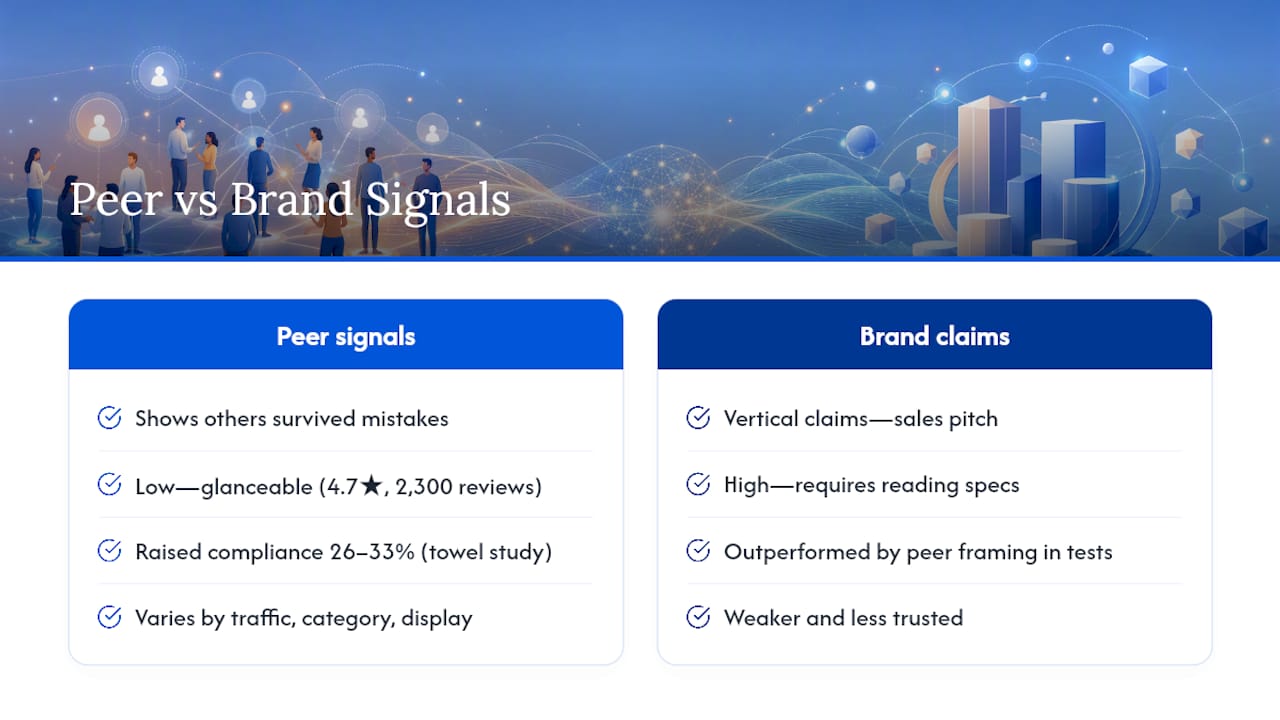
Wharton’s executive education program frames this slightly differently but reaches the same conclusion. Their research describes social proof as a trust signal that reduces cognitive burden, and notes the effect is often stronger when influence comes horizontally, from peers, rather than vertically, from the brand making claims about itself. That distinction explains why a Yelp review usually beats a homepage slogan.
The classic lab demonstration behind all of this is Solomon Asch’s conformity experiments, where participants often echoed an obviously wrong group answer rather than break with the crowd. Marketers didn’t invent the instinct. They just learned to design for it.
What Are the Main Types of Social Proof?
Social proof shows up in more forms than most people realize, and each one earns trust through a slightly different route.
- Customer reviews: Star ratings and written feedback on product pages, Google Business Profile, or Amazon listings. Works best when reviews are specific and recent, not generic five-star blurbs.
- Testimonials: Longer-form endorsements, often with a name and photo, placed on service pages or landing pages. Video testimonials convert better than text because they’re harder to fake convincingly.
- User-generated content (UGC): Customer photos, unboxing videos, or social posts featuring your product. Best displayed as an Instagram-style gallery or embedded feed near the point of purchase.
- Influencer endorsements: A recognized figure using or recommending a product. Effective for awareness, weaker for high-stakes purchase decisions where audiences want peer validation instead.
- Trust badges and certifications: Security seals, “as featured in” logos, industry certifications. Place near checkout buttons or forms where hesitation peaks.
- Numbers and activity signals: Live purchase counts, “10,000 businesses served,” or real-time visitor notifications. Effective on pricing pages and product pages with strong existing demand.
- Expert endorsements: A credentialed professional backing a claim. Useful in health, finance, or B2B contexts where technical trust matters more than popularity.
Pro Tip: When you have to choose between a celebrity endorsement and a review from someone who looks like your actual customer, pick the customer every time. Cialdini’s research on “similar others” shows that relevance beats fame for most purchase decisions, especially anything above a low-consideration impulse buy.
For a deeper look at formats that convert well in practice, this breakdown of social proof examples that lift conversions walks through several of these types with real placement ideas.
Why Does Social Proof Actually Change Buying Behavior?
It comes down to reducing risk. Every purchase decision involves some fear of making a mistake, and social proof quiets that fear by showing the mistake, if there is one, has already been made and survived by someone else.
The cognitive load argument matters here too. Reading a full product spec sheet takes effort. Glancing at a 4.7 star rating with 2,300 reviews takes almost none. Wharton’s research on trust signals points out that social proof reduces the mental work of evaluating a claim, which is exactly why horizontal peer signals often beat vertical brand claims: your brain trusts the shortcut more than the sales pitch.
The empirical evidence backing this isn’t just theoretical. One of the most cited field experiments involved hotel towel reuse programs. Signs referencing “the majority of guests in this room reuse their towels” outperformed generic environmental appeals, and Cialdini’s own writeup of the research shows the specific, similar-guest framing raised compliance by roughly 26 to 33 percent over the standard message. That’s not a marketing statistic. It’s a behavioral science result, and it maps directly onto how review counts and activity notifications work online.
Industry data backs up the scale of the effect in commercial settings too. Compiled statistics on social proof implementation show that real-time activity notifications and layered review displays correlate with meaningful conversion lifts, though the exact size varies widely depending on traffic quality, product category, and how the proof is displayed. The direction of the effect is consistent even when the magnitude isn’t.
Where Should Businesses Display Social Proof?
Placement matters as much as the proof itself. A five-star review buried on a “testimonials” page nobody visits does nothing. The same review next to the checkout button can change a mind mid-hesitation.
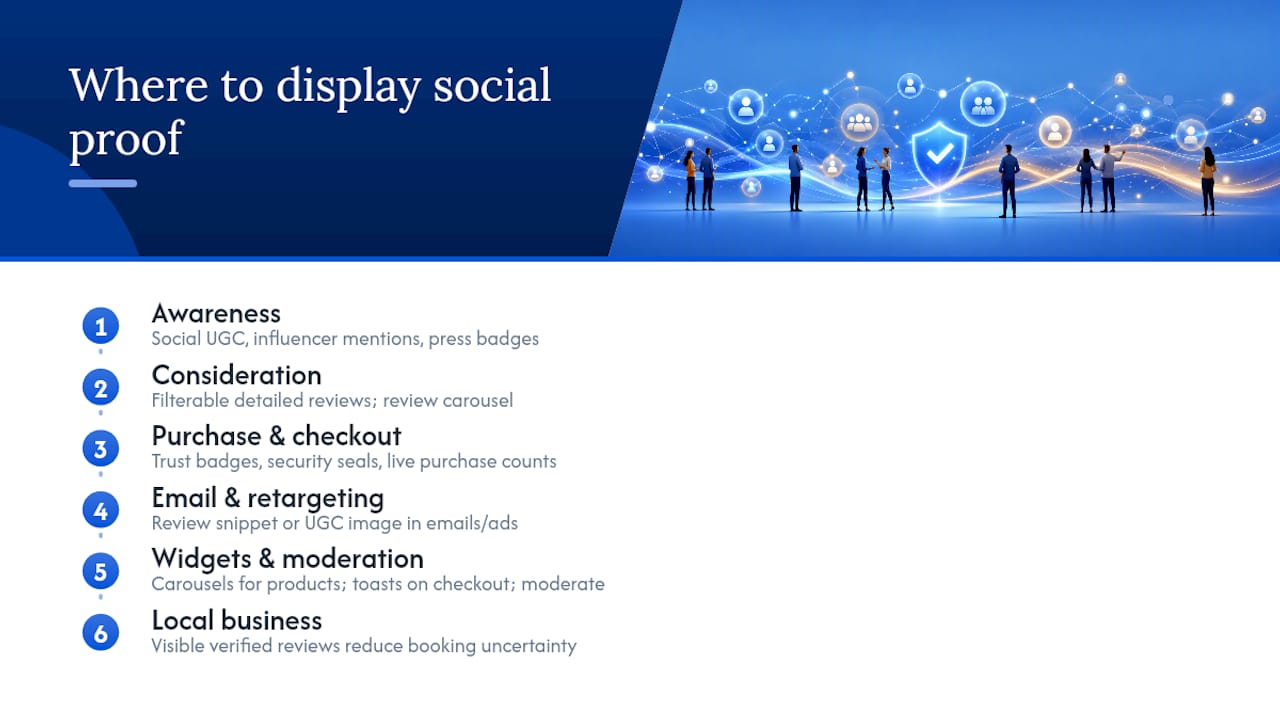
Awareness stage. This is where social media UGC, influencer mentions, and press badges do the most work. A visitor who has never heard of you needs a fast signal that you’re real and reputable before they’ll click deeper.
Consideration stage. Product and service pages need specific, detailed reviews, ideally filterable by use case. A review carousel that lets a visitor see feedback from someone with a similar problem outperforms a generic star average sitting alone at the top of the page.
Purchase and checkout stage. This is the highest-friction moment, and it calls for the most concrete proof: trust badges, security seals, live purchase counts, and short, high-credibility testimonials. Toast notifications (“Sarah in Ohio just booked a consultation”) work here specifically because they’re timestamped and specific, not because they’re flashy.
Email and retargeting. Recovery emails and follow-up ads convert better when they include a review snippet or a UGC image rather than another discount code.
For widget formats, review carousels and star-rating aggregators work well on product pages, while toast-style activity popups fit better on pricing and checkout pages. Whatever widget type you choose, moderate it. Unverified reviews or unmoderated UGC feeds can backfire fast if a fake or off-brand post slips through. A local business specifically benefits from keeping this simple: visible, verified customer reviews reduce the uncertainty that stops a website visitor from picking up the phone or booking online, more than almost any other tactic available to a small team. For broader implementation ideas across different SMB categories, this guide to digital marketing examples for small businesses covers tactics beyond proof widgets alone.
How Do You Get More Reviews and Testimonials?
Collecting social proof isn’t passive. Waiting for customers to volunteer reviews gets you a trickle. Asking systematically gets you a pipeline.
- Time the ask right after a win. Request a review within 24 to 48 hours of a completed purchase, resolved support ticket, or delivered service, while satisfaction is fresh.
- Segment by channel. Email works for detailed written reviews; SMS works for quick star ratings; a direct in-app prompt works best for UGC photo submissions.
- Make the request specific. Instead of “leave us a review,” ask a pointed question like “What problem did this solve for you?” Specific prompts produce specific, more persuasive reviews.
- Follow up once, not five times. A single reminder five to seven days after the first ask typically doubles response rates without annoying the customer.
- Get explicit permission for UGC. If a customer posts a photo using your product, a short direct message asking to reshare it, with credit, is standard practice and protects you legally.
A basic review request might read: “Hey [name], glad the [product/service] worked out. Mind leaving a quick review? Takes about 90 seconds and helps other people trust us the way you did.” A testimonial request goes further: “Would you be open to a short quote about your experience? A sentence or two is perfect, we may use it on our site with credit to you.”
Pro Tip: Small incentives like discount codes can boost response rates, but disclose them. An unlabeled incentivized review is exactly the kind of gray area that erodes trust once customers figure it out.
How Do You Measure Whether Social Proof Is Working?
Track five metrics, not just one: conversion rate lift on pages where proof was added, average time on page, review volume and sentiment trend, satisfaction scores like NPS or CSAT, and micro-conversions such as add-to-cart or email signup rate.
A/B testing is the only reliable way to separate correlation from causation here. Before you launch a test, confirm:
- The hypothesis is specific: “Adding a review count near the CTA will increase conversion by at least a measurable margin,” not “reviews will help.”
- Sample size is large enough to reach statistical significance before you draw conclusions, not just “it felt better after a week.”
- Placement stays consistent across the test, since even small position shifts can skew results independent of the proof itself.
- Tracking events fire correctly before the test starts, so you’re not debugging analytics after the data’s already compromised.
Watch for three common traps. Seasonality can make a lift look bigger or smaller than it really is if you’re testing across a holiday period. Selection bias skews review sentiment upward, since happy customers write reviews far more often than neutral ones. And survivorship bias can inflate testimonial results if you only showcase customers who stuck around, ignoring the ones who churned. Broader industry benchmarks, including consumer trust comparisons across advertising types, are useful for context but shouldn’t replace your own site-specific test data.
What Are the Ethical Risks of Using Social Proof?
Fake reviews, inflated activity counters, and manufactured urgency (“only 2 left!” when that’s not true) are the fastest way to convert short-term lift into long-term reputation damage. Once a customer catches a fabricated number, they don’t just distrust that claim, they distrust every claim you make afterward.
The Federal Trade Commission treats fake or undisclosed paid reviews as deceptive advertising, and enforcement against review manipulation has increased. Disclosure isn’t optional cleanup, it’s baseline compliance.
Do: verify reviews before display, disclose incentivized feedback, keep activity counters accurate and updated in real time.
Don’t: buy reviews, hide negative feedback selectively, or round up vague claims (“thousands of customers”) that you can’t actually substantiate.
Three Short Case Studies Worth Studying
- Airbnb built trust through mutual review systems. Guests and hosts review each other, which solved the two-sided uncertainty problem baked into staying in a stranger’s home. The lesson for most marketers: when trust runs in both directions in a transaction, mutual proof systems outperform one-sided review boxes.
- Amazon normalized the star rating as a purchase gate. Its review volume and Q&A sections became so central to buying decisions that products with few or no reviews now struggle to convert regardless of quality. The lesson: review volume itself becomes a trust signal, independent of the actual star average.
- Trustpilot and similar third-party platforms solved the credibility gap of on-site reviews. A rating hosted independently of the brand carries more weight because it’s harder to manipulate, and Trustpilot’s own transparency framework for review collection explains why third-party verification matters. The lesson: when your audience is skeptical of your own site’s reviews, a third-party badge from a platform like Trustpilot, Google Reviews, or Yelp closes that gap fast.
A 30-Day Plan to Start Collecting Social Proof
Three short templates make this easier to execute without overthinking the wording.
- Review request: “Thanks again for choosing us. If you have 90 seconds, a quick review helps other customers know what to expect, here’s the link.”
- UGC prompt: “Loved seeing your post! Mind if we reshare it on our page with credit to you? Just reply yes and we’ll tag you.”
- Testimonial permission: “We’d love to feature your feedback on our site. A sentence or two works great, and we’ll credit you by first name unless you’d prefer otherwise.”
Here’s a sequential rollout for the first month:
- Week 1: Audit existing reviews across Google, Trustpilot, Yelp, and any industry-specific platforms. Fix or remove anything inaccurate.
- Week 2: Set up an automated review request trigger after every completed purchase or service.
- Week 3: Add one review widget and one trust badge to your highest-traffic page, then start an A/B test.
- Week 4: Review test results, request two to three testimonials from your best recent customers, and publish the first UGC gallery.
Pro Tip: Verification beats volume. Ten reviews you can vouch for outperform a hundred you can’t defend if a customer or a regulator ever asks where they came from. For local businesses building this out for the first time, the brand authority guide for local businesses walks through how proof collection fits into a broader credibility strategy, and platforms like Mysearchhero can handle the recurring content and review-visibility work so this doesn’t fall to the bottom of a busy owner’s to-do list.
The Editorial Take: What Actually Deserves Your Attention
Most advice on social proof treats every type as roughly interchangeable, stack up reviews, badges, and counters and hope for lift. That’s backward. Cialdini’s “similar others” finding is the single most underused insight in this entire field, and it deserves more weight than review volume alone.
A thousand five-star reviews from strangers move the needle less than twenty specific reviews from people who look, sound, and shop like your actual customer. Most businesses chase the wrong number. They obsess over star averages instead of asking whether the voices behind those stars feel relevant to the person currently deciding.
If you’re starting from zero, skip the trust-badge shopping spree and the review-count vanity metric. Go get twenty specific, verifiable testimonials from customers who match your target buyer’s situation, and put them exactly where hesitation peaks. That’s a smaller, harder task than slapping a widget on your homepage, but it’s the one the research actually supports.
Sources
- Social proof – Wikipedia
- Gentle science: persuasion part three—social proof (Robert Cialdini commentary) | W. P. Carey News
- The importance of social proof as a trust signal | Wharton Online Insights
- Dr. Robert Cialdini’s Seven Principles of Persuasion | Influence at Work
FAQ
What Is Meant by Social Proof?
Social proof is the tendency to look at what other people are doing and copy it when you’re unsure how to act, a shortcut that reduces the mental effort of deciding on your own.
What Is an Example of Social Proof in Marketing?
A product page showing a high star rating with many reviews or a checkout page displaying live purchase counts are both classic examples, each reducing purchase hesitation by showing others already made the same choice.
How Do You Get Social Proof for Your Business?
Ask for reviews within 48 hours of a completed purchase, request permission to reshare user-generated content, and follow up once with a reminder, since a single follow-up often doubles response rates.
Which Statement Is an Example of Social Proof?
“Most guests in this room choose to reuse their towels” is a textbook example, it references what similar people actually did rather than making a generic environmental appeal, and it measurably increased compliance in field research.
Why Does Social Proof Work Better From Peers Than From Brands?
Peer signals carry less perceived bias than brand claims, and research on trust signals shows this horizontal influence reduces the cognitive effort needed to trust a decision, which is why a stranger’s review often outweighs a company’s own marketing copy.