
Expect the first hints of movement within a few weeks, measurable ranking and traffic gains in 3 to 6 months, and consistent business impact in 6 to 12 months. Competitive industries, like legal services, insurance, or SaaS with entrenched national players, often push that timeline past 12 months. This isn’t a guess. Search Engine Land’s SEO guidance puts it almost exactly this way: three to six months for measurable results, six to 12 for significant ranking and revenue impact in competitive spaces.
“Results” isn’t one thing, though, and that’s where most confusion starts. There are three distinct tiers:
- Indexing and technical health (days to weeks): Google finds and crawls your pages correctly.
- Ranking movement (1 to 6 months): your pages start climbing for target keywords, especially long-tail ones.
- Business impact (3 to 12+ months): rankings translate into organic leads, sales, or revenue you can point to on a spreadsheet.
Orbit Media’s research backs this staggered model: most sites need about 2 to 3 months to rank for low-competition keywords, and 4 to 12 months to see significant success across the board. One caveat worth internalizing now: your competition, budget, and how fast you actually implement fixes will shift you toward the front or back of every range in this article.
TL;DR:
- Technical fixes and internal linking improvements can produce noticeable ranking and indexing benefits within days to weeks.
- Most sites start seeing measurable traffic and lead growth after three to six months, with competitive niches potentially taking over a year.
- Content strategy that develops topic clusters and consistently publishes accelerates ranking results, especially when combined with technical health and backlink building.
- Backlink and authority gains are the slowest to impact, typically taking three to six months, but they serve as the foundation for long-term growth.
- Execution speed and site history significantly influence individual timelines, with older, well-maintained sites ranking faster than new or penalized domains.
Table of Contents
- How Long Does SEO Take? Typical Milestones by Month
- How Content, Technical SEO, and Links Each Change the Timeline
- What Factors Push Your Timeline Faster or Slower?
- A Month-by-Month Plan for the First Year
- What Metrics Actually Show SEO Is Working?
- What Actually Speeds SEO Up (and What It Costs)
- Does AI Search Change How Long SEO Takes?
- Who’s Behind This Guide and What Mysearchhero Delivers
- Key Takeaways
- Why the “Just Wait 6 Months” Advice Misses the Point
- Get Consistent SEO Output Without Managing It Yourself
- Sources
- FAQ
How Long Does SEO Take? Typical Milestones by Month
SEO doesn’t move in a straight line. It moves in stages, and each stage unlocks the next one. Here’s what typically happens, broken into brackets that map to what you should actually expect to see, not what a sales pitch promises.
- Month 0 to 1: audit and foundation. This is unglamorous but critical. A technical audit surfaces crawl errors, broken internal links, slow page speed, and indexing problems. You’ll often see impressions in Google Search Console tick up simply from fixing a crawl block or submitting a corrected sitemap. No rankings yet, just the plumbing getting fixed.
- Month 1 to 3: first ranking movement. Long-tail, low-competition keywords start appearing on page one or two. If you published new content in month one, this is when it typically gets indexed and starts earning impressions. Traffic gains are real but usually modest, often in the range of a handful of extra visitors a day rather than a flood.
- Month 3 to 6: measurable traffic and leads. This is the inflection point most business owners are actually waiting for. Content published in the earlier months starts compounding, meaning older articles keep gaining ground while new ones join them. Marketing By Kevin’s practitioner breakdown describes this stretch bluntly as “the short answer: three to 12 months, with a giant asterisk,” and the asterisk is almost always about how much work got done in months one and two.
- Month 6 to 12 and beyond: authority and compounding ROI. Backlinks accumulated earlier start carrying more weight. Broader, more competitive keywords become winnable because your domain has built topical depth and trust signals. Shopify’s SEO guidance notes that while most sites see measurable results in three to six months, highly competitive verticals can take 12 months or more to show significant impact.
The pattern holds across industries, but the slope of the curve depends entirely on what you do in the first 90 days. Sites that publish consistently and fix technical issues fast tend to hit month 3 outcomes that laggards don’t reach until month 6.
How Content, Technical SEO, and Links Each Change the Timeline
Not all SEO work moves at the same speed. Understanding which lever affects which timeframe helps you stop waiting on the wrong thing.
Content volume versus content quality is the first fork in the road. A single deep, well-researched article on a specific problem often outranks five shallow ones, but topical depth, meaning a cluster of related articles that together cover a subject exhaustively, shortens how long it takes Google to trust your site on that topic. One article says “we know this.” Fifteen interlinked articles say “we’re the source.” The second earns rankings faster once the cluster reaches a certain size, typically somewhere around 8 to 12 pieces on a topic.
Technical health is the silent timeline killer. A site with crawl errors, slow load times, or messy canonical tags can lose weeks or months before a single new article gets a fair shot at ranking. Common culprits:
- Pages blocked by
robots.txtor missing from the sitemap, which delays indexing entirely. - Duplicate or conflicting canonical tags, which split ranking signals across near-identical URLs.
- Slow page speed, which affects both user experience and how much of your site Google bothers to crawl on a given pass.
- Thin or orphaned pages with no internal links pointing to them, which can sit invisible for months.
Fix these first. They cost nothing to identify and often unlock ranking gains that were already earned but never delivered.
Backlinks and authority move the slowest of the three, and that’s by design, not accident. WordStream’s analysis of ranking factors points to a roughly 13-month accrual window for satisfied clicks, meaning pages that consistently earn engagement keep building ranking signal well past the point most people assume the work is “done.” Link velocity matters too: a sudden spike of low-quality links looks unnatural and can trigger scrutiny, while a steady trickle of relevant, editorially earned links compounds authority without raising flags. This is why link building often shows its effect three to six months after the outreach actually happened, not immediately.
Internal linking is the fastest fix on this list, and the most underused. Restructuring your navigation and adding contextual internal links to orphaned or underperforming pages can surface content that’s been sitting invisible for months. Google discovers pages faster when they’re linked from high-authority pages already on your site, sometimes within days rather than weeks.
Pro Tip: If you only have time for one technical fix this month, audit your internal links. A page with zero internal links pointing to it is functionally invisible to Google, no matter how good the content is.
What Factors Push Your Timeline Faster or Slower?
Every SEO timeline claim is really an average. Your actual timeline depends on five variables you can mostly assess before you start.
Competition and SERP ownership. If the top 10 results for your target keyword are occupied by domains with a decade of backlinks and massive content libraries, you’re not competing on the same clock as a niche local business targeting an underserved long-tail term. Entrenched competitors slow everyone down, not because Google is unfair, but because trust and authority accumulate over time and there’s no shortcut around that.
Keyword intent and specificity. “Best plumber near me” behaves differently than “plumber.” Long-tail, specific, high-intent phrases rank faster because fewer sites compete for them and the searcher’s intent is clearer, which helps Google match your page confidently. Head terms, the short, broad, high-volume ones, take longer because everyone wants them.
Budget and resourcing. This one is more decisive than most people admit. Doing SEO tasks sequentially, meaning one blog post a month while slowly fixing technical issues on the side, stretches a 6-month timeline into 12 or more. Running content, technical fixes, and outreach simultaneously compresses the same work into half the time. It’s not that more budget buys “better” SEO, it buys parallel execution instead of a queue.

Site history. A five-year-old domain with a clean track record starts ranking new content faster than a brand-new site with zero authority. A site recovering from a past Google penalty or years of technical neglect carries baggage that needs to be cleared before new work compounds at all.
Execution speed. How fast you actually ship fixes and content matters as much as what you plan. A checklist sitting in a project management tool for eight weeks isn’t helping anyone. Practitioner data on execution speed suggests that smaller budgets can still produce results, but sequential, drawn-out execution is what actually kills timelines, more than budget size itself.
Run through these five factors honestly before you set expectations with anyone, including yourself.
A Month-by-Month Plan for the First Year
Knowing the timeline brackets is one thing. Knowing what to actually do inside each one is what separates businesses that hit the fast end of the range from those stuck at the slow end.
- Months 0 to 1: audit and setup. Run a full technical audit, fix urgent crawl and indexing issues, and set up Google Search Console tracking if it isn’t already live. Identify “quick win” pages, ones ranking on page two or three that need only minor optimization to jump to page one. These are often the fastest wins available and cost almost nothing to fix.
- Months 1 to 3: publish and optimize. Start publishing prioritized content targeting the long-tail keywords identified in your audit. Optimize existing on-page elements, titles, headers, meta descriptions, on pages that already have some authority but underperform. Begin light link outreach to relevant sites in your niche or local market.
- Months 3 to 6: scale and test. Increase content production cadence and broaden outreach to a wider set of link targets. Run basic conversion rate experiments on pages that are already gaining organic traffic, since a page pulling visitors but not converting them is wasted momentum.
- Months 6 to 12: expand and sustain. Build out full topic clusters around your highest-performing content. Repurpose strong-performing articles into other formats, like short social posts or expanded guides, to extend their reach. Keep link building and publishing at a steady, sustained cadence rather than a one-time push, since Google’s evaluation of a site’s structure and content rewards consistency over sporadic bursts.
Businesses that follow this sequence tend to hit month 3 outcomes that others don’t reach until month 6, simply because the work started on time rather than getting delayed in planning. If you want a structured breakdown of exactly what to publish in those early months, this practical content guide covers the format decisions that matter most.
What Metrics Actually Show SEO Is Working?
Waiting for revenue to prove SEO is working means waiting too long. There are earlier signals, and knowing which ones matter keeps you from panicking during the normal lull between months one and three.
- Indexing and coverage in Google Search Console: are your pages actually getting crawled and indexed, or stuck in “discovered, not indexed” limbo?
- Impressions and average position trends: rising impressions with a slowly improving average position (say, moving from position 34 to position 18) means Google is testing your page, even before it hits page one.
- Clicks relative to rank: a page can rank at position 8 and still get very few clicks if the title and meta description don’t earn attention, so track click-through rate alongside position, not instead of it.
- Ranking movement on long-tail terms first: these move faster than head terms, so early wins usually show up here before your primary keywords budge at all.
- Engagement and micro-conversions: newsletter sign-ups, contact form starts, or time-on-page increases often precede actual leads by weeks.
Some volatility is completely normal, rankings can swing several positions week to week without meaning anything. What’s worth investigating is a sustained drop across multiple pages at once, which usually signals a Google algorithm update or a technical issue rather than random noise. If impressions keep climbing but clicks stay flat, the fix is usually the title tag, not the content itself.
What Actually Speeds SEO Up (and What It Costs)
Some levers genuinely compress a timeline. Others just sound like they do. Here’s what’s real, and roughly what it takes to pull each one.
- Prioritize by intent, not by ease. Publishing the pages most likely to convert first, rather than whatever’s fastest to write, gets revenue-relevant traffic moving sooner even if total page count grows slower.
- Outsourcing content production removes the bottleneck of one person trying to write, optimize, and publish alone. A done-for-you content pipeline can sustain a publishing cadence that a solo operator simply can’t match on top of running a business.
- Quality link building over quantity. A handful of relevant, editorially earned links from sites in your actual niche moves rankings faster than dozens of low-relevance directory links, which barely register anymore.
- Budget bands roughly track velocity. A low-budget, single-person effort tends to land at the slow end of every range in this article. A mid-range budget covering consistent content plus basic outreach usually reaches month-3-to-6 outcomes on schedule. Higher budgets that fund simultaneous content, technical fixes, and outreach are what compress a 12-month timeline into 6 to 8.
- Paid channels can bridge the gap. Running search ads while organic SEO compounds means you’re not waiting on rankings to generate any traffic at all, an approach worth considering for service businesses that can’t afford a quiet first quarter.
None of these are shortcuts around the fundamentals. They’re ways to do more of the fundamental work in parallel instead of one piece at a time.
Does AI Search Change How Long SEO Takes?
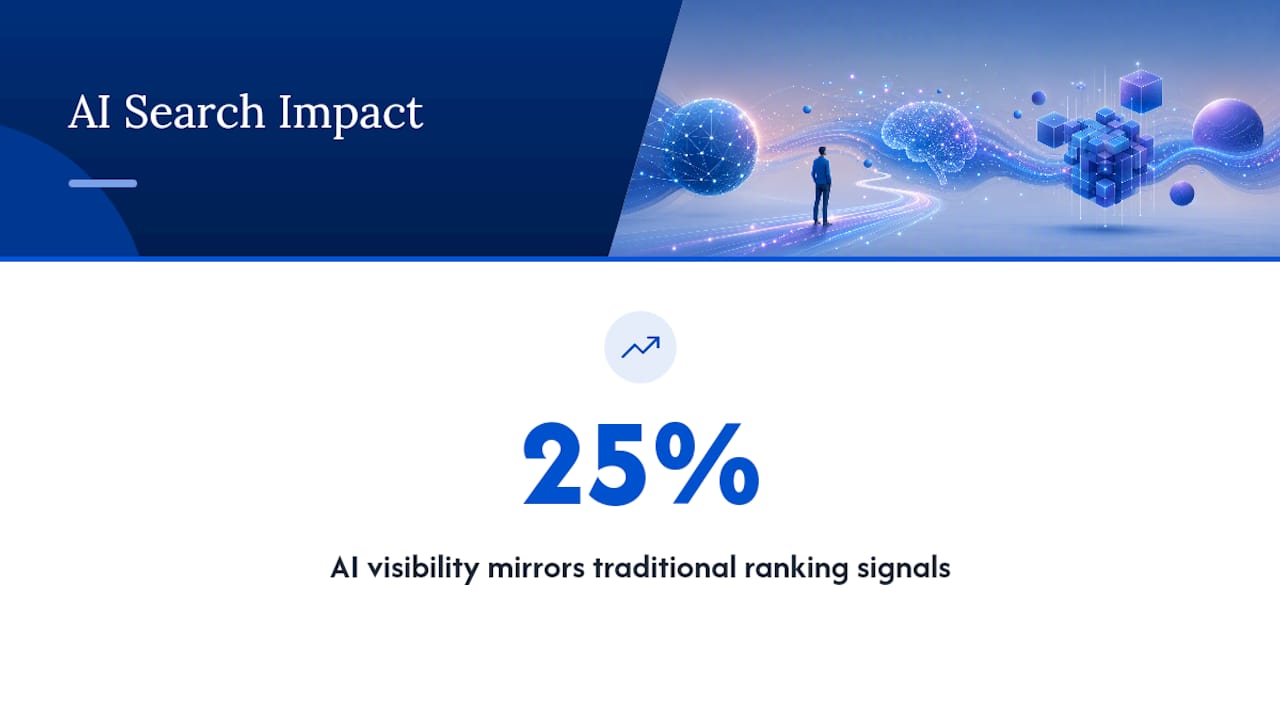
AI search hasn’t shortened the timeline, and it hasn’t made SEO optional either. Research from Search Engine Journal found that pages ranked #1 on Google appear in AI-generated search answers about 25% of the time, meaning traditional ranking success still strongly predicts AI visibility. If your page hasn’t earned a top position through the usual fundamentals, showing up inside an AI Overview isn’t likely either.
Google’s own guidance on generative AI search makes the same point directly: original perspective, human-first structure, quality visuals, and solid technical SEO remain what wins visibility, not special AI-only tricks like keyword stuffing an llms.txt file. A well-structured guide such as this AI search visibility overview reinforces that AI citation and traditional ranking are pulling from largely the same underlying signals.
Practically, this means your month-by-month plan doesn’t need an “AI version.” It needs the same clean structure, clear answers, and technical soundness that’s always driven rankings, just executed with the awareness that AI Overviews are now one more surface competing for that same click.
Who’s Behind This Guide and What Mysearchhero Delivers
This guide draws on Mike’s ongoing coverage of SEO strategy and timelines for Mysearchhero, where the focus stays on what actually moves rankings rather than trends that fade in a quarter. Mysearchhero itself runs on the same principles laid out above.
- Monthly deliverables include published SEO articles, authority backlinks through a publisher network, and Reddit mentions in relevant conversations, the exact mix of content and links this guide identifies as the two slowest, most compounding levers.
- AI-generated social posts extend the reach of top-performing content, matching the “repurpose what works” step in the 6-to-12-month plan above.
- Built-in CTR signal boosting and reporting means clients can track impressions, clicks, and ranking movement without manually pulling Search Console data every week.
Case studies and client results specific to individual industries are being compiled and will be added here as they become available.
Key Takeaways
SEO timelines follow a predictable curve, from indexing in weeks to measurable traffic in 3 to 6 months to compounding ROI in 6 to 12 months, and skipping the sequence never speeds it up.
| Point | Details |
|---|---|
| Early signals arrive fast | Indexing and impression growth in Google Search Console often show up within the first few weeks. |
| Measurable results take 3 to 6 months | Traffic and lead gains typically become visible once early content and technical fixes compound. |
| Competitive niches take longer | Six to 12 months or more is normal when entrenched competitors dominate the SERP. |
| Technical fixes and internal links are fastest | Crawlability and internal linking issues can be resolved in days and unlock existing content quickly. |
| AI search rewards the same fundamentals | Pages ranked #1 on Google appear in AI answers about 25% of the time, so traditional SEO still drives AI visibility. |
| Mysearchhero maps deliverables to the timeline | Monthly content, backlinks, and Reddit mentions target the exact levers that compound over 3 to 12 months. |
Why the “Just Wait 6 Months” Advice Misses the Point
Most SEO timeline advice treats months as the unit that matters. They’re not. Execution density is what matters, how much actually got shipped inside those months. Two businesses can both “wait six months” and land in completely different places, because one published four articles and fixed nothing technical, while the other cleared every crawl error in week one and published weekly.
The conventional wisdom undersells how much competition and site history warp these averages. A five-year-old site with decent backlinks can beat the “3 to 6 month” range easily. A brand-new domain in a crowded niche might not see real movement until month nine, and that’s not failure, that’s the actual math of how authority accumulates.
What I’d prioritize first, before anything else: fix technical issues and internal linking in month one. It’s the cheapest, fastest lever in this entire guide, and most businesses skip it in favor of publishing content onto a foundation that’s quietly sabotaging every page they write.
— Mike
Get Consistent SEO Output Without Managing It Yourself
Mysearchhero is the alternative to hiring an in-house content team or juggling freelancers separately for writing, links, and social. Every month, subscribers get published articles, backlinks through a vetted publisher network, Reddit mentions, and AI-generated social posts delivered through one automated pipeline instead of five different invoices and deadlines.
That matters most in exactly the timeline this article describes: the 3-to-12-month window where consistency beats bursts. Falling behind on publishing for even one month can stretch your timeline by more than that month alone, since compounding content needs a steady drip, not a sprint followed by silence. Mysearchhero’s monthly cadence is built to remove that risk without requiring you to manage a team or chase down deliverables yourself.
If you’re a local or service-based business trying to hit the month 3 to 6 milestones covered above without hiring anyone, check out what Mysearchhero includes in each monthly plan and see which tier matches how fast you want to move.
Sources
- How long does SEO take to work? SEO timeline & results …
- How Long Does SEO Take to Work?
- Google ranking factors — WordStream
FAQ
Is SEO dead now that AI search is everywhere?
No. Pages ranked #1 on Google still appear in AI search answers about 25% of the time, and Google’s own generative search guidance confirms that original content, technical health, and clear structure remain what earns visibility in both traditional and AI results.
What is the 80/20 rule in SEO?
It generally refers to the idea that a small share of your pages, often the ones targeting the highest-intent keywords or covering your most valuable topics, drive the majority of your organic traffic and conversions. Prioritizing those pages first, rather than spreading effort evenly across your whole site, tends to produce faster measurable results.
How long does it take to learn SEO?
Learning the fundamentals, on-page optimization, basic technical audits, and keyword research, typically takes a few months of hands-on practice, though mastering how the pieces compound over a real timeline usually takes at least one full campaign cycle of 6 to 12 months to fully understand.
How long does SEO take to show results in 2026?
The timeline hasn’t changed with AI search: expect early signals like indexing and impressions within weeks, measurable ranking and traffic gains in 3 to 6 months, and consistent revenue impact in 6 to 12 months, longer in highly competitive industries.
Can a done-for-you service like Mysearchhero speed up my timeline?
It can help you avoid the delays that come from inconsistent publishing or sequential execution. Mysearchhero’s monthly bundle of articles, backlinks, and social content is designed to keep the compounding pieces of an SEO timeline, content and links, moving simultaneously rather than one at a time.