
Content decay is the gradual loss of organic clicks, rankings, or visibility on a page that once performed well, and the fix depends entirely on which of four types you’re facing. Before touching a word of copy, pull clicks, impressions, and average position for the page from Google Search Console and compare two equal date ranges. That single comparison tells you whether you need a rewrite, a merge, a redirect, or nothing at all.
TL;DR:
- Content decay types include ranking decline, zero-click capture, intent drift, and demand decay, each requiring different diagnostic and corrective approaches.
- Regularly compare equal periods in Search Console to identify true traffic loss, filtering by prior traffic levels and considering backlinks and conversions for prioritization.
- The best fix depends on decay type: update for ranking issues, consolidate for cannibalization, redirect for off-strategy backlinks, and prune low-value pages.
- Refreshes should add new information, match current SERP formats, and preserve URLs, with measurement over four to six weeks to confirm impact.
- Quarterly audits, monitoring SERP changes, and assigning ownership prevent decay from silently accumulating over time.
Table of Contents
- What Are the Four Types of Content Decay?
- How Do You Find Pages Losing Traffic in Search Console?
- Should You Update, Consolidate, Redirect, or Prune a Page?
- What Should You Change When You Refresh a Page?
- How Often Should You Audit Your Content for Decay?
- What Proof Backs This Diagnostic Approach?
- Why Most Teams Fight Content Decay Wrong
- Fix Decay Without Adding It to Your To-Do List
- Sources
- FAQ
What Are the Four Types of Content Decay?
Not every traffic drop calls for a rewrite, and treating them all the same way wastes time on pages that don’t need one. Search Engine Land’s framework splits decay into four categories, each with its own metric fingerprint in Google Search Console.
Ranking decay is the classic case: your page lost its spot because a competitor built something better, or Google’s quality bar moved. Clicks fall, impressions fall, and average position gets worse. This is the one type where a genuine content refresh usually works.
Zero-click capture looks different and gets misdiagnosed constantly. Clicks drop while impressions stay flat or even climb, and your position holds steady or improves. Google is answering the query directly, often through an AI Overview or featured snippet, and pulling the click before the searcher ever reaches your page. Rewriting the same information rarely helps here, because the problem isn’t quality. It’s format.
Intent drift happens when the SERP shifts around your content type. A query that used to reward a blog post now surfaces video carousels, tools, or product listings instead. Your rankings can even stay okay while clicks quietly erode, because you’re no longer matching what the search results page actually wants to show.
Demand decay is the quiet one: impressions fall while position holds steady. Nobody is searching the term as much anymore. No rewrite fixes disinterest, and this is often the strongest signal to prune or consolidate rather than “improve.”
| Decay type | Clicks | Impressions | Avg. position | Right first move |
|---|---|---|---|---|
| Ranking decay | Down | Down | Worse | Substantive content refresh |
| Zero-click capture | Down | Flat or up | Stable or better | Add citable data, tools, or original research |
| Intent drift | Down | Variable | Often stable | Reformat to match the new SERP intent |
| Demand decay | Stable-ish | Down | Stable | Consolidate or prune |
When intent drift looks ambiguous, checking the live SERP directly resolves the confusion, because sometimes what looks like fading demand is actually zero-click capture wearing a different disguise.
How Do You Find Pages Losing Traffic in Search Console?
You need a repeatable export process, not a gut check every time traffic dips. Here’s the workflow that scales across a content portfolio of any size.
- Open Search Console’s Performance report and export page-level clicks and impressions for your defined period (90 days is a reasonable default).
- Pull the same metrics for the prior period of equal length, and ideally the year-over-year window too, since seasonal topics can look like decay when they’re just cyclical.
- Merge the two exports in a spreadsheet and calculate the click delta and impression delta for every URL.
- Filter out pages with a low prior-period click count. Systems Architect recommends a minimum threshold, such as pages that had more than 100 clicks previously, so you’re not burning hours chasing a page that went from three clicks to one.
- Sort the surviving list by absolute click loss, not percentage loss. A page that fell from 40 clicks to 4 is a 90% drop, but a page that fell from 4,000 to 3,200 lost far more real traffic and deserves attention first.
Year-over-year comparison matters more than most audits admit. A tax-season guide or holiday shopping page will show a scary month-over-month drop every single year, and treating that as decay leads to unnecessary rewrites on pages that were never actually broken.
Once you have your ranked backlog, layer in two more signals before deciding what to do with each page:
- Referring domains and backlink count, since a page with real link equity is worth preserving even if you have to redirect it rather than delete it.
- Conversion or assisted-conversion value, because a page generating leads at a lower traffic volume can outrank a high-traffic page that never converts.
This is where a content audit framework earns its keep. Without a structured way to weigh traffic loss against link value and business impact, you’ll end up rewriting the wrong pages first.
Should You Update, Consolidate, Redirect, or Prune a Page?
Diagnosis tells you what happened. This decision matrix tells you what to actually do about it, and the choice hinges on business relevance, not just traffic numbers.

Update the page when the keyword is still commercially relevant, the page holds meaningful backlinks, and the ranking decay signature (clicks down, impressions down, position worse) points to a genuine quality gap. This is the highest-effort option and the one teams reach for by default, often when it isn’t warranted.
Consolidate when you find two or three pages competing for the same query, a classic cannibalization pattern where rankings shuffle between URLs month to month. Merge the content into one stronger page and redirect the rest.
Redirect when a topic no longer fits your strategy but the page carries backlinks worth keeping. A 301 to a closely related, currently relevant page preserves that link equity instead of throwing it away.
Prune when a page has low traffic, few or no backlinks, and no clear business purpose. Removing pages that no longer serve a goal keeps your site’s overall quality signal cleaner, and it stops you from spending refresh cycles on pages that were never going to earn their keep back.
| Action | Best for | Effort | Risk |
|---|---|---|---|
| Update | Ranking decay, relevant keyword, real backlinks | High | Low if surgical, high if a full rewrite |
| Consolidate | Cannibalization, overlapping rankings | Medium | Low |
| Redirect | Off-strategy topic with backlink value | Low | Low |
| Prune | Low traffic, low links, no business case | Low | Very low |
What Should You Change When You Refresh a Page?
A refresh only works when it adds something Google and readers didn’t already have. Cosmetic touch-ups get detected and ignored, both by algorithms and by the people landing on your page.
- Add information gain first. Original data, a calculator, a proprietary survey, or a fresh interview does more for rankings than rewording existing paragraphs. This is also your best defense against zero-click capture, since content an AI summary can’t easily replicate is more likely to earn the click anyway.
- Match the format to the current SERP. If Google now shows a comparison carousel for your query, add a comparison table. If video results dominate, embed one, or split a long guide into a tool plus a shorter explainer.
- Rewrite metadata deliberately. Update the title tag and meta description to reflect what actually changed, not just to insert the current year. Adjust H1 and H2 wording only where it improves clarity, since gutting your heading structure resets signals you don’t need to lose.
- Fix internal links pointing at the page. Old anchor text referencing outdated angles confuses both users and crawlers. Point relevant organic traffic growth content at the refreshed page with anchors that match the new framing.
- Choose 301s over noindex for consolidation, and reserve 410 for true removals. A 301 passes equity to a live replacement. A 410 tells Google the page is gone for good, which only makes sense when nothing on your site should inherit that URL’s signals.
- Measure against a control window. Track clicks, impressions, and position for at least four to six weeks post-refresh, and compare against a similar page you didn’t touch, so a broader algorithm shift doesn’t get credited or blamed on your edit.
Pro Tip: Changing only the “last updated” date without touching the substance of the page is a move search engines increasingly detect, and it can backfire by signaling low effort rather than freshness. Only bump the date when you’ve genuinely changed something a reader would notice.
Keep the URL intact whenever possible. A surgical refresh that preserves the existing signals is far safer than a structural rewrite or a URL change, both of which risk resetting the exact rankings you’re trying to protect. Save full rebuilds for pages where the content is so outdated that nothing about the current version is worth keeping.
How Often Should You Audit Your Content for Decay?
Decay compounds when nobody’s watching for it, and by the time a stakeholder notices a traffic drop in a monthly report, the page has often been sliding for two or three cycles already.
Run a full decay audit quarterly. A quarterly cadence paired with scheduled refreshes for high-value pages catches most decay before it becomes a bigger recovery project. Between audits, a few habits keep the backlog from growing unmanageably:
- Set alerts for large SERP-format shifts on your priority keywords, since a new AI Overview or shopping carousel appearing on a page you rank for is worth knowing about the week it happens, not the quarter after.
- Watch for competitor content updates on your top 20 pages by traffic value, since a rival’s refresh is often the actual cause behind a ranking decay signature.
- Schedule annual, deeper updates for your highest-value pages regardless of whether they’ve shown decay yet, since prevention is cheaper than recovery.
- Maintain topic clusters so related pages get reviewed together, catching cannibalization before it becomes a two-year-old problem nobody remembers creating.
- Assign clear ownership. A page without an owner doesn’t get updated, no matter how good your audit spreadsheet looks.
- Build in small SLAs for minor freshness fixes (broken links, outdated screenshots, pricing changes) so they get handled in days, not queued behind the next big content project.
A freshness-focused audit playbook built around this kind of quarterly rhythm turns content maintenance from a fire drill into a routine line item.
What Proof Backs This Diagnostic Approach?
This piece draws on Search Engine Land’s decay-type framework, Systems Architect’s diagnostic methodology, and SiteGuru’s audit-cadence research, cross-checked against how decay actually shows up in Search Console exports across real content portfolios.
- Mike, the author of this piece, has spent years auditing organic traffic drops across content portfolios ranging from single-location service businesses to multi-location franchises, with a focus on separating genuine quality decay from SERP-format shifts.
- Mysearchhero’s blog publishes ongoing guidance on content strategy as SERP formats evolve, including how to reclaim visibility lost to zero-click results.
- A managed monthly content pipeline reduces decay risk structurally, simply because pages get scheduled attention instead of waiting for a traffic crash to trigger action.
Why Most Teams Fight Content Decay Wrong
The biggest mistake I see is teams treating every weekly traffic dip like an emergency. Search Console data is noisy week to week, and chasing every wobble burns hours that should go toward the quarterly audit that actually catches real decay.
The second mistake is a publish-more mentality substituting for portfolio maintenance. Adding ten new posts a month feels productive, but if forty older pages are quietly decaying underneath, you’re filling a bucket with a hole in it.
What actually works is unglamorous: small, scheduled edits, one clear owner per content cluster, and a decision matrix applied consistently instead of reinvented every time someone notices a drop. Teams that win at this don’t rewrite more. They diagnose faster and act on the right pages first.
— Mike
Fix Decay Without Adding It to Your To-Do List
Diagnosing decay is one job. Executing the fix, month after month, on every page that needs it, is a different job entirely, and it’s the one most site owners never get to. Some services replace the scramble of hiring a writer, an SEO consultant, and a link-building freelancer separately with one automated pipeline that keeps publishing, refreshing signals, and building authority on autopilot, all for a single monthly plan instead of three separate retainers.
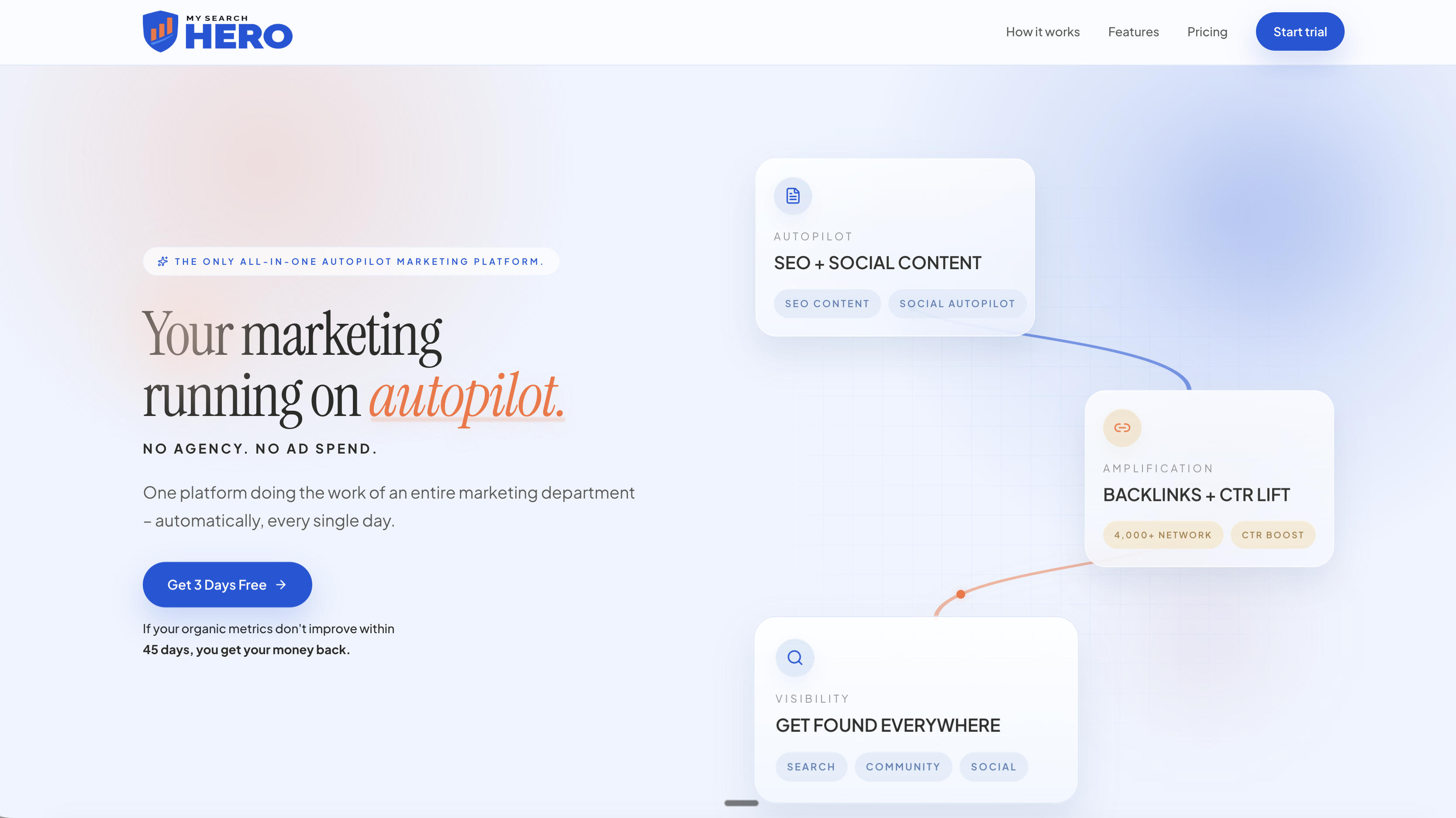
Each month, subscribers get a bundle built for exactly the kind of upkeep this article describes: new SEO articles published to your site, authority backlinks through a publisher network, Reddit brand mentions in relevant conversations, and AI-generated social posts, all pushed out automatically. It’s built for local and service-based business owners who want their content portfolio staying current without hiring an in-house team to run quarterly audits themselves.
Plans run from a lower price tier to higher tiers, with options available for larger portfolios, some backed by a money-back guarantee if organic metrics don’t improve. Visit the Mysearchhero landing page to see which plan fits your site.
Sources
Use Google Search Console for the clicks/impressions/position exports this entire workflow depends on, Google Trends to confirm demand decay against seasonal or long-term interest shifts, and Ahrefs for backlink value when deciding between redirect and prune. The Search Engine Land framework and Systems Architect diagnostics informed the decision matrix above.
- Content Decay: What It Is & How to Reverse Traffic Drops
- Content Decay: Find and Fix Pages Losing Traffic
- How to Find and Fix Content Decay | SiteGuru
FAQ
Is SEO dead now that AI Overviews are everywhere?
No. Search volume is shifting, not disappearing. Gartner projected a meaningful decline in traditional search engine volume by 2026 due to AI chatbots and virtual agents, which is exactly why zero-click capture needs its own diagnosis instead of getting lumped in with ranking decay.
What is the 80/20 rule in SEO as it applies to content decay?
Applied to decay, it means a small share of your pages, usually your highest historical traffic earners, account for most of the recoverable clicks lost to decay.
What are the three C’s relevant to fixing decaying content?
There’s no single fixed “three C’s” framework in the decay research itself, but the practical version that shows up across diagnostic guidance is content, consolidation, and cadence: get the content genuinely better where it needs updating, consolidate where pages compete with each other, and keep a consistent audit cadence so decay doesn’t compound.
Can ChatGPT do a content decay audit?
ChatGPT can help interpret a Search Console export or draft a triage plan once you’ve pulled the clicks, impressions, and position data yourself, but it can’t pull that data or read your live SERP for intent drift signals. A managed service like Mysearchhero handles the ongoing publishing and monitoring side, while diagnosis still starts with your own Search Console numbers.
How is content decay different from a Google algorithm penalty?
Decay is a gradual, predictable slide tied to changing demand, competitor improvements, or SERP-format shifts, not a manual action or algorithmic penalty. Industry guidance is consistent on this point: content decay reflects normal shifts in user interest and competition, which is why diagnosis matters more than assuming you did something wrong.