
A zero-click search happens when Google or an AI engine answers the query directly on the results page, so the person never visits a website. That single fact rewrites the SEO scoreboard: Over 58% of Google searches ended without a click in 2024, and early 2026 estimates put U.S. rates closer to 68%. The strategic shift for marketers is blunt: stop optimizing purely for clicks and start optimizing to be the source AI engines and SERPs cite by name.
TL;DR:
- Over 58% of Google searches ended without a click in 2024, and estimates for 2026 suggest the rate could reach 68%, especially on queries with AI Overviews.
- AI Overviews synthesize multiple sources into a single answer and appear above organic results, significantly reducing click-through rates on affected queries.
- Traditional pageview metrics are insufficient; proxies like citation share and branded search growth better indicate content visibility and brand recognition in a zero-click environment.
- Implementing answer-first content, schema markup, and entity consistency can improve chances of being cited by AI engines, helping maintain visibility.
- Small businesses can automate AI citation audits and content updates through managed services that focus on answer-first strategies and authoritative backlinks.
Table of Contents
- What Counts as a Zero-Click Search Result
- Why AI Overviews Are Driving More Zero-Click Behavior
- The Metrics That Actually Matter Now
- The Priority Playbook for Winning Citations
- How to Run an AI Citation Audit
- When Click-First Content Still Wins
- How We Rebuilt Our Own Reporting Around Citations
- Getting Cited Without Adding Headcount
- Sources
- FAQ
What Counts as a Zero-Click Search Result
A zero-click result comes from any SERP feature that satisfies the query without a click through to a website. The main formats are worth knowing because each one rewards slightly different content structure:
- Featured snippets: a short extracted answer, usually 40 to 60 words, pulled from a ranking page
- Knowledge panels: entity summaries built from structured data and trusted sources like Wikipedia
- People Also Ask (PAA) boxes: expandable question and answer pairs tied to related searches
- Local packs: map results with business info for “near me” and service queries
- AI Overviews and AI Mode: generative summaries that synthesize several sources into one answer
Searches that go zero-click tend to be informational: definitions (“what is GEO”), quick how-tos, unit conversions, and long-tail questions with a single factual answer. Semrush’s analysis of zero-click behavior notes that snippets, panels, and PAA boxes have been standard SERP furniture for years. AI Overviews are the newer force multiplying the effect, and on queries where they appear, zero-click rates can climb above 80%.
Why AI Overviews Are Driving More Zero-Click Behavior
AI Overviews don’t just excerpt one page the way a featured snippet does. They pull from multiple sources, blend the language into a single generated paragraph, and place it above every organic result. That structural change is why click-through rates on affected queries fall so hard.
A few forces are compounding at once:
- Synthesis over extraction: AI Overviews summarize several pages into one answer, so no single source “owns” the snippet the way it might with a classic featured snippet.
- Mobile result density: small screens push organic listings further down, so an answer box at the top captures attention before a user ever scrolls.
- Conversational query patterns: people increasingly type full questions rather than keyword fragments, which favors direct-answer formats over ten blue links.
The practical difference from classic snippets matters for strategy. A featured snippet rewards one well-structured page. An AI Overview can cite several pages at once, or none, depending on how clearly each page states its answer. Agency data compiled by Beancount’s small business guide to AI Overviews shows organic CTR dropping 30% to 61% on queries where an AI Overview appears. That’s not a marginal dip. That’s the traffic model changing under your feet.
The Metrics That Actually Matter Now
Google Search Console and Google Analytics were built to count clicks, not citations. When someone reads your answer inside an AI Overview or a featured snippet and never visits your site, standard pageview-based tracking registers nothing at all. That blind spot is why so many teams think their content “stopped working” when it’s actually working differently than the dashboard can see.
Four proxies fill that gap better than raw session counts:
- Citation share: the percentage of relevant AI-generated answers that name your brand or link your content, tracked through manual or automated audits.
- Impressions-to-click ratio in GSC: a query with rising impressions and flat or falling clicks is a strong signal you’re being shown, and possibly cited, without the visit.
- Branded search growth: if people search your company name after encountering it in an AI answer, that’s downstream proof the citation worked.
- Direct traffic: visits with no referrer often mean someone remembered your brand from an answer engine and typed the URL later.
Forbes’ analysis of the zero-click economy argues executives need to treat these as board-level KPIs, not SEO team trivia, because the risk isn’t just lost traffic. It’s disappearing from the buyer’s consideration set entirely if an AI answers a category question without ever naming your brand. A practical guide to search visibility walks through how these proxies fit into a broader visibility framework beyond clicks.
The Priority Playbook for Winning Citations
Not every tactic here deserves equal time. Some changes move the needle within weeks; others are longer plays. Work through them roughly in this order.
- Write liftable answers first. Put a tight, 40 to 60 word answer near the top of any page targeting an informational query, before the narrative explanation. This is the exact length window snippets and AI Overviews tend to extract cleanly, and it’s the single highest-leverage change most sites haven’t made.
- Add structured data that matches your content. FAQPage, HowTo, and Organization schema give extractors a machine-readable map of your answers instead of forcing them to guess. Pages without schema aren’t excluded from citation, but they’re competing at a disadvantage.
- Build tight Q&A blocks, not walls of text. A clearly labeled question followed by a two-sentence answer is easier for an AI engine to lift than the same information buried inside a six-paragraph explainer.
- Fix entity consistency across your site and off it. Your business name, description, and key facts should read the same on your site, your Google Business Profile, and any third-party mentions. Inconsistent entity signals make it harder for a knowledge panel or AI Overview to trust a single version of the truth.
- Earn off-site corroboration. Authoritative backlinks and press mentions still function as trust signals for generative engines, not just for classic rankings. A guide from Macrolight Builder on generative engine optimization covers how local businesses specifically can build this kind of corroboration.
- Build topical clusters instead of isolated posts. A hub page linked to a dozen supporting articles on the same subject signals depth that a single standalone page can’t match, and depth is a recurring factor in what gets cited repeatedly.
- Refresh what you want cited most. Recency is a real tiebreaker. Practitioners tracking citation performance into 2026 report visibility on a given answer can decay by roughly half within four to six weeks if the page sits untouched.
- Sort your pages by intent before you touch anything. Not every page should chase a citation. The next section covers exactly which ones shouldn’t.
Pro Tip: Don’t rebuild your whole content library at once. Pick your ten highest-impression, lowest-click pages in Search Console first. Those are the ones already earning visibility Google just isn’t crediting with a visit, which makes them the fastest wins for a citation-focused rewrite.
For teams building this out page by page, a practical guide to writing SEO content covers the answer-first structure in more implementation detail, and the AI Overviews playbook goes deeper on schema specifics.
How to Run an AI Citation Audit
An AI citation audit works the same way a rank tracker does, except you’re checking whether an engine names you instead of where you rank. Start with 10 to 40 real buyer prompts, the kind of questions your prospects would actually type into ChatGPT, Perplexity, or Google’s AI Mode. Run each one across at least two or three engines, and log three things every time: whether your brand or content gets cited, where in the answer it appears, and which competitor shows up instead when you don’t.
That log becomes your baseline. Watch these signals over time:
- Citation rate: the share of your target prompts where you’re named, tracked monthly.
- Branded-search lift: a rising trend after content updates suggests citations are driving brand recall.
- Direct-traffic growth: parallel movement here reinforces that people are acting on what they read in an AI answer.
None of these live in a standard analytics report, which is exactly the point Forbes’ zero-click economy piece makes about needing new KPIs. Treat citation share as its own reporting channel, sitting alongside organic sessions and paid conversions, not folded into either. A dedicated framework for measuring AI search visibility lays out a fuller set of metrics and sample prompts if you want to formalize the process.
When Click-First Content Still Wins
Not every page should chase a citation, and treating all content as citation bait is its own mistake. Segment by intent before you touch anything.
- Transactional pages, pricing pages, and booking flows exist to convert, not to get quoted inside an AI answer. Optimize those for clarity and speed to conversion, not liftable snippets.
- Comparison pages built to persuade a near-decision buyer should keep a strong click-through CTA front and center.
- Informational queries, the “what is” and “how do I” searches, are the citation-first candidates worth restructuring around answer-first copy.
Mixing the two goals on one page usually weakens both.
How We Rebuilt Our Own Reporting Around Citations
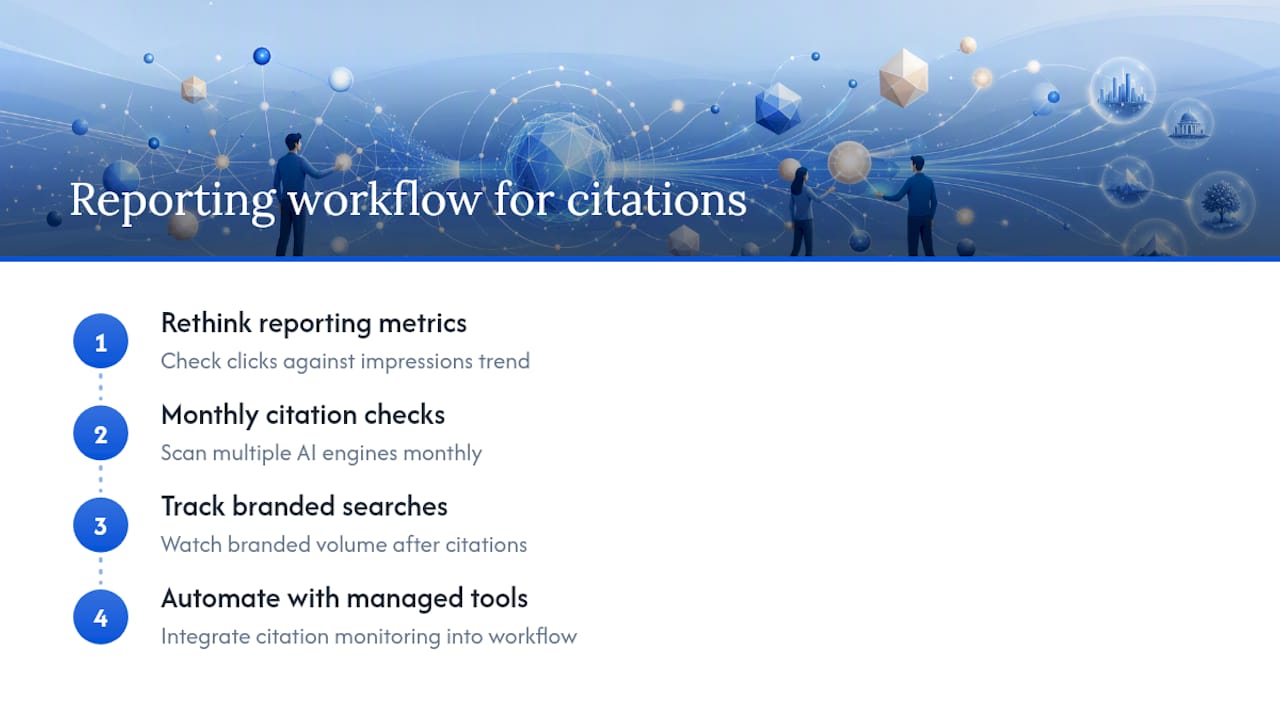
Once it became clear that impressions and clicks told two different stories, our reporting had to catch up. We stopped treating a flat or declining click number as automatic bad news and started checking whether the impressions on that same query were climbing, a pattern that usually means an AI Overview or featured snippet is doing the answering instead of the page.
Running informal citation checks across a handful of AI engines each month, alongside standard rank tracking, became part of the routine rather than a side project. Watching branded search volume next to that citation log made the connection obvious: when a piece started getting cited consistently, branded searches for the underlying topic followed within weeks. For teams without the bandwidth to run that loop manually every month, some managed options can fold citation monitoring into the same pipeline as content production, so the audit doesn’t quietly stop happening the moment things get busy.
— Mike
Getting Cited Without Adding Headcount
Running an AI citation audit every month, refreshing pages before they decay, and rewriting old content into answer-first blocks is real, recurring work, on top of whatever a marketing team is already shipping. An automated route exists to GEO and citation visibility for small and local service businesses that can’t hire a full content team to chase it manually.
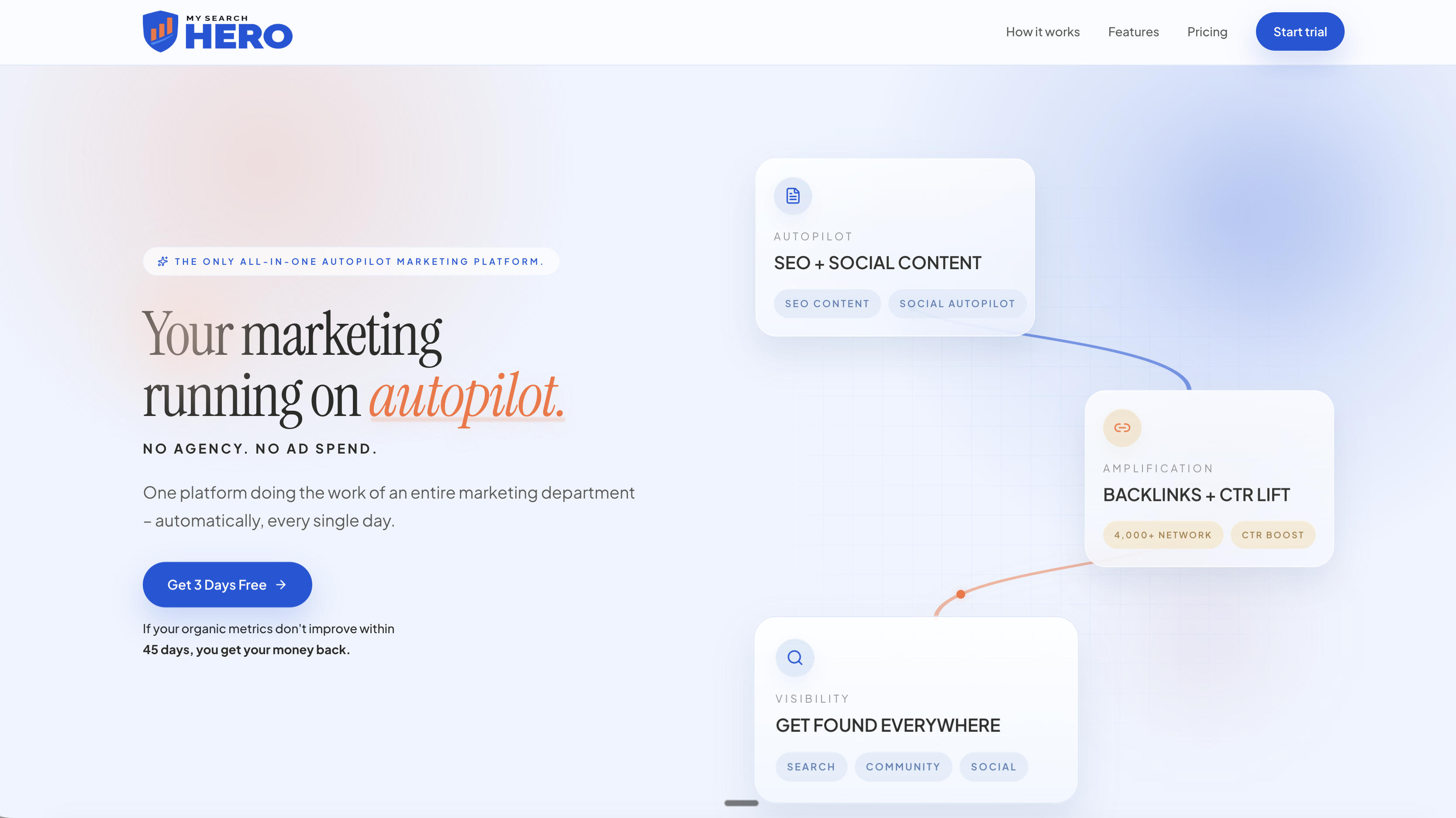
Some services deliver published SEO articles built around the answer-first structure described here, authority backlinks through a publisher network, Reddit brand mentions, and AI-generated social posts, all pushed out through one automated pipeline instead of a pile of separate freelancers. The goal isn’t just ranking anymore. It’s showing up as the source cited when someone’s prospect asks an AI engine the exact question your business answers every day. If you want to see what a managed audit and content pipeline looks like for your own site, check out Mysearchhero and start with a trial.
Sources
- Nearly 60% of Google searches end without a click in 2024
- How to Win Zero-Click Search in 2026 | Cite Solutions
- AI Overviews Are Cutting Google Clicks in Half: A Small Business Guide to Zero-Click Search in 2026
FAQ
What Are Zero-Click Searches?
A zero-click search is a query the search engine or an AI answer engine resolves directly on the results page, through a snippet, panel, or generated summary, so the user never clicks through to a website.
Why Are Zero-Click Search Rates Increasing?
AI Overviews and conversational search synthesize multiple sources into one on-page answer, and that shift alone has cut organic CTR by 30% to 61% on affected queries.
How Common Are Zero-Click Searches Now?
Google searches ended without a click in 2024](https://searchengineland.com/google-search-zero-click-study-2024-443869), and estimates for 2026 put that figure closer to 68%](https://cite.solutions/blog/zero-click-search-how-to-win), higher still on queries where an AI Overview appears.
How Do I Know If I’m Losing Traffic to Zero-Click Results?
Check Search Console for queries where impressions are rising but clicks are flat or falling. That gap usually means you’re being shown, and possibly cited, without earning the visit.
Can Small Businesses Compete for AI Citations Without a Big Team?
Yes. Answer-first copy, basic schema, and consistent entity details across your site and listings close most of the gap, and a managed service like Mysearchhero can run the recurring audit and content work for teams without the internal bandwidth.